
































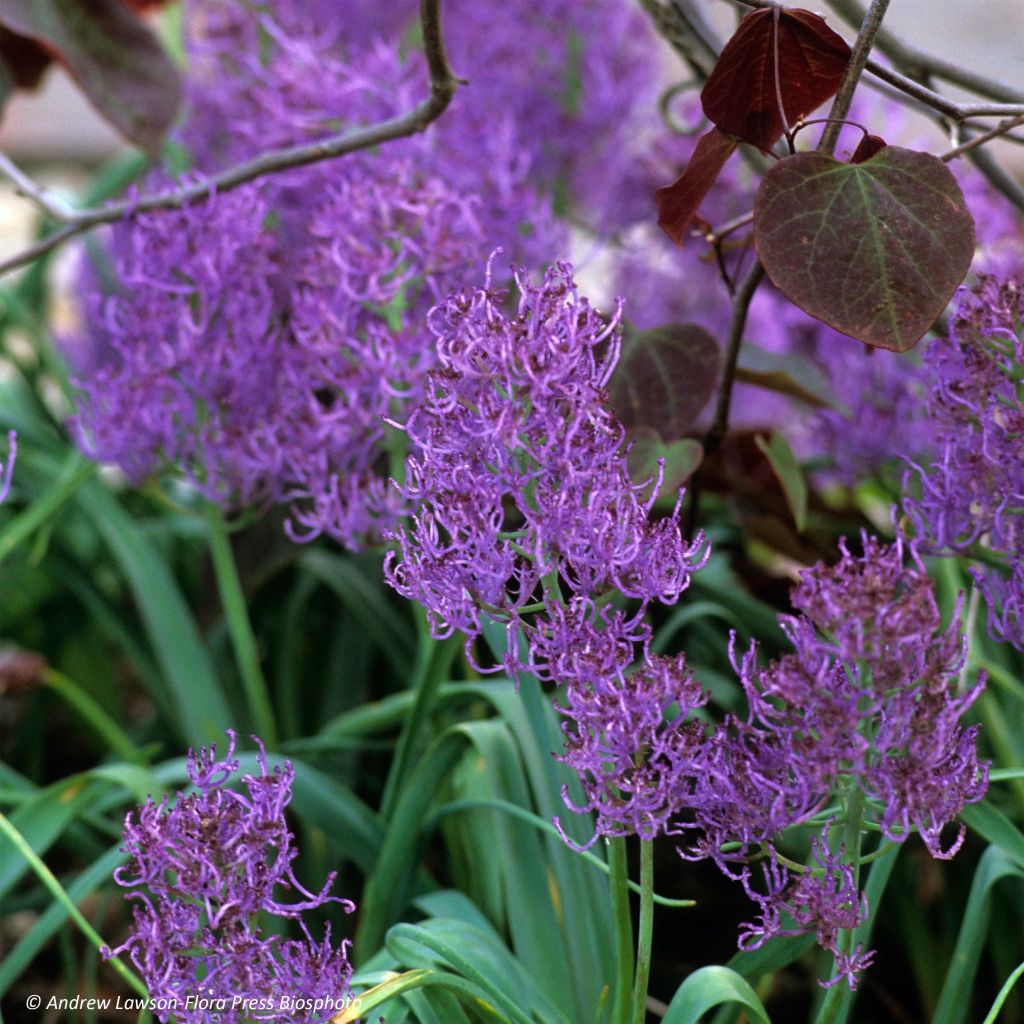
Muscari comosum Plumosum - Muscari chevelu, Ail à toupet, Muscari à houppe, Muscari à toupet
Muscari comosum Plumosum - Muscari chevelu, Ail à toupet, Muscari à houppe, Muscari à toupet
Muscari comosum Plumosum
For now, bulbs eagerly await the arrival of spring!
Catherine, 05/11/2023
Special offer!
Receive a €20 voucher for any order over €90 (excluding delivery costs, credit notes, and plastic-free options)!
1- Add your favorite plants to your cart.
2- Once you have reached €90, confirm your order (you can even choose the delivery date!).
3- As soon as your order is shipped, you will receive an email containing your voucher code, valid for 3 months (90 days).
Your voucher is unique and can only be used once, for any order with a minimum value of €20, excluding delivery costs.
Can be combined with other current offers, non-divisible and non-refundable.
Home or relay delivery (depending on size and destination)
Important : des droits de douane sont susceptibles de vous être facturés par la douane de votre pays lors de la livraison.
Schedule delivery date,
and select date in basket
This plant carries a 6 months recovery warranty
More information
We guarantee the quality of our plants for a full growing cycle, and will replace at our expense any plant that fails to recover under normal climatic and planting conditions.
Would this plant suit my garden?
Set up your Plantfit profile →
Description
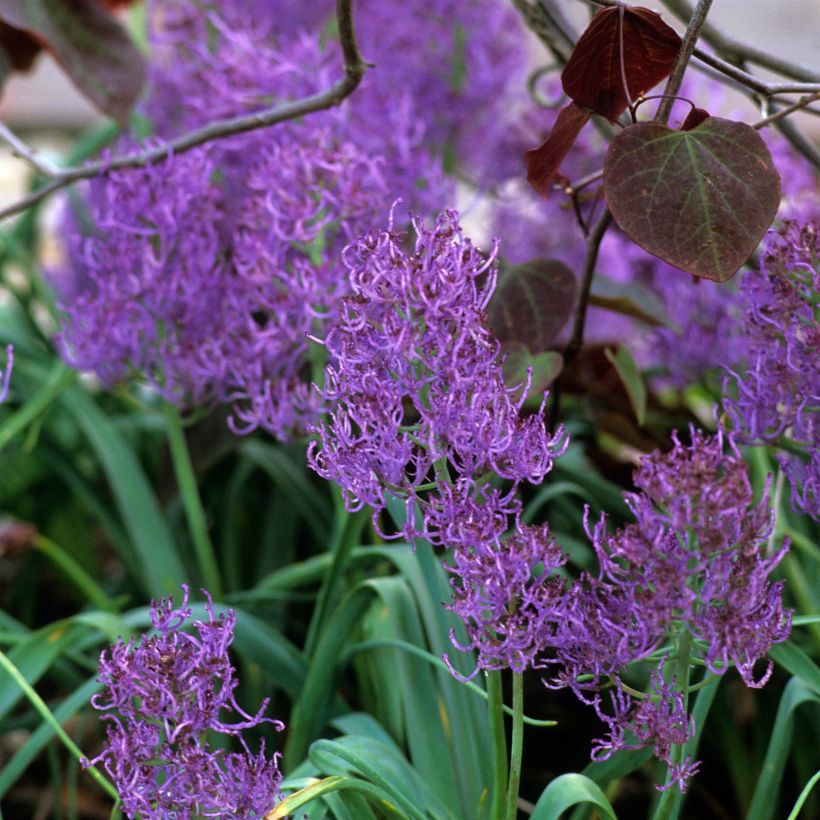
Muscari comosum ‘Plumosum’, the feather hyacinth or tassel hyacinth, has a flowering habit very different from that of the usual grape hyacinths. Its spikes do not resemble clusters of little bells, but rather lilac to pale violet plumes, finely branched and slightly ruffled. This flowering is rather late for a grape hyacinth, taking place in the heart of spring. Hardy and faithful in the garden, this small bulbous plant thrives in the sun, in any light, well-drained soil. It also grows very well in pots.
The tassel hyacinth belongs to the Asparagaceae family. It is a bulbous perennial plant, whose entire foliage disappears during the summer before starting again at the end of winter or the beginning of spring. The species Muscari comosum is found over a vast area stretching from the Canary Islands and the Mediterranean basin to Central Europe, the Middle East and Iran. It grows particularly in dry meadows, vineyards, cultivated land, stony ground and near well-exposed walls. The name Leopoldia comosa, still used in some books and catalogues, is now considered a synonym of Muscari comosum.
The cultivar ‘Plumosum’ has been known in cultivation since the early 17th century. It is also listed under the name ‘Monstrosum’. Its flowering results from a transformation of the flowers: the small fertile bells of the wild species are here almost entirely replaced by sterile flowers with branched pedicels, which form that characteristic feathery mass. The plant does not self-seed like the wild tassel hyacinth, but its bulb produces bulblets that allow the clump to gradually widen. The green leaves, narrow, linear and slightly channelled, reach 15 to 20 cm in length. An upright flowering stem rises above the foliage and bears its violet plume, which becomes denser as it opens. The plant reaches 20 to 25 cm in height when in flower. It flowers mainly in April and May, depending on the climate. After flowering, the leaves turn yellow then dry up, while the bulb enters a period of rest. This summer dormancy enables it to withstand fairly dry soil during the warm season. Very hardy, this ‘Plumosum’ variety withstands temperatures close to –15 °C, provided the soil is not too wet in winter.
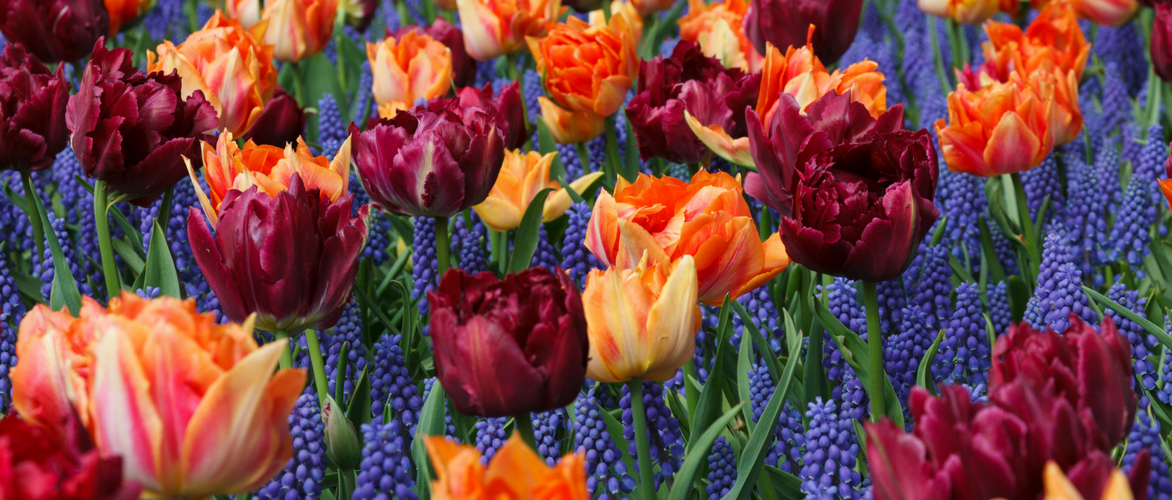
The Muscari ‘Plumosum’ should be planted in groups of 10 to 15 bulbs in a rock garden, a sunny border or a gravel bed. Its violet plumes combine well with the white flowers with pink reverses of the botanical tulip ‘Lady Jane’ and the cherry-red flowers of the dwarf iris ‘Cherry Garden’. The Anemone blanda ‘White Splendour’ flowers a little earlier and can spread between the groups of bulbs. The Allium karataviense ‘Ivory Queen’, with its ivory globes and broad glaucous leaves, takes over at the end of spring. All these plants appreciate sun, well-drained soil and a relatively dry rest period in summer.
Muscari comosum Plumosum - Muscari chevelu, Ail à toupet, Muscari à houppe, Muscari à toupet in pictures
Plant habit
Flowering
Foliage
Botanical data
Muscari
comosum
Plumosum
Asparagaceae
Leopoldia comosa ‘Plumosum’, Muscari comosum ‘Monstrosum’, Muscari plumosum
Central Europe, Southern Europe, Middle East, Caucasus
Planting and care
Plant the Muscari comosum 'Plumosum' from September to November, in full sun or light shade. Place the bulbs 8 to 10 cm deep, spacing them 8 cm apart. Ordinary soil, whether lime-bearing or not, suits it as long as it drains excess water quickly. In heavy, clay soil, incorporate fine gravel and plant the bulbs on a slight slope or in a raised bed.
The soil may remain moist during growth and flowering, but it will benefit from being drier once the foliage dies back. Water after planting, then only in the event of a very dry spring. In containers, use a pot with drainage holes and a mix of potting compost, garden soil, and gravel. When the clumps become too congested, lift them during their summer dormancy, separate the bulblets, and replant them without waiting for autumn.
Planting period
Intended location
Care
Planting & care advice
-
-
-
-
-
-

-

-
-
, onOrder confirmed
Reply from on Promesse de fleurs
Recently viewed products
Haven't found what you were looking for?
Hardiness is the lowest winter temperature a plant can endure without suffering serious damage or even dying. However, hardiness is affected by location (a sheltered area, such as a patio), protection (winter cover) and soil type (hardiness is improved by well-drained soil).

Photo Sharing Terms & Conditions
In order to encourage gardeners to interact and share their experiences, Promesse de fleurs offers various media enabling content to be uploaded onto its Site - in particular via the ‘Photo sharing’ module.
The User agrees to refrain from:
- Posting any content that is illegal, prejudicial, insulting, racist, inciteful to hatred, revisionist, contrary to public decency, that infringes on privacy or on the privacy rights of third parties, in particular the publicity rights of persons and goods, intellectual property rights, or the right to privacy.
- Submitting content on behalf of a third party;
- Impersonate the identity of a third party and/or publish any personal information about a third party;
In general, the User undertakes to refrain from any unethical behaviour.
All Content (in particular text, comments, files, images, photos, videos, creative works, etc.), which may be subject to property or intellectual property rights, image or other private rights, shall remain the property of the User, subject to the limited rights granted by the terms of the licence granted by Promesse de fleurs as stated below. Users are at liberty to publish or not to publish such Content on the Site, notably via the ‘Photo Sharing’ facility, and accept that this Content shall be made public and freely accessible, notably on the Internet.
Users further acknowledge, undertake to have ,and guarantee that they hold all necessary rights and permissions to publish such material on the Site, in particular with regard to the legislation in force pertaining to any privacy, property, intellectual property, image, or contractual rights, or rights of any other nature. By publishing such Content on the Site, Users acknowledge accepting full liability as publishers of the Content within the meaning of the law, and grant Promesse de fleurs, free of charge, an inclusive, worldwide licence for the said Content for the entire duration of its publication, including all reproduction, representation, up/downloading, displaying, performing, transmission, and storage rights.
Users also grant permission for their name to be linked to the Content and accept that this link may not always be made available.
By engaging in posting material, Users consent to their Content becoming automatically accessible on the Internet, in particular on other sites and/or blogs and/or web pages of the Promesse de fleurs site, including in particular social pages and the Promesse de fleurs catalogue.
Users may secure the removal of entrusted content free of charge by issuing a simple request via our contact form.
The flowering period indicated on our website applies to countries and regions located in USDA zone 8 (France, the United Kingdom, Ireland, the Netherlands, etc.)
It will vary according to where you live:- In zones 9 to 10 (Italy, Spain, Greece, etc.), flowering will occur about 2 to 4 weeks earlier.
- In zones 6 to 7 (Germany, Poland, Slovenia, and lower mountainous regions), flowering will be delayed by 2 to 3 weeks.
- In zone 5 (Central Europe, Scandinavia), blooming will be delayed by 3 to 5 weeks.
In temperate climates, pruning of spring-flowering shrubs (forsythia, spireas, etc.) should be done just after flowering.
Pruning of summer-flowering shrubs (Indian Lilac, Perovskia, etc.) can be done in winter or spring.
In cold regions as well as with frost-sensitive plants, avoid pruning too early when severe frosts may still occur.
The planting period indicated on our website applies to countries and regions located in USDA zone 8 (France, United Kingdom, Ireland, Netherlands).
It will vary according to where you live:
- In Mediterranean zones (Marseille, Madrid, Milan, etc.), autumn and winter are the best planting periods.
- In continental zones (Strasbourg, Munich, Vienna, etc.), delay planting by 2 to 3 weeks in spring and bring it forward by 2 to 4 weeks in autumn.
- In mountainous regions (the Alps, Pyrenees, Carpathians, etc.), it is best to plant in late spring (May-June) or late summer (August-September).
The harvesting period indicated on our website applies to countries and regions in USDA zone 8 (France, England, Ireland, the Netherlands).
In colder areas (Scandinavia, Poland, Austria...) fruit and vegetable harvests are likely to be delayed by 3-4 weeks.
In warmer areas (Italy, Spain, Greece, etc.), harvesting will probably take place earlier, depending on weather conditions.
The sowing periods indicated on our website apply to countries and regions within USDA Zone 8 (France, UK, Ireland, Netherlands).
In colder areas (Scandinavia, Poland, Austria...), delay any outdoor sowing by 3-4 weeks, or sow under glass.
In warmer climes (Italy, Spain, Greece, etc.), bring outdoor sowing forward by a few weeks.