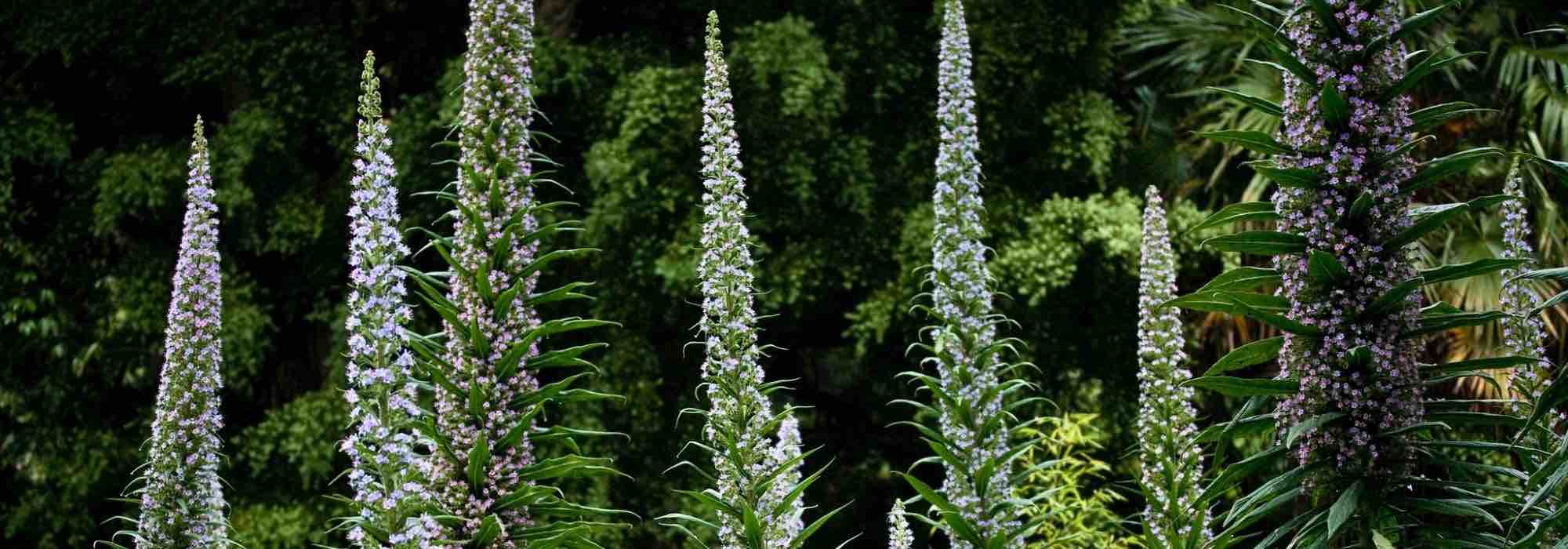
Pair Echium or viper's bugloss
Invite viper's bugloss into a sunny garden
Contents
Echium, or viper’s bugloss, is a herbaceous plant or shrub that takes different forms depending on the species. What all Echiums have in common is their flowering in spikes, their short lifespan and their ability to self-seed in poor soil and mild climates. Echium pininana, or Canary Islands viper’s bugloss, is a spectacular exotic shrub with long, tall blue spires. Echium candicans, also known as Echium fastuosum or Madeira viper’s bugloss, forms a large silvery bush with medium-sized spires. Both species are remarkable for their architecture and the intense blue of their spikes.
Two other species are grown: Echium russicum and Echium vulgare, perennials reaching 90cm in height, with delicate pink-red and violet-blue spikes.
In well-drained, dry soil, in full sun and sheltered from the wind, try growing Echiums by planting or sowing them, and enjoy watching them wander elsewhere in the garden. Discover possible planting combinations with these beautiful wild plants.
In a sunny border
Viper’s bugloss thrives in sun and warmth, in very well-drained soil all year round. Its frost hardiness varies according to the species. The large shrubby viper’s buglosses, Echium pininana and Echium candicans (syn. fastuosum), suffer from temperatures of 0 °C and are said to tolerate brief frosts of around -5 °C in well-drained soil that stays dry in winter. They are suitable for USDA hardiness zones 10a to 9a.
Echium fastuosum flowers more prolifically in cool, fertile soil, but this shortens its lifespan, which is around 5 to 7 years. It forms a bush approximately 1.5 m high and 3 m wide. Also known as Madeira viper’s bugloss, its silver rosette foliage is accompanied by flowering spikes that are long, dense and 25 cm tall, in an intense blue. This is a very beautiful, architectural and spectacular species, as well as a wild plant that wanders and self-seeds when conditions are favourable.
Plant it in a bed of dry soil, accompanied, for example, by Sages such as Salvia guaranitica ‘Black and Blue’ and Salvia jamensis ‘Reve Rouge’, together with a Fuchsia magellanica var. gracilis. Seedlings of the annual Nigella papillosa ‘Midnight Blue’ add touches of deep blue throughout the planting.
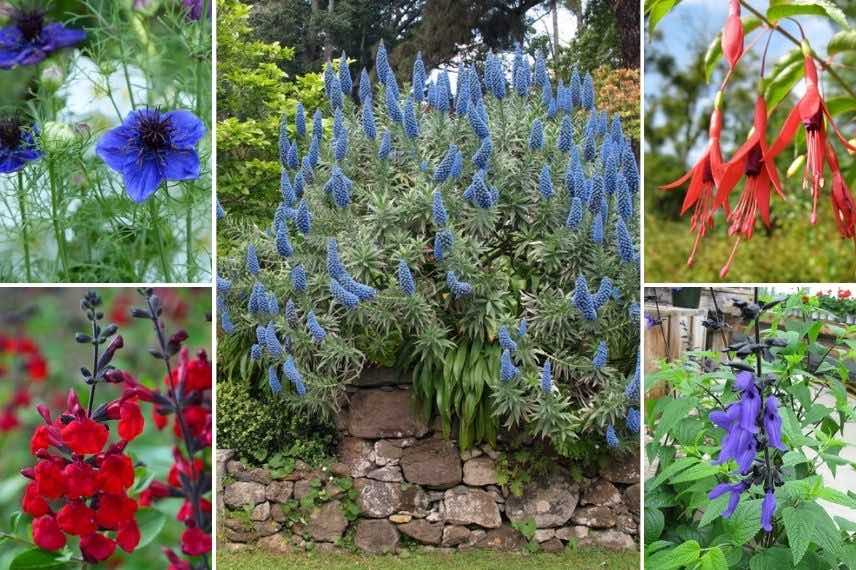
Nigella papillosa ‘Midnight Blue’, Echium fastuosum, Fuchsia magellanica var. gracilis, Salvia guaranitica ‘Black and Blue’, Salvia jamensis ‘Reve Rouge’
In isolation
Beautiful, large specimens such as the Macaronesian island viper’s buglosses, Echium pininana and Echium fastuosum, are certainly shown to their best advantage when planted as solitary specimens. Echium fastuosum, seen in the previous paragraph, makes a fine solitary specimen, attracting everyone’s attention.
Let us focus here on Echium pininana, giant viper’s bugloss, particularly impressive and bearing immense spikes that can reach 3 to 4 m in height! It produces a pretty basal rosette, relatively modest compared with the subsequent growth of this viper’s bugloss’s flower. It is a biennial, flowering 1 to 2 years after its foliage appears and then disappearing, having remembered to self-seed. If you have several plants, you get a truly impressive display for a short time. In a clear, sunny position, its spikes grow straight up, reaching towards tall shrubs and palm trees.

Echium pininana
Discover other Echium - Viper's-buglosses
View all →
Available in 2 sizes
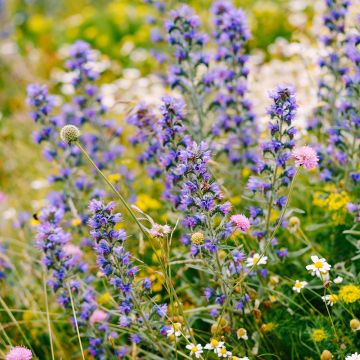
Available in 1 sizes
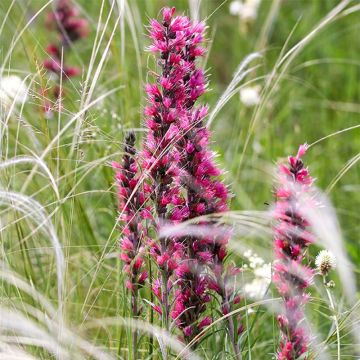
Available in 1 sizes
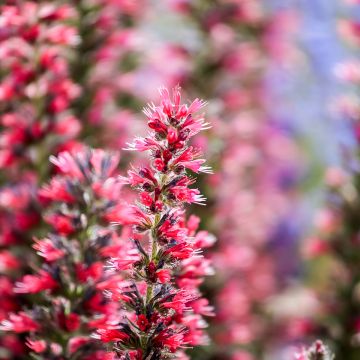
Available in 1 sizes
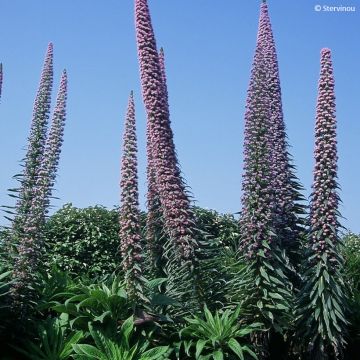
Available in 1 sizes
In a container
In containers or large pots, you can grow all Echiums. Canary Island echium, Echium pininana, produces one flower stem per rosette, so you can grow it in a pot too. This is an appealing solution for anyone without soil suited to growing these captivating plants. It is also a good option for those with harsher winters, provided you can keep it in very bright, frost-free conditions over winter, in a conservatory or greenhouse.
Echium candicans, or Madeira viper’s bugloss, needs a very large container. The smaller Echiums, which we will explore later, are easy to grow in pots, mixed with perennials or annuals for dry soil.
Read also
Climate zones and USDA zones in FranceExotic atmosphere
It will not have escaped your notice that the two giants we discussed in the previous chapters have a distinctly exotic appearance. The conditions they favour naturally make them companions for many plants from mild-climate regions and from far-flung parts of the world. Plant it with Cordylines, Agapanthus, Melianthus major or Geranium maderense.
So let us create an exotic scene for our charming Madeira viper’s bugloss. Here, Echium fastuosum is accompanied by Aloe arborescens, Euryops chrysanthemoides, or savannah daisy, reaching 90 cm in height, and a large honey-scented spurge, Euphorbia mellifera.
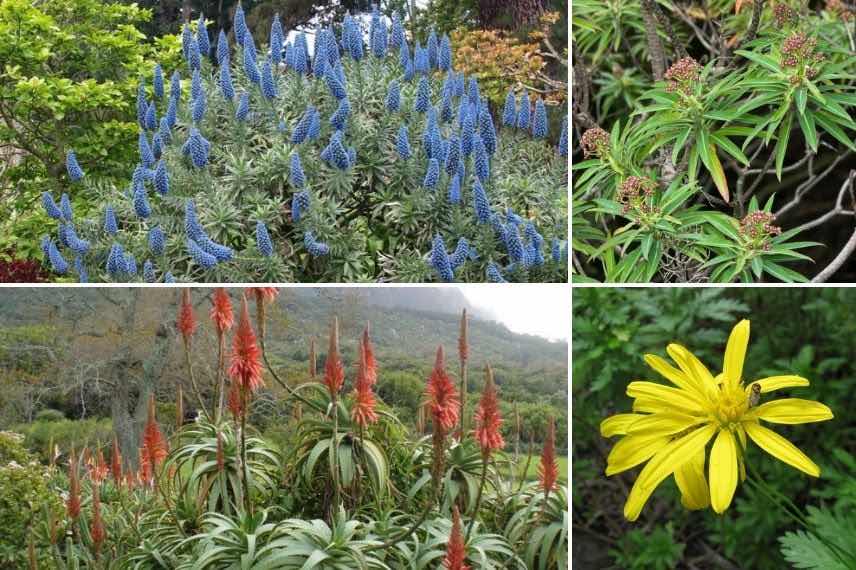
Echium fastuosum, Euphorbia mellifera, Euryops chrysanthemoides, Aloe arborescens
In a Mediterranean garden
More specifically than a sunny bed, the Mediterranean garden brings together all the conditions needed to grow Viper’s bugloss: dry, poor and stony soil, very well drained to filter winter rainfall, with no risk of waterlogging. It is ideal for growing self-seeding plants, those short-lived plants that reseed themselves spontaneously in light soil.
Grow Viper’s bugloss alongside plants typical of Mediterranean gardens: rock roses, lavenders, spurges…
For example, plant Echium pininana in a walled garden, well sheltered from the wind, which could break its stem, in a green garden or herb garden. Here, it is combined with Pittosporum tobira ‘Nana’, whose rounded form provides a contrast, long fennel stems, Foeniculum vulgare, and Phillyrea angustifolia, with narrow leaves reminiscent of those of the olive tree.
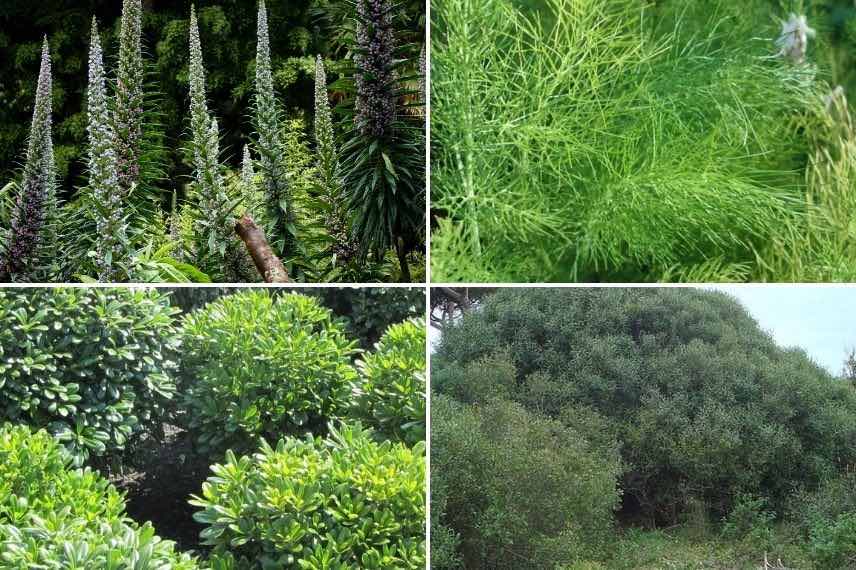
Echium pininana, Foeniculum vulgare, Phillyrea angustifolia, Pittosporum tobira ‘Nana’
By the sea
Coastal gardens along the Atlantic coast can also quite easily accommodate the large viper’s buglosses from Madeira and the Canary Islands, which are perfectly tolerant of sea spray. However, take care to protect them well from the wind.
Imagine an Echium fastuosum with a Tetrapanax papyrifera ‘Rex’, a Hedychium gardnerianum and a Brugmansia arborea and a giant reed, Arundo donax.
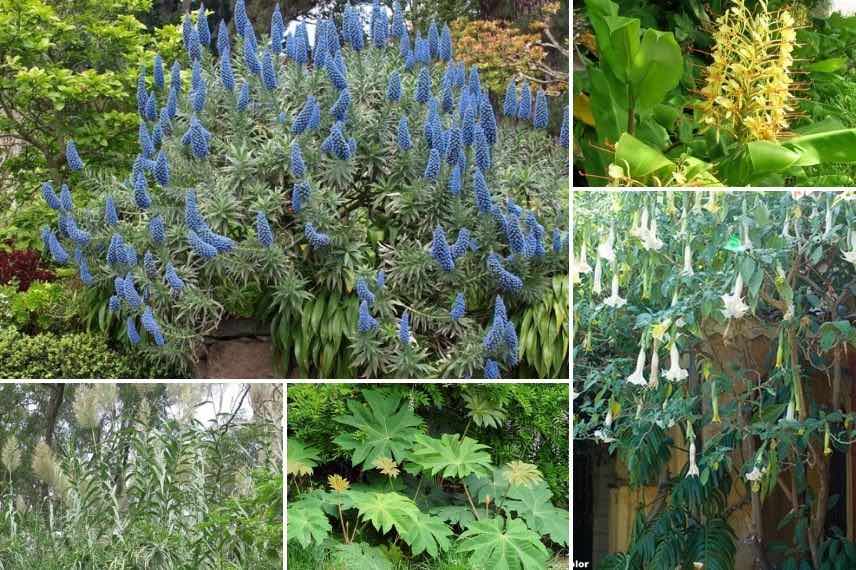
Echium fastuosum, Hedychium gardnerianum, Brugmansia arborea, Tetrapanax papyrifer ‘Rex’, Arundo donax
As a border
Let us now turn to the more modest species of Echium: Echium russicum, Echium vulgare and the variety Echium vulgare ‘Blue Bedder’. All three are different and lack the monumental character of the shrubby species. That does not make them any less interesting.
Let us look at Echium vulgare ‘Blue Bedder’, a dwarf variety of Echium vulgare that reaches 30cm in height. Annual or biennial, it can be used as an edging plant, in a rock garden, on a bank or at the front of a bed. It produces remarkable, long-lasting flowering on spikes covered with a multitude of tiny, intensely blue flowers, which attract attention. The flowers open from pink buds and fade to purple, with great refinement. It self-seeds abundantly in light, rather dry soil and is a delight for pollinators.
For the sheer pleasure of it, here is an all-blue combination with several annuals: phacelia, cornflower Centaurea cyanus, Nigella papillosa ‘Midnight Blue’, around Echium vulgare ‘Blue Bedder’, together with a perennial: Linum perenne, perennial flax.
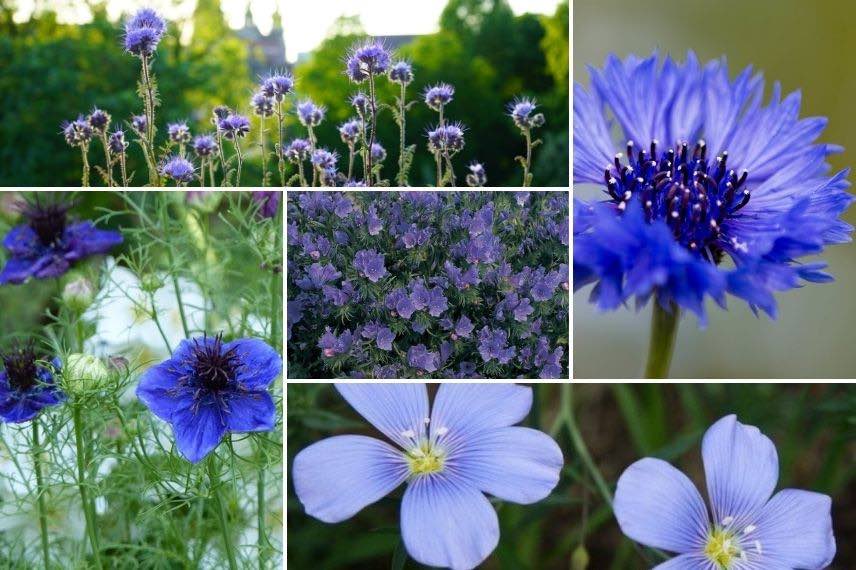
Phacelia, Centaurea cyanus, perennial flax, Nigella papillosa ‘Midnight Blue’, around Echium vulgare ‘Blue Bedder’
On a bank or in a rockery
On a bank or in a large rock garden, plant the beautiful Echium russicum, with its long dark red spikes and small old rose and claret flowers. Grown as a biennial or perennial in well-drained soil in areas with mild winters, it is hardy down to -10° C. Like Madeira viper’s bugloss, it is more luxuriant in cool, fertile soil, but its longevity suffers as a result.
Growing to 90 cm tall, plant it in very natural-looking scenes, alongside blonde grasses that suit it perfectly, with summer- and late-summer-flowering perennials.
Here Kniphofia ‘Nancy’s Red’, with coral red spikes, and the Echinacea ‘Tangerine Dream’, with its brilliant mandarin-orange flowers, combine beautifully with Echium russicum, alongside Pennisetum orientale ‘Karley Rose’, a beautiful blue globe thistle, Echinops bannaticus ‘Taplow Blue’, and Stipa tenuifolia.
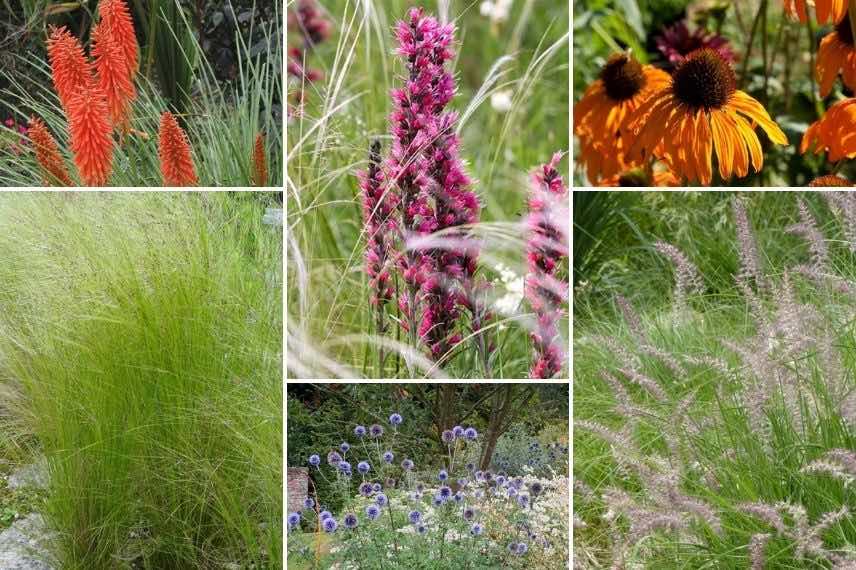
Kniphofia ‘Nancy’s Red’, Echium russicum, Echinacea ‘Tangerine Dream’, Pennisetum orientale ‘Karley Rose’, Echinops bannaticus ‘Taplow Blue’, Stipa tenuifolia
In a natural meadow alongside bees and butterflies
Let’s finish with the pleasure of a plant and butterfly combination! Common viper’s bugloss, Echium vulgare, is a magnet for bees and butterflies, and is remarkably nectar-rich. Biennial and bushy, it bears 15 to 30cm spikes of bell-shaped flowers, purple in bud and then violet-blue.
A meadow plant like the previous two, it settles happily in rock gardens, borders, beds and wildflower meadows. It tolerates very dry soils extremely well.
Here in a wildflower meadow of annual and self-seeding flowers, with Briza media, Echium vulgare, Centaurea cyanus, Matricaria recutita, Chrysanthemum segetum, Papaver rhoeas.
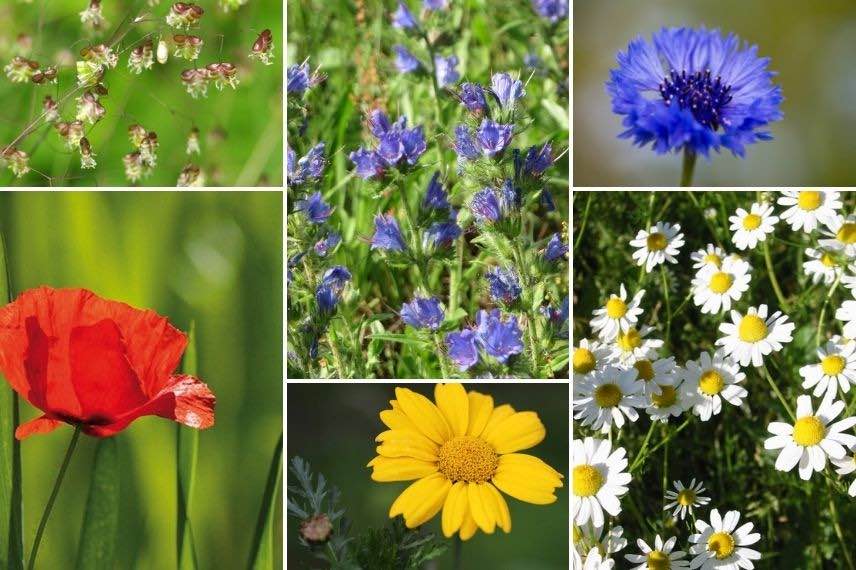
Briza media, Echium vulgare, Centaurea cyanus, Matricaria recutita, Chrysanthemum segetum, Papaver rhoeas
- Subscribe!
- Contents
This form is protected by reCAPTCHA - the Google Privacy Policy and Terms of Service apply.

































Comments