
Creating a border in a windy garden
Top wind-resistant plants: those that defy the wind (and how to combine them)
Contents
When creating a new flower bed in a wind-exposed garden, you face several challenges that must be managed cleverly. From installation to choice of plants, here are some tips to succeed with a bed that will be exposed to strong winds, whether you live on the coast, in inland plains, or in continental or mountain regions dominated by easterly winds.

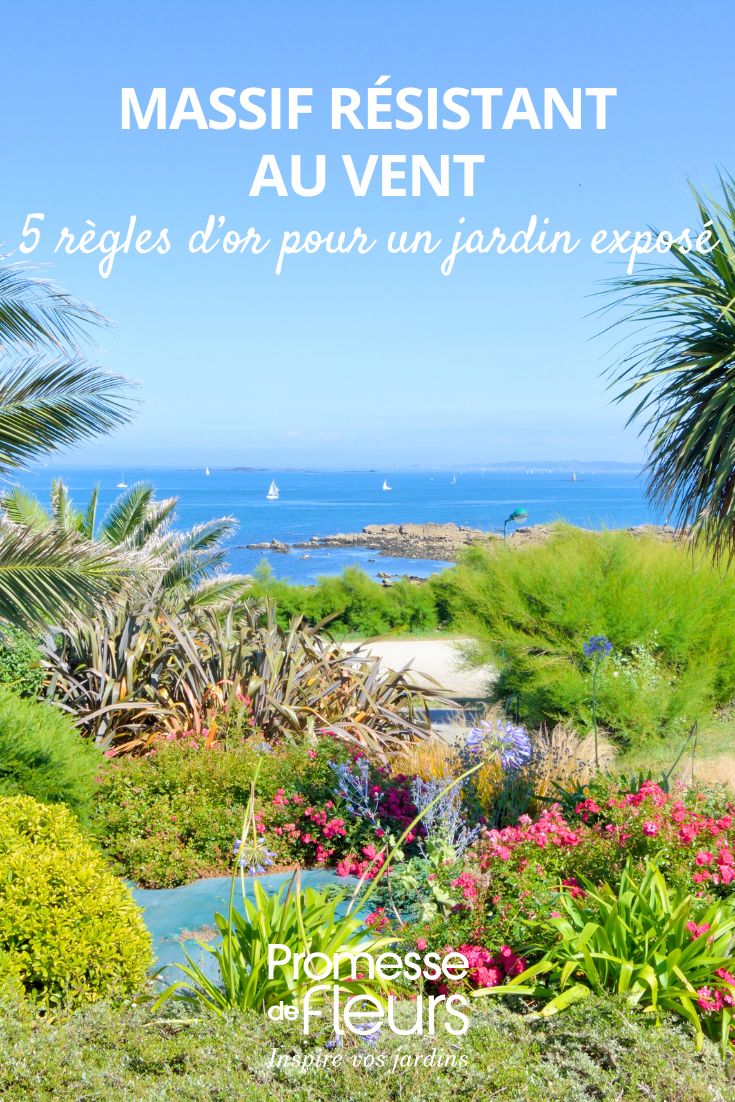
On Île de Batz in Finistère (France), Madeiran viper’s-bugloss and cushion-forming shrubs withstand strong winds very well

Effects of wind on plants
Because you live by the sea, facing elements that are regularly unleashed, or in a wind corridor where tramontane, cers or mistral blow, certain natural conditions put the garden under severe strain. It is worth knowing their impact on a garden before planning any landscaping, whether in a region where wind will blow strongly, often throughout the year:
- Wind is cold in winter; it increases perceived chill for us and for plants, and this chilling factor should be taken into account in hardiness ratings (we cover this in How to understand a plant’s hardiness data?) ;
- Wind is drying in summer and sometimes in spring, damaging foliage and buds that may abort before opening ;
- Winter winds such as mistral scorch vegetation ;
- Wind can cause uprooting or broken branches during storms ;
- Finally, wind batters plants and vegetation, deforming them, a very common phenomenon on the coast, scientifically called anemomorphosis.
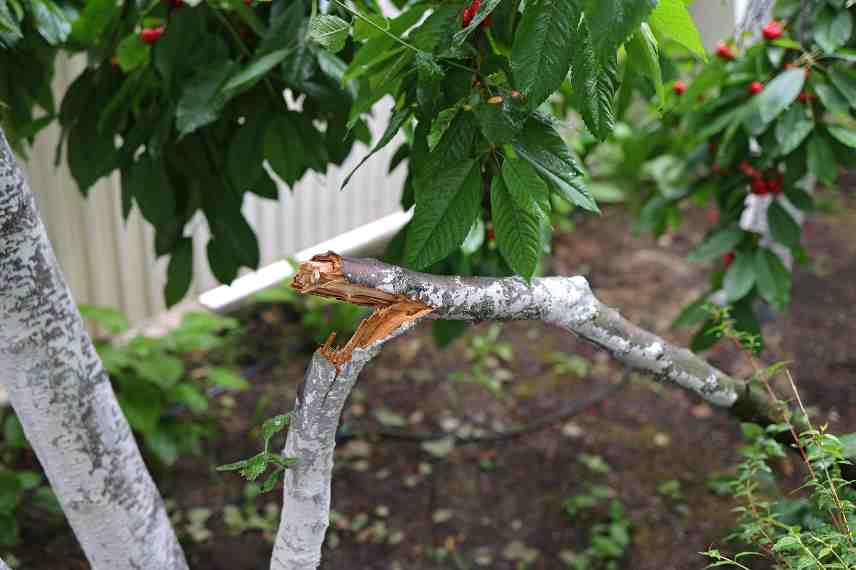
Broken branches on shrubs are a primary consequence of poor plant choice in windy areas
Read also
Protecting a very windy gardenWhat types of plants to choose for a flowerbed in a windy area, and which style to favour?
With that in mind, when designing a bed, it is, even more than in conventional gardens, vital to make the right choices in very windy locations. The adage “right plant in right place” is particularly apt here.
As in many countries, winds in France are numerous and well known locally. Whether you have to cope with a strong, cold wind from inland or a coast-sweeping wind laden with ocean moisture, you should always choose plants that are less sensitive to it, notably in their texture and habit.
- Choose robust, sarmentous, woody or highly resilient flexible plants : take inspiration from what nature offers and endures in wind-swept places: hardy junipers, grasses such as marram of the dunes, heathers, etc.
- Choose plants that are not too tall, forming cushion-like mounds or prostrate silhouettes, able to withstand gusts thanks to their low height;
- Include plants with fine, grey foliage and with small leaves, less susceptible to repeated wind damage.
- Favour taproot systems to ensure anchorage in soil;
- Finally consider flexible branches naturally arched, less prone to breaking.
Garden types meeting all these criteria include naturalistic gardens that play mainly with flexibility of grasses, English-style gardens with opulent mixed borders made largely of perennial plants that go dormant in winter and therefore do not suffer wind’s whims during this critical period, or garrigue garden for extreme endurance of its components. Feel free to consult our articles on these gardens to learn about their main advantages!
My advice: local nurseries will always help you choose plants that thrive in this specific context; our tool Plantfit, indicated by a green shoot in the site’s top navigation, also helps select suitable plants by accurately taking into account your climate zone previously entered in your account.

Karoo National Park in South Africa, exposed to strong winds, supports low vegetation (© Flickr – Esther Westerveld)
Best wind-tolerant shrubs and plants by region
Choice will inevitably fall on plants accustomed to extreme conditions. But it will not be exactly the same according to region: by the sea where winters hardly ever freeze, and in inland wind corridors exposed to winds such as the Mistral, vent d’Autan or tramontane.
However, adopt the same reflex whatever the region: shrubs known for wind resistance, whose branches do not break at the slightest gust, plants of modest height and species with a taproot system, well anchored in soil. Habits described as prostrate, globose, cushion or mat‑forming should also be prioritised because they present less wind surface (often labelled ‘globosa’ in Latin or with adjectives such as globe, compacta, nana).
Here are three scenarios you can try in your garden :
1- By the sea
Obviously, plants here must also tolerate salty air. Here is a short selection; find further plants in Plants resistant to sea spray and Perennials resistant to sea spray. Several plants native to South Africa or New Zealand will be useful and highly ornamental in well‑sheltered coastal areas without winter frosts (Brittany, Atlantic coast, Mediterranean rim). On colder coasts, always respect maximum hardiness ratings, subtracting two to three degrees from the data to avoid losing plants in winter :
- Perennials : asters, heathers, Eryngium (and all thistles), Nepeta, asphodel, Euryops pectinatus, potentilla, santolina, catananche, Lathyrus ovatus (hare’s‑tail), asphodels, Juniperus, Armeria maritima, cistus, broom (Cytisus scoparius), Solidago, Iridaceae such as Watsonia
- Among shrubs or undershrubs providing structure, choice is wide: Olearia, Yucca, Grevillea juniperina and G. lanigera, airy tamarisks, Pittosporum tobira, Pittosporum undulatum, Madeira viper’s‑bugloss, small spireas, Polygala, Leptospermum, strawberry tree (Arbutus unedo), Abelia, crownvetchs, Sambucus nigra…
- Do not forget plants with thick, rigid foliage, much more robust, such as agaves (A. montana, A. parryi), cordylines or Dasylirion.
Also consult our articles: 10 evergreen shrubs for coastal gardens, Designing a garden by the sea and Designing a garden under pine trees.
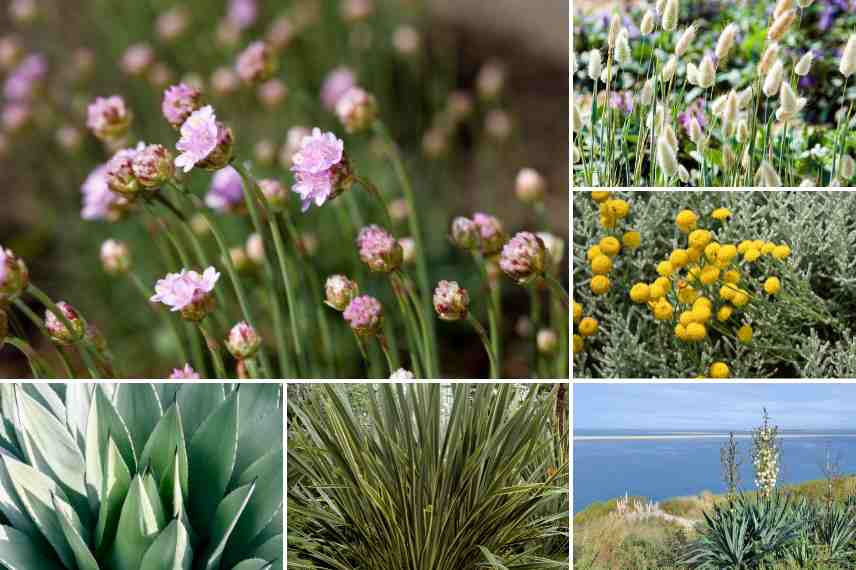
Armeria maritima, Lagurus ovatus, Santolina chamaecyparis, Yucca gloriosa, Phormium tenax, Agave parryi
2- Wind corridor on plains or at low altitude
This concerns regions that are hot yet cold in mid‑winter, such as garrigue, the Rhône corridor or the Occitan region in France. Plants must be tough, resistant both to sun and to drying winds. Turn to the wide palette of garrigue plants or species from steppe plains, perfect on poor soils :
- Plants with leathery/shiny/fuzzy/spiny foliage, protective: Montpellier cistus, Corbières cistus, Phlomis fruticosa, lavenders, Callistemon…
- Plants that offer least wind resistance or do not break in gusts: shrubby sages, Iberis sempervirens, Alyssum, Daphne cneorum, Chaenomeles, Catananche…
- Hardy grey foliage: Helichrysum, Echinops, Perovskia (Russian sage), Stachys byzantina, common sage, artemisias, cistus, lavenders, santolinas, Teucrium…
- Bank or groundcover plants also suit well: Stachys byzantina, creeping rosemary, Sedum acre, Westringia fruticosa, dwarf pines such as Pinus mugo.
- Grasses flexible or robust: Panicum virgatum, Molinia, Pennisetum alopecuroides, medium‑sized Miscanthus, Schizachyrium, fescues…
Also draw inspiration from: How to design a garden in a garrigue area? and Planting in a garden exposed to the Mistral or tramontane winds.
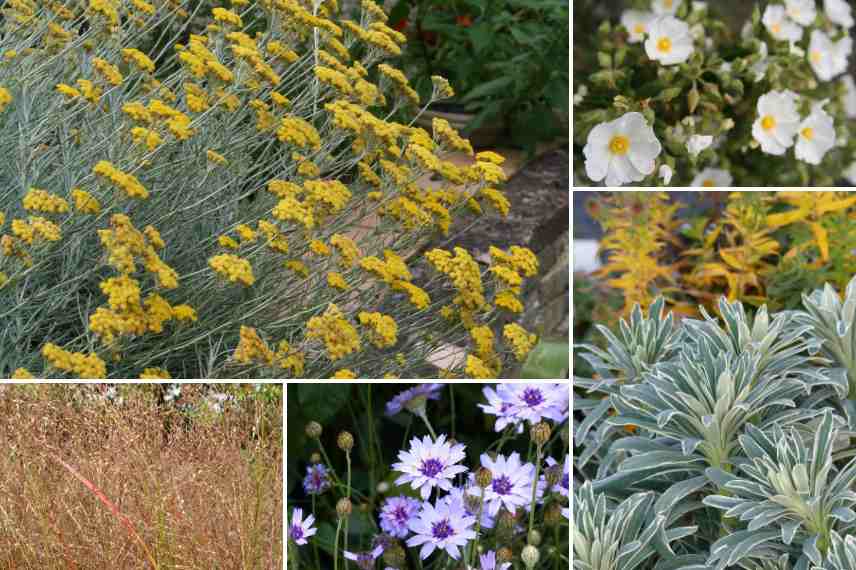
Helichrisum italicum,cistee de Montpellier, Panicum virgatum ‘Hanse Herms’, Catananche, Euphorbia characias ‘Glacier Blue’
3- Cold corridor: mountainous regions
At altitude, cold winds and severe winters demand even more stringent plant choices. Cold, dry, often violent winds add to climatic constraints: large temperature amplitudes, prolonged snow cover, poor, stony soils. Plants must therefore combine cold tolerance, strong anchorage and ability to withstand winter desiccation (wind removes moisture and dries soils). Again here, dwarf and compact forms will be favoured.
Here is a non‑exhaustive selection of good candidates :
- Compact shrubs: creeping junipers (Juniperus squamata ‘Blue Star’, Juniperus horizontalis, etc.), compact hawthorns such as Crataegus monogyna ‘Compacta’ or ‘Tortuosa‘, Cotoneaster dammeri, shrubby potentillas (Dasiphora fruticosa), dwarf service trees (Sorbus chamaemespilus) are ideal for their matting or rounded habit.
- Evergreen or leathery‑foliaged plants: Berberis such as ‘Orange Torch‘, dwarf rhododendrons (Rhododendron impeditum), heathers, Pieris (Pieris japonica), brooms such as ‘Boskoop Ruby‘, Ulex parviflorus protect soils and provide year‑round structure.
- Dwarf conifers: creeping spruces (e.g. Picea abies ‘Pumila’), mountain pines (Pinus mugo), dwarf larches (Larix decidua ‘Puli’) provide a resilient framework.
- Perennials and grasses: Cerastium tomentosum (mouse’s‑ear), ferns, medium‑sized bulb plants (Triumph tulips), Panicum grasses, Catananche, achilleas, armerias, fescues and carex, sempervivums resist well thanks to their low habit and hardiness.
- Certain botanical roses such as Rosa rugosa, Rosa canina, blueberries and erect aronia, and also Japanese quinces if sheltered.
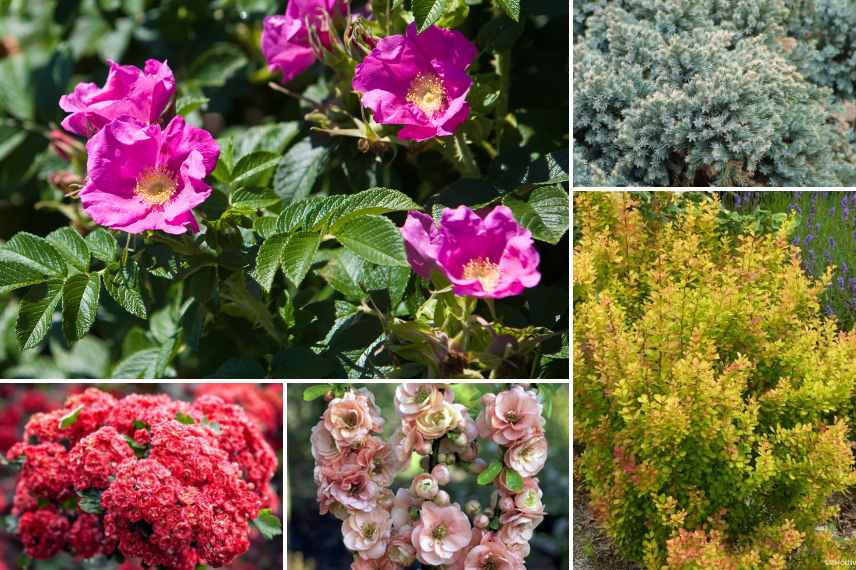
Rosa rugosa, Juniperus squamata ‘Blue Star’, Crataegus monogyna ‘Tortuosa’, Chaenomeles x superba ‘Cameo’ and Berberis ‘Orange Torch’
→ To read: Designing a mountain garden ; 10 wind‑resistant shrubs.
Planting, layout and maintenance of a border in an exposed site: 5 golden rules
Designing a border in a windy location, as in any garden, is not something to improvise, and the preparatory phase is as important as planting. Moreover, unlike rain, which is hard to control, there are tricks to counter wind, or at least reduce it. From this we can draw five main lessons:
1- Observe before deciding on border location
If possible, wait until autumn to observe wind patterns. In this season, when leaves have fallen, the main paths of prevailing winds are much easier to see. Ideally, create a border as sheltered as possible and set away from that trajectory. You will also detect in winter garden microclimates that should be favoured.
Also observe neighbouring gardens: they usually give a good indication of what can be planted at this distance from the coastline/at this altitude, etc.
2- Understand you must protect and water new plantings well in the early years
Many plants mentioned in this article will only tolerate strong, repeated winds once they have reached a certain maturity. Therefore, in the early years, you should pamper them, protecting less hardy specimens with a winter fleece + a thick mulch until they establish their root system properly. Watering is also crucial to help plants root correctly (deep watering rather than repeated shallow watering).
3- Stake plants to improve anchorage
Windy areas are places where staking is not just a gardener’s whim! For a shrub border, however, we do not recommend standard (single-stem) forms, which are more vulnerable. But you can discreetly stake certain docile climbers, roses, perennial plants or young shrubs. We give some practical tips in How to stake a perennial plant?
4- Maintain with appropriate pruning
Two important points to remember about pruning :
- Keep airy shapes by pruning central branches to reduce wind exposure on shrubs. Pruning into ball or dome shapes on dense shrubs is also useful.
- Timing : prune after frosts (not before March) to avoid winter burn caused by wind.
5- Opt for specific design and materials
Marion covers this in detail in 5 tips for designing a garden in a windy climate and I summarise a few essentials to know and mistakes to avoid when creating a border, once the right plants have been chosen.
- Reduce wind exposure :
- by planting a compact, dense windbreak hedge to create a perimeter barrier if space allows;
- by staggering plant heights, mixing low groundcover plants, compact shrubs and taller but flexible shrubs;
- by adding a small dry-stone wall (50–80 cm high) at the rear of the border: it breaks gusts without creating turbulence, while warming plants thanks to the thermal inertia of the stones.
- Mulching is essential to protect roots and limit evaporation. It also helps stabilise soil. Apply mulch correctly, wetting it so it does not blow away at the first gust of wind, or choose, if the garden allows, a mineral mulch, which is heavier.
- Never plant in front of a poorly fixed fence (risk of collapse + “wind tunnel” effect if wind passes underneath).
- Keep border away from large fragile or ageing trees: their fall or shade may smother shrubs.
- Avoid planting in a straight line: a hedge or linear bed perpendicular to the wind increases damage. Prefer curved or diagonal shapes to disperse airflow.
- Finally, avoid excessive nitrogen fertilisers, which weaken stems.

Plant a taller planting layer around borders for extra protection (© Flickr -Harald de Payrebrune)
Further reading
Don’t forget our advice in How and why to create a windbreak hedge?
Also discover our articles on garden design by aspect:
How to design a west-facing garden?
How to design an east-facing garden?
- Subscribe!
- Contents
This form is protected by reCAPTCHA - the Google Privacy Policy and Terms of Service apply.

































Comments