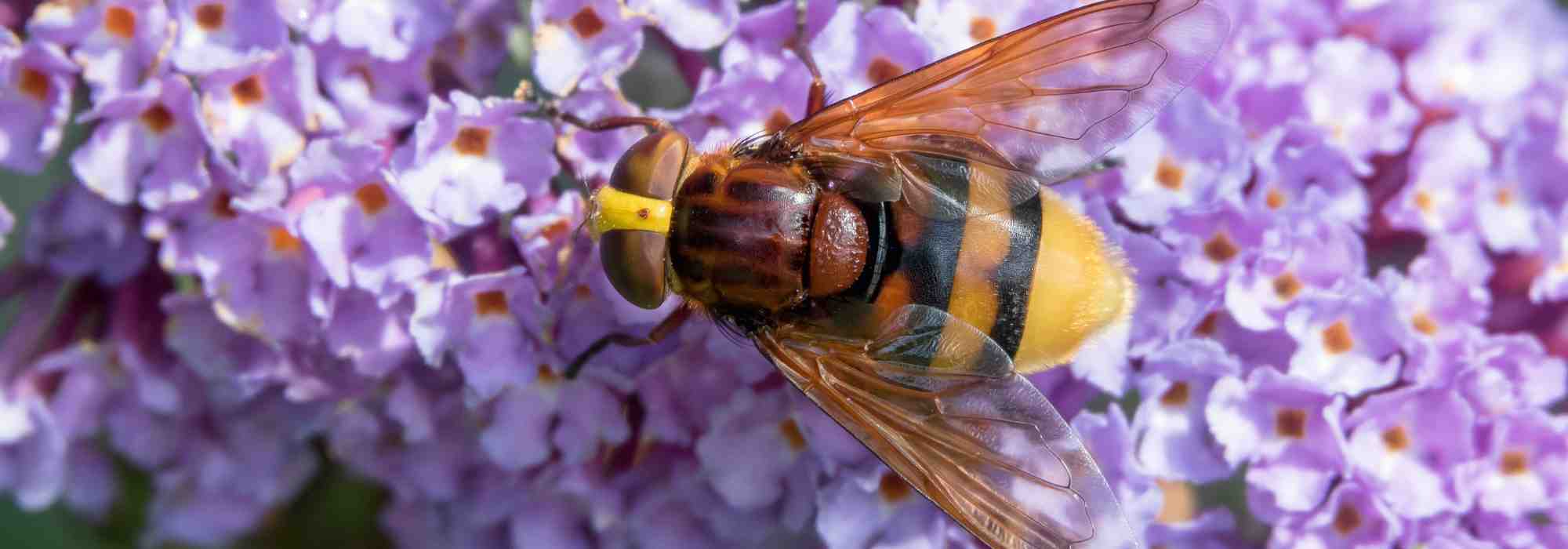
Plants that attract hornets
...to avoid in certain parts of the garden to enjoy a peaceful summer
Contents
Hornet seeking energy to fly and reproduce finds it in abundance in our gardens in summer. It gathers large amounts of sugar from flowers and fruits to feed. Which plants attract hornets most? Useful to know these plants so they are not placed in pathways, around dining areas, or so people do not fall asleep under a tree that attracts them.

What do hornets eat?
Like wasps and bees, hornets are hymenopteran insects. But they do not forage in the strict sense like those insects, not seeking pollen.
Hornets, whether European or Asian, feed mainly on nectar, the sweet, honey-like liquid secreted by flowers. Larvae, meanwhile, need proteins supplied by other, smaller insects (bees, wasps, flies, caterpillars…).
Not only flowers but sap of certain trees is useful to the European hornet in spring to make up for lack of food at that time.
Its diet therefore consists mainly of flower nectar, fruit, honeydew (that produced by aphids on tree leaves) and crude tree sap, with a protein component from other insects for the larvae.
Note that the formidable adult Asian hornet also feeds mainly on sugars (fruits, nectar, honeydew), and preys on animals (bees, wasps, beetles and flies) to feed its larvae, making it a real scourge for beekeepers and biodiversity as a whole.
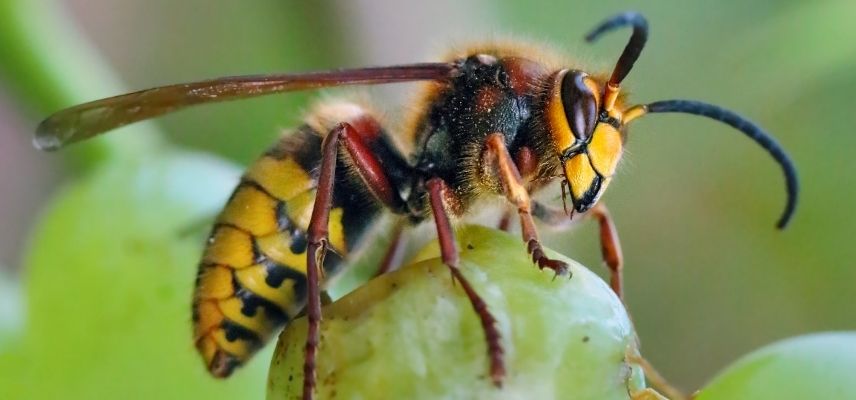
A perfectly ripe grape is nectar for the European hornet
Plants that attract the most hornets
Hornets searching for nectar therefore turn to plants that contain most of it. To avoid being bothered by their presence in areas for resting, eating or children’s play, take care with certain plants.
Fruit trees
Firstly, fruits — full of sugar and very ripe on the tree or bush, often in late summer — attract hornets, especially Asian hornets. Hornets need this energy to fuel themselves. Fig is among their favourite foods, as are grapes, plums and cherries in spring, all of them among the sweetest fruits. grapevines trained as a pergola, commonly seen in the south, should therefore be avoided if you want to dine in peace.
Rotten fruit fallen to the ground is another of their little weaknesses. It is best to collect it regularly to avoid attracting hornets into an orchard.
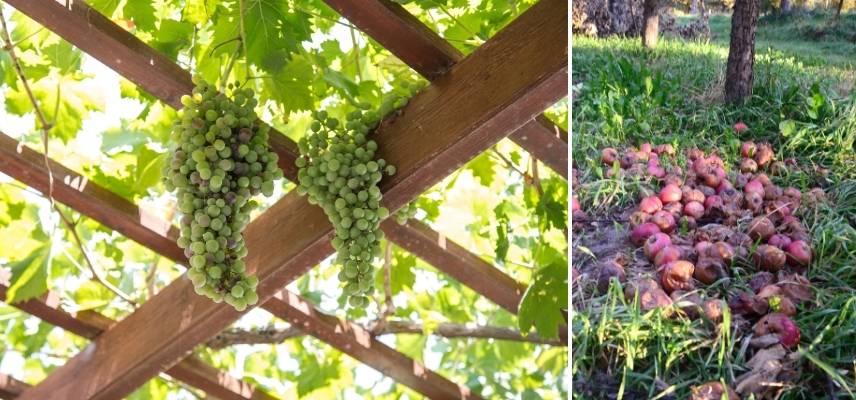
Grapevines and rotten fruit invariably attract hornets
Flowers of perennial plants
Certain flowers that produce a large amount of nectar are real hornet bars! They clearly prefer violet, blue, yellow and white (as do bees). Their preferences are strongly biased towards these colours, which are detected in UV.
Among the most nectar-rich perennial plants commonly planted in gardens are:
- agastaches, such as Agastache rugosa
- borage
- thistles (Cirsium)
- purple coneflower
- tall sedums
- Nepetas
- saviours
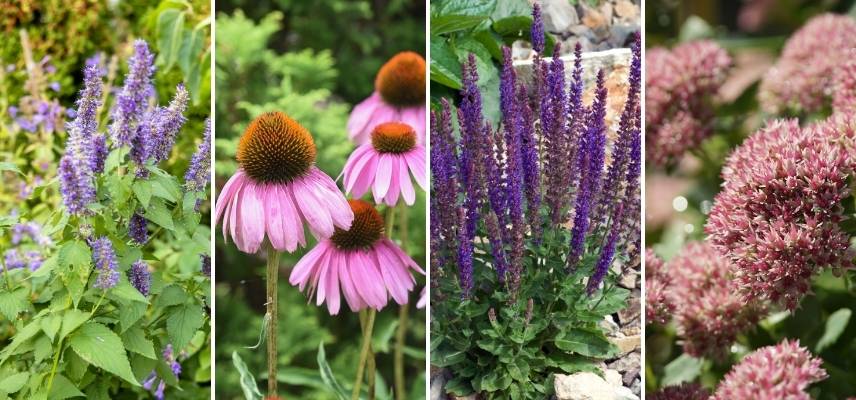
Agastache, purple coneflower, woodland sage and tall autumn sedum
Trees, shrubs and climbing plants
Certain trees are known to be very attractive to hornets:
- Acacia (Robinia pseudoacacia)
- all lindens
- horse chestnuts
- field maple (Acer campestre), Norway maple (Acer platanoides), box elder (Acer negundo) and sycamore (Acer pseudoplatanus)
As well as the following shrubs and climbers, whose flower shape fits hornet anatomy perfectly:
- lavender
- butterfly bush (Buddleia sp.)
- lemon trees and other citrus trees
- thyme
- honeysuckle
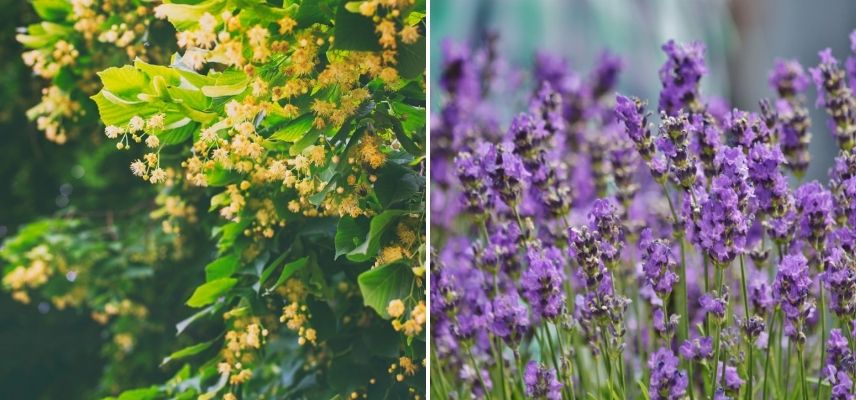
Linden and lavender, two flowers most favoured by hornets
Late-summer flowers
Many plants that flower in late summer and early autumn particularly attract hornets: ivy, Fatsia japonica, loquat and autumn sedums.
Sap-bearing trees
Crude sap circulating in plants, notably woody plants, is another feast for hornets. It provides an energy source, especially in spring when flowering is not yet abundant for nectar. Hornets lick the honeydew secreted by aphids on leaves, and crude sap directly on trunks or branches, without needing to bore through bark.
Among crude saps most consumed are oak, linden, maples, willows and conifers.
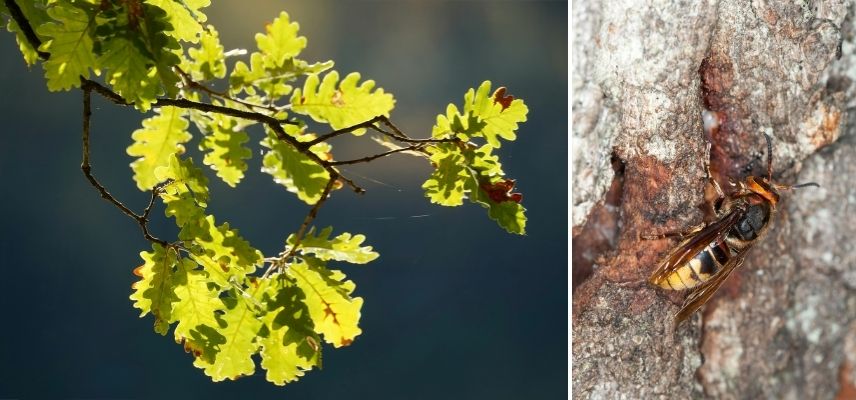
Oak sap is particularly prized by hornets in spring
Brambles (Rubus spp.)
Finally, all brambles of the genus Rubus — including raspberry plants and blackberries, but also attractive ornamental brambles often forgotten (Rubus odoratus, Rubus thibetanus, etc.) — are much liked by hornets. Shade-tolerant, they are also an important source of nectar from spring to summer. Rarely placed in inconvenient locations, brambles should nonetheless not be overlooked in a garden designed to promote biodiversity and welcome many pollinating insects.
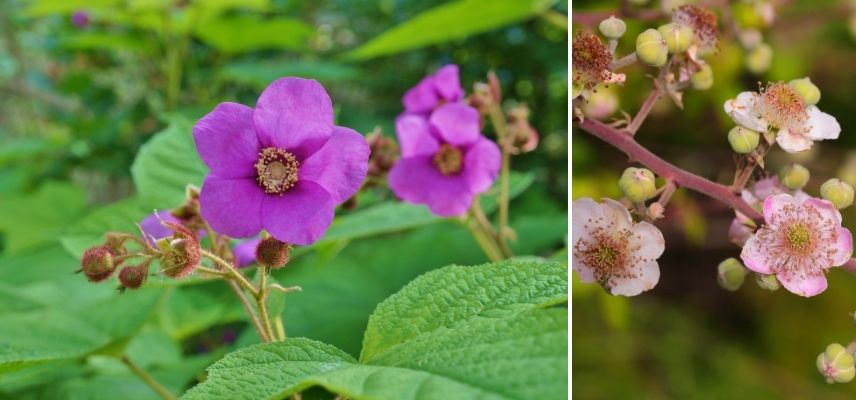
Rubus odoratus and the flowers that will become blackberries
Les frelons (Vespa spp.) peuvent être impressionnants mais il est possible de réduire fortement leur présence dans le jardin en combinant prévention, aménagement et, si nécessaire, intervention professionnelle. Voici des conseils pratiques et sûrs. 1) Identifier l’espèce - Frelon asiatique (Vespa velutina) : plus petit, thorax sombre et abdomen avec bande claire orange. Très prédateur d’abeilles. - Frelon européen (Vespa crabro) : plus grand, couleur plus vive. Savoir quelle espèce est présente aide à choisir la meilleure réponse (et à signaler les observations si nécessaire). 2) Éliminer les sources de nourriture - Ramassez les fruits tombés, nettoyez régulièrement les plans de travail extérieurs et couvrez les compotes/boissons sucrées. - Couvrez poubelles et composteurs hermétiquement. - Évitez de laisser de la nourriture humaine ou animale à l’air libre. 3) Réduire les lieux de nidification possibles - Bouchez les trous dans murs, combles, souches et haies denses où une femelle pourrait s’installer. - Taillez les branches basses et éclaircissez les masses de végétation dense. - Vérifiez et entretenez abris de jardin, remises et toits. 4) Moyens de dissuasion non-violents - Faux-nids : suspendre faux nids éloigne parfois de nouveaux nids (les frelons évitent les colonies proches). Efficacité variable mais simple et sans risque. - Filets/écrans : protégez zones de repas extérieures et points d’accès des ruches (pour apiculteurs). - Éviter d’installer points d’eau stagnante près des zones fréquentées. 5) Piégeage : usages et précautions - Les pièges à appât peuvent réduire quelques individus mais capturent aussi d’autres insectes utiles (abeilles, syrphes). - Utiliser des pièges sélectifs et ne les laisser que peu de temps (surtout au printemps pour capturer reines). - Pour le frelon asiatique, des appâts protéinés ou sucrés spécifiques sont employés ; renseignez-vous auprès d’un service local avant de piéger. - Ne placez jamais de pièges à proximité immédiate d’une ruche (risque d’attirer davantage). 6) Si vous trouvez un nid - Ne vous approchez pas et ne tentez pas de retirer le nid vous-même (risque de piqûres en masse). - Contactez un professionnel agréé en désinsectisation ou les services locaux compétents (mairie, service de lutte anti-nuisibles). - En cas de suspicion de Vespa velutina (espèce invasive), signalez l’observation aux autorités / plateformes locales de surveillance (par ex. applications ou services nationaux de signalement). 7) Conseils pour apiculteurs - Installer dispositifs de protection à l’entrée des ruches (réducteurs d’entrée, filets, « piégeage sélectif » placé loin de la ruche). - Surveiller tôt au printemps pour détecter les reines et poser des pièges de monitoring. - Contacter associations apicoles locales pour méthodes éprouvées. 8) Produits chimiques et interventions - Les pulvérisations domestiques sont souvent inefficaces et dangereuses pour la faune non visée. - La destruction d’un nid doit être réalisée par un professionnel, de préférence la nuit, avec équipement adapté. 9) Plantes répulsives (effet limité) - Certaines plantes aromatiques (menthe, citronnelle, lavande) peuvent atténuer l’attractivité locale mais ne constituent pas une barrière fiable contre un nid établi. En résumé : supprimez sources de nourriture, réduisez lieux d’accueil, utilisez de simples moyens dissuasifs (faux-nids, filets), soyez prudent avec les pièges et, surtout, faites appel à des professionnels pour tout nid ou si l’activité est importante. Si vous êtes au Royaume‑Uni ou en Irlande et suspectez la présence du frelon asiatique, signalez la découverte aux services de surveillance locaux.
Hornets are not all harmful : European species are valuable garden allies, regulating populations of flies, caterpillars and other pests. Only Asian hornets cause problems by attacking bees. They can become a nuisance in the garden because of their appetite for bees and fruit. Fortunately, simple natural solutions can keep them away without harming the ecosystem. To start, and as a preventive measure, collect fallen fruit regularly.
For deterring them naturally, rely on repellent plants such as mint, basil or scented geraniums (Pelargonium graveolens, Pelargonium crispum), removing the flowers, as it is the strong scent of the leaves that deters them. In spring, selective traps (brown beer or fruit syrup) can capture queens before they establish new colonies. They are only effective early in the season and should be placed well away from areas frequented by bees. If you keep hives, protect them with hornet entrance guards (6 mm mesh).
Finally, never destroy a European hornet’s nest (protected species), but report nests of Asian hornets to the fire brigade or your local council so professionals can intervene safely.
→ Read also : a hornet’s nest in your garden: what to do ? and Asian hornet trap: how to make it – illustrated tutorial
- Subscribe!
- Contents
This form is protected by reCAPTCHA - the Google Privacy Policy and Terms of Service apply.

































Comments