Virginia tulip tree, Liriodendron: planting, care
Contents
Tulip tree in a nutshell
- Tulip tree is a remarkable tree with its beautifully truncated leaves, green in spring turning golden in autumn, and its unusual summer flowering
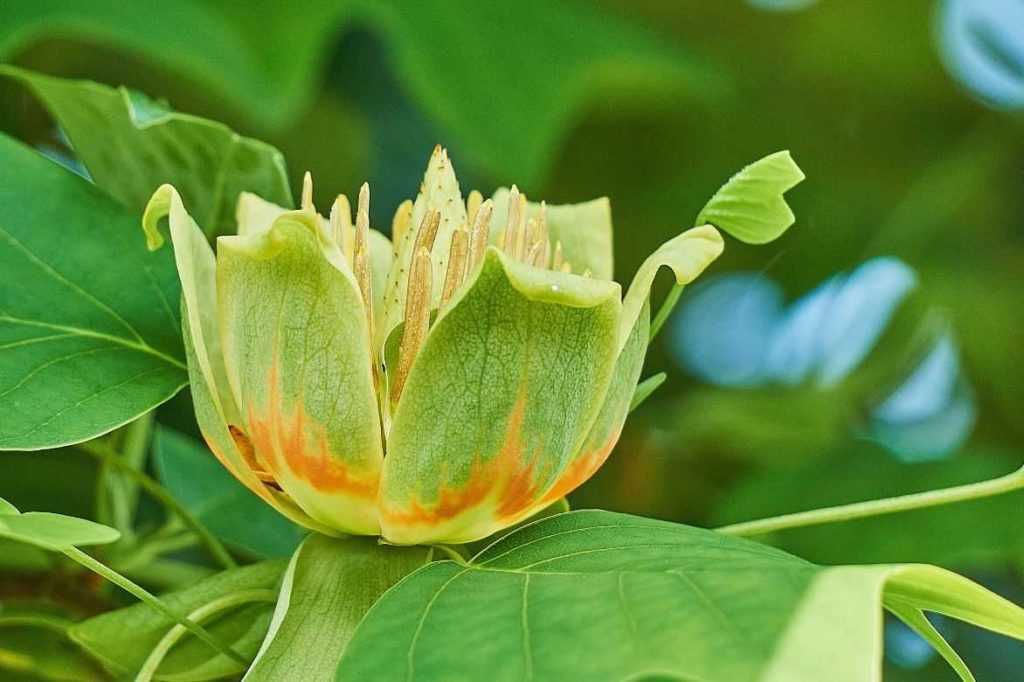
- Its large yellow-green flowers, orange at the base, appear on mature specimens and resemble the shape of a tulip
- It is a tree that requires a little patience: expect to wait at least 10 years to enjoy its first flowers
- Symbol of eternal life, tulip tree has a lifespan of five centuries!
- Majestic, it is ideal for parks or large gardens
A word from our expert
Liriodendron tulipifera, or Tulip tree, is a remarkable tree with beautiful deeply cut leaves and curious flowers, both evoking a tulip shape.
In summer, large flowers with broad petals exuding a lemon scent open as wide tulips very light green to yellowish, tinged with orange at the base, on lobed green foliage or variegated with yellow (‘Aureomarginatum’), valued for its beautiful autumn colours.
Symbol of eternal life, Tulip tree is one of those trees that never die: it can live for more than 400 years! And, as a little anecdote, in 1783 Queen Marie-Antoinette had two Tulip trees planted in the Grand Trianon park at the Château de Versailles; had they not been carried away by a storm they would still be alive!
You will need to be very patient and allow at least 10 years to see first flowers, and also reserve a space suited to this tree — minor inconveniences compared with Tulip tree’s splendour and longevity.
Elegant and majestic, with its large flowers in tangy shades, it brings in summer an exotic and sophisticated touch to large parks and gardens. Mature size ranges between 15 and 25 m in height, but some varieties such as Tulip tree ‘Fastigiata’ or Tulip tree Fastigiate, of more modest stature, will fortunately suit medium-sized gardens better.
It is an easy tree to grow in sun or partial shade, sheltered from cold, dry winds, in soil permanently cool, well drained and rich in humus. It also offers good hardiness that makes it resistant across all our regions.
Splendid as a specimen on a lawn or in a strategic spot in the garden to enjoy its unusual summer flowering, near a water feature or planted as an avenue tree, discover the Tulip tree, this magnificent flowering tree related to magnolias!

Description and botany
Botanical data
- Latin name Liriodendron tulipifera
- Family Magnoliaceae
- Common name Tulip tree
- Flowering May to August depending on climate
- Height Between 15 and 25 m
- Exposure Sun, partial shade
- Soil type All soil types, fresh
- Hardiness down to -15°C
The Liriodendron tulipifera or Tulip tree is a large deciduous tree of the family Magnoliaceae, native to the central-west and eastern United States where it grows naturally along riverbanks and on mountain slopes.
The genus contains only two species, among them Liriodendron tulipifera, which has given rise to some cultivars such as Liriodendron tulipifera ‘Fastigiata’, distinguished from the typical species by its more upright, narrower habit, and Liriodendron chinensis, or Chinese tulip tree, smaller and less hardy than the American species.
Anchored by a deep taproot, the Tulip tree forms a majestic tree with a straight trunk and a columnar habit whose branches unfold into a conical crown that broadens with age. In Liriodendron tulipifera ‘Fastigiata’, the crown is narrower and branches are almost parallel to the trunk. Taller than broad, it can reach 50 m with a trunk 2–3 m in diameter in its natural environment.
In gardens, adult height is usually limited to 15–25 m with a spread of about 15 m. Growth is rapid, especially during first years after planting, then may slow to appear stagnant, but longevity is exceptional; the Tulip tree can live for nearly 500 years.
Bark is smooth and grey-orange when young, then darkens and fissures with age, which earned the tree the common name “yellow poplar”.
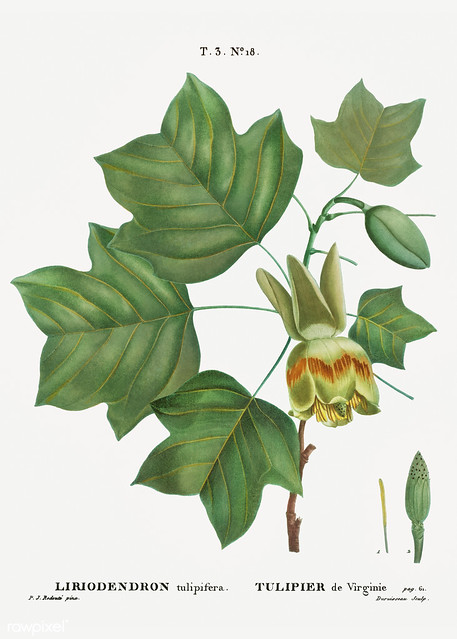
Liriodendron tulipifera – botanical illustration by PJ Redouté
Liriodendron tulipifera is notable for its attractively truncated leaves, almost as striking as its flowers.
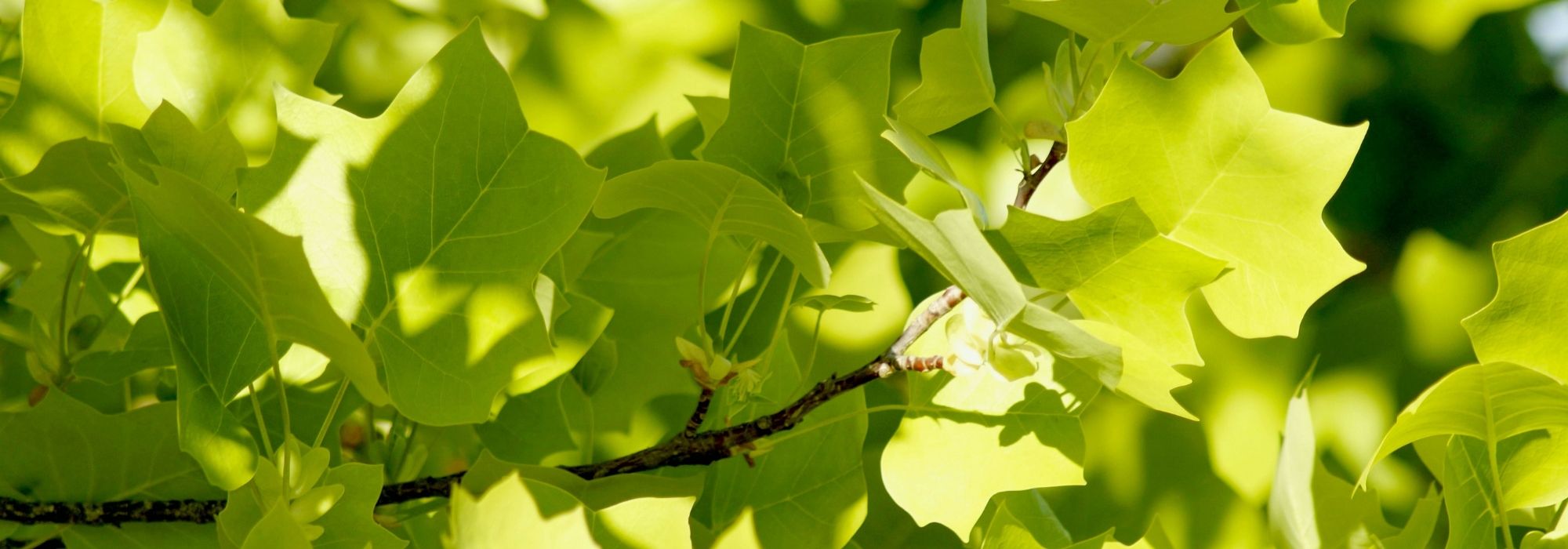
Leaves are deciduous, alternate, borne on very long petioles up to 10 cm, almost as broad as long, measuring 10–16 cm. Tulip tree owes its name to their very particular shape. Lamina divided into four symmetrical, pointed lobes separated by deep notches, appearing truncated at the tip. In these oddly lobed leaves that end in a point some see the shape of a tulip, a lyre or even a saddle.
Leaves are glossy, ranging from pale green to bright green with a glaucous underside in spring. The Liriodendron tulipifera ‘Aureomarginatum’ is distinguished by particularly luminous foliage, irregularly margined with golden yellow in spring.
The whole tree dons a remarkably flamboyant autumn dress. Leaves turn golden yellow, tobacco brown or pretty orange hues in autumn before falling.
Liriodendron tulipifera is characterized by an unusual summer flowering. In summer, from May to July after leafing, large cup-shaped, upright flowers appear on trees at least 10–20 years old. Nestled in the foliage, they open solitarily at branch tips. Their elongated shape evokes both a tulip, hence the species name, the natural elegance of the fleur-de-lis and inevitably the grace of magnolia flowers.
These flowers, 6–10 cm in diameter, consist of nine tepals, three sepals surrounding six waxy, thick petals. The interior of the cup reveals a central creamy-white cone circled by a cluster of yellow stamens 4–5 cm long.
They open in corollas shaded with very fresh, tangy hues from very pale green to white or pale yellow-green tinged with orange at the base.
Nectar-rich flowers are melliferous and slightly scented; they give off a pleasant lemony citrus scent.
Later, but only after about 20 years, they transform into pale brown conical fruits 7–8 cm long, upright and scaly, resembling magnolia cones.
They persist on the tree long after leaf fall and release numerous small winged seeds (achenes or samaras) that feed birds and small mammals in winter.
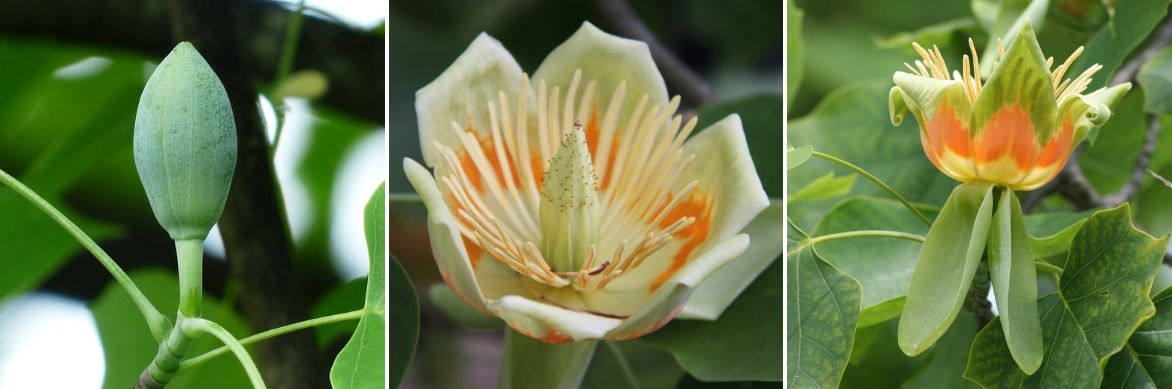
Development of the superb flowering of the Tulip tree
Very hardy, the Tulip tree tolerates severe winters down to -30 °C, sometimes beyond. It prefers sunny to partially shaded exposure and deep, fertile, well-drained soils that remain cool throughout the year.
The Liriodendron tulipifera is a splendid specimen planted alone, as a focal point in a large park or garden to enjoy its spectacular flowering, near a sizeable pond or used as a street or avenue tree. Some more modest cultivars suit medium-sized gardens.
Tulip tree wood, pale yellow to greenish-brown, is a light, soft timber much prized in marquetry, in luthiery and for shipbuilding.
Bark also has anti-inflammatory and antitussive properties and may be used as a substitute for quinine.
Main species and varieties
With the type species Liriodendron Tulipifera, only a few varieties of tulip tree are commonly offered in nurseries. Here are our favourites!
Most popular
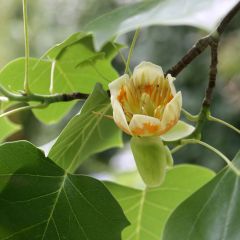
Liriodendron tulipifera - Tulip Tree
- Flowering time June to August
- Height at maturity 25 m
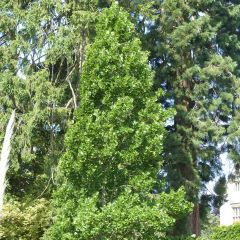
Liriodendron tulipifera Fastigiatum - Tulip Tree
- Flowering time June to August
- Height at maturity 15 m
Our favourites
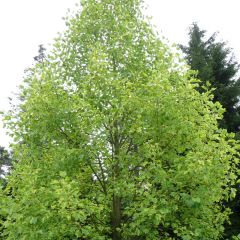
Liriodendron tulipifera Aureomarginatum - Tulip Tree
- Flowering time June to August
- Height at maturity 15 m
Planting Liriodendron
Where to plant the Tulip tree?
Le Liriodendron tulipifera or Tulip tree shows excellent hardiness, down to -30°C, sometimes -35°C, allowing planting in coldest regions of country. Native to wet areas, it prefers rainy climates and will probably be less at ease in overly dry Mediterranean regions.
Although very hardy, in regions with long winters or exposed to wind, give it a well-sheltered position because late frosts can damage flower buds and strong winds can break branches.
It favours non-scorching sun or partial shade in rich, light, deep, well-draining in winter, cool or even moist soil, in any case not too dry since it needs some moisture in soil to develop well. While tolerant like magnolia, it prefers slightly acidic and
This tree tolerates transplanting poorly and does not appreciate heavy pruning or major cutting back; think carefully about location before planting and allow plenty of space because at maturity (after 40–50 years) it will easily exceed 20 m in height with a 15 m spread.
Its monumental size makes it an excellent specimen planted alone in a large park or garden as well as in rows in urban layouts, since it shows perfect resistance to pollution. It will also be splendid near a body of water.
In a medium-sized garden or a city garden, prefer Liriodendron tulipifera ‘Fastigiata’, a less bulky variety, slightly slower-growing than species type and with a narrower habit, not exceeding 15 m in height and 6–7 m in spread.
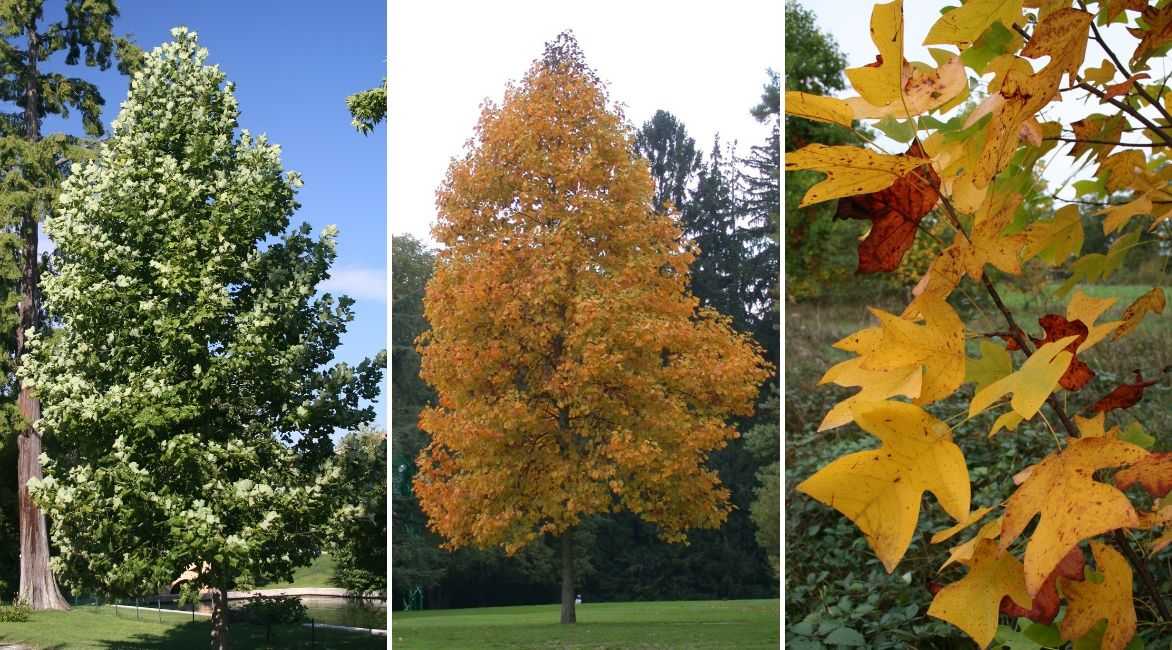
Foliage colour change of Tulip tree according to seasons
When to plant the Tulip tree?
Planting Tulip tree is ideally done in spring from February to April in cold regions or from September to November elsewhere to encourage rooting before winter. In all cases avoid periods of frost.
How to plant the Tulip tree?
Secret to a healthy Tulip tree is sufficiently rich, deep and cool soil! In very calcareous soil, we recommend adding heather soil at planting. Once established, avoid moving it; its root will tolerate transplanting very poorly. Give it plenty of room — at least 8 to 10 m between trunk and any other tree, wall or fence.
- Plant in a wide planting hole at least three times volume of root ball
- Provide a good draining layer so water does not stagnate, using coarse sand or gravel
- Enrich soil with well-rotted compost and a little potting compost
- Plant at collar level without burying root ball too deeply
- Keep tree upright and stake if necessary
- Firm soil and water copiously until established and during first two summers after planting
- Mulch base to retain coolness during summer
To succeed with planting your tree, watch our video!
Maintenance, pruning and care
Tulip tree requires very little maintenance. Good mulching and regular watering in summer are the essentials of its care.
In summer, monitor its water needs during first two years and water generously in dry weather. Spread a good layer of organic mulch to keep soil consistently cool. Its growth can also be limited by lack of water, so soil should never be dry. Afterwards, it will better withstand short periods of drought.
Once a year in spring, amend soil with a good organic fertiliser.
Should tulip tree be pruned?
Tulip tree dislikes frequent and especially severe pruning: prune only if necessary, for broken, weak or poorly positioned branches. At end of winter, carry out maintenance pruning only to remove dead or damaged wood. Apply plant tar, as every wound favours penetration of pathogenous fungi.
Find out more in our tutorial : How to prune a tulip tree?
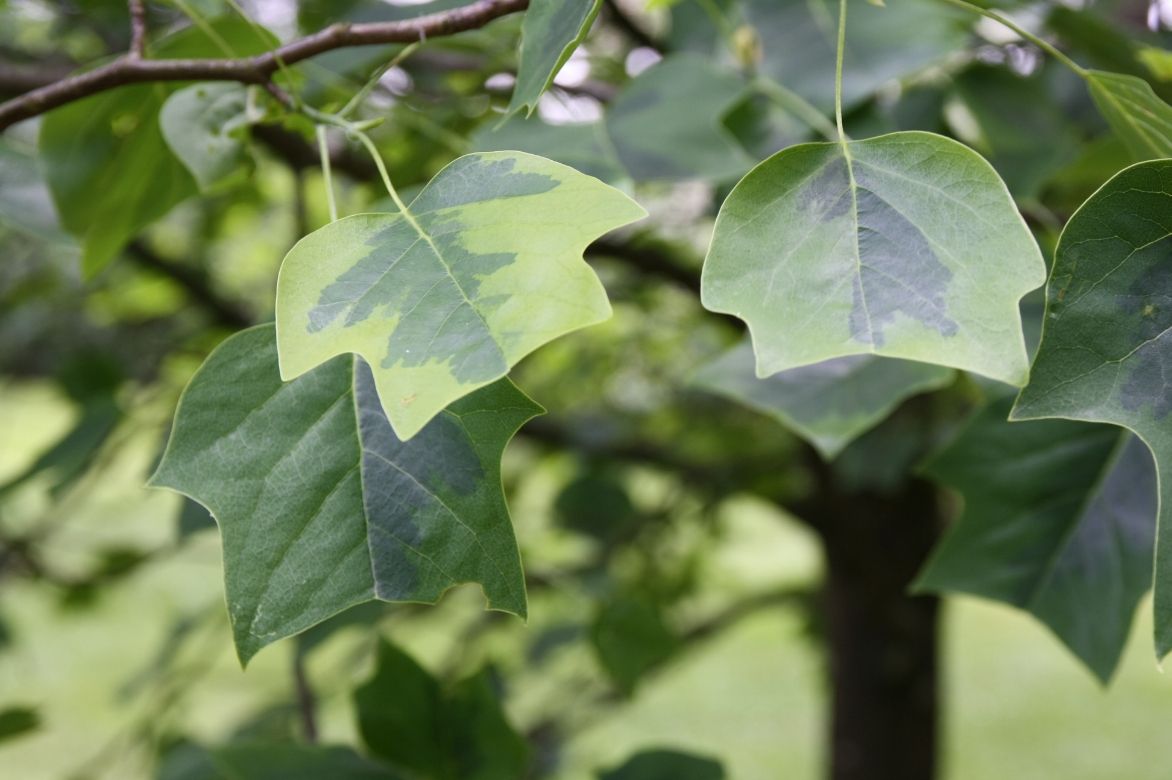
Stunning variegated foliage of Liriodendron tulipifera ‘Aureomarginatum’
Diseases and potential pests
When planted in suitable growing conditions, Virginia tulip tree is not very susceptible to most diseases or to insect or pest attacks.
In waterlogged, poorly drained soil it will be threatened by cryptogamous diseases caused by fungi such as verticillium wilt. As a preventive measure: spray Bordeaux mixture in autumn and in late winter. If attacked you will notice leaves wilting, drying out and rolling up: remove affected leaves and burn them.
Excessively lime-bearing soil can cause a chlorosis leading to yellowing of leaves and, in time, decline of the tree. Regularly amending soil with a shovelful of heather soil will help prevent it.
→ Find out more with our information sheet on Diseases and pests of the Virginia tulip tree.
Multiplication
The tulip tree is propagated by sowing, sometimes seeds take a whole year to germinate or by grafting for more experienced gardeners. However, as tulip tree fruits only appear after about 20 years, we recommend buying another tulip tree from our nursery.
→ Learn more about propagation of Liriodendron in our tutorial How to propagate the tulip tree?
Associate
This large‑growing tree will become the centrepiece in the middle of a large bed of lower shrubs that flower earlier in spring such as Mahonia Media with its lemon‑yellow flowers, Chimonanthus praecox with sulphur‑yellow blooms, forsythias or later flowering shrubs such as a Buddleja weyeriana ‘Sungold’, shrubby potentillas, rambling roses or a Hypericum ‘Golden Beacon®’ or St John’s wort.
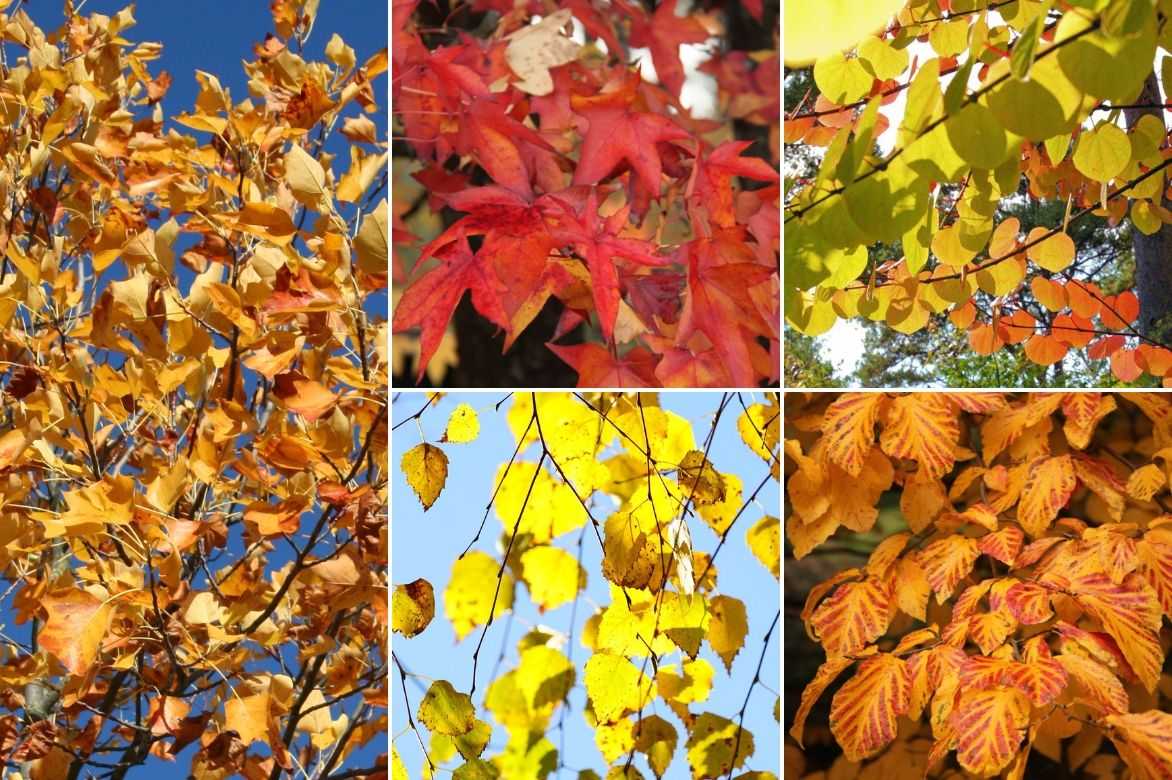
An example of a small‑woodland planting: Liriodendron tulipifera, Liquidambar styraciflua, Cercidiphyllum japonicum, Betula utilis (B. utilis var. jacquemontii for example), Parrotia persica… in autumn it will be an explosion of colour !
A Lonicera nitida Elegant, an evergreen honeysuckle, will form a perfect low hedge around its base.
In spring, surround it with a carpet of spring bulbs, such as imperial fritillaries, Eremurus, daffodils, narcissi, late tulips.
Its luxuriant summer foliage shades the ground beneath, so choose some perennials for cool shade with yellow or blue flowers, such as Brunnera macrophylla, creeping bugle, Corydalis, foxgloves or hardy geraniums that will keep its roots cool.
The lavender‑blue panicles of a Buddleia davidii ‘Nanho Blue’ and the cobalt‑blue flowers of a Ceratostigma willmottianum, a mat‑forming shrub, will provide a striking contrast with the yellow flowering of the Tulip tree which will also set off beautifully against a backdrop of blue conifers such as Cedrus libani atlantica ‘Glauca’, Cupressus arizonica ‘Fastigiata’ or Chamaecyparis lawsoniana ‘Columnaris’.
At season’s end, the leaves of a katsura tree (Cercidiphyllum japonicum) or of a Persian ironwood will enhance its foliage in autumn colours.
Useful resources
- Discover our tips for successfully planting a Tulip tree.
- Have a small garden but want to plant a tree? Fortunately, there are species and varieties of modest size — discover our selection of trees for small gardens!
- Everything you need to know about trees is on our blog!
- The most beautiful trees and large shrubs are in our nursery!
- Discover our collection of summer-flowering shrubs that could complement your Tulip tree!
- Discover 7 trees with unusual foliage
Frequently asked questions
-
Why is my tulip tree losing its leaves?
Native to riverbanks, this tree requires moist soil all year round. Dry soils must be avoided. If water is lacking, the tulip tree may lose its leaves. In summer, monitor water needs, especially for young trees, and water generously during the first two years after planting to ensure establishment. Soil must never be dry.
-
My tulip tree is not flowering, why?
Planting a tulip tree in the garden is a lesson in patience! It takes many years to flower. You will not see its first flowers until after 8 to 15 years in cultivation.
- Subscribe!
- Contents
This form is protected by reCAPTCHA - the Google Privacy Policy and Terms of Service apply.

































Comments