If you love indoor begonias — those rhizomatous begonias with beautiful coloured, spotted or puckered leaves — you can never have enough! Propagating a rhizomatous begonia guarantees an identical copy, ideal for gifting or expanding your houseplant collection.
In this tutorial, we explain how to easily divide your indoor begonia, either by propagation by leaf cuttings, stem cuttings, or by dividing the rootstock.
Which begonias are rhizomatous?
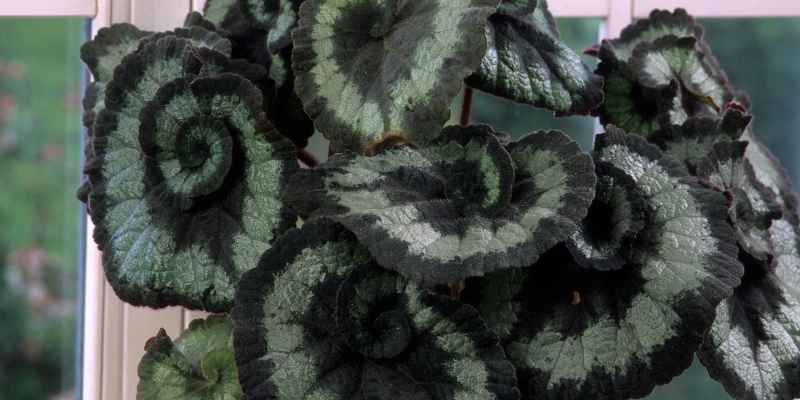
Their leaves, with unique patterns and textures, make them stars of indoor spaces! In cultivation here the main ones are Begonia rex and Begonia masoniana. Rhizomatous-rootstock begonias are also found among Begonia manicata and Begonia boweri, both native to Mexico.
NB: this tutorial concerns only rhizomatous begonias. These species are recognised by their thick rootstock, often visible at surface of the growing medium.
When to divide a rhizomatous begonia?
Whichever method you choose, we recommend propagating an indoor begonia in spring, between March and May, to encourage good establishment. Begonias are in active growth then and have energy to produce new roots. Indoor warmth and light conditions are optimal at that time. Autumn (September) is also a suitable period in mild climates.
My tip: an indoor temperature between 18 and 22°C favours success for these propagations.
Propagation by leaf cuttings
*****
Equipment (same for all three methods)
- A healthy rhizomatous begonia
- A sharp knife, a pruning shear or a clean pair of scissors, disinfected with alcohol
- Small pots (6–8 cm diameter) or a tray
- Light, well-draining potting compost (special indoor plant mix or universal compost + sand/perlite)
- A spray bottle
*****
- Prepare tray or pots: fill with light potting compost, then moisten growing medium with a spray bottle;
- Take a healthy leaf, well formed and free of spots, with its petiole (stem that connects leaf to plant);
- Cut leaf into several pieces (triangles) if large, ensuring each piece contains a main vein (roots will form from the vein). Make a slight incision on the main vein on the back of the leaf with a clean knife to stimulate rooting.

- Plant leaf sections or petiole in prepared pots or tray, vein side down, either flat or inserted vertically;
- Place tray or pots under a mini greenhouse (20–23°C), under a cloche or transparent plastic, in bright, indirect light;
- Keep growing medium slightly moist until new plantlets appear. Lift plastic or cloche for a few minutes about every three days to avoid excessive condensation;
- Roots appear in 4–6 weeks; repot new plantlets when they are 3–5 cm tall.
Propagation by stem cuttings

- Cut a healthy stem about 8–10 cm long with 2–3 leaves;
- Remove lower leaves, keeping only top leaves and cutting them in half;
- Insert stem into light substrate, water moderately, and place under a cloche or in a warm, bright spot out of direct sun.
- Roots appear in 2–4 weeks; pot on when they measure 2–3 cm.
Division of rootstock
This is most reliable method for species with a thick, visible rootstock (see table below).
- Water begonia 2 days before dividing so rootstock is easier to cut.
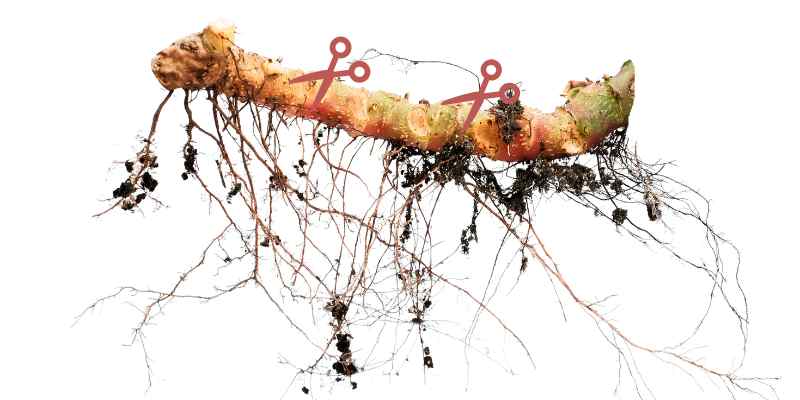
- Gently remove plant from pot and clear soil around roots to locate the rootstock: it looks like a thick horizontal stem with "eyes" (small buds) or shoots.

- Divide the rootstock: with a clean knife, cut on a slant — this increases healing surface — into sections 5–8 cm long. Each section should have at least 1–2 eyes/buds (future shoots) and some visible roots.
- Fill pots with light potting compost moistened beforehand.
- Lay each section flat on compost (rootstock should not be buried, just laid on compost and covered with a thin layer max 0.5 cm).
- Lightly firm compost around to stabilise.
- Keep substrate slightly moist and place pots in indirect light.
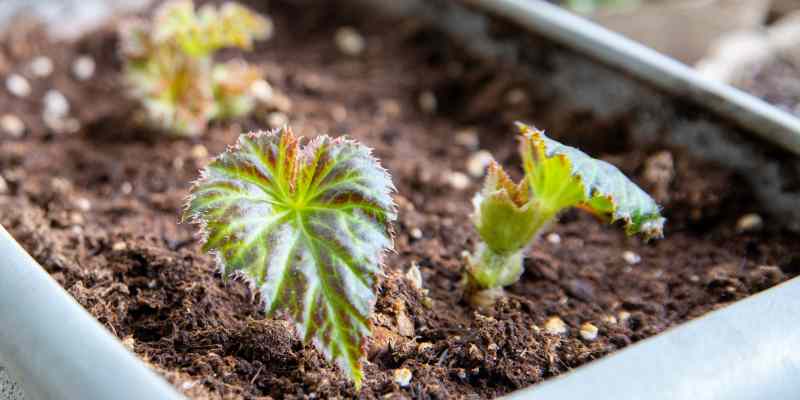
- Small shoots will appear after about 2–4 weeks.
To summarise
Each method has advantages and disadvantages and specific features. Note that speed varies with conditions (temperature, humidity).
| Propagation method | Ideal period | Success rate | Speed | Difficulty | Good for | Recommended species |
| Propagation by leaf cuttings | May to June | 60–75% | Slow 4–6 weeks | Very easy | Experimentation, small quantities | B. masoniana, B. rex, B. boweri, B. feastii |
| Propagation by stem cuttings | April | 70–80% | Medium 3–5 weeks | Easy | Beginners | B. boweri, B. diadema and B. feastii |
| Division of rootstock | 80–90% | Visible regrowth in 2–4 weeks | Medium | Mature plants | Begonia rex and B. manicata |



































Comments