Fatsia japonica seeds - Japanese aralia
Fatsia japonica seeds - Japanese aralia
Fatsia japonica seeds - Japanese aralia
Fatsia japonica seeds - Japanese aralia
Fatsia japonica
Paperplant, False Aralia, Japanese aralia, Caster Oil Plant
Back-to-school special offer!
Get €10 off for every €50 you spend! And get up to €40 off on a single order.
How does it work?
1. Shop your favourites
Add your favourite plants to your basket. For every €50 you spend (excluding delivery charges, store credit and the plastic-free option), you’ll receive a €10 voucher.
€50 spent = €10 voucher
€100 spent = €20 voucher
€150 spent = €30 voucher
€200 spent = €40 voucher
2. Place your order
Once your basket reaches one of the spending thresholds, place your order. You can even choose your delivery date!
3. Receive your voucher
As soon as your order has been shipped, you’ll receive an email containing your personal voucher code and its value.
4. Use it on your next order
Your voucher is valid for 90 days from the date you receive it. It can be used once only, on a new order worth at least the value of the voucher, excluding delivery charges.
Please note: Vouchers can be combined with other offers, but cannot be split or refunded.
Home or relay delivery (depending on size and destination)
Important: You may be charged customs duties by your country’s customs authorities upon delivery.
Schedule delivery date,
and select date in basket
This plant carries a 6 months recovery warranty
More information
We guarantee the quality of our plants for a full growing cycle, and will replace at our expense any plant that fails to recover under normal climatic and planting conditions.
Would this plant suit my garden?
Set up your Plantfit profile →
Description
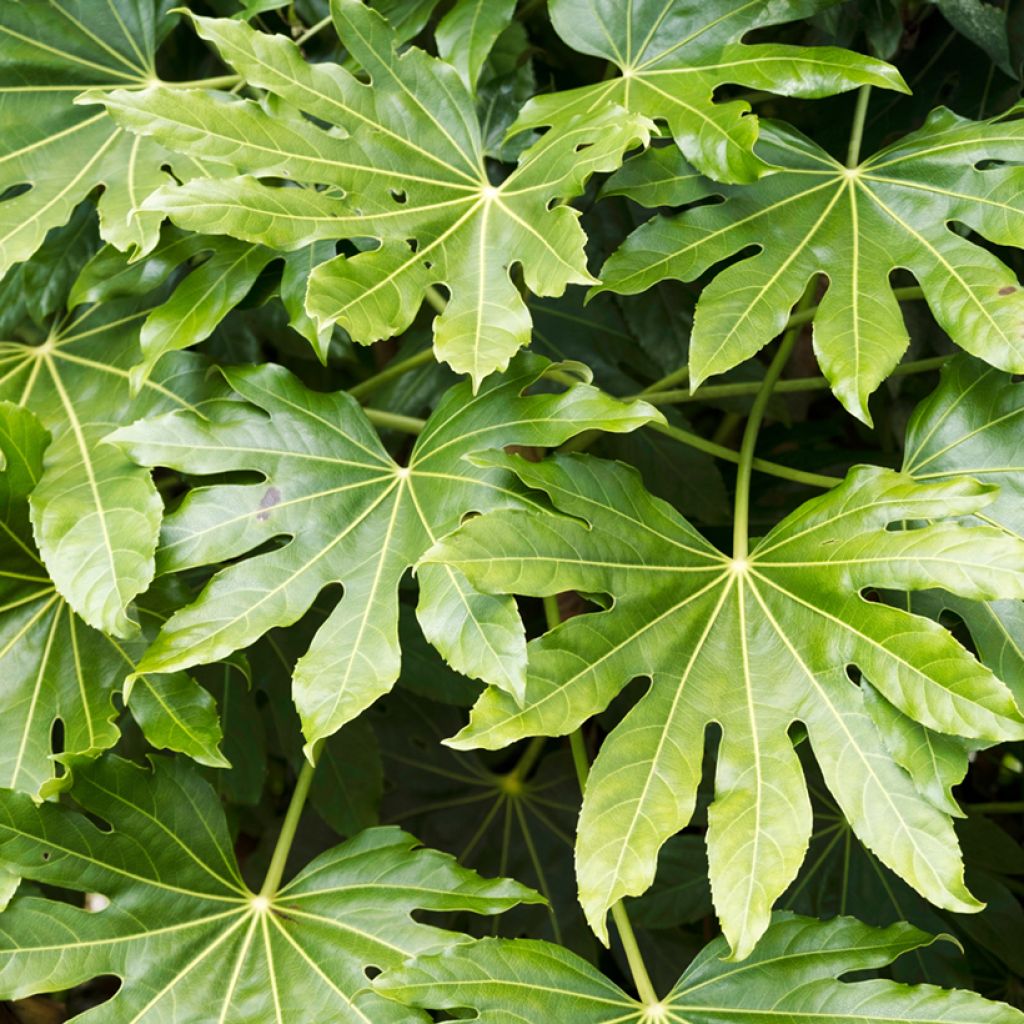
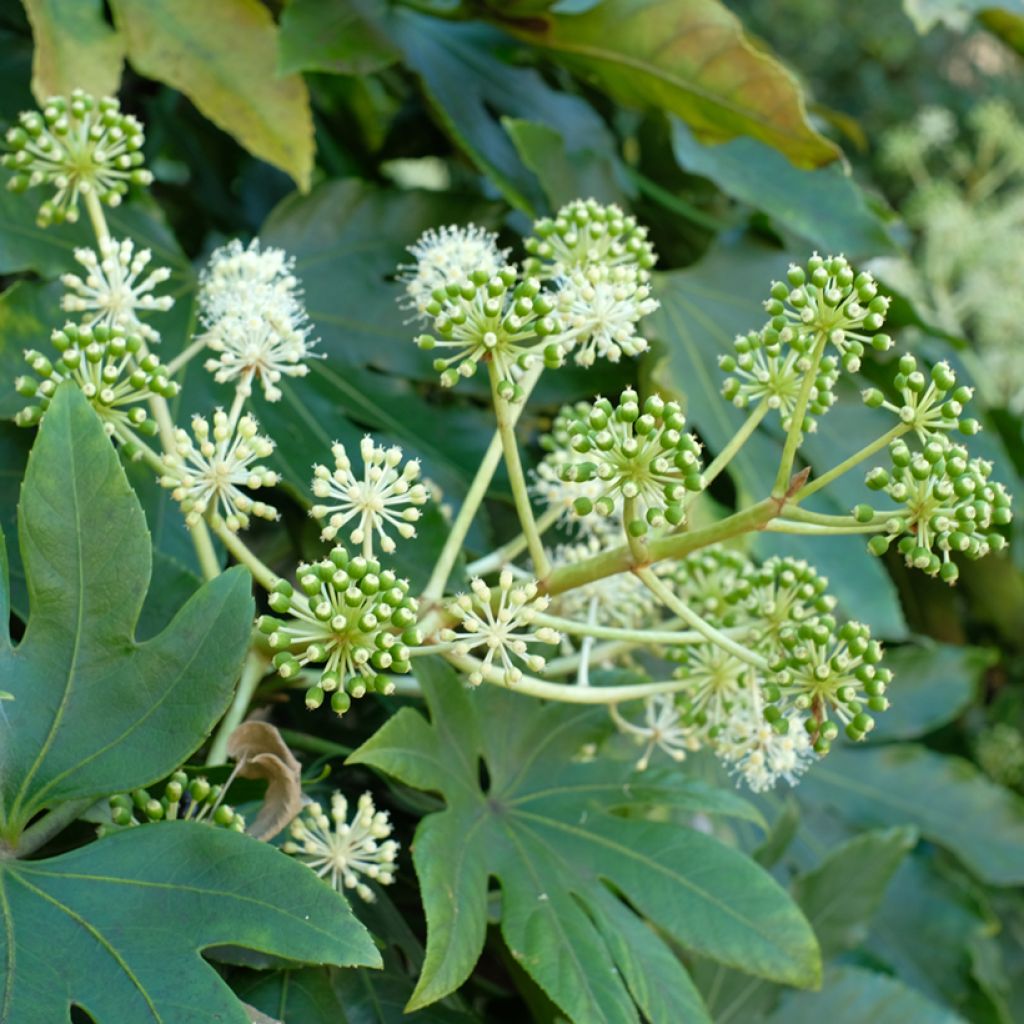
Sowing Japanese Aralia or Fatsia japonica seeds allows you to witness the germination and growth of this exotic evergreen bush with its luxuriant foliage. Its development is slow, but with a little patience, it forms a beautiful plant adorned with large, broad, dark green, glossy and deeply lobed leaves. In autumn, it becomes covered with small white pompom flowers, followed by decorative black fruits in winter. Suitable for shady or semi-shady gardens, this Aralia can also be grown in pots to add an architectural touch to sheltered terraces and balconies. Growing from seed allows you to enjoy it at a lower cost.
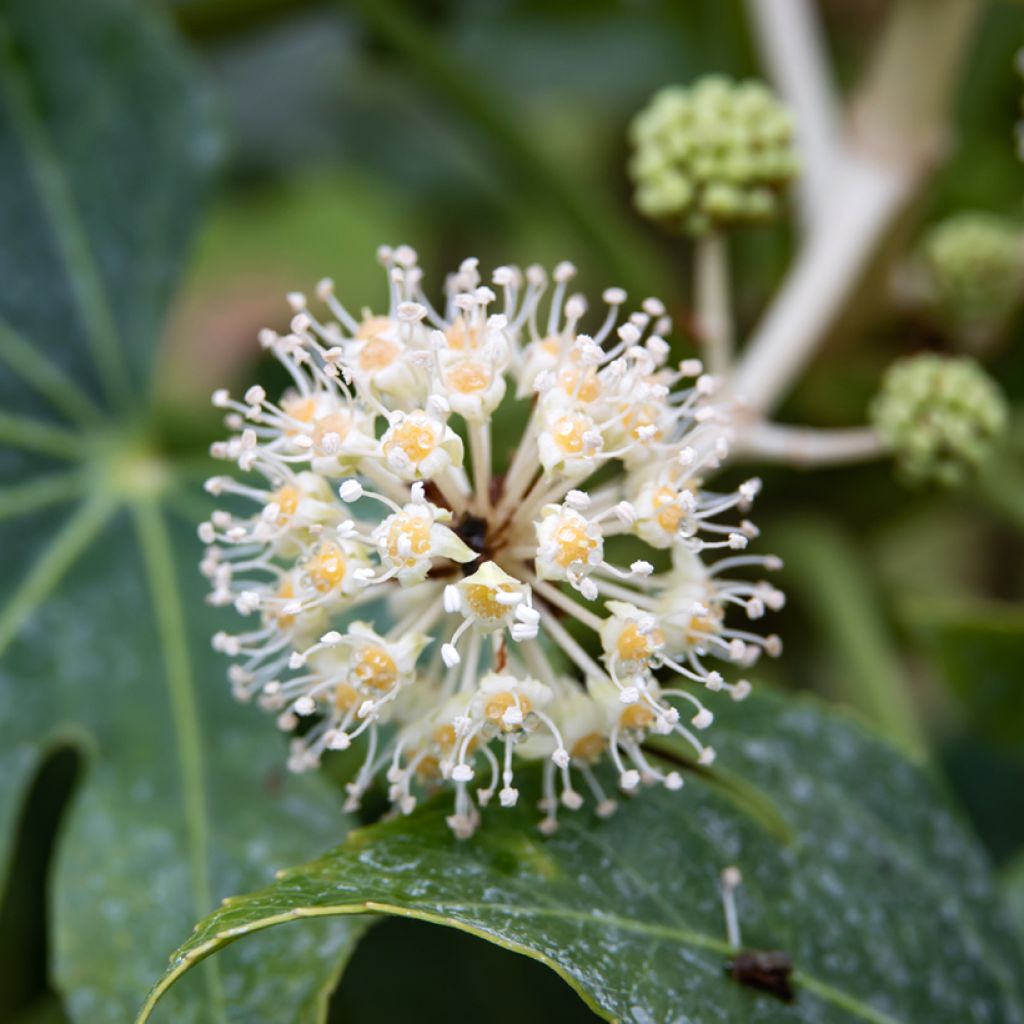
Native to southern Japan and Taiwan, Fatsia japonica, also called Aralia japonica, Aralia sieboldii or Siebold's Fatsia, belongs, like ivy, to the Araliaceae family. In its natural habitat, it grows naturally on the edges of humid forests, often under the cover of larger trees that filter the light. It thrives in soil rich in organic matter, moist and well-drained, which allows it to develop dense and decorative foliage. It is a giant herbaceous perennial, not to be confused with Aralias, which are true deciduous trees with thorny stems. The Japanese Aralia has long petioles bearing very large leaves. Its habit is rounded and spreading, giving a lush, tropical plant appearance. Its growth is rather slow. Its magnificent palmate leaves, divided into 7 to 9 lobes, measure 15 to 30 cm in diameter; they are evergreen and borne on a branching false trunk, giving it a very structured habit and an exotic look. The tiny flowers appear from July to September, grouped in clusters of small creamy-white pompoms. Later, they turn into equally decorative black beads, much appreciated by birds. In a garden, Fatsia japonica reaches 2 to 3 m in height and spreads just as wide. Hardy down to -12°C, its foliage can be damaged by frost, cold wind or snow. A sheltered planting, against a wall or under deciduous trees, improves its resistance and helps preserve its foliage in winter.
Perfect for shaded borders, ideally in partial shade, Japanese Aralia pairs well with bamboos, hostas, ferns, rodgersias or the Chinese windmill palm in a lush and exotic setting. In pots, it adapts well to protected spaces and makes a beautiful year-round green feature. It adds a great deal of originality to gardens and shaded terraces.
Fatsia japonica seeds - Japanese aralia in pictures
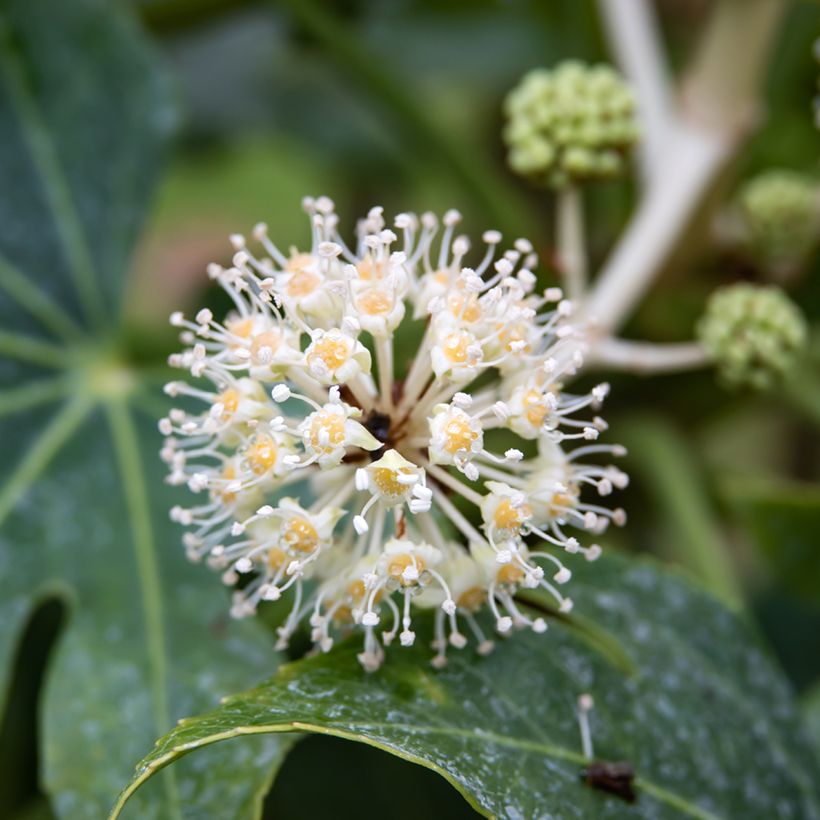
Flowering
Foliage
Plant habit
Botanical data
Fatsia
japonica
Araliaceae
Paperplant, False Aralia, Japanese aralia, Caster Oil Plant
Aralia japonica, Aralia sieboldii
East Asia
Planting and care
Sowing Fatsia japonica seeds can be done indoors at any time, but spring is ideal to take advantage of an active growth period. A light, well-draining compost rich in organic matter, composed of a mix of seed compost and perlite or sand, is recommended. A slightly acidic to neutral substrate is most suitable.
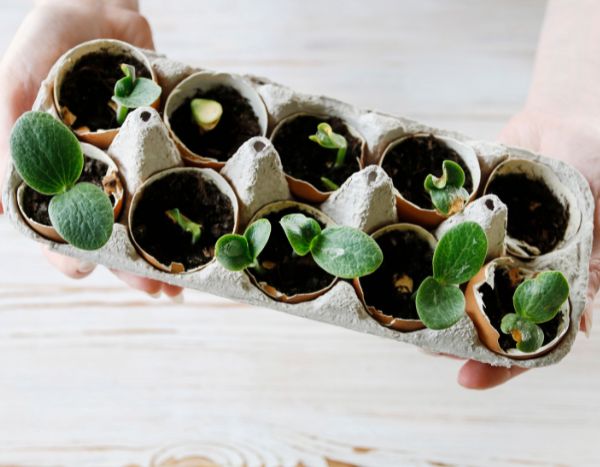
The seeds should be sown by lightly covering them with substrate, at a depth of about 0.5 cm, and spaced a few centimetres apart. Watering should be regular but not excessive, moistening the substrate without waterlogging it. A constant temperature between 20 and 25°C is required. Good humidity is important, which is why it is advisable to cover the container with plastic film or place the sowing in a propagator, ventilating it regularly to prevent mould from forming. A bright position, without direct sunlight, is preferable.
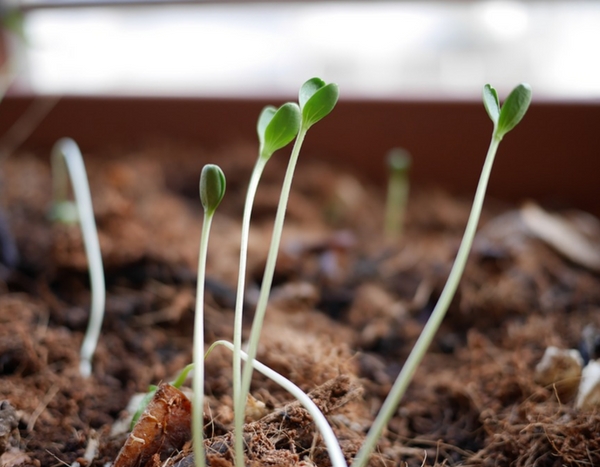
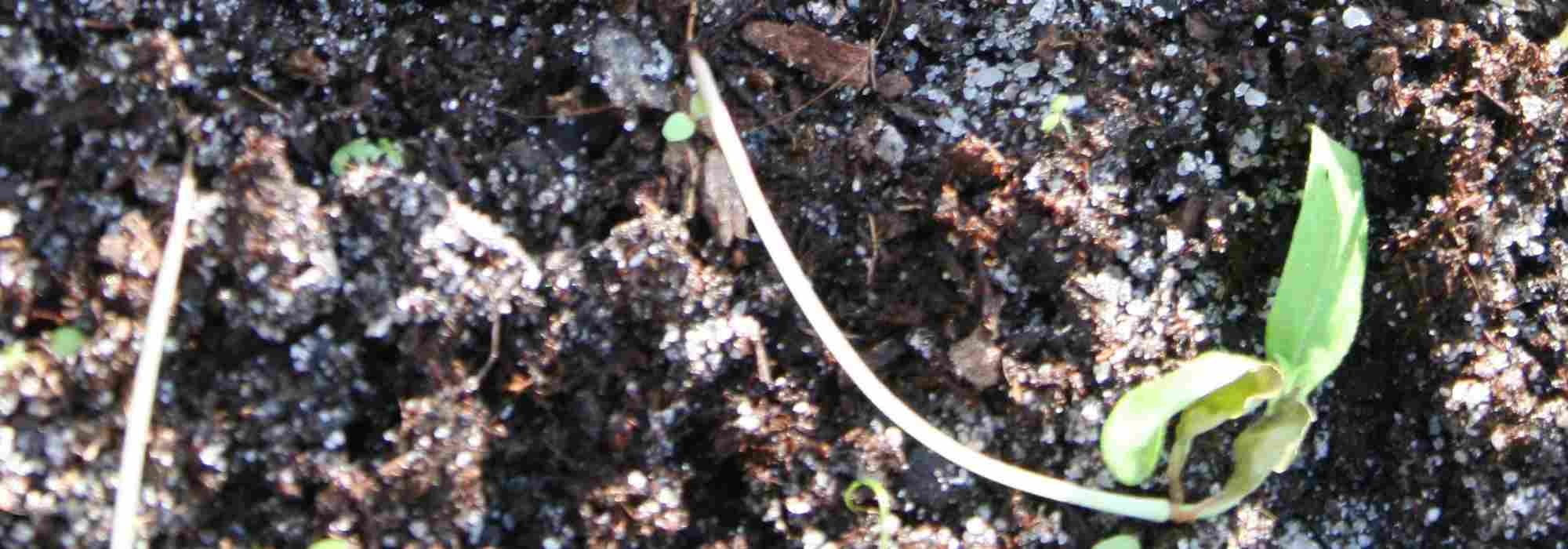
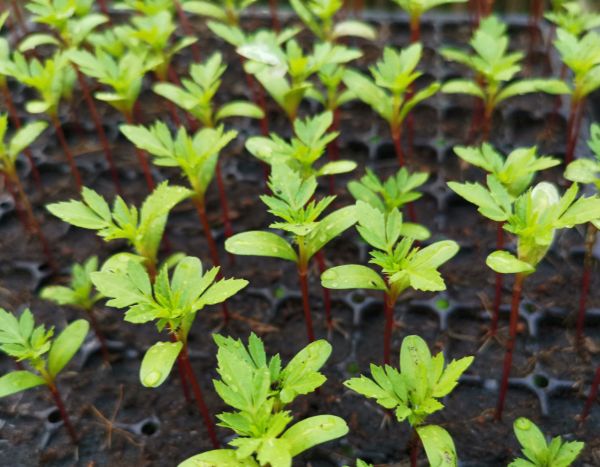
Germination may take two to four weeks. Once the first seedlings appear, it is important to gradually remove the plastic cover to acclimatise them to the surrounding air. The substrate should remain moist but not waterlogged. When the young plants have developed two to three true leaves, they can be transplanted into individual pots with a similar substrate. After a few months, they can be acclimatised outdoors, taking care to avoid direct sunlight and draughts. A balanced fertiliser during the growing season will encourage healthy development.
Sowing period
Intended location
Planting & care advice
-
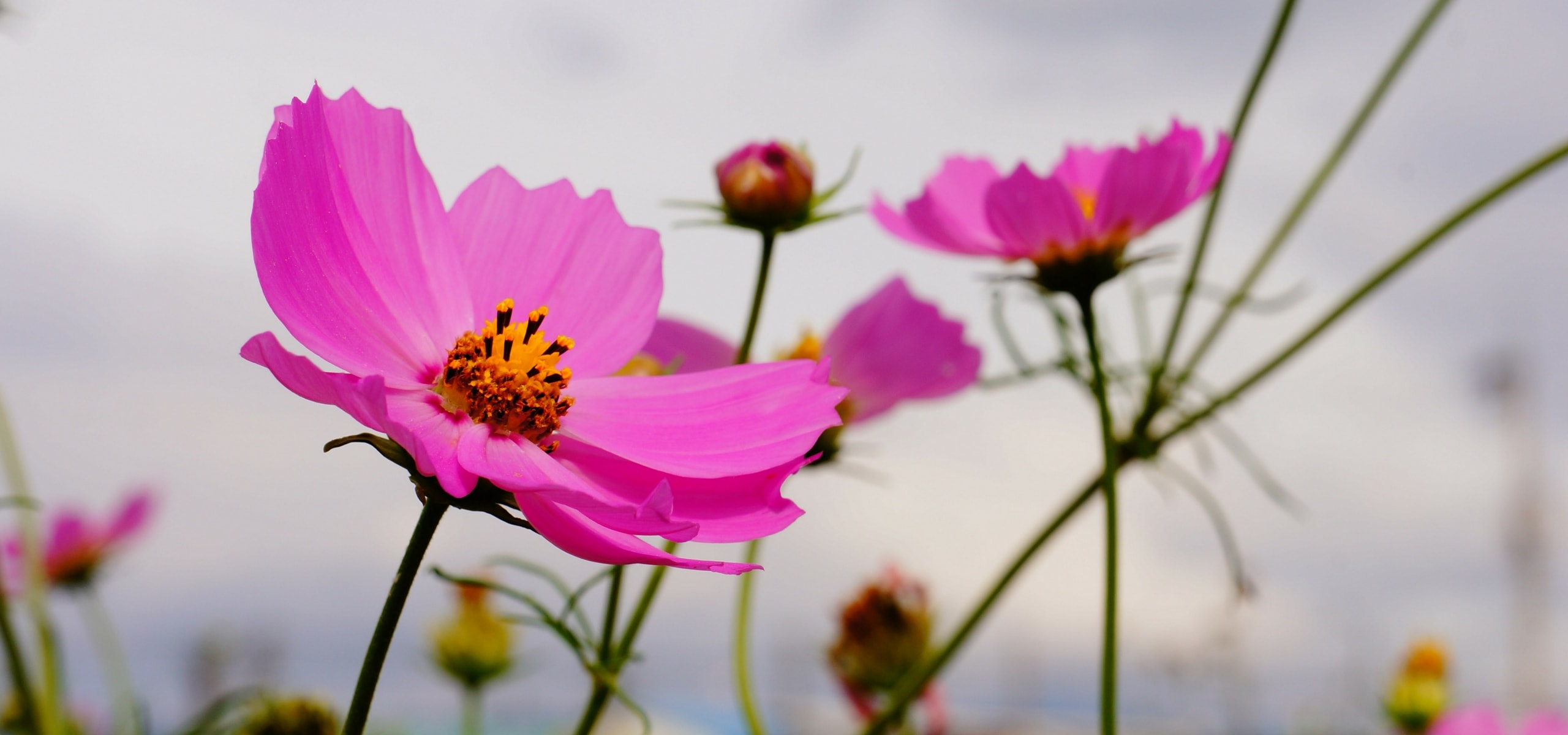
-
-
-
-

-
-
-
This item has not been reviewed yet - be the first to leave a review about it.
Recently viewed products
Haven't found what you were looking for?
Hardiness is the lowest winter temperature a plant can endure without suffering serious damage or even dying. However, hardiness is affected by location (a sheltered area, such as a patio), protection (winter cover) and soil type (hardiness is improved by well-drained soil).

The flowering period indicated on our website applies to countries and regions located in USDA zone 8 (France, the United Kingdom, Ireland, the Netherlands, etc.)
It will vary according to where you live:- In zones 9 to 10 (Italy, Spain, Greece, etc.), flowering will occur about 2 to 4 weeks earlier.
- In zones 6 to 7 (Germany, Poland, Slovenia, and lower mountainous regions), flowering will be delayed by 2 to 3 weeks.
- In zone 5 (Central Europe, Scandinavia), blooming will be delayed by 3 to 5 weeks.
In temperate climates, pruning of spring-flowering shrubs (forsythia, spireas, etc.) should be done just after flowering.
Pruning of summer-flowering shrubs (Indian Lilac, Perovskia, etc.) can be done in winter or spring.
In cold regions as well as with frost-sensitive plants, avoid pruning too early when severe frosts may still occur.
The planting period indicated on our website applies to countries and regions located in USDA zone 8 (France, United Kingdom, Ireland, Netherlands).
It will vary according to where you live:
- In Mediterranean zones (Marseille, Madrid, Milan, etc.), autumn and winter are the best planting periods.
- In continental zones (Strasbourg, Munich, Vienna, etc.), delay planting by 2 to 3 weeks in spring and bring it forward by 2 to 4 weeks in autumn.
- In mountainous regions (the Alps, Pyrenees, Carpathians, etc.), it is best to plant in late spring (May-June) or late summer (August-September).
The harvesting period indicated on our website applies to countries and regions in USDA zone 8 (France, England, Ireland, the Netherlands).
In colder areas (Scandinavia, Poland, Austria...) fruit and vegetable harvests are likely to be delayed by 3-4 weeks.
In warmer areas (Italy, Spain, Greece, etc.), harvesting will probably take place earlier, depending on weather conditions.
The sowing periods indicated on our website apply to countries and regions within USDA Zone 8 (France, UK, Ireland, Netherlands).
In colder areas (Scandinavia, Poland, Austria...), delay any outdoor sowing by 3-4 weeks, or sow under glass.
In warmer climes (Italy, Spain, Greece, etc.), bring outdoor sowing forward by a few weeks.
Shipping country and language
Your country of residence may be:
Your country of residence is:
For a better user experience on our website, you can select:
Your shipping country:
-
 Austria
-
 Belgium
-
 Bosnia & Herzegovina
-
 Bulgaria
-
 Croatia
-
 Cyprus
-
 Czechia
-
 Denmark
-
 Estonia
-
 Finland
-
 France
-
 Germany
-
 Greece
-
 Hungary
-
 Iceland
-
 Ireland
-
 Italy
Italy
-
 Latvia
-
 Liechtenstein
-
 Lithuania
-
 Luxembourg
-
 Malta
Malta
-
 Netherlands
-
 Poland
-
 Portugal
-
 Romania
-
 Serbia
-
 Slovakia
-
 Slovenia
-
 Spain
Spain
-
 Sweden
-
 Switzerland
Language:
-
French
-
 English
-
Spanish
-
Italian
-
German
-
Portuguese
-
Dutch
-
Finnish
My Account
Hello
My wish lists
My cart
Log in / Register
Existing customer?
This form is protected by reCAPTCHA - the Google Privacy Policy and Terms of Service apply.
New customer?
Create an account to track your orders, access our customer service and, if you wish, make the most of our upcoming offers.