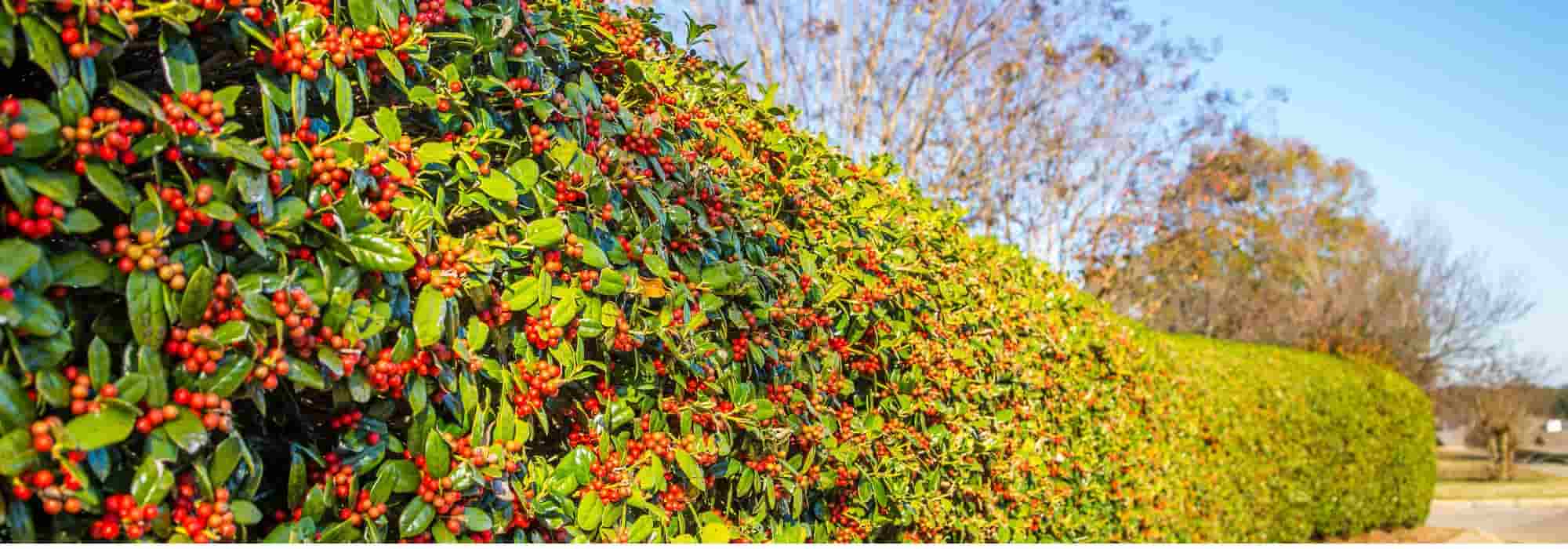
9 hedging shrubs with ornamental fruit
Selection of ornamental shrubs by their berries
Contents
Whether defensive, screening or a windbreak, a shrub hedge is above all ornamental since, beyond hiding or protecting you, it will be a structural element of your garden. Needless to say, choice of ornamental shrubs that will make up this informal or country-style hedge (we exclude formal, uniform hedges straight away — time-consuming to prune and unlikely to favour biodiversity!) deserves some thought. You can of course choose your shrubs according to their flowering (flower colour, flower longevity and flowering period, flower scent…) or foliage. Again, foliage, deciduous or evergreen, can assume a variety of colours and forms. Growth is also a determining factor when planting a hedge.
But a hedge shrub can also be attractive for its fruiting, most often in autumn or winter. These berries or small fruits, sometimes edible or simply favoured by birds, indeed offer undeniable appeal at times when flowers, and even foliage, have faded.
Discover our selection of 9 shrubs chosen for their decorative fruiting, perfect for incorporating into a hedge.

Serviceberry
Amelanchier is one of the most popular shrubs, as it combines many advantages. It is robust, very vigorous, undemanding in terms of soil or exposure, and above all very hardy, allowing planting throughout France. Aside from these cultivation advantages, Amelanchier is above all a shrub with an exceptional spring flowering, abundant and melliferous, pure white, sometimes slightly tinged with pink. Autumn foliage is equally spectacular with coppery, purplish or orange hues.
Ideal in free-form, country-style hedges, Amelanchier is also valued for its fruiting. In early summer, Amelanchier produces sweet berries that turn from red to dark purple, almost black. These berries, called juneberries, are delicious raw or cooked, in jams, compotes, desserts or juices, and are also very decorative against medium-green foliage. Birds do not miss them and may feast on them before you have time to harvest.
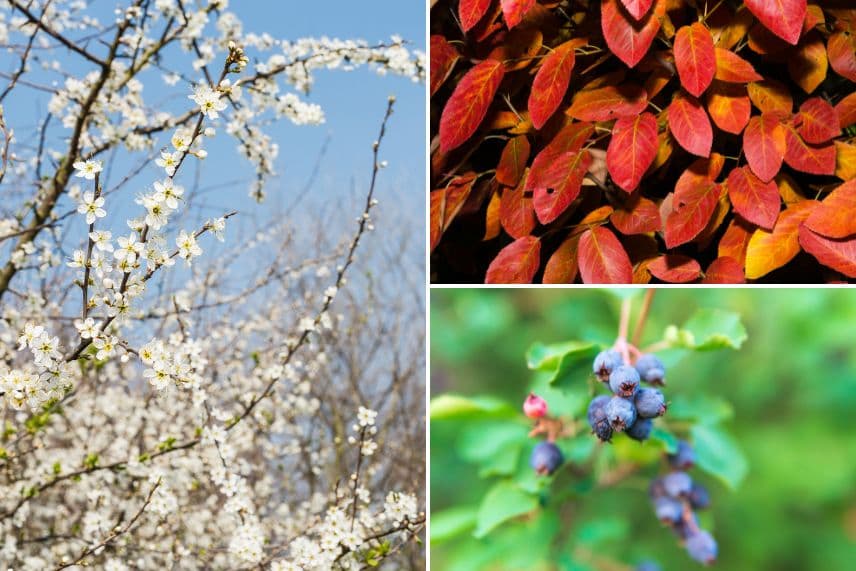
For hedge planting, we particularly recommend ‘Amelanchier spicata’, with an open, rounded, compact habit, reaching 3 m in height with a spread of 2 m.
How to grow it? Amelanchier thrives in any good garden soil, non-calcareous but capable of being acidic, provided it is perfectly drained and cool. It adapts to sunny or semi-shaded positions. It requires no particular care but does not tolerate severe pruning.
Read also
8 decorative fruiting viburnumsPheasant berry (Leycesteria formosa)
The leycesteria formosa, better known by vernacular name pheasant berry, is a shrub, native to the Himalayas, which rarely exceeds 2 m in height, with an upright and very ramified habit. Its semi-evergreen to deciduous foliage, depending on planting region, borne on hollow, glabrous shoots often pruinose with blue, is usually dark green with a bluish tinge beneath. Leaves are oval or oblong, acute or acuminate. From July to September, flowers, grouped in pendulous spikes, appear in leaf axils. These flowers, with a white to purple corolla, are surrounded by striking dark purple bracts.
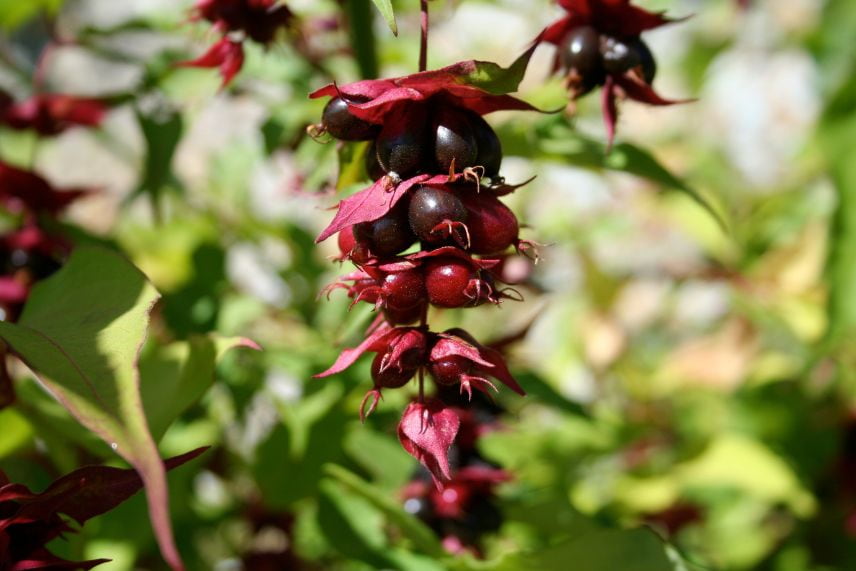
After flowering, shiny, globose berries appear, wine-red in colour. These berries persist for much of winter. With a caramel flavour, they are favoured by birds, especially pheasants — hence vernacular name. This shrub is hardy to – 20 °C.
How to grow it? Pheasant berry has few planting requirements: a well-drained, rather cool soil suits it perfectly. As for aspect, choose sunny but not scorching or partial shade. In cold climates, stems can freeze. In that case, a severe cutting back is necessary and, in spring, shrub reblooms strongly.
Snowberry (Symphoricarpos)
The snowberry (Symphocarpos) is a growing like a bush shrub, very dense and more or less stoloniferous, which gives it a suckering habit. With slender, arching branches it establishes fairly quickly, reaching about 2–3 m tall with a spread of 1.20–1.50 m. Its small pink-red or white flowers, grouped in terminal or axillary inflorescences, are insignificant but melliferous. They are also of interest because they give rise to spherical berries, most often white, pink or even red in some varieties. These small berries cluster on the stems and persist throughout winter. Thanks to the shape and colour of its berries, snowberry is often nicknamed the “tree of pearls”. This delicate fruiting brings a touch of softness to winter gardens.
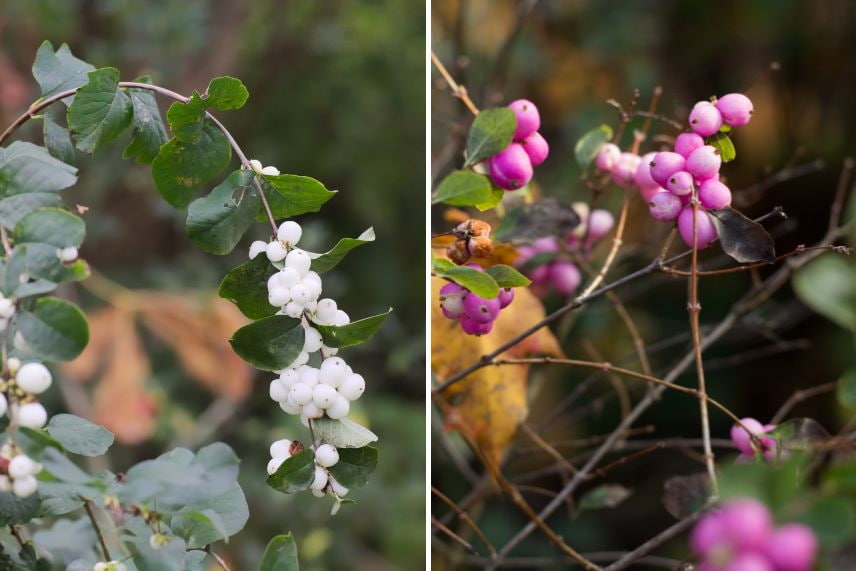
Berries of snowberry
To create an informal hedge, we particularly recommend the variety ‘Mother of Pearl’ with large berries in a delightful pearly pink, which arise from white flowering. Snowberry ‘Magical Candy’ produces berries of a deeper pink, almost fuchsia.
How to grow it? Snowberry is a robust shrub that adapts to all soil types. It appreciates both sun and partial shade. It only needs a top dressing of compost in autumn and a light pruning in March.
Read also
6 climbing plants with decorative fruitsChokeberry (Aronia)
Aronia is a deciduous shrub particularly hardy (down to -28 °C). Taller varieties (Aronia arbutifolia) are well suited to an informal hedge, reaching 1.5 to 3 m in height. Fast-growing, Aronia has a compact, bushy habit and finely dentate foliage that takes on beautiful, vivid colours in autumn. White or slightly pink flowers open in spring (May–June) and attract many insects due to their melliferous properties.
But it is above all the berries that give this robust shrub its appeal, as it requires very little care. Edible and similar in appearance to blueberries, the berries can be eaten cooked or dried. They are rich in nutrients and are even considered superfoods. Berries are harvested from September to December.
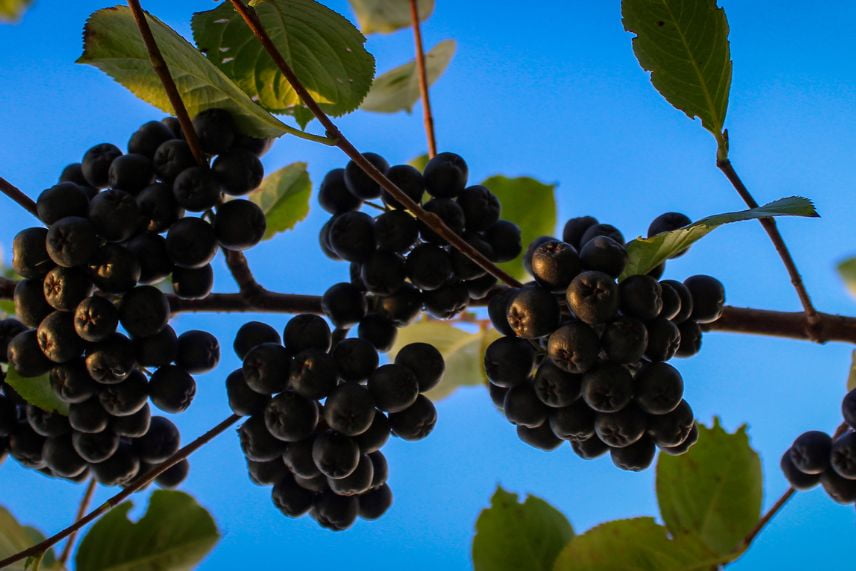
Aronia berries Aronia
To include in an informal hedge, we recommend Aronia artbutifolia ‘Brilliant’, which combines all the best qualities: 3 m in height, bright red autumn foliage, large white flowers and bright red berries.
How to grow it? Aronia prefers light, fresh, humus-bearing, well-drained soils and semi-shaded positions, tolerating sun if necessary but not scorching conditions. Pruning is necessary in late winter.
Buttonbush (Cephalanthus)
Cephalanthus occidentalis is a medium-sized shrub (2 m x 3 m), very ramified from the base, fast-growing, very suited to cultivation as a hedge. With deciduous foliage, very colourful in autumn, still too little known, this shrub is above all prized for its highly unusual flowering in large cream-white pompons. These flowers, very fragrant, nectariferous and melliferous, open in late summer. They are followed by an equally original and ornamental fruiting. At tips of the current year’s shoots appear hirsute-looking fruits of a fairly bright red that persist throughout winter. This shrub has hardiness well beyond -20 °C.
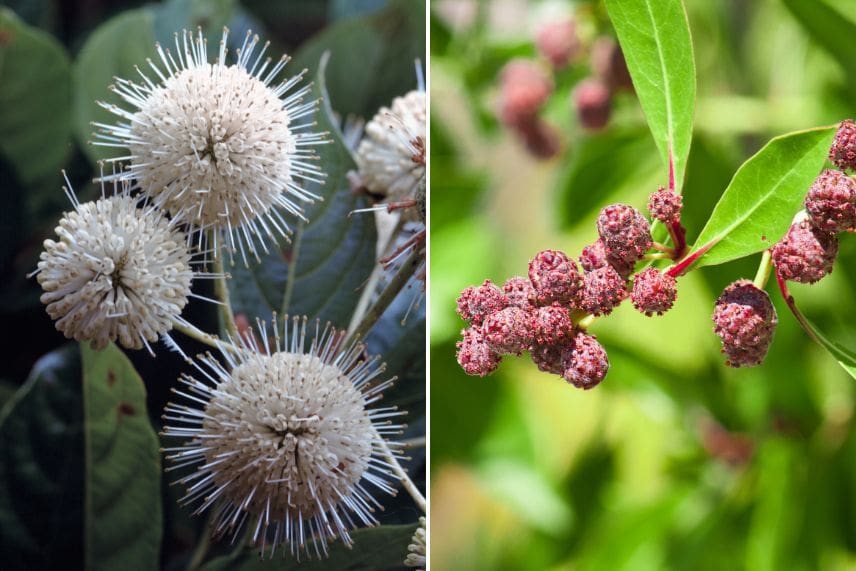
Flowers and berries of Cephalanthus occidentalis
How to grow it ? Cephalanthus should be planted in fresh to moist soil, ideally near a water source. It can adapt to all soil types, except calcareous soils. It establishes in partial shade or in non-scorching sun.
Goji berry (Lycium barbarum)
The goji berry bush (Lycium barbarum) is a shrub best known for its goji berries and their many nutritional benefits when dried. That said, it is a shrub with deciduous foliage and a bushy habit that can be used in a country hedge. In late summer and autumn, the arching, supple shoots of the goji berry bush bear small star-shaped flowers, from purplish-pink to mauve. Highly melliferous, they attract swarms of pollinating insects. These flowers then give rise to ovoid berries that change from green to orange. These berries are only edible when ripe, as they contain solanine. However, they are noted for their protein, calcium, vitamin, potassium and iron content. This shrub is also easy to train. It is hardy down to −23 °C. Some cultivars, such as ‘Amber Sweet’, produce yellow berries.
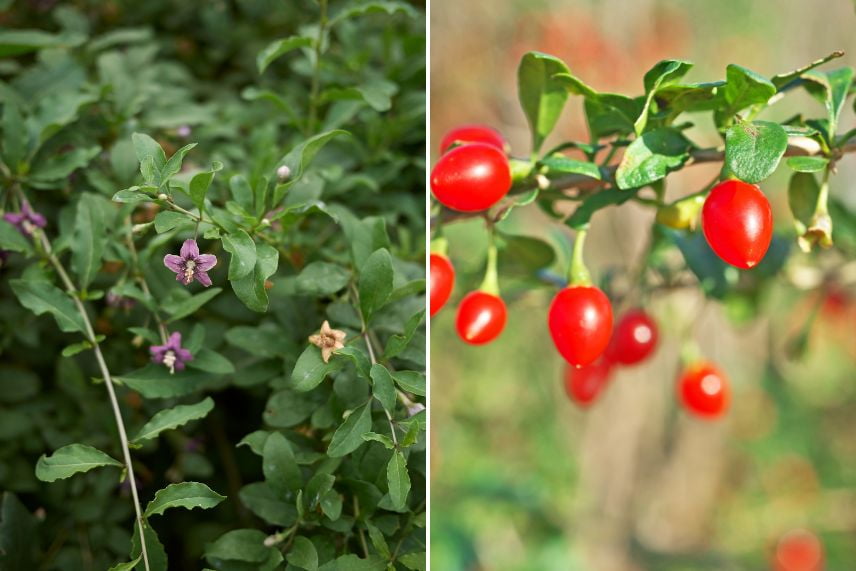
To grow as a hedge, we recommend the variety ‘Lifeberry’, which reaches 2 m in all directions. It is also a very productive variety.
How to grow? Goji berry bush prefers slightly cool, rather calcareous, well-drained soils. It needs a sunny position. It begins fruiting two years after planting.
Chinese privet (Ligustrum lucidum)
Chinese privet or glossy privet (Ligustrum lucidum) is a large shrub that can reach 7 m tall and 5 m wide. With its evergreen foliage and conical habit, it is perfect for planting in a hedge, mainly in regions with a mild climate as it is hardy to -12 °C, but only for short periods. This shrub is notable for its late-summer flowering: long panicles of small pale pink to creamy-white flowers open late, in September–October, amid a thick, leathery foliage, ovate and pointed. These flowers are very fragrant, melliferous and attract a multitude of pollinating insects.
These flowers mainly give way to small berries of a very dark blue, almost black, gathered in compact clusters. Naturally, to obtain this attractive fruiting, avoid pruning the shrub.
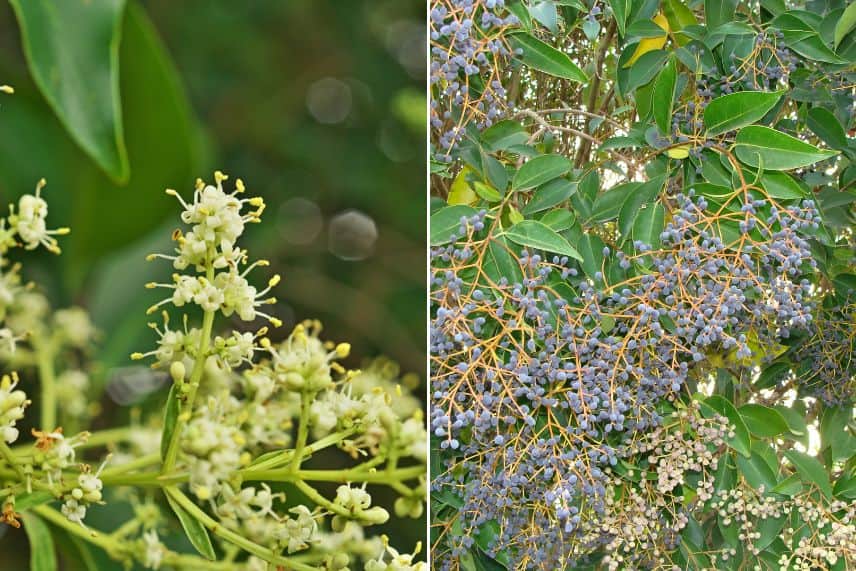
Flowers and berries of glossy privet glossy privet
How to grow it? This variety of privet is planted in full sun or partial shade in all soil types that are sufficiently deep and well-drained.
Clergyman's tree (Clerodendron trichotomum)
Native to China, Clerodendron trichotomum does not exceed 3 m in our latitudes. It is absolutely remarkable for its autumn flowering in corymbs of white flowers measuring up to 20 cm in diameter. The calyx of the flowers, greenish at flowering, becomes fleshy and pink at fruit maturity. This shrub indeed bears magnificent turquoise-blue fruits, enclosed within that pink calyx. As for foliage, opposite, ovate-elliptical and slightly downy, it is deciduous. Fast-growing, this shrub is hardy to -15 °C.
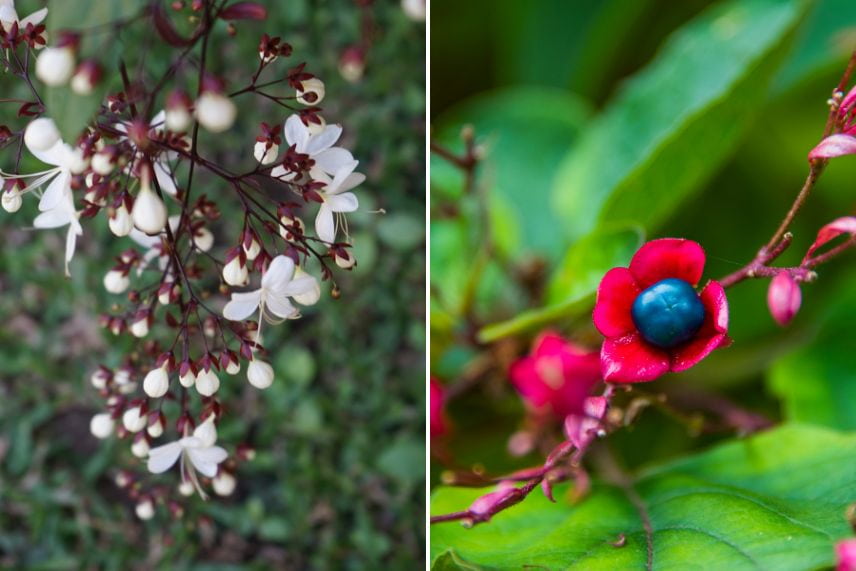
Flowers and berries of Clerodendron trichotomum
How to grow it? This very floriferous, fruit-bearing shrub thrives in deep, rich, moist yet well-drained soil, in full sun or partial shade, but in a position sheltered from cold winds.
Aucuba
Although some consider it ordinary because widely planted in parks and public gardens (where it is not always shown to best advantage), Aucuba remains a handsome evergreen shrub that combines many virtues. Indeed, throughout the year, Aucuba offers its thick, green foliage variegated with yellow, very glossy and highly ornamental, and pale green shoots that bring a note of freshness to any garden.
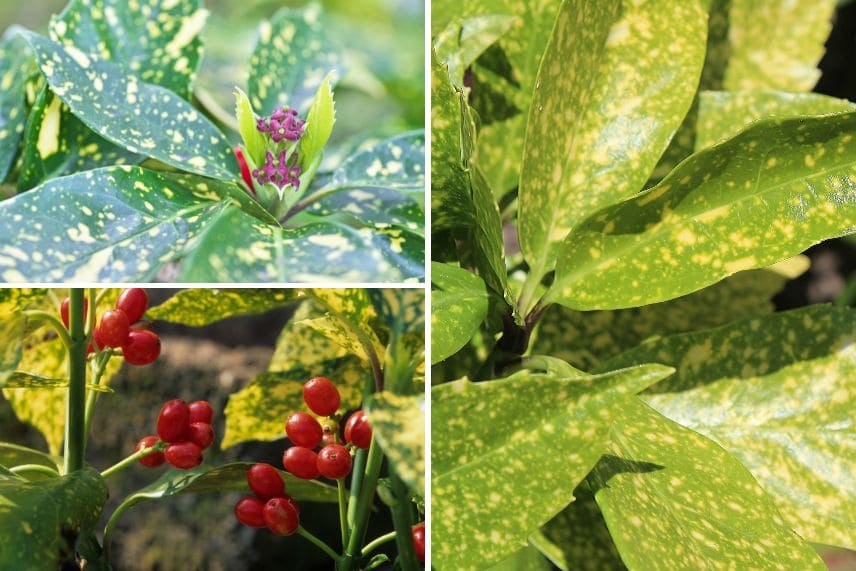
Foliage, flowers and berries of Aucuba
In May–June, small, inconspicuous flowers appear; in winter these produce pretty red berries that are highly decorative and add colour. Note, however, that Aucuba, being a dioecious shrub, only female plants bear fruit, provided a male plant is nearby. They are perfect for hedges, especially as they can reach 3–4 m in our latitudes. Aucuba is also a very hardy shrub, tolerant of urban pollution and salt spray, undemanding and largely disease-resistant.
How to grow it? Aucuba is planted in moist, well-drained, fertile soil, neutral to slightly acidic, in shaded to partially sunny positions.
- Subscribe!
- Contents
This form is protected by reCAPTCHA - the Google Privacy Policy and Terms of Service apply.

































Comments