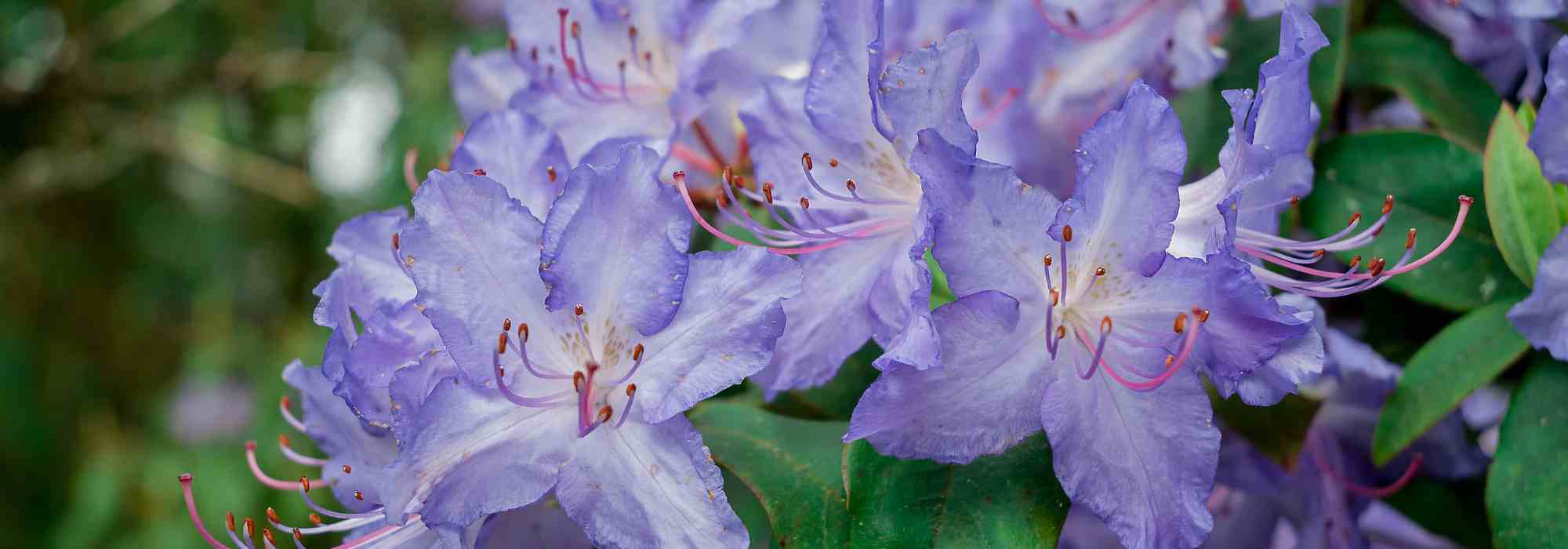
Discover rare and little-known rhododendrons!
A selection of exceptional and unusual rhododendrons
Contents
Rhododendron enthusiasts appreciate this spectacular shrub in spring for its dazzling flowering, from pure white to red and purple, but did you know that behind these wonderful ericaceous plants lie some little-known treasures? Such as rhododendrons that flower in mid-winter or in summer, astonishing blue colours, atypical foliage, tropical flowering displays, interesting bark or subtle fragrances.
Join me in the unexplored world of atypical rhododendrons!
NB: although genus Rhododendron includes both azaleas (deciduous and evergreen) and rhododendrons (generally evergreen), I will mainly discuss large-flowered rhododendrons in this article. Unless stated otherwise, all rhododendrons mentioned are evergreen.

Blue Rhododendrons
Sought by collectors, blue rhododendrons are the least numerous in the genus. Depending on exposure*, this colour, not truly a clear blue, can read as bluish-violet or sometimes even close to mauve. These are small, even dwarf, rhododendrons with small flowers.
In my view they are essential for their originality, to enrich a collection, a rockery or to harmonise with a blue garden; ideally buy them in flower to be sure of their colour. Here are the bluest among them, from three main species (although a few others exist, such as R. scintillans):
- Rhododendron impeditum: this is the best-known species, with the most intense blue, and is readily available. It was discovered by a Scottish plant collector, George Forrest, in the Chinese forests of Yunnan in the early 20th century. Very compact (60 cm), although in its native range it can sometimes reach 1.20 m. A small-leaved, small-flowered species. Its colour ranges between bluish-violet and mauve.
It has given rise to several hybrids, including:
– ‘Azurica‘ (Russatum x Impeditum), also compact (50–60 cm), with a more intense blue and bluish-green foliage; its leaves are covered with scales.
– Blue Tit’, Impeditum Lavender x Augustinii, which flowers better in sun, has rather pale foliage and, above all, grey-blue flowers.
– ‘Blue Silver‘: another fine compact and fairly early variety, of intense blue, with silvery foliage.
Also ‘Artic Blue’, ‘Blue Diamond’ and ‘Blue Wonder’… - Rhododendron russatum of Chinese origin, and its cultivars:
– Rhododendron russatum ‘Lauretta’: easiest to find at nurseries, a dwarf rhododendron with small leaves and violet flowers. - Rhododendron augustinii and its hybrids flower from lavender-blue to deep blue, fairly variable, such as Rhododendron x augustinii ‘Saint-Tudy’, with bronze foliage, larger, about 1 m at maturity.
* N.B.: partial shade enhances this bluish cast (I explain this in the perception of flower colour).
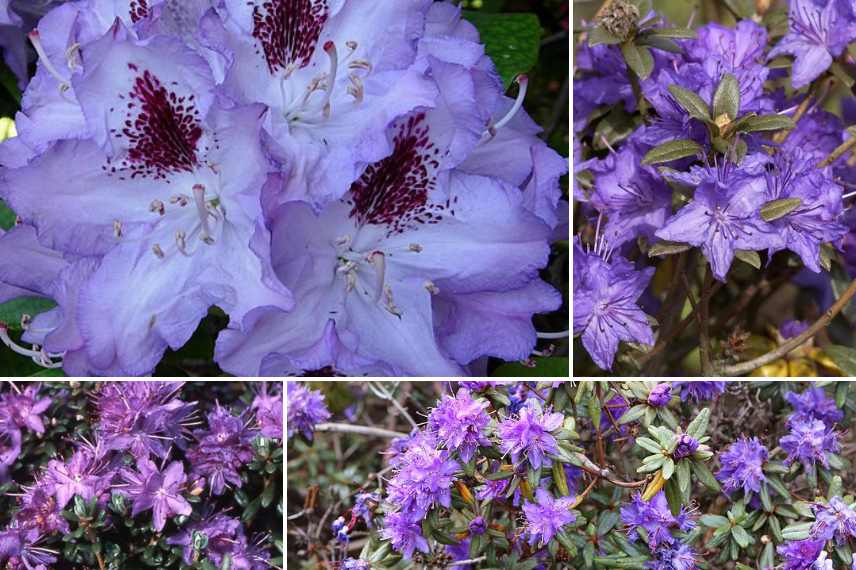
Top: Rhododendron ‘Blue Peter’ (© Wikimedia Commons, Todd Petit), Rhododendron russatum ‘Lauretta’, and bottom Rhododendron impeditum (© Stervinou) and the type species russatum (© Wikimedia Commons, CT Johansson)
Read also
Rhododendron: planting, growing and careEarly and Late Rhododendrons
Rhododendrons flower mainly in spring, but a few species or cultivars choose winter or early summer for flowering. A boon for gardens! Among them:
Winter-flowering rhododendrons
Most emblematic winter-flowering rhododendron and favourite with our friends across the Channel is the aptly named ‘Christmas Cheer‘, with pink flowers that become paler as they open. It flowers between December and January.
Type species Rhododendron lanigerum flowers in February, sometimes March, with beautiful cherry-pink blooms; it is a large species from south-east Tibet, in subsection Arborea. Rhododendron dauricum, whose cultivar ‘Mid-Winter’ also flowers very early around January or February. Also among botanical species are Rhododendron ririei (Ponticum group) and Rhododendron mucronulatum (whose ‘Cornell Pink’ flowers in very early spring).
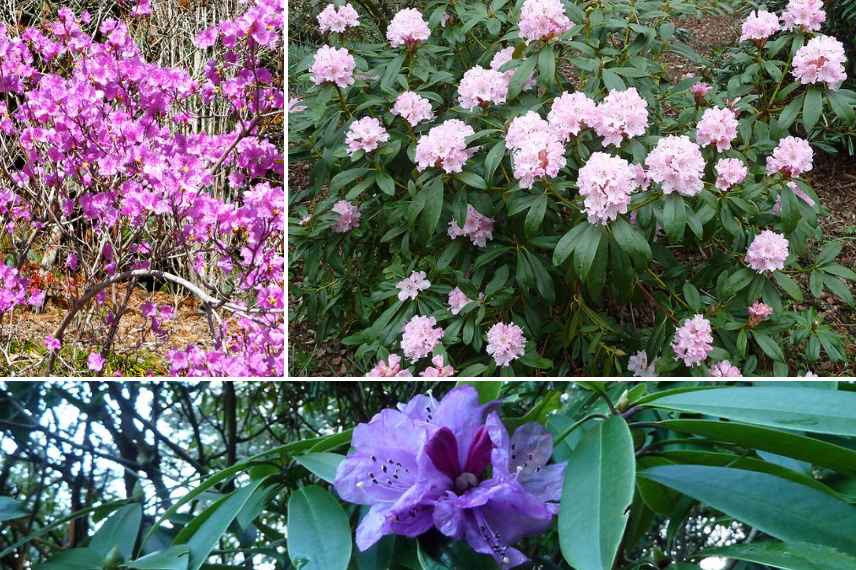
Top left, Rhododendron mucronulatum (© Flickr Art Poskanzer). Top right, Rhododendron ‘Christmas Cheer’ (© Wikimedia Commons, Peganum) and below Rhododendron ririei (© Wendy Cutler)
Summer-flowering rhododendrons
‘Polar Bear’ is perhaps best known for flowering out of season, in early July, producing an abundant white display.
Rhododendron auriculatum, native to Sichuan in China, is a large-growing species that also flowers in July with superb white blooms with a yellowish-green centre, making it one of the latest. As for Rhododendron ‘High Summer’, a hybrid from the 1960s, it opens its superb cream to pale-yellow florets in late June, as does Rhododendron brachycarpum, also white.
Also worth noting is another magical, scented rhododendron, Rhododendron fortunei ‘Discolor’.
While rhododendrons deliver a single spectacular flowering, a few species can boast repeat flowering, meaning they flower a second time (much more lightly and generally in late summer or autumn). Any repeat flowering will occur only in certain azalea hybrids (such as the ENCORE repeat-flowering Azaleas series), encouraged by a mild climate and summer pruning, but never after a frost, and more rarely in our temperate climates with rhododendrons of the Vireya subgroup (see below).
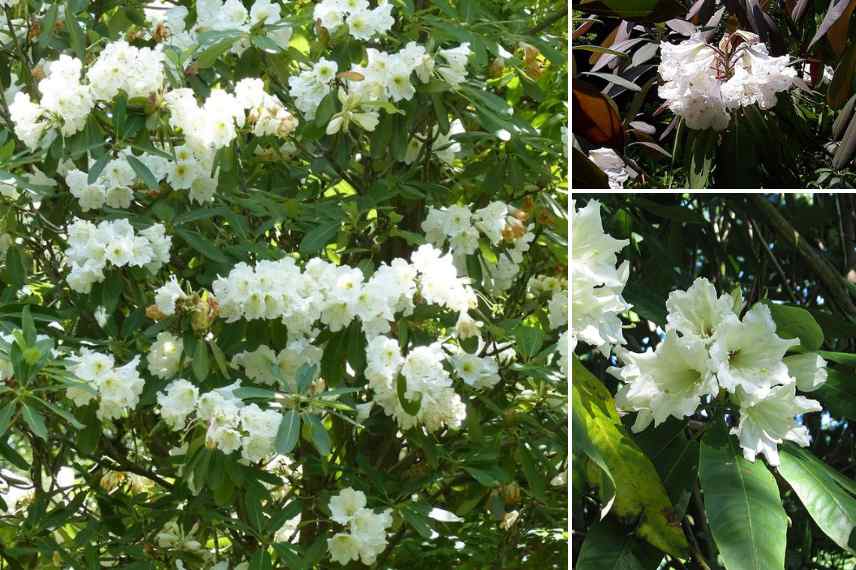
Left, Rhododendron ‘Polar Bear’. Top right, Rhododendron serotinum and below Rhododendron auriculatum (both photos © Wikimedia Commons – Peganum)
Rhododendrons with distinctive foliage
Sometimes foliage is what is striking or rare, prolonging interest in these evergreen shrubs when their flowering is, after all, ephemeral. Here are some rhododendrons to remember for their foliage, including both botanical species and hybrids:
- ‘Wine and Roses‘, utterly original with its bicoloured leaves, the underside raspberry to purple all year round. A compact cultivar, growing to 1.50 m tall, with bright pink flowers that gradually fade to pale pink, well suited to shade.
- More common but very ornamental, large Rhododendron ponticum ‘Variegatum’ bears cream-margined foliage.
- Rhododendron ‘Président Roosevelt’, with curiously yellow-variegated foliage, shows red flowers with white centres in May.
- With Rhododendron ‘Elisabeth Red Foliage’, it’s the young shoots we adore: they emerge purplish — an evolving variety that flowers in vivid orange-red.
- Rhododendron edgeworthii and its puckered, wrinkled foliage, somewhat similar to that of Viburnum rhytidophyllum, is distinctive (we also love its fragrance — see below).
- Largest foliage, if that’s what you’re after, is found in Rhododendron macrophyllum (aptly named), and also in Rhododendron sinogrande, a Chinese species whose very strongly veined, silver-backed giant leaves can reach up to 70 cm long (its flowering bears large campanulate white and cream flowers with red blotches — a beauty!).
- Another small oddity, Rhododendron orbiculare, is as interesting for its rounded leaves as for its divine display of small pendulous pink bells.
- Finally, Rhododendron lutescens, another shrub from Yunnan, smaller (about 1 m), has young coppery-bronze foliage that turns purplish in winter. Its pale yellow flowers contrast beautifully with the reddened foliage.
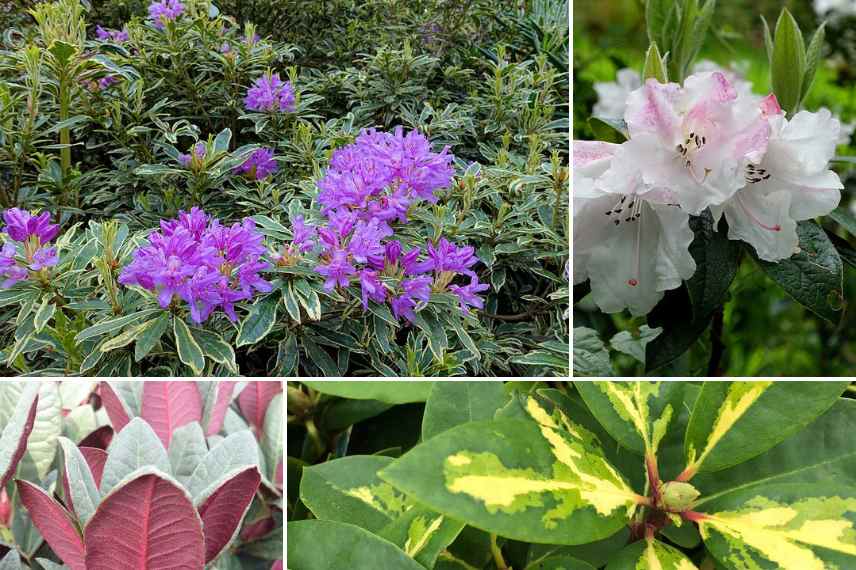
Rhododendron panicum ‘Variegatum’, Rhododendron edgeworthii, Rhododendron ‘Wine and Roses’ and Rhododendron ponticum ‘Président Roosevelt’
Read also
Which rhododendron to choose?Rhododendrons that tolerate lime
Yes indeed! Who would have thought? Although emblematic of plants known as heather soil plants, i.e. those that grow in acidic soil, a range of rhododendrons proves a little more tolerant of soil conditions. Quite simply because, as with fruit trees for example, German nurserymen have grafted them onto a hybrid Rhododendron (resulting from a cross between Rhododendron ‘Cunningham’s White’ and a Rhododendron fortunei). The result? They are somewhat better able to tolerate calcareous soils: tolerance remains relative, up to pH 7.5, but this allows them to be planted where others would suffer. This hybridisation also gives them good resistance to disease. Thus the INKARHO® series was born, with varieties such as “Happydendron” and ‘Bloombux‘ or ‘Dufthecke Weiße Dufthecke’, among others.
→ We explain everything you need to know in our article: Finally rhododendrons that tolerate calcareous and clay soils.
Gwenaëlle’s view: remember, however, that rhododendrons should always be planted in areas with high rainfall for healthy development, as they suffer greatly from repeated hot summers that are becoming more frequent, and that even with these new, more tolerant rhododendrons, planting will still need to be done carefully, in rich soil that remains cool and loose.
Rhododendrons with bark
I was impressed to discover in England unique rhododendron species, not for their flowering or growth, although they prove magnificent, but for their bark. They are often old shrubs that develop trunks and impressively coloured branches, usually exfoliating, sometimes smooth. The Rhododendron barbatum thus displays a grey-pink to red bark, striking on old specimens.
The bark of the Rhododendron luteiflorum, brown, peels like that of an Acer griseum, while that of the Rhododendron halopeanum, with its lovely pale pink flowers, becomes increasingly contorted with age. One could also mention Rhododendron shilsonii, superb with a rosy-beige bark.
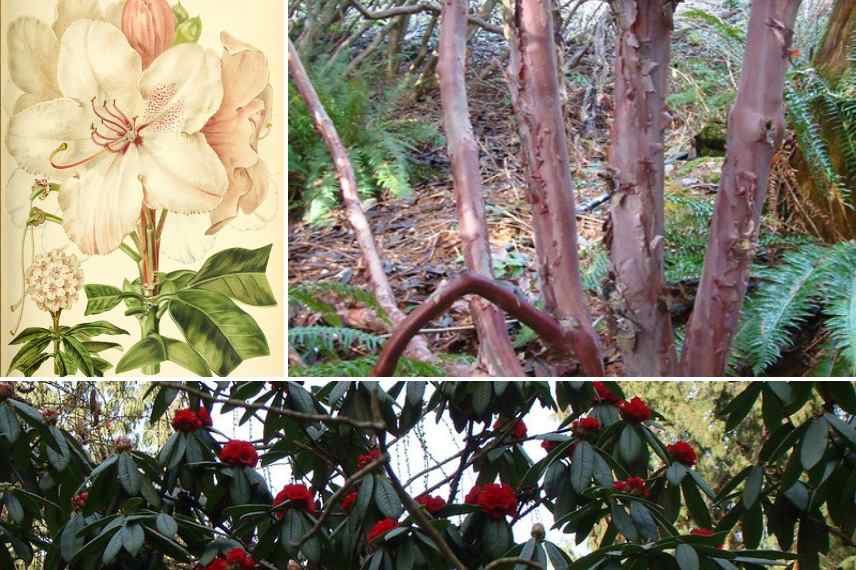
Rhododendron luteiflorum (botanical plate; at right and below Rhododendron barbatum) (©Wendy Cutler-Flickr)
'Tropical' Rhododendrons
Unlike their temperate-zone cousins, tropical rhododendrons of subgenus Vireya bear shimmering, very vivid flowers (red, orange, yellow, pink) and evergreen leaves, sometimes leathery. They can flower several times a year, offering a continuous display in tropical gardens. They are compact or of medium size.
They remain botanically very distinct and, for botanical species, originate in Southeast Asia (Malaysia, Philippines). Some species (around 300 of them!) are even epiphytic in their natural habitat, growing on tree branches or in rock crevices, where they take advantage of ambient moisture and accumulated organic debris. Typical species include: Rhododendron jasminiflorum, Rhododendron zoelleri, Rhododendron macgregoriae and Rhododendron konori, and numerous hybrids.
Tropical rhododendrons are therefore much more tender than Chinese rhododendrons acclimatised here, only withstanding light, short-lived frosts (may regrow from the stump). To be clear, they are non-hardy. Reserve them for frost-free coastal regions and Mediterranean microclimates where they will be protected in winter, the period when most flower.
Gwenaëlle’s advice: as a precaution, better to grow the most compact Vireya hybrids in pots, to overwinter in a greenhouse or heated winter garden.
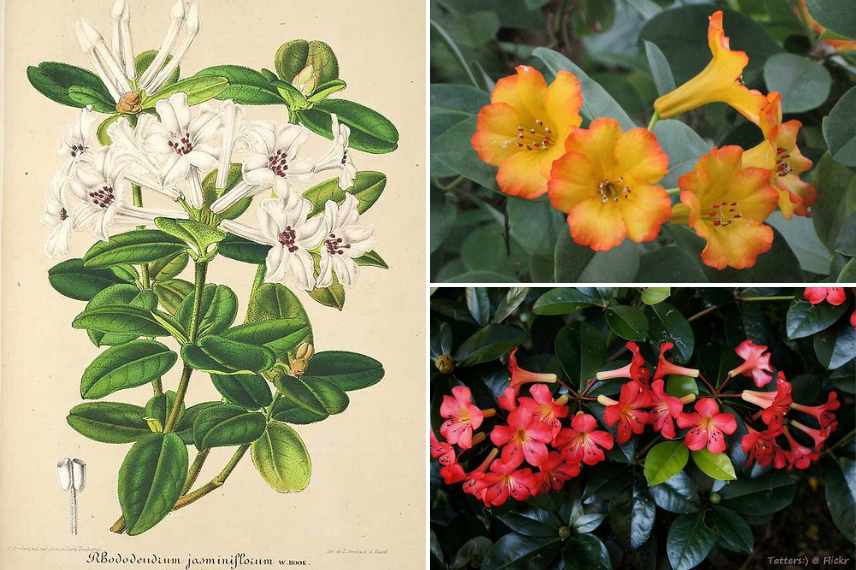
Rhododendron jasminiflorum (botanical plate), Rhododedron zoelleri (© Flickr, KHQ) and Rhododendron retusum – © Flickr, Tatters)
Fragrant rhododendrons
Let’s finish with a few scent notes… When discussing scent, let’s not get carried away. This notion should be taken with a pinch of salt, as we do not all have the same sense of smell nor the same sensitivity. But some rhododendrons again stand out for their delicate or powerful scents. In fact, flower buds of certain botanical rhododendrons are used in incense-making, notably in Nepal and Tibet.
For example, dwarf rhododendron bearing an unmistakable name, ‘Fragrantissimum‘: it is a hybrid involving Rhododendron edgeworthii, from which it inherited its fragrant qualities. Among botanical rhododendrons, Rhododendron decorum and its close relative Rhododendron fortunei are also worth mentioning, as is Rhododendron auriculatum, with creamy-white flowers and yellow centres, noted above for its late flowering.
Among hybrids, the Loderi group includes several cultivars of interest that are appreciated in their own right for their fragrance: ‘King George‘, ‘Pink Diamond’, ‘Venus’, etc.
NB: Rhododendron luteum, also called yellow azalea or Pontic azalea, the only Eurasian species, deciduous and showing lovely autumn colour variations, is also among the most fragrant, with powerful honeysuckle notes.
- Subscribe!
- Contents
This form is protected by reCAPTCHA - the Google Privacy Policy and Terms of Service apply.































Comments