How to choose a Davidia or handkerchief tree?
Buying guide and criteria for finding perfect variety
Contents
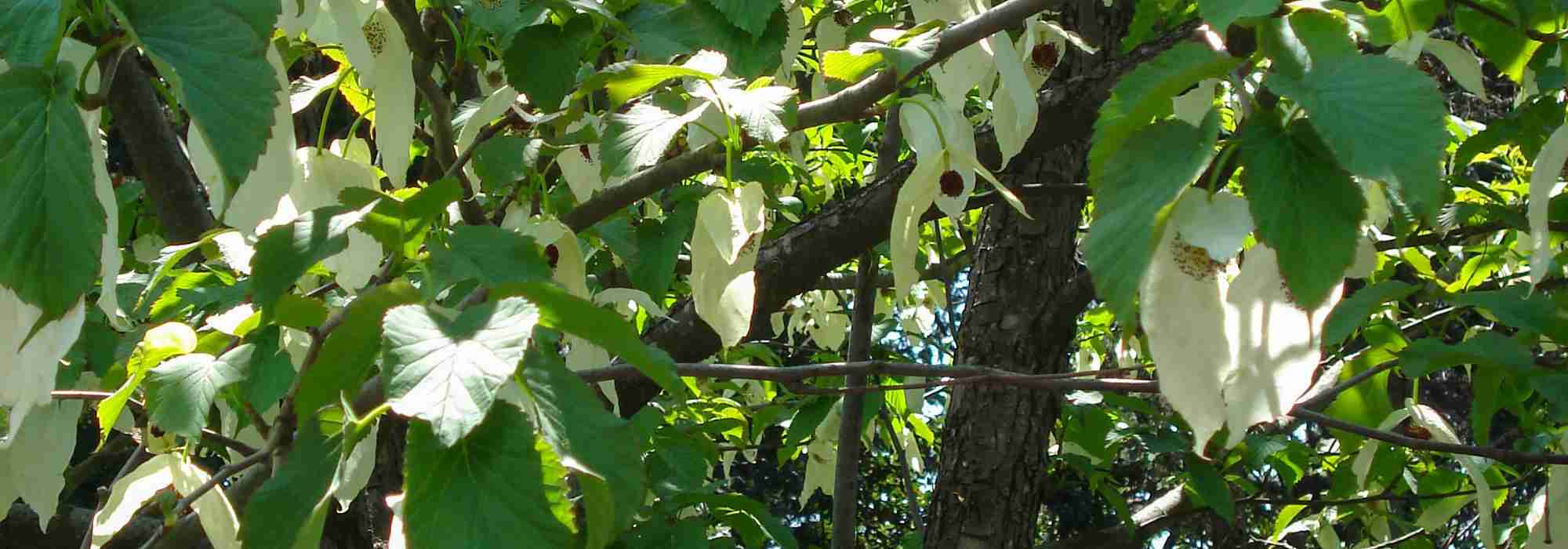
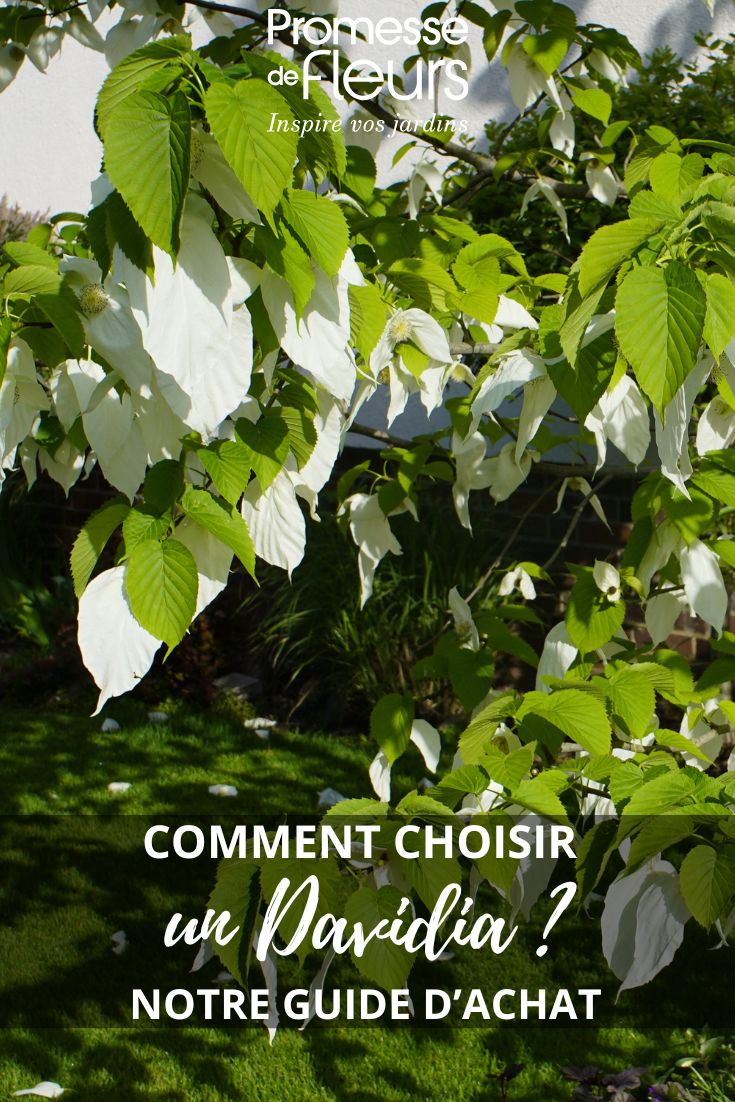
Davidia involucrata or dove tree is one of those trees capable of drawing all attention in the garden and adding a real touch of originality when it flowers. In late spring, it produces long, immaculate pendulous bracts, which earn it the nickname dove tree or handkerchief tree, so much do they evoke light fabrics.
But this tree is also prized for its light green foliage reminiscent of linden, and for its hardiness.
There are several varieties of Davidia. To help you choose according to various criteria, follow our buying guide!
A unique display of flowers!
Choosing a handkerchief tree based on foliage
Green foliage
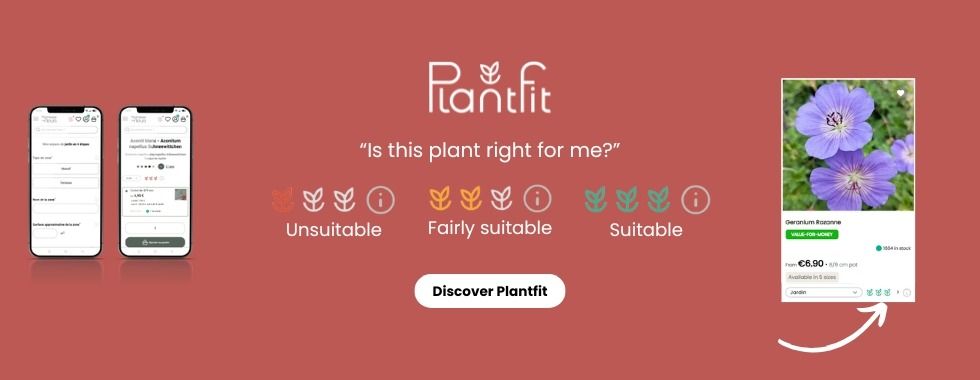
The foliage of Davidia displays a pretty soft green colour. Leaves are veined and dentate, slightly heart-shaped, reminiscent of lime. Each leaf measures 8–16 cm long. In autumn, leaves take on pretty glossy bronze tones. This is the case with type species Davidia involucrata, which has a greyish, felted and downy leaf underside.
Same applies to cultivar ‘Sonoma’. Variety ‘Vilmoriniana’ produces foliage that is distinguished mainly by a glabrous leaf underside.
Davidia involucrata var. Vilmoriniana
Variegated foliage
But some varieties also offer a touch of originality with variegated foliage, which brings extra brightness. This is the case with Davidia involucrata ‘Lady Sunshine’, which produces a striking variegated foliage with green at the centre of the lamina and broadly edged with cream. The variegation fades by late summer and foliage returns to full green. Then, with arrival of autumn, leaves take on lovely golden hues. This changeable variety is particularly decorative and enlivens garden for many months.
For its part, ‘Lady Dahlia’ offers a rare foliage — green marked with a yellow to chartreuse-green blotch, depending on sun exposure. This irregular colouring is random from leaf to leaf. It fades progressively during summer, returning to a uniform green. This Davidia is particularly luminous, perfect for brightening semi-shaded areas.
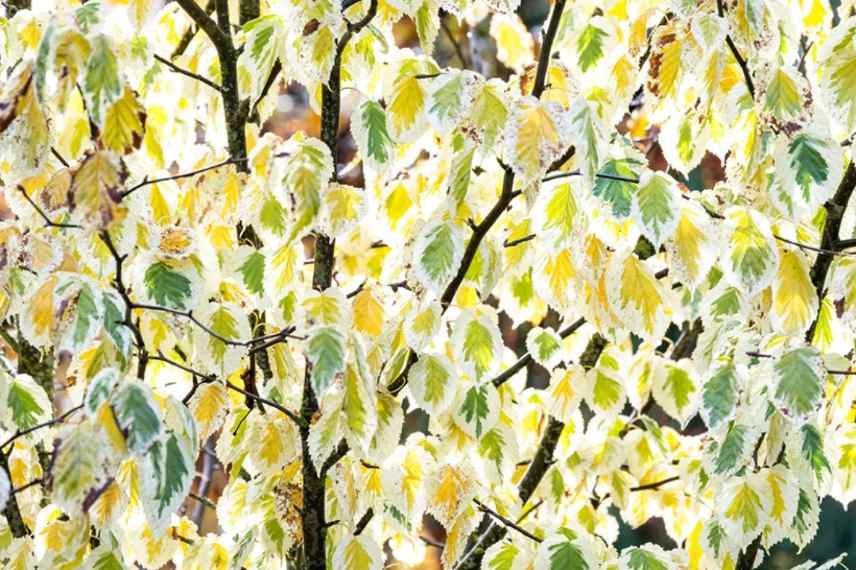
Davidia involucrata ‘Lady Sunshine’
Choosing a handkerchief tree based on flowering speed
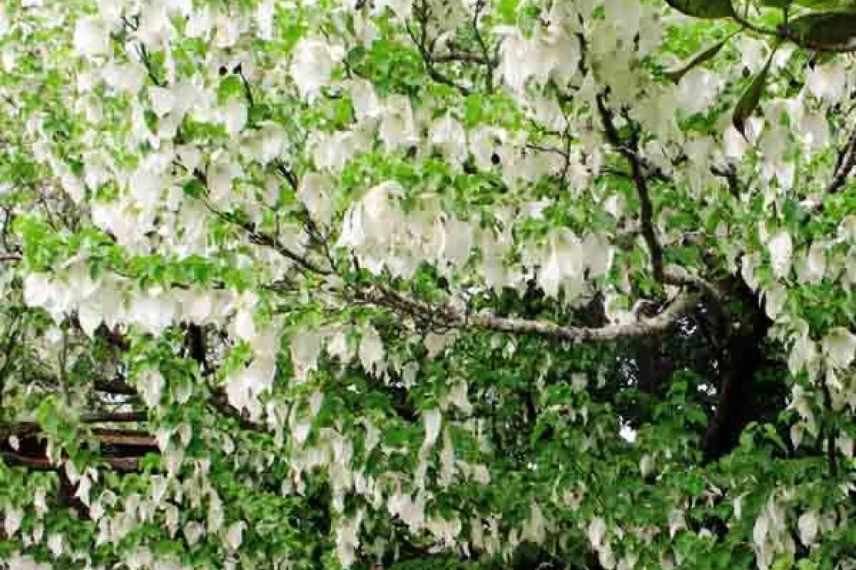
Davidia’s number-one asset is its spectacular flowering, which sometimes resembles pieces of fabric, sometimes birds, ghosts or butterflies. This plant is also nicknamed “dove tree” or “ghost tree”. These inflorescences are actually composed of bracts, that is modified leaves that surround the inflorescences (as in Arum or bougainvilleas, for example). They protect small globose flowers 1 to 2 cm in diameter, with reddish-purple anthers and numerous white stamens. This flowering occurs in late spring, between May and June, and lasts about three weeks.
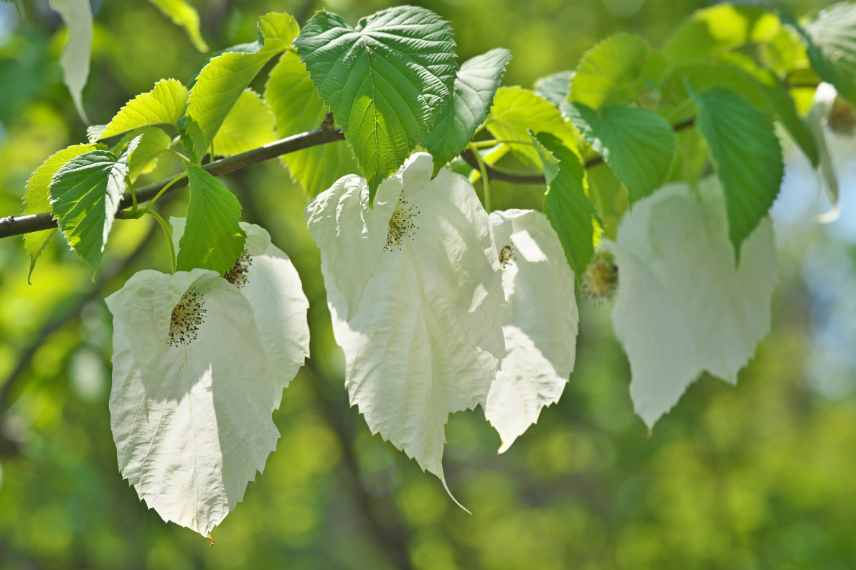
Unique flowers of Davidia involucrate remain its greatest asset
Generally, patience is required when choosing to grow dove tree, since flowering usually occurs at best only after around ten years on average, sometimes 15 to 20 years. But there are two exceptions that ensure earlier flowering.
This is the case with cultivar ‘Sonoma’, whose flowering can sometimes occur as early as the 1st year after planting, if the plant is already at least around 40 cm tall. Of course, it will not yet be very abundant, but will already add a touch of originality. Optimal flowering will occur a little later, after about 5 to 6 years. As the flowers develop on a smaller tree, they appear larger than those of the species type, but are actually the same size.
‘Lady Sunshine’ also produces early flowering from a very young age.
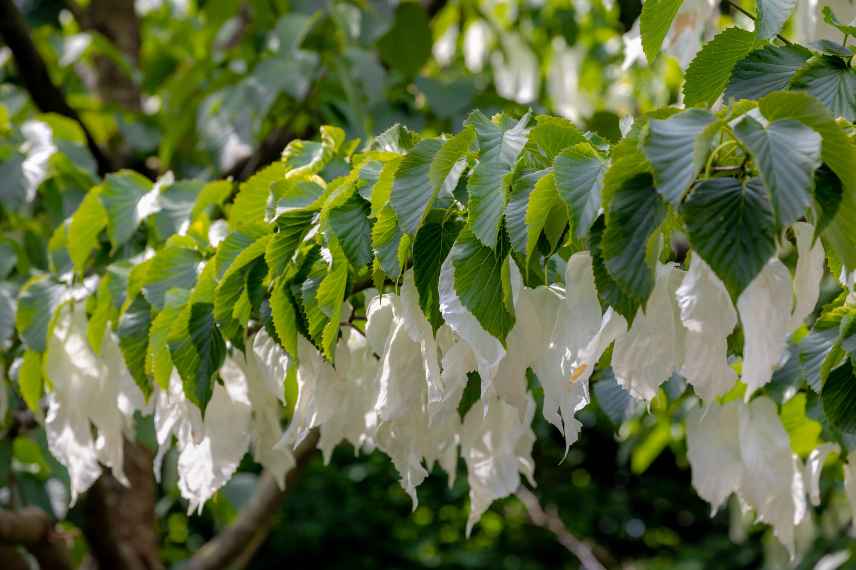
Choosing a handkerchief tree by size and intended use
Most Davidia are trees, which will reach at least 12 metres in height over time (and up to 20 metres in their native range) with a 10-metre spread. They are often grown as specimen trees, to showcase their silhouette and flowering. But they can also be planted at the edge of larger trees, especially in warm climates, where they will prefer a little more shade.
The two early-flowering cultivars (‘Sonoma’ and ‘Lady Sunshine’) grow more slowly, making them suitable for smaller gardens. They can therefore also be used in borders, for example alongside white-flowering Cornus, which flower at the same time and in the same colour range, creating a pleasing harmony. A pairing with the generous blooms of hydrangeas also works very well. If you have acidic soil, any shrubs that thrive in those conditions will make excellent companions, such as Rhododendrons, Pieris or camellias. By staggering flowering times, you ensure a border that remains lively for many months. Finally, shrubs such as viburnums, spiraeas or euonymus, which are very undemanding, will also accompany our handkerchief tree beautifully.
The ‘Lady Dahlia’ cultivar is more compact: at maturity it will reach 8 to 9 metres in height with a spread of about 5 metres. It has a slow growth rate of around 40 to 50 cm per year, so will typically reach only 3.5 m to 4.5 m within 10 years. This cultivar is therefore suitable for smaller spaces.
To dress the base of Davidia in winter and spring, consider hellebores, and early spring bulbs: daffodils, grape hyacinths, snowdrops, Iris reticulata, tulips, etc.
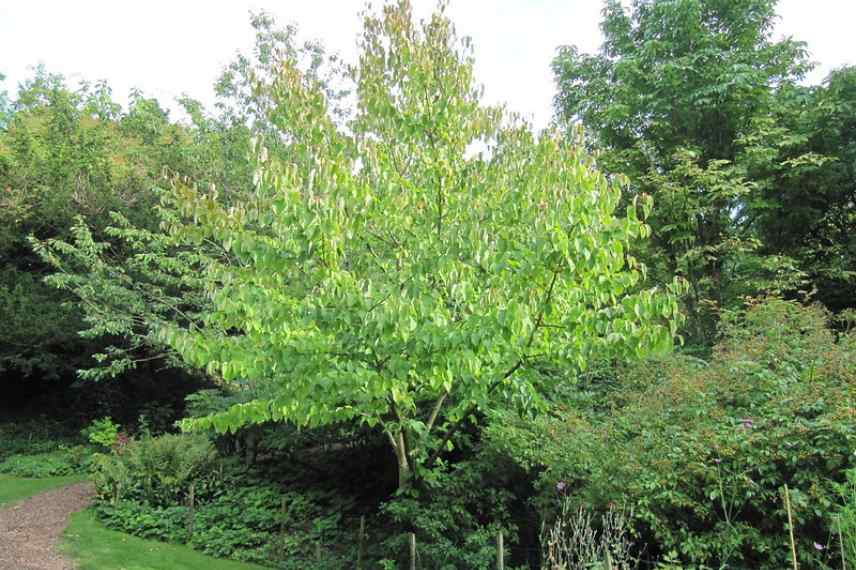
Small tree or large shrub, the handkerchief tree has a place in gardens of all sizes (© Leonora Enking)
Davidia also create beautiful autumn scenes thanks to their foliage turning colour. They will brighten the garden with blazing hues alongside dogwoods, nandinas, Japanese maples, Cotinus (smokebush) or even a Ginkgo biloba.
- Subscribe!
- Contents
This form is protected by reCAPTCHA - the Google Privacy Policy and Terms of Service apply.




























Comments