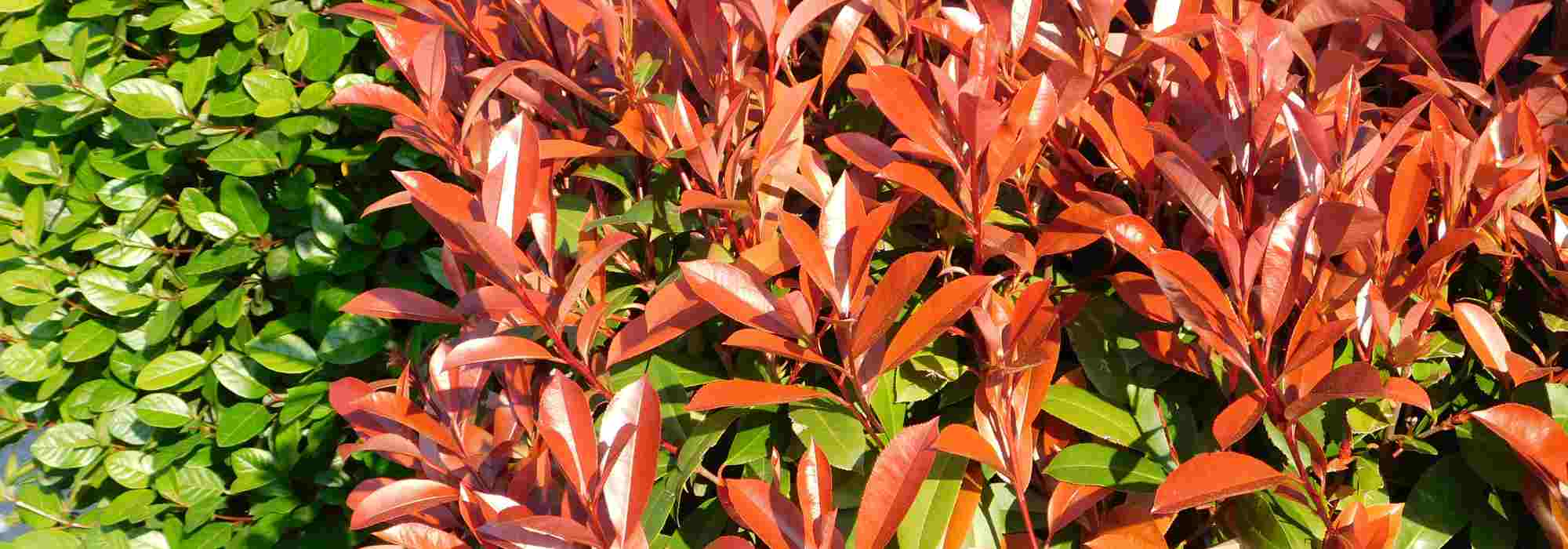
How to enhance Photinia's red colour?
Our tips for making colourful foliage even more striking
Contents
Photinias are very popular shrubs. It is true they have plenty going for them: attractive evergreen foliage all year round, charming flowering, easy cultivation, low maintenance and many uses. The most appreciated varieties are notable for their colourful foliage, producing especially vivid red young shoots. To make the most of this ornamental quality, a few measures are worth taking. Discover our tips here to enhance the red colour of your Photinia leaves.
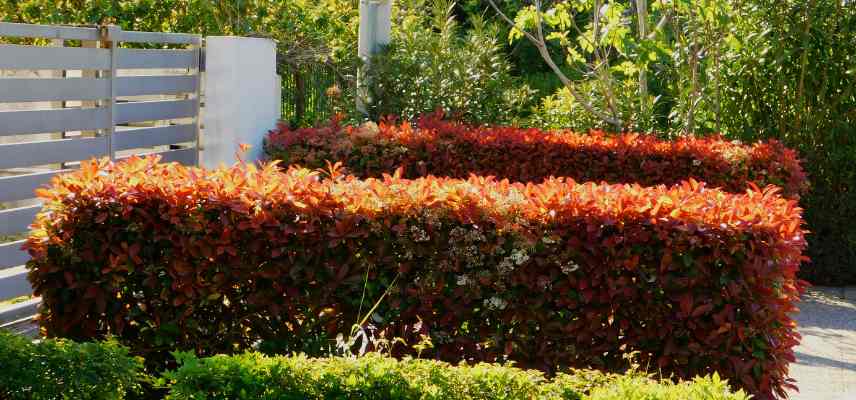
We love the red colouring of Photinias!

Which Photinia varieties have red foliage?
Photinia varieties with red foliage are certainly the most common.
The Photinia fraseri ‘Red Robin’ is the sure-fire choice among red Photinias. Growing to about 3 metres tall with a 2-metre spread, it rewards us with young coppery-red leaves, creating a striking contrast with the mature dark green leaves.
‘Carré Rouge’ has roughly the same dimensions but stands out for naturally denser, more colourful foliage. It bears simply striking cherry-red young shoots.
In ‘Devil’s Dream’, the spring red foliage is a little narrower than on ‘Red Robin’.
For a more upright, compact form (only about 2 metres spread on average), opt for ‘Camilvy’, whose young shoots are also nicely red.
Meanwhile, Photinia fraseri ‘Dicker Toni’ suits confined spaces well, with a dense silhouette, well branched from the base, reaching 2 metres in height with a 1.5-metre spread. Its bright red young shoots renew through to summer.
Among dwarf varieties, the adorable ‘Chico’ will easily find a place in a pot or at the front of a border, at about 1 metre high by 80 cm wide. Its young shoots show coppery-red shades.
Don’t forget ‘Little Red Robin’, which forms a truly luminous ball about 1 metre across, showing a bright red in spring.
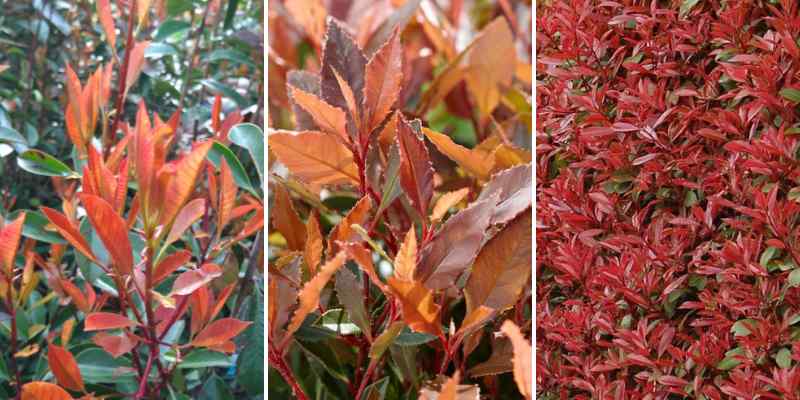
Young shoots on ‘Red Robin’ at left. In centre, Photinia ‘Chico’, and at right Photinia ‘Carré Rouge’
Read also
Photinia: planting, pruning and careProper pruning of foliage to intensify red in Photinia
With Photinias, red leaves correspond to new shoots, that is young leaves that appear in spring and through summer. Over time, foliage naturally takes on green shades and loses its reddish cast.
To deepen a Photinia’s red colour, pruning plays a fundamental role. Photinia is one of the shrubs that tolerate pruning very well.
This pruning has several functions. First, it helps rebalance shrub habit by encouraging branching and therefore foliage density. It is also a good way to keep plant to moderate dimensions where space is limited.
Next, pruning will aerate the crown by removing damaged or badly placed branches, which will benefit overall growth of Photinia and limit disease risk (even though this shrub is fairly resistant).
Finally, and this is particularly relevant here, pruning promotes regrowth of new red leaves.
Although we usually recommend annual pruning in spring, it is preferable to prune Photinia in summer. This will stimulate production of young shoots from autumn and again the following spring. Importantly, this summer pruning will not compromise spring flowering, which would be a pity to miss. You can, however, perform several prunings during the year, for example in June or July once flowering has finished, then in autumn. To further enhance foliage colouration, make regular light prunings as soon as shoots green up again. In any case, favour several light prunings rather than a single drastic cut.
For dwarf Photinias or those grown in pots, an annual prune at the end of flowering is sufficient.
For this, equip yourself with a well-sharpened pruning shear or loppers, disinfected beforehand with 70% alcohol to limit risk of disease spread. Also wear gloves as a precaution.
Start with dead, diseased or damaged branches, and also those that cross or are poorly positioned. Then, cut branchlets back by about one third of their length. Shape shrub silhouette according to taste and needs. Prefer bevelled cuts, which will promote healing. Cut just above a bud (eye).
To learn more about pruning Photinias, feel free to consult our article: When and how to prune Photinia?
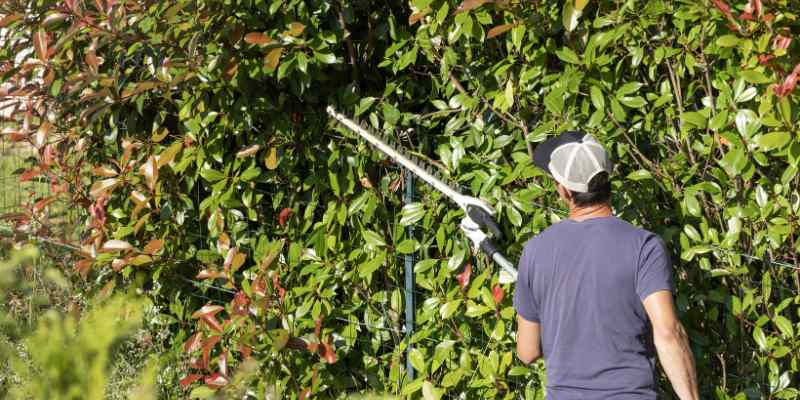
For large hedges use a hedge trimmer
Optimise growing conditions to promote red colouring of leaves
Photinia is renowned for being easy to grow across all our regions, and this is one reason for its great popularity. It is fairly tolerant and does not require much care. However, some growing conditions are more conducive than others to producing young shoots of a deep, intense red.
Photinia fits perfectly as a privacy hedge, an informal hedge, as a specimen or at the back of a border. To boost the red colour of the leaf, choose a sunny but not scorching position. In warm regions of southern France, Photinia is best given some shade around midday, when the sun is strongest. A less bright aspect may make red tones less intense. Also avoid sites exposed to strong, drying winds. In areas with severe, late frosts, favour a sheltered spot, to avoid risking damage to young red shoots in spring.
Plant Photinia in light, well drained soil (where water does not pool), preferably rich in organic matter. Do not hesitate to add draining materials (gravel, river sand, clay pebbles…) at planting time if your soil is heavy, and work it well. If soil is poor, add well-rotted compost, well-matured manure or another organic fertiliser to supply nitrogen, which is necessary for healthy leaf growth. Avoid very clayey or very calcareous soils. Prefer planting in autumn (especially in regions with hot summers) or in spring. In climates with mild, fairly humid and cool seasons, Photinia can produce young red shoots almost year-round.
During the first two years, water regularly, as soon as surface soil is dry. After that, red Photinia will be more tolerant of occasional drought. Consider applying an organic mulch, which will help retain moisture and reduce evaporation.
When grown in containers (pot or tub), top up with compost or fertiliser each year at the end of winter, since nutrients are depleted more quickly. This can affect growth, and therefore production of new red shoots. Water as soon as the substrate is dry in the top few centimetres.
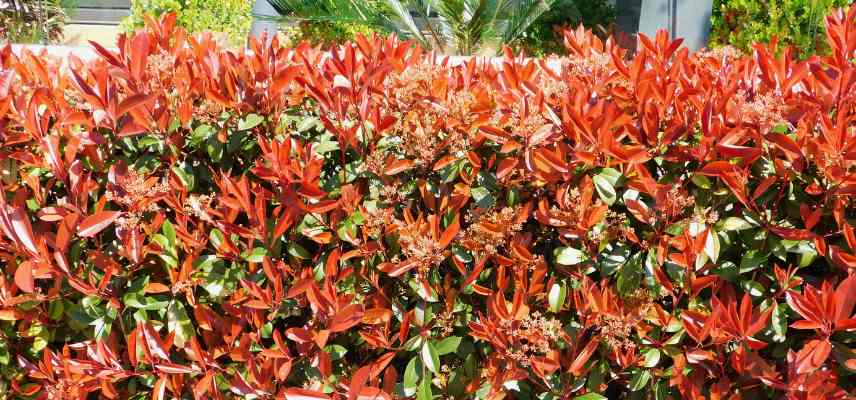
Photinia planted in full sun will develop much redder foliage
- Subscribe!
- Contents
This form is protected by reCAPTCHA - the Google Privacy Policy and Terms of Service apply.

































Comments