Ornamental alliums: most beautiful large varieties
These Alliums are fascinating for their size and aesthetic appeal.
Contents
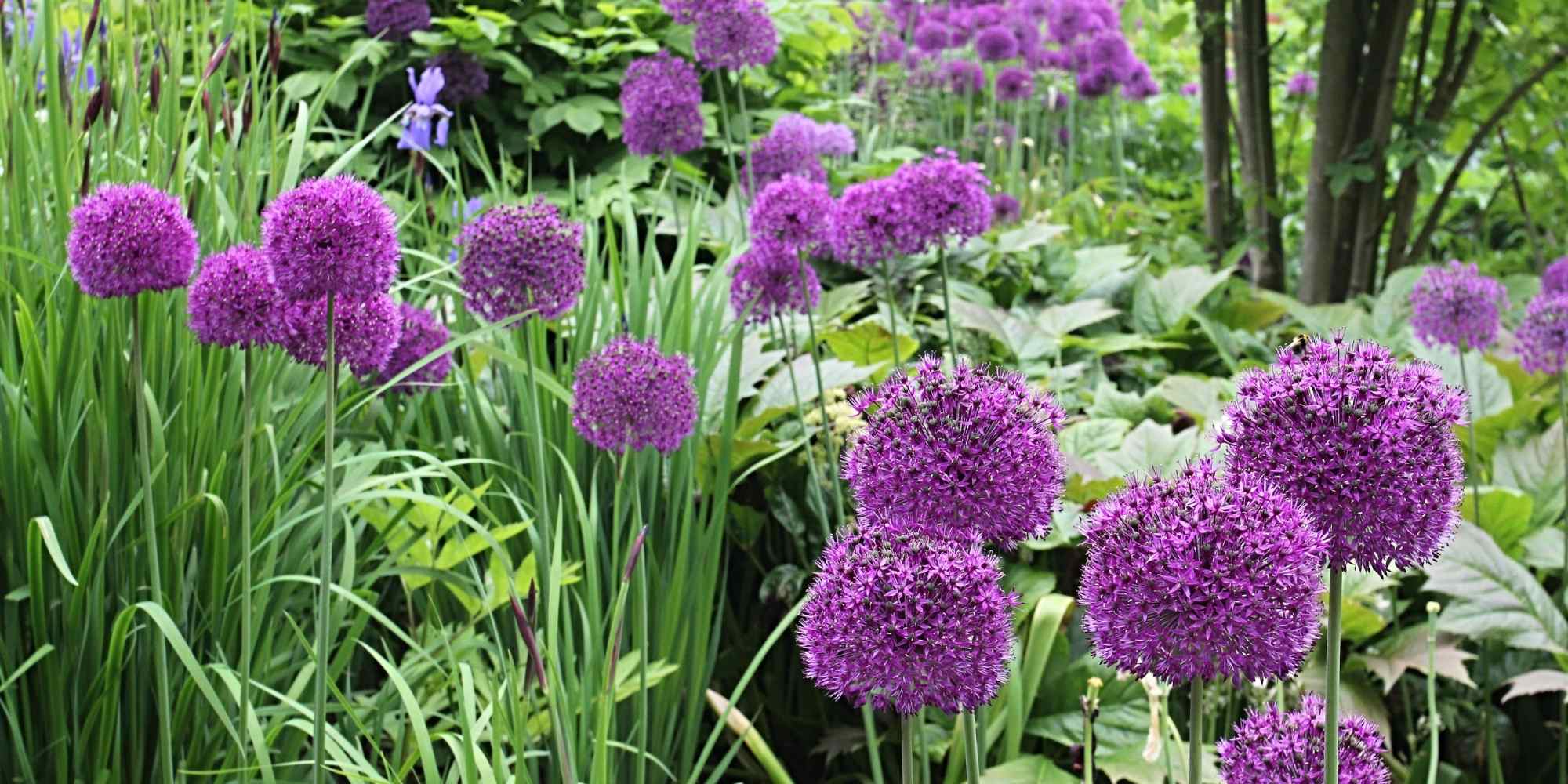
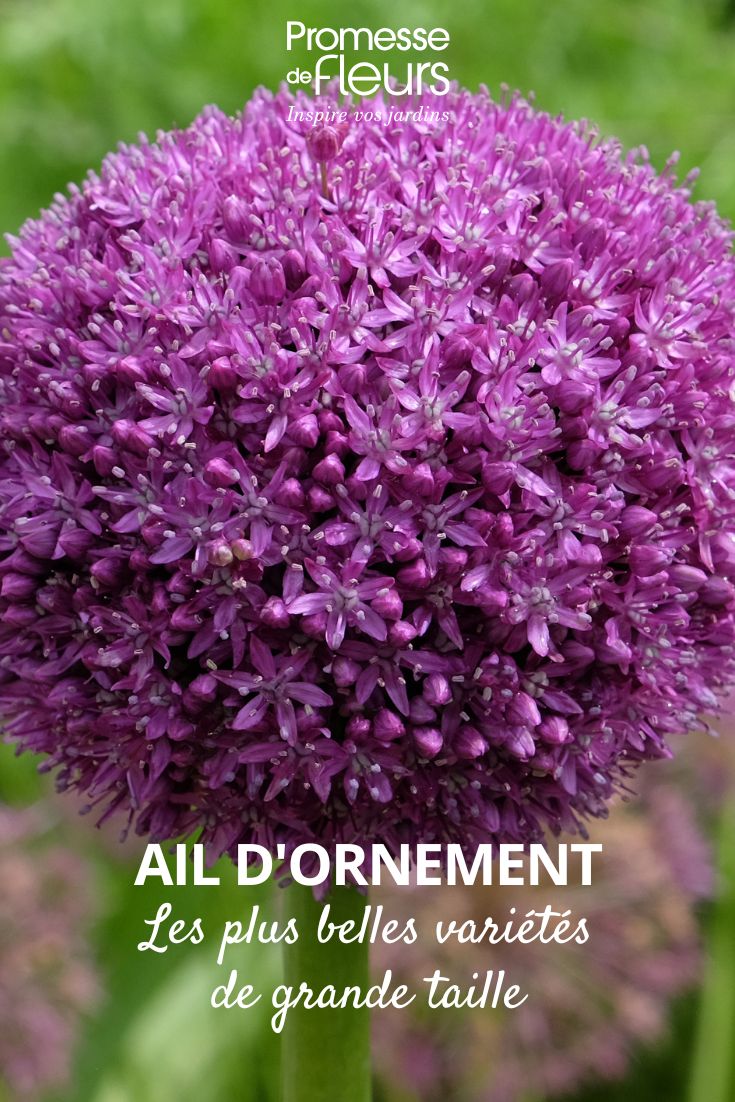
In recent years, ornamental alliums (Allium) have become favourites of landscapers and amateur gardeners, thanks to their simple aesthetic and unmistakable graphic appeal. Ornamental alliums belong to that rare category of plants capable of structuring space in no time. While smaller varieties enliven rockeries and low borders with panache, large ornamental allium varieties quickly make a bold statement. Perched atop slender yet sturdy stems, their spherical umbels appear to float above surrounding vegetation.
Discover the most beautiful large Allium varieties to transform your garden in a single season.
Why plant large Alliums?
Obviously, aesthetically speaking, these Alliums add real value to gardens. But their appeal goes much further.
A unique structure
In a garden, it is easy to find plants that spread across the ground. It is harder to find plants that grow vertically without taking up width. Allium is that plant par excellence: it occupies aerial space without smothering its neighbours. Their flowering in large spherical inflorescences is very distinctive. These round heads seem to float above the rest of the vegetation. Especially as their foliage turns yellow then disappears before or at the same time as the flowers.
A delight for pollinators
Looking closely at an Allium head, you quickly see it teeming with life. Bees, bumblebees and butterflies love these hundreds of small nectar-rich flowers grouped into a single inflorescence. These small flowers also give off a slight sweet scent that delights all nearby insects. These Alliums are therefore ideal plants for inviting wildlife into your garden and maintaining beneficial biodiversity.
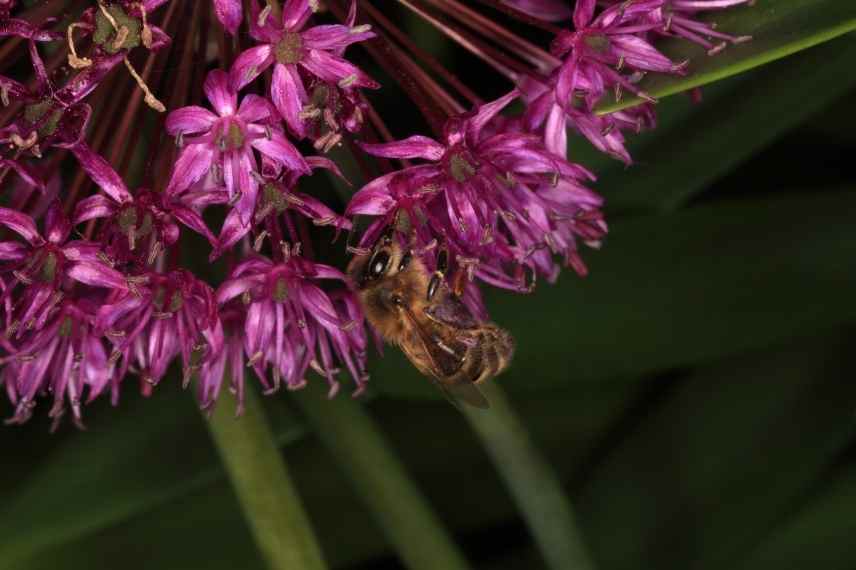
Allium flowers are very melliferous
Even when faded, they remain beautiful
One of the greatest assets of large Alliums is their dry silhouette. Once the colour has faded and the pollinated flower has withered, the umbel’s structure remains rigid for at least three months. You can leave them in place all summer for a graphic effect or cut them to create spectacular dried bouquets indoors.
Giant Allium varieties
This category includes ornamental alliums that often reach 1.50 m in height, roughly the height of a young child. They are truly imposing and make their presence felt by their stature.
- Allium giganteum : It is the most famous and often the first that comes to mind. Allium giganteum lives up to its name. Easily reaching 1.50 m, it produces dense spheres 10 to 12 cm in diameter, made up of hundreds of small star-shaped flowers ranging from purplish-lilac to mauve-violet. Its flowering from June to July marks the perfect transition between late tulips and early roses
- Allium ‘Gladiator’ : the name alone is imposing! The Gladiator is a close relative of Allium giganteum, but with a more robust character. Its stems are often thicker, allowing it to better withstand wind despite its impressive height of around 1.40 m. Its flowers, a soft blue-lavender to lilac-violet, are slightly larger than those of Allium giganteum. It is a long-lived variety that returns reliably each year.
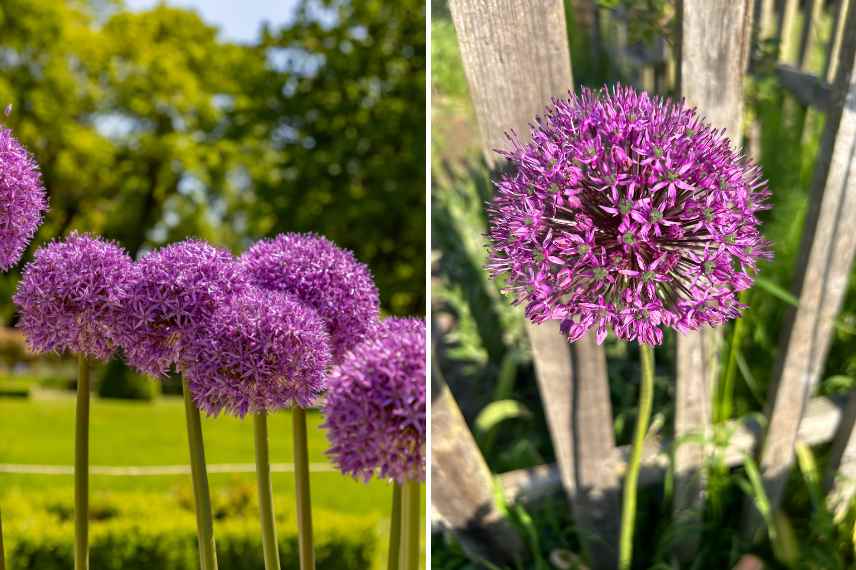
Giganteum and ‘Gladiator’ varieties
Large Allium varieties: pure elegance
These varieties range between 1 metre and 1.20 metres in height. They are easy to incorporate into mixed-border beds.
Allium ‘Ambassador’, most intense
L‘Allium ‘Ambassador’ is regarded by many as one of the greatest successes of hybridisation. At about 1.20 m tall, it stands out for the incredible density of its flowers and their mauve-lilac to deep purple, almost royal, colour. It flowers later than Allium giganteum and lasts longer than average, remaining decorative even once the flowers, 15 to 20 cm across, begin to dry.
Large varieties with white flowers
White brings a different architectural dimension, purer and more modern.
- Allium ‘Mount Everest’ : With stems of 1.20 m, it bears balls of pure, immaculate white, sometimes threaded with greenish tints, carried on extremely sturdy stems. It is a plant that brings light to the slightly shady corners of the garden
- Allium ‘Mont Blanc’ : Very similar, it is renowned for the perfect regularity of its flowering. Its nicely rounded flowers measure 15 to 20 cm in diameter
- Allium ‘White Giant’ : This new cultivar is the most imposing of the whites. It can reach 1.30 m to 1.40 m and produces massive umbels up to 20 cm in diameter. It is the ideal partner to contrast with purple varieties.
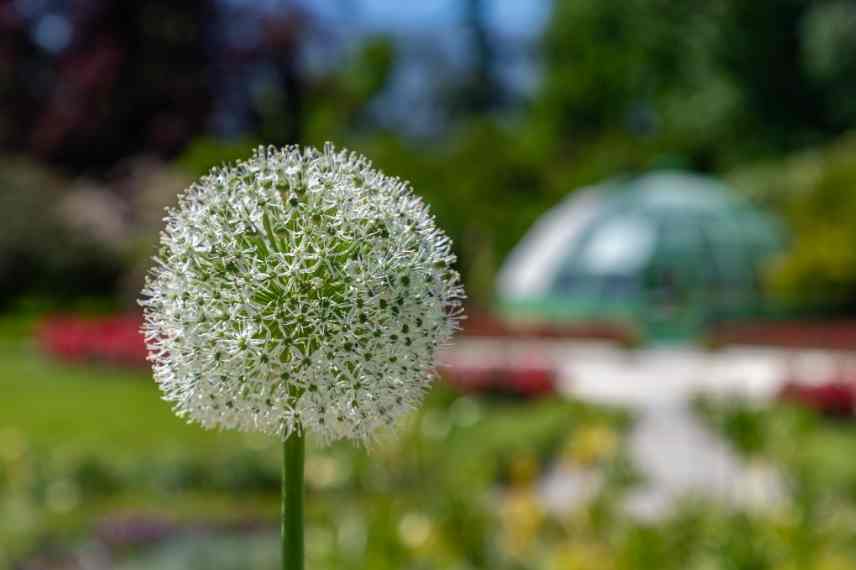
The ‘White Giant’
Allium ‘Forelock’ for a touch of eccentricity
L’Allium ‘Forelock’ is a botanical curiosity. At about 1 m tall, its burgundy-purple flower is not a perfect sphere: it sports a small crest of flowers at the top, giving it a ‘punk’ look. Over time this outgrowth diminishes and the flowers round out. It is a variety that always provokes questions and interest from visitors.
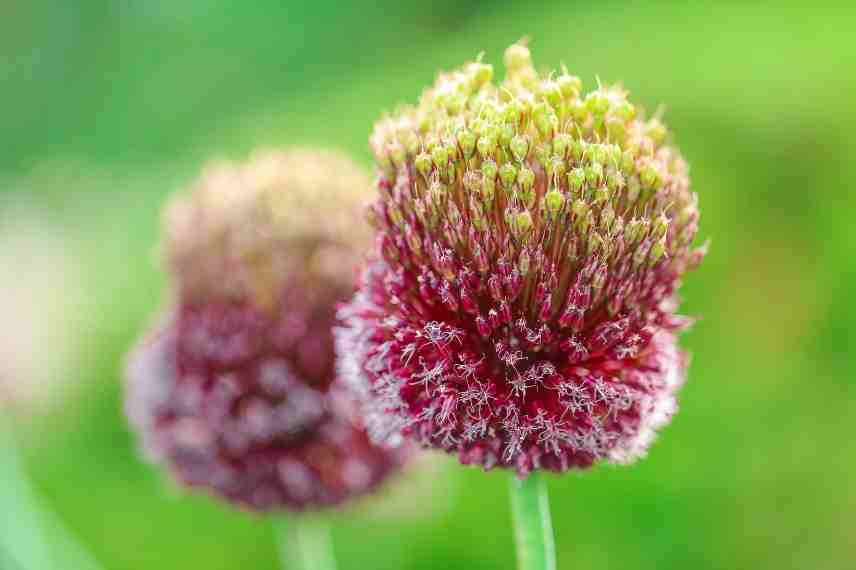
Allium ‘Forelock’
Allium stipitatum ‘Album’
Often simply called Allium ‘Album’, this variety easily reaches 1.20 m in height but ranks among the large ones because of the impact of its very dense white flowers, firmly borne on sturdy stems. It naturalises easily.
Large Alliums
With these varieties, height matters, but it is the flower diameter and visual impact that count most.
Globemaster, the all-round champion
If you could only plant one, this might be it. The ‘Globemaster’ isn’t the tallest at 80 cm to 1 m, but it produces the largest flowers on the market, up to 25 cm in diameter. What’s its secret for producing such flowers? Its pink-mauve flowers are sterile, so the plant keeps producing new florets within the same globe for weeks, dramatically extending the flowering period.
Summer Drummer, the late-season giant
The Allium ‘Summer Drummer’ is unique. It can reach 1.50 m or more, but flowers in midsummer, between July and August, well after the others. Its heads are compact, a mix of purple and white. It’s a large specimen in both stature and its ability to emerge among tall summer perennials such as dahlias.
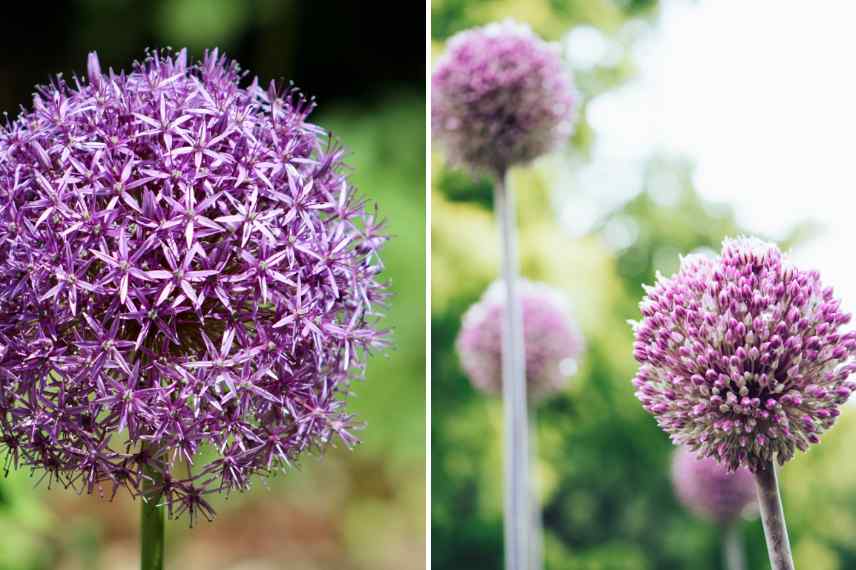
Globemaster and Summer Drummer
Allium decipiens
Less common, Allium decipiens offers an elegant silhouette with white or lavender-to-lilac flowers, sometimes tinged with green, very long-lasting. It is prized for its excellent presentation and the striking, graphic form of its inflorescence, which remains magnificent even after the blooms have faded.
How to incorporate these large Alliums into the garden?
Successfully integrating Alliums requires knowing a little cultivation trick: their foliage.
Hide that base…
The ‘downside’ of Alliums is that their foliage begins to yellow and wither just as the flower opens. It’s a natural process, as the plant redirects energy back to the bulb. Never plant them alone in the foreground. It’s better to plant the bulbs in the heart of perennial plants that will conceal the lower stems.
Ideal companions are nepetas, hardy geraniums, hostas or grasses such as feather grass.
Stay grouped
For a spectacular effect, avoid planting a single bulb on its own. Alliums are best planted in groups of 3, 5 or 7, or scattered randomly through a border to create the impression of balloons floating above the plants. Over the years, they will thicken and multiply to occupy the space.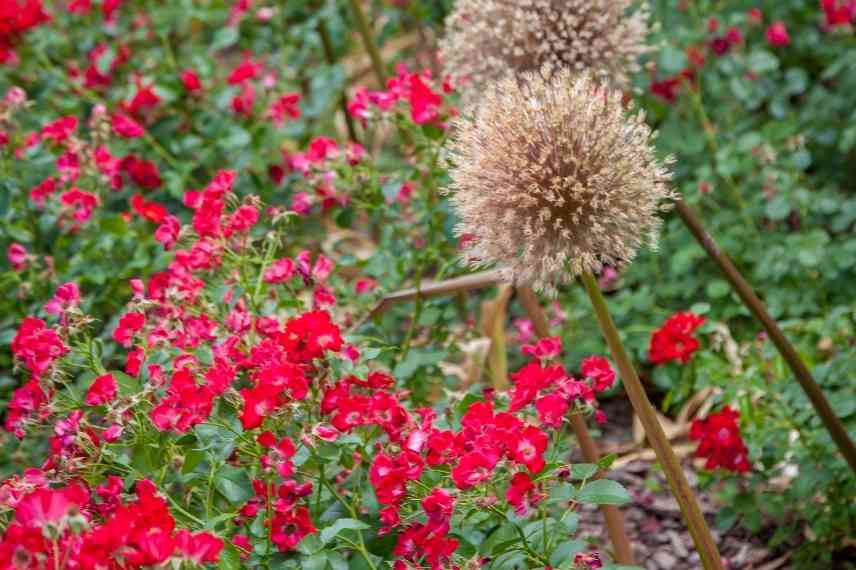
Combine colours
- For a modern contrast, mix ‘Mount Everest’ white with ‘Ambassador’ deep purple
- For romantic harmony, pair ‘Gladiator’ with old-fashioned pink roses or peonies
- For a rustic effect, combine ‘Summer Drummer’ with golden grasses for a sophisticated meadow look.
How to plant and care for them?
Cultivation of Alliums is simple :
-
When to plant? In autumn, September to November
-
How deep to plant? Rule of thumb: plant Alliums to a depth equal to three times the bulb height. For giant varieties, don’t hesitate to dig 20-25 cm
-
What exposure? Full sun is essential. They need light for their stems to remain upright
-
What soil? Must be well drained, even dry in summer. Stagnant moisture in winter is the number one enemy of the Allium bulb.
- Subscribe!
- Contents
This form is protected by reCAPTCHA - the Google Privacy Policy and Terms of Service apply.

































Comments