Winter barks, from orange to purple
For a garden bursting with colour!
Contents
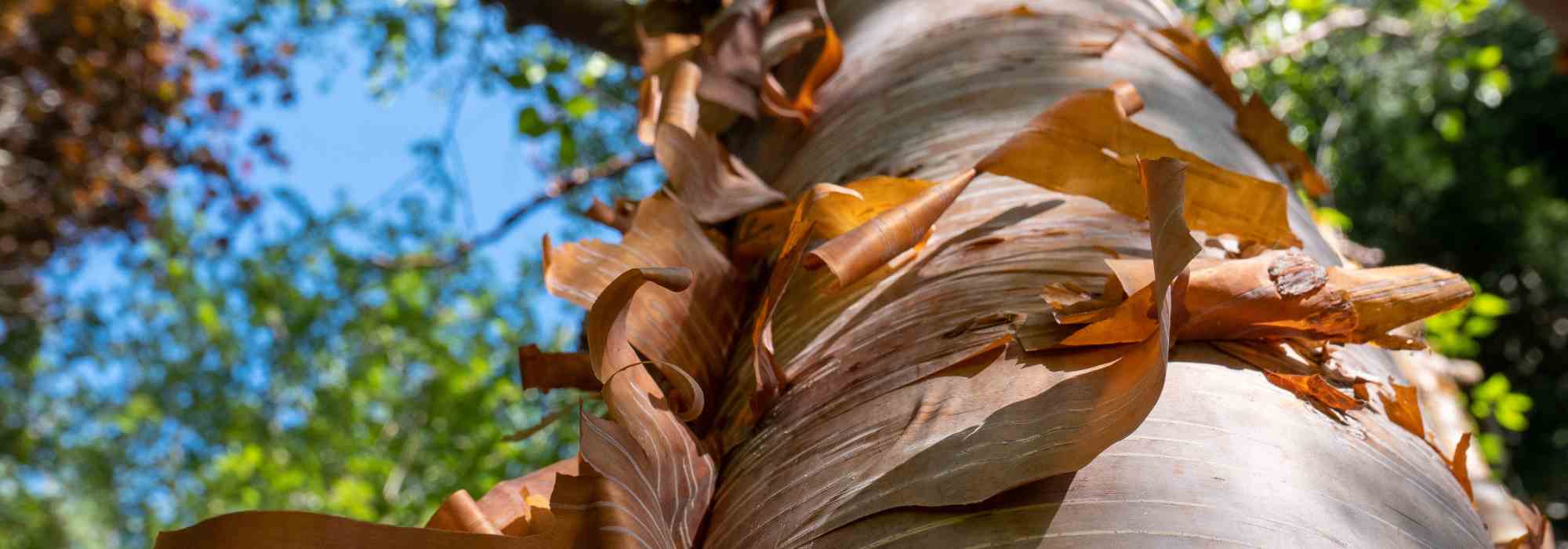
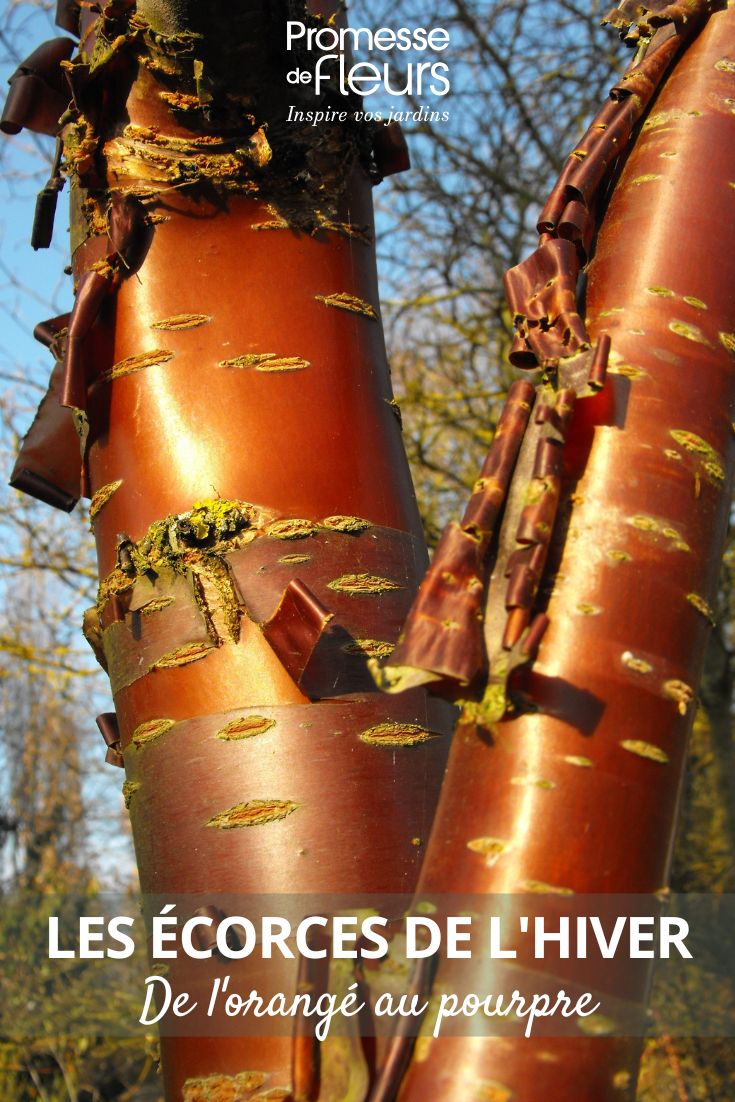
Deep winter showcases bark in the garden with birches and other deciduous trees such as Prunus, revealing a major feature of their appearance. Among the vibrant colour range in the coldest days of the year there is a beautiful palette of warm, coppery tones, ranging from orange to the deepest purple. Their bark, certainly unique in its hue, often bears streaks or peels away in strips with age. Here I present the most beautiful orange-to-purple barks to add colour and enhance a winter garden.

Prunus
The Prunus with decorative bark are among the stars in this category of trees with interesting bark. Their bark is often smooth and shiny, coppery to mahogany in colour. Two species are particularly noted for the remarkable ornamental appeal of their warm colours: the Tibetan cherry, or Prunus serrula, and the Manchurian cherry, or Prunus maackii. All these deciduous cherries need a sunny position in the garden to make their glowing colours shimmer.
Prunus serrula
The species itself is already very striking, with a mahogany-brown bark that exfoliates, growing up to 9 m in height. It flowers between April and May with white blooms and tolerates most soils. It forms a handsome tree 6 to 8 m tall with a slightly smaller spread of 5 to 6 m.
Prunus serrula ‘Jaro’ gives a caramel-coloured bark, paler than the species, and grows to 8 m in height.
Prunus serrula ‘Branklyn’ is notable for the gloss of its bark,
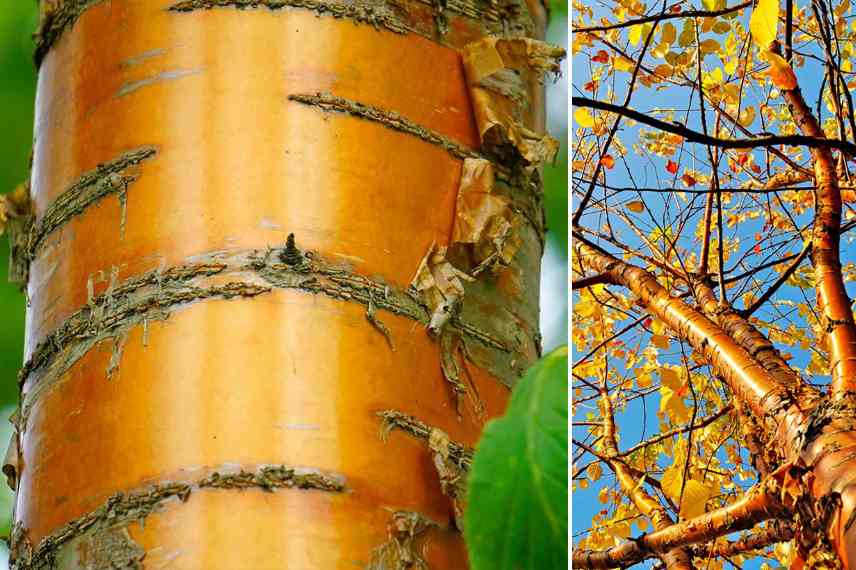
As for Prunus serrula ‘Amber Scots’, it is a hybrid between Prunus serrula and Prunus serrulata. Its cinnamon-red bark is sumptuous and satiny, and its spring flowering of white, melliferous flowers is delightful, as with all cherries. Another asset is the autumnal change of its foliage to golden-yellow. ‘Amber Scots’ has an upright habit. It will reach approximately 8–9 m under favourable planting conditions.
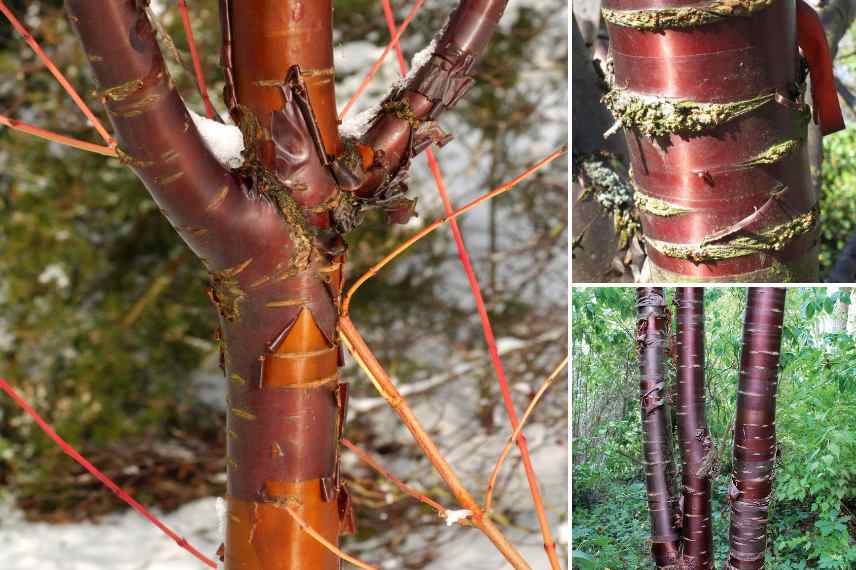
Prunus serrula ‘Jaro’ on the left; Prunus serrula – species type, top right, and Prunus serrula ‘Branklyn’, bottom right (copyright Ester Westerveld)
Prunus maackii
The Manchurian cherry is a wild species native to Korea and Manchuria. There is an attractive variety particularly suitable for ornamenting a winter garden, smaller than the species type:
The Prunus maackii ‘Amber Beauty’, whose evocative name recalls the trunk’s golden-amber hue, will over the years exfoliate in transverse strips. Its glossy orange trunk is often short, and this small tree (7–8 m tall), easy to incorporate, takes on a rounded to spreading form as it matures. It also flowers in April or May with small simple white flowers, and its foliage turns yellow. It is slightly more sensitive to heat than the other species and cultivars mentioned here and dislikes clay soils.
Read also
The most beautiful barksBirch trees
If one often thinks of the beauty of white bark on many birches, some, less well known admittedly, stand out with coppery bark, notably the species albosinensis. Here are a few of these copper-barked birches to consider for a winter border.
Betula albosinensis or Chinese birches
They are also called copper birches. The type species comes from western China and can be very tall (25 m).
The Betula albosinensis var. septentrionalis is one of the most used Chinese birches. Elegant, it is valued for its in large plates with age, offering a remarkable winter display. Hardy and adaptable, with a graceful habit, it thrives in fresh, well-drained soil and tolerates full sun or partial shade, ideal for . Resilient and , it will bring .
The Betula albosinensis ‘Blason’ is a unique Chinese birch, recognisable by its bright red, smooth and exfoliating bark, which contrasts with classic white birches. Its pyramidal habit and moderate size (8–10 m) make it an ideal tree for winter gardens. Hardy and easy to grow, it tolerates most soils that are not dry. An original, graphic choice for a truly striking visual effect.
The Betula albosinensis ‘Fascination’ is one of the better-known orange-barked birches, with bark of a paler vermilion, very bright once its exfoliation peels away.
Betula albosinensis ‘Red Panda’ is an ornamental birch with an elegant habit, recognisable by its . Easy to grow, it , in full sun or partial shade, and . Its light green foliage and originality make it an as well as for winter borders. Hardy and decorative, it provides a .
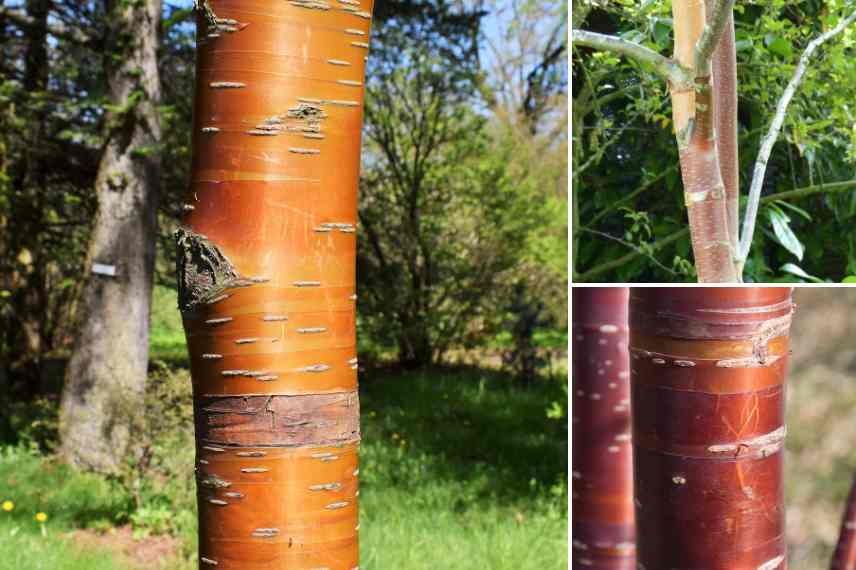
Betula albosinensis (type species on left), ‘Fascination’ top right and ‘Red Panda’ bottom right
Himalayan birches
These birches also originate from western China and are generally prized for their pure white bark. But one of them differs: Betula utilis ‘Nepalese Orange’, a horticultural cultivar. Its fairly rapid growth is appreciated, and its bark, dotted with lenticels and horizontal bands, is coppery when young, then becomes more brown-marked as it grows.
Other birches of interest
Betula ermannii ‘Hakkoda Orange’ and Betula x ‘Crimson Frost’ are two other birches worth knowing: the first for its bright, exfoliating orange bark, the second for the cinnamon colouring its white bark takes on and for foliage that turns purple then reddens in autumn.
Acers or maples
Paperbark maple
The maple best known for its bark is undoubtedly the paperbark maple or Acer griseum which we love for its perfect exfoliation. It is also known as paperbark maple. Its bright reddish-brown bark peels away in long, very thin strips, a marvel! It is rather slow-growing, reaching, depending on growing conditions, between 6 and 10 m in height and as wide at maturity. It is somewhat sensitive to drought and prefers moist, well-drained soils.
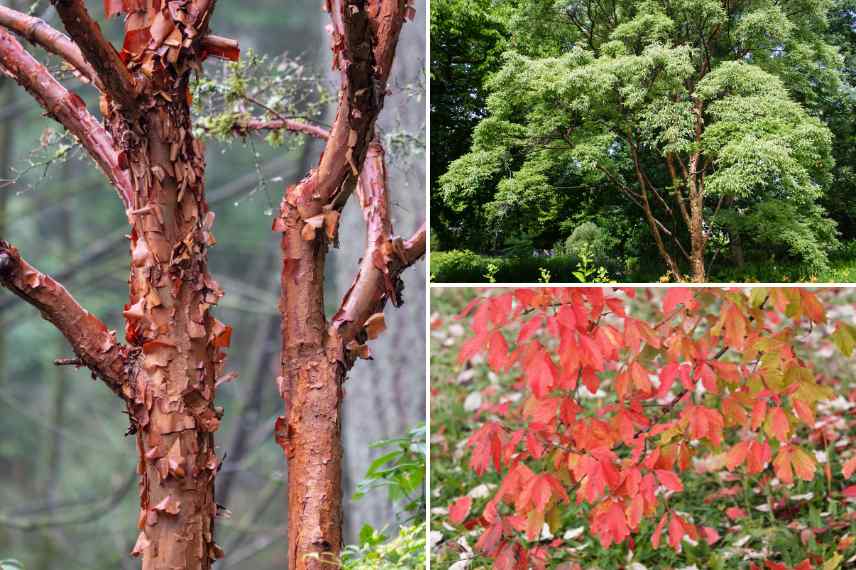
Acer griseum in winter, summer and autumn
Olivier presents it in more detail in this video :
Japanese maples with colourful bark
Some Japanese maples with colourful bark delight us in mid-winter, after their autumn flamboyance. These maples come to life when nature enters dormancy and the garden foliage has fallen, accompanying the warm colours of dogwoods and other trees with bright bark.
L’Acer palmatum ‘Sango-kaku’ is a little winter gem for its young coral bark that helped make it renowned among many Japanese maples. Sango-kaku means ‘coral tower’ in Japanese. It generally reaches between 4 and 6 m in height at maturity. It is one of the most attractive in winter, thanks to this bright bark, which deepens in colour with the cold. This handsome maple has light green foliage, preceded by pale pink buds, then turns golden yellow to red in autumn. A real little gem!
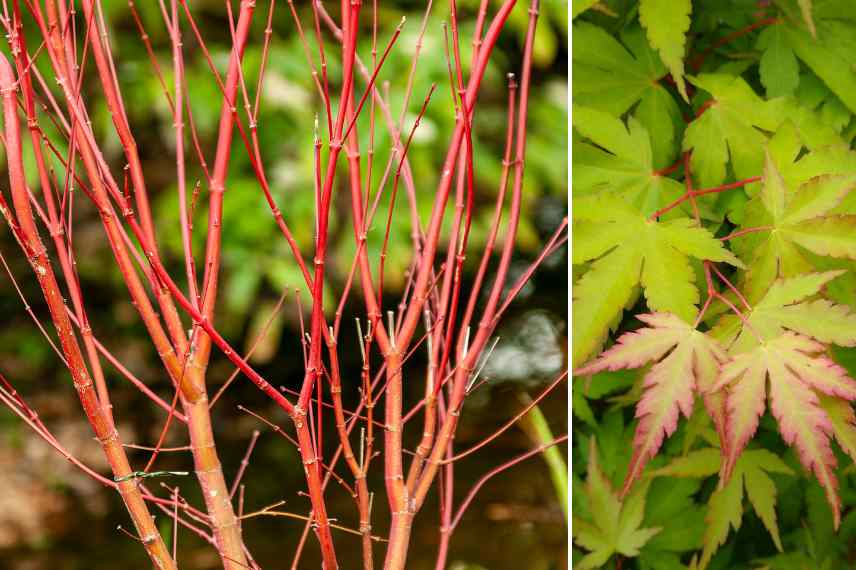
Acer palmatum ‘Sango Kaku’
L’Acer palmatum ‘Red Wood’ is another Japanese maple to include in the garden (or in a pot!) to bring the sublime coral-red colouring of its branches into a winter border. We also like its pretty spring chartreuse green, followed in autumn by foliage turning orange-yellow, tinged with pink and red.
Read also
The Winter gardenExceptional tree: Cyprus strawberry tree
In winter, Cyprus strawberry-tree (Arbutus andrachnoides) stands out for its distinctive bark. Its trunk, smooth and reddish, peels naturally in fine flakes, revealing coppery to cinnamon hues. This decorative effect, particularly noticeable in cold weather, brings a touch of colour to Mediterranean gardens and landscapes. Tolerant of drought and moderate frost, this evergreen shrub keeps its charm even after its red fruits, typical of autumn, have fallen.
A species to plant for its elegant habit and sumptuous bark year-round, which becomes remarkable when mature. Note that it is hardy to -10°C.
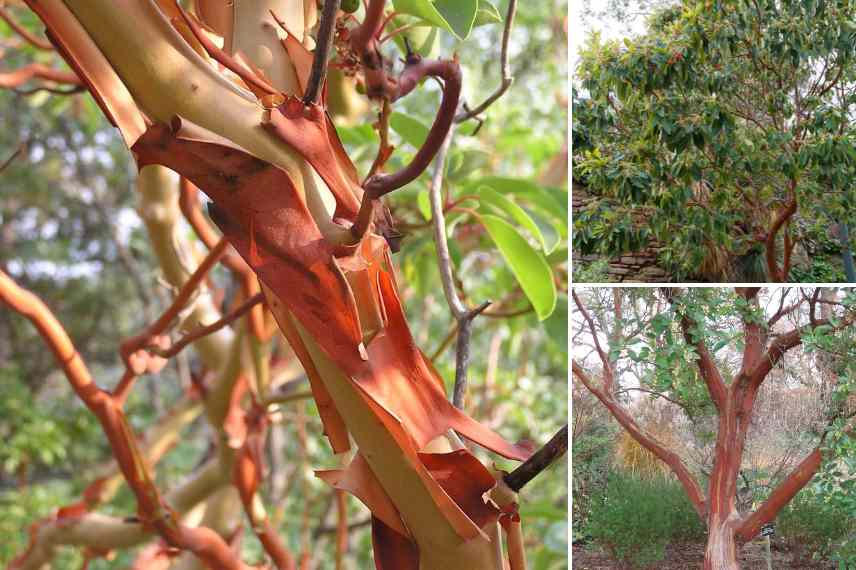
Ornamental woods: red-twig cornelian cherries and willows
We cannot fail to mention coloured-stem dogwoods (Cornus spp.) and willows (Salix spp.) that also warm our winters!
Here are some winter-garden stars thanks to their striking stems.
-
Cornus sanguinea ‘Winter Beauty’ : notable for its young shoots of vivid coral-red, almost fluorescent in midwinter. Compact (2–3 m), it fits perfectly in an informal hedge or mixed border, and tolerates most soils, including clay. Its autumn foliage, tinged purple, prolongs its ornamental interest.
-
Cornus alba ‘Sibirica’ : with stems ranging from bright red to red‑orange, this Siberian dogwood lights up gardens down to -20°C. Ideal for cool soils, it pairs beautifully with grasses or heathers.
-
Salix acutifolia ‘Blue Streak’ : this willow with young orange to reddish shoots brings a graphic touch. Hardy and fast‑growing, it is perfect for structuring a space or creating a winter plant screen.
Important: for maximum colour impact, prune these shrubs every 2 years, in late winter, to stimulate production of new colourful stems.
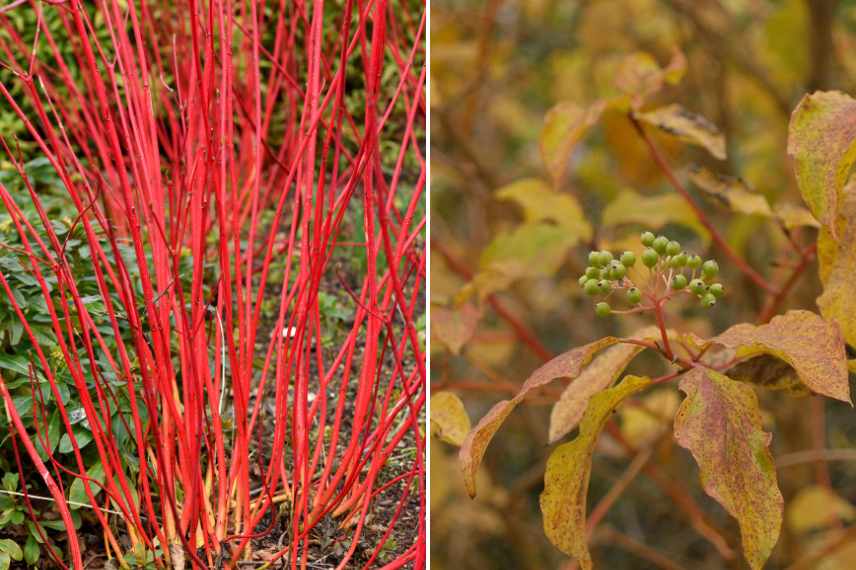
Variety ‘Winter Beauty’
Practical tips and FAQ
For your refined search at promesse de fleurs, remember to select “remarkable bark” in the “ornamental interest” filter!
How to combine these trees in a garden?
To achieve best effect, pair these trees with evergreens (conifers, Pittosporums, etc.) and ornamental grasses, which will highlight their bark by contrast. Feel free to play with heights and textures (smooth/exfoliating bark) to create a striking winter display, inspired by the famous Winter garden English!
How to care for coloured bark and which exposure to choose?
- Care : no unnecessary pruning except for dogwoods and willows, mulch around base, gently remove moss by hand.
- Exposure : full sun intensifies colours of this type of bark (Prunus, Acer); partial shade is tolerated for Cornus and Salix.
- Colour looking dull? Check sun exposure (6 h/day is ideal in winter) and soil fertility.
- Subscribe!
- Contents
This form is protected by reCAPTCHA - the Google Privacy Policy and Terms of Service apply.
































Comments