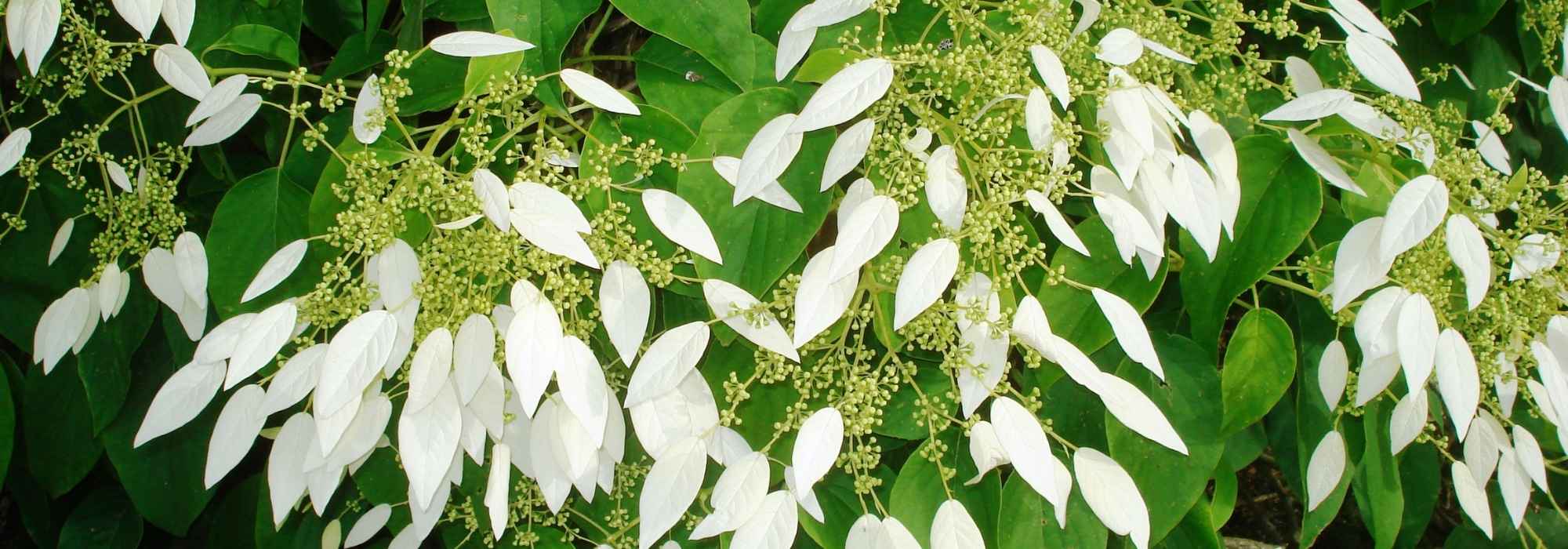
Schizophragma hydrangeoides: planting, cultivation, care
Contents
Schizophragma in a nutshell
- Schizophragma is a climbing plant with a splendid summer display, producing large inflorescences measuring up to 30 cm in diameter.
- Known as ‘False climbing hydrangea’ or ‘Japanese climbing hydrangea’, it clings to its support without damaging it.
- Its dense foliage is deciduous and turns beautiful colours in autumn.
- It prefers semi-shaded positions and fresh, humus-bearing, slightly acidic soils.
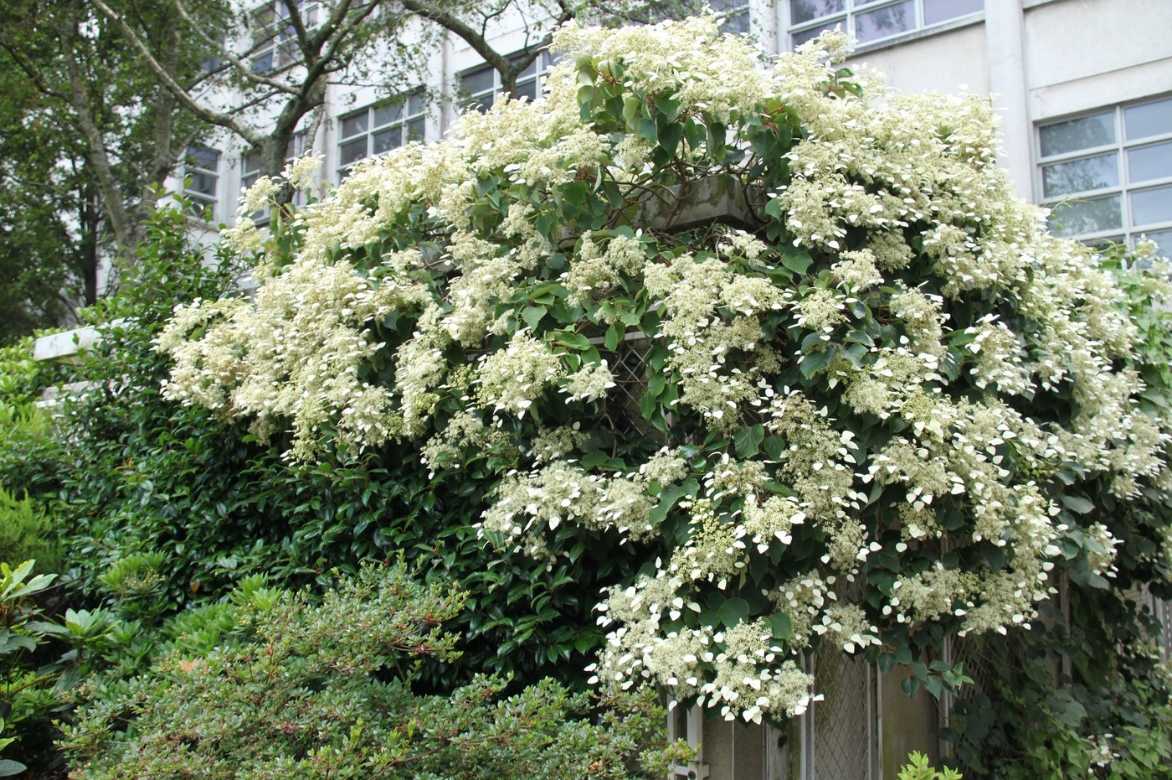
- Fairly hardy, Schizophragma is ideal for adorning the trunk of a large tree, a wall or a pergola.
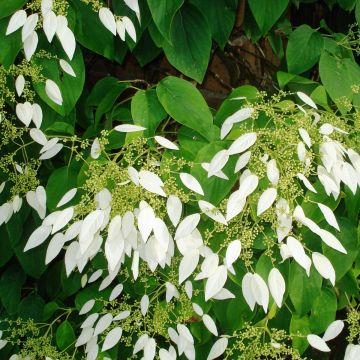
- Its flowering, enhanced by white or pinkish bracts, is more spectacular and refined than that of its close cousin Hydrangea petiolaris, with which it is often confused.
- A little slow to establish, this still little-known sarmentous liana requires little maintenance for a spectacular decorative effect.
A word from our expert
Schizophragma is a very attractive climber valued for its spectacular summer flowering. More than its small flowers, it is the large bracts that surround them that steal the show. They can be ivory-white as in the type, Schizophragma hydrangeoides, or tinged with pink in Schizophragma ‘Rose Sensation’. The whole forms airy inflorescences 20–30 cm in diameter.
Closely related and often confused with Hydrangea petiolaris, this ‘false climbing hydrangea’ offers a more spectacular flowering that can last up to 3 weeks.
Opposite foliage, deciduous to semi-evergreen, is cordate, sometimes dentate and pubescent. It is borne on robust, twisting stems. Most species have green foliage, but Schizophragma ‘Moonlight’ bears velvety leaves with silvery tones and well-marked veins. Schizophragma ‘Angel Wings’ meanwhile produces large rough, grey-green leaves highlighted by darker veins.
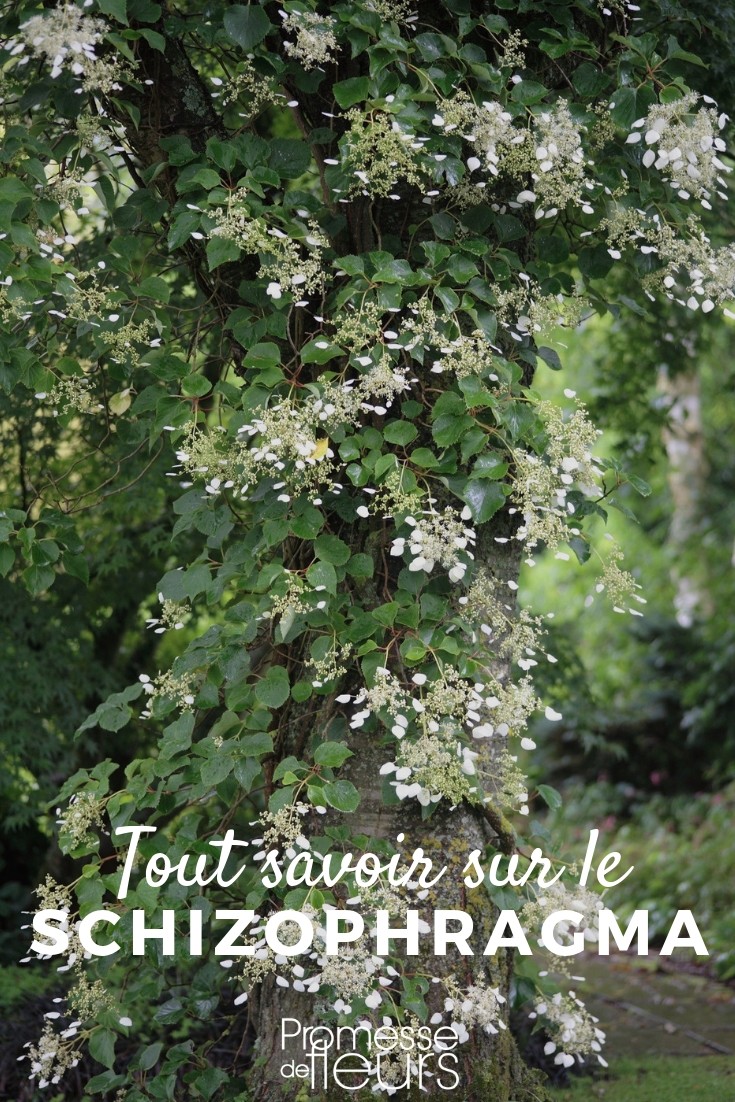
Japanese climbing hydrangea is a rooting liana, equipped with powerful climbing roots that allow it to attach itself to supports unaided, without causing damage. It is therefore ideal for climbing a tree, dressing a cool wall or festooning a pergola.
Fairly hardy, Schizophragmas tolerate down to -10°C, some even lower.
A climber for light shade, Schizophragma prefers exposures that are not scorching but a little sun, for example in late afternoon, encourages good flowering.
Growing in neutral to acidic soil, it requires a fairly rich, humus-bearing soil that stays cool while draining well.

Description and botany
Botanical data
- Latin name Schizophragma sp.
- Family Hydrangeaceae
- Common name False climbing hydrangea, Japanese climbing hydrangea
- Flowering Summer
- Height 3 to 10 m
- Exposure Partial shade, light shade, non-scorching sun
- Soil type fresh, humus-bearing, well-drained, acidic to neutral
- Hardiness -10°C to -20°C
The Schizophragma originates from the wooded, humid regions of Asia (Japan, the Himalayas, Taiwan). Belonging to the family Hydrangeaceae, as do Deutzias or mock-oranges, its closest relative is Hydrangea petiolaris, another climbing hydrangea to which it bears a resemblance. It is, however, distinguished by a more spectacular flowering with large inflorescences and very decorative bracts. Introduced to Europe at the end of the 19th century and praised by the Royal Horticultural Society for its beauty, it remains a rather little-known and seldom used plant.
Schizophragma, also called ‘Japanese climbing hydrangea’ or ‘false climbing hydrangea’, is a woody climbing plant. It is a rooting climber with tortuous branches that attaches itself to its support thanks to aerial roots but, unlike ivy, its climbing roots do not damage the structure. Slow-growing, this climbing hydrangea needs 2 to 3 years to establish properly and requires training in its early years.
There are 4 or 5 species cultivated in gardens. Some do not exceed 4 metres in height, such as Schizophragma ‘Moonlight’ or Schizophragma corylifolium. Others are more vigorous and demand appropriate supports. This is the case for Schizophragma fauriei, the giant of the genus, which can reach nearly 15 m in height while its spread rarely exceeds 3 to 4 m.
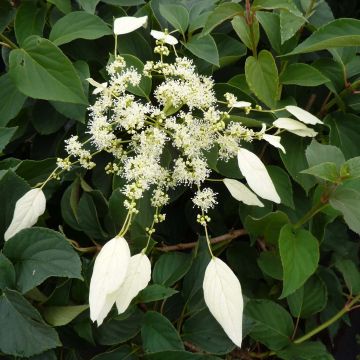
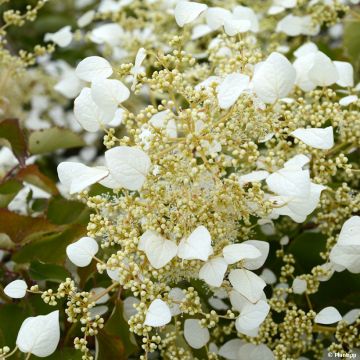
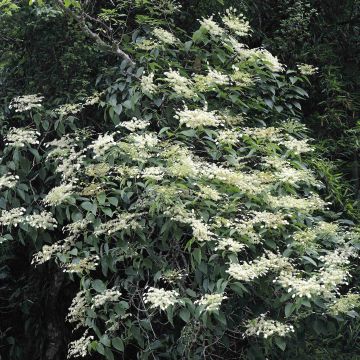
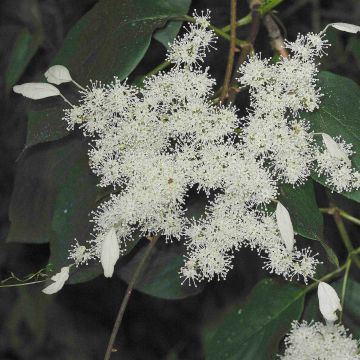
The false hydrangea produces main stems that grow vertically. From these structural stems arise lateral branches bearing the inflorescences. Between May and August, for around three weeks, many small flowers appear at the ends of the branches in flat cymes. Fertile and melliferous, they are much appreciated by pollinating insects. This climber is above all admired for the large bracts that surround the flowers. Carried on long petioles, elongated and pointed in shape, they seem to float around the plant. In the wind, these ‘tears’ give the impression that a swarm of butterflies has taken over. The inflorescences then dry and remain decorative through winter.
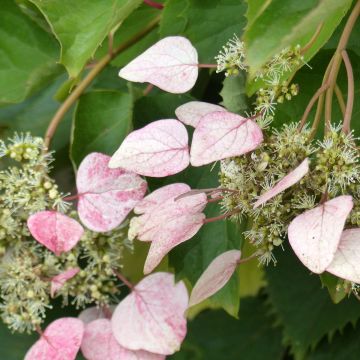
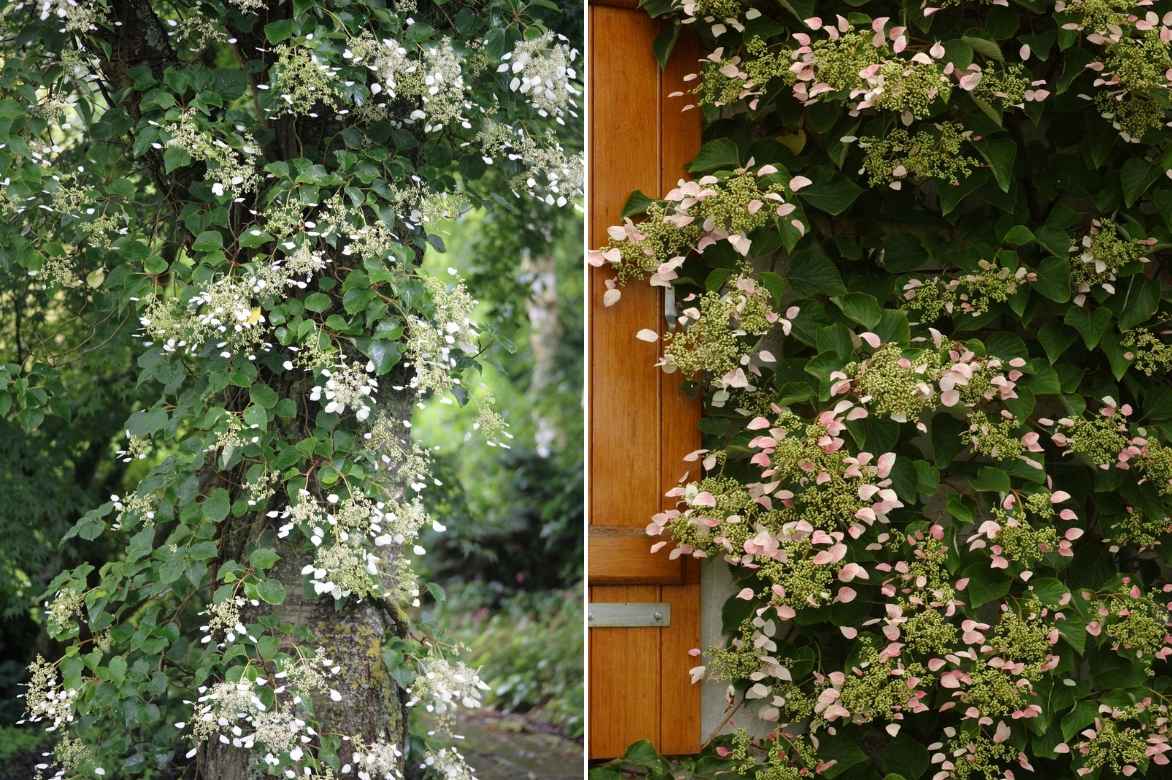
Mostly ivory-white, the bracts take on delicate pink tints in a single variety, Schizophragma ‘Rose Sensation’, sometimes sold under the name ‘Roseum’.
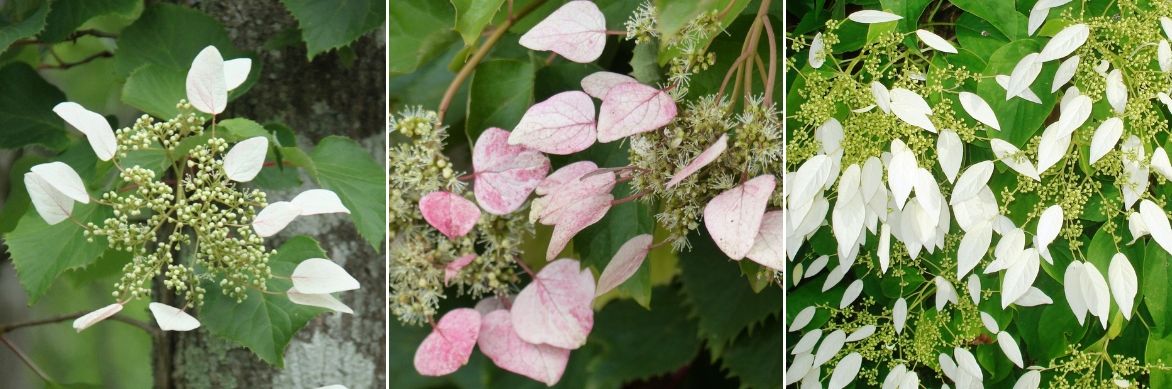
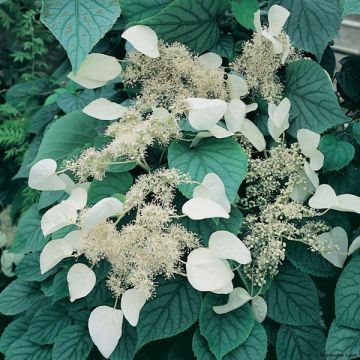
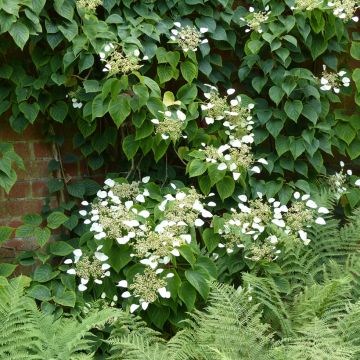
Inflorescences of False climbing hydrangeas: Schizophragma hydrangeoides, S. hydrangeoides ‘Rose Sensation’ and S. integrifolia
Schizophragma integrifolia may be the most spectacular with its white inflorescences, larger (up to 30 cm) and more graceful appearance.
Slow to establish, Schizophragmas may not flower during their first 2 or 3 years but once established they charm more each season.
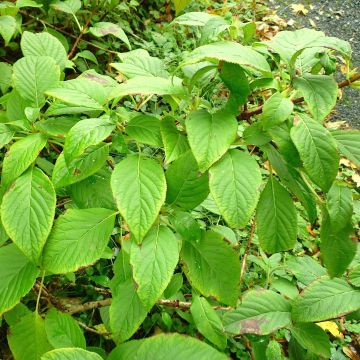
With dense growth, Schizophragma bears opposite, heart-shaped leaves. Sometimes pubescent with slightly dentate margins.
Foliage is deciduous to semi-evergreen and ranges from pale to deep green, except in Schizophragma ‘Moonlight’, which displays silvery reflections that highlight the darker veins. It also develops beautiful autumn colours and takes on a deep red hue.
Schizophragma ‘Angel Wings’ is also notable for its grey-tinged foliage.
All Schizophragmas prefer fairly fertile, humus-bearing soils that are fresh but well drained. They tolerate neutral soils but show a preference for slightly acidic soils. They can grow in heavier, clay soils provided water does not remain stagnant there in the unfavourable season.
A woodland climber, flowering is at its best in partial shade or light shade. It tolerates denser shade but is then more discreet. A sunny position is possible provided it is not scorching (avoid south-facing walls) and the soil retains good freshness.
Schizophragma is very disease resistant but young shoots can attract slugs and snails. Natural control methods exist, and this risk mainly applies to young plants. Aphids may also take up residence in the plant but do not usually pose a danger. In case of a serious infestation, discover how to limit their presence.
Read also
What to do with a dead tree?Different varieties of Schizophragmas
Schizophragma hydrangeoides
- Flowering time July to September
- Height at maturity 10 m
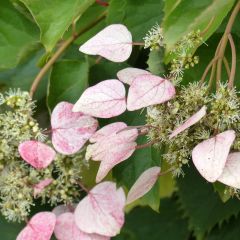
Schizophragma hydrangeoides Rose Sensation
- Flowering time July, August
- Height at maturity 6 m
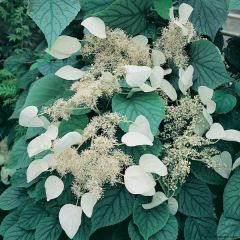
Schizophragma hydrangeoïdes Moonlight
- Flowering time July, August
- Height at maturity 4 m
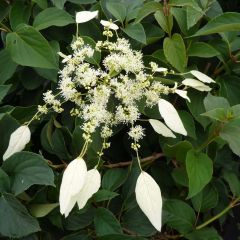
Schizophragma hydrangeoides Windmills
- Flowering time July to September
- Height at maturity 5 m
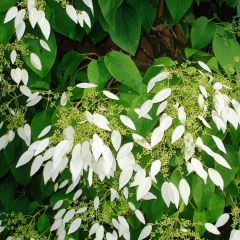
Schizophragma integrifolium
- Flowering time July to September
- Height at maturity 8 m
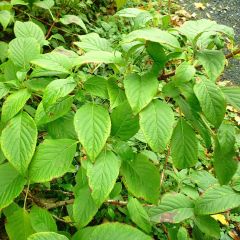
Schizophragma corylifolium
- Flowering time June to August
- Height at maturity 4 m
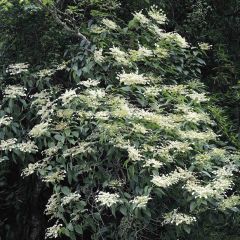
Schizophragma fauriei
- Flowering time August, September
- Height at maturity 15 m
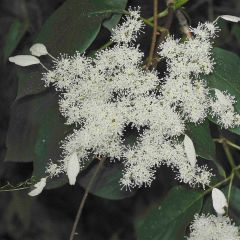
Schizophragma fauriei Angel Wings
- Flowering time August, September
- Height at maturity 15 m
Discover other Schizophragma
View all →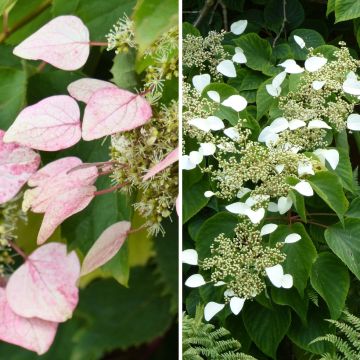
Available in 0 sizes
Available in 1 sizes
Available in 1 sizes
Available in 2 sizes
Available in 1 sizes
Available in 1 sizes
Available in 1 sizes
Available in 1 sizes
Available in 2 sizes
Available in 1 sizes
Where, when and how to plant Schizophragmas?
Where to plant?
Schizophragma enjoy bright, semi-shaded positions where light favours flowering. In cooler areas north of the Loire, planting in sun is possible. Further south, a north-facing aspect is an option.
Plant your ‘false climbing hydrangea’ in rich, deep, humus-rich soil. Preference is for slightly acidic soils but neutral soils are accepted. If necessary, add heather soil or turf and compost, and mix in a handful of horn meal. Avoid calcareous soils in all cases.
Although it can tolerate occasional dry spells once established, prefer a soil that remains cool but not waterlogged, especially in winter.
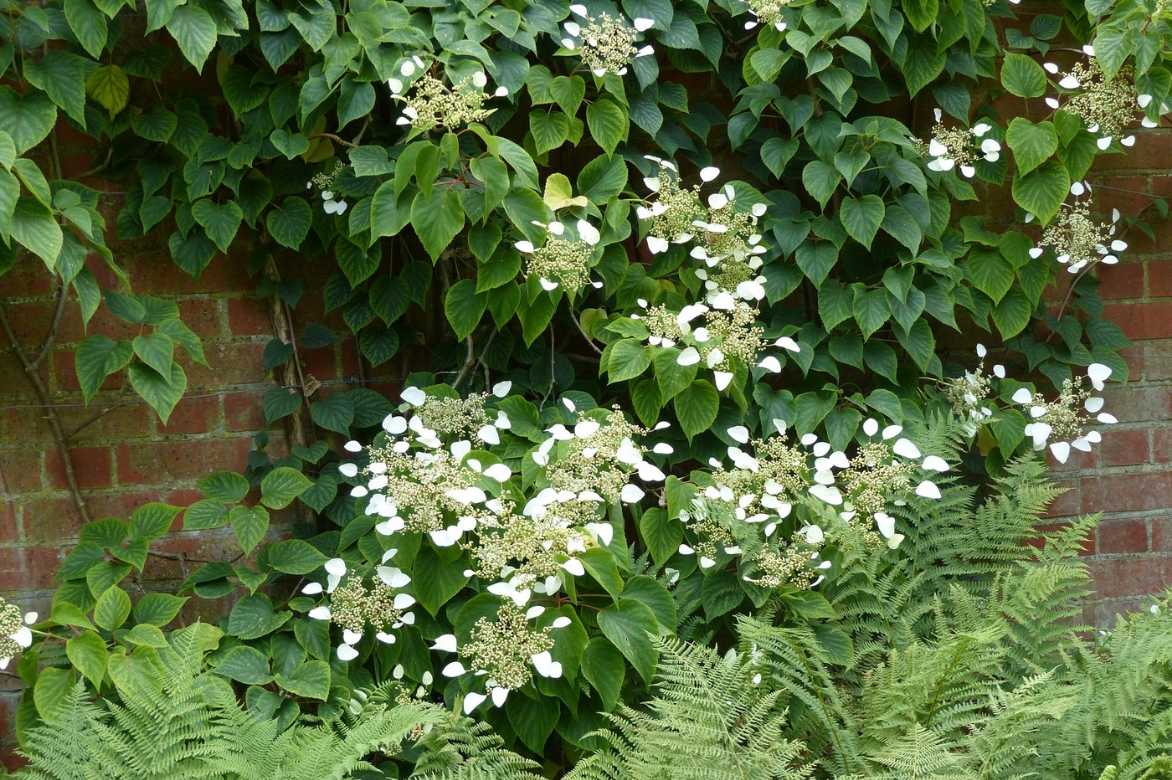
‘Japanese climbing hydrangea’ is a liana. It needs a support to cling to. Plant it on trunk of a deciduous tree or where shade beneath the tree is not too dense, grow it up a wall, train it to festoon a pergola of suitable proportions or wrap a garden shed in its delicate bloom.
On a terrace or large balcony, plant Schizophragma in a pot of good size (50 cm in all directions minimum) and use it to screen a wall or climb a trellis.
In all cases, Schizophragma is slow to establish. Expect 2 to 3 years before it really gets going (and before it flowers). To help it, and until it can cling unaided, guide and stake its branches.
Once well established, growth speeds up and flowering becomes more generous each year.
When to plant?
Plant Schizophragma ideally in autumn, when soil is still warm and seasonal rains provide necessary freshness. Spring planting is also possible; in that case, water regularly if weather is dry.
How to plant?
Planting in open ground :
1. Start by soaking the rootball in plenty of water so the whole substrate becomes evenly moist.
2. Ideally, dig a hole 2 to 3 times the width of the rootball and about 50 cm deep. Adjust planting distance according to chosen support :
– Plant at base of a post if training Schizophragma on a pergola, for example.
– If support is a tree, find a pocket of soil between two large roots, about 50 cm from the trunk. Dig carefully to avoid damaging large roots and prune small roots cleanly with pruning shear. When placing plant, orient it obliquely towards the trunk.
– Against a façade, an overhang may deprive the plant of some or all rainwater. In that case, position the planting hole further away to compensate (or check soil freshness regularly!).
3. Lay a 5 cm bed of gravel in the bottom of the hole to ensure good drainage.
4. Place a stake if needed in the planting hole and angle it towards the support to help the climber attach. After 2–3 years it will manage alone.
5. Mix excavated soil with quality potting compost or heather soil, and a shovelful of well-rotted compost. Add a handful of horn meal to feed the plant long-term.
6. Remove the pot and place rootball in the hole, filling around it with the mixture.
7. Firm lightly and form a saucer-shaped hollow to help water reach the roots.
8. Water thoroughly so soil adheres well to roots.
9. Secure main branches to the stake using soft ties and without strangling the shoots.
10. Mulch the base using leaf litter, dried grass clippings, RCW (ramial chipped wood) or commercial mulches (flax shives, buckwheat or coconut husks, pine bark…). A mulch several centimetres thick ensures good freshness at the plant’s base.
Planting in a pot :
Soil volume is necessarily smaller in a pot than in open ground, so plant growth is generally more limited. Container size matters. The larger it is, the more nutrients and moisture the plant has. A pot 50 cm in all directions is a minimum for a climber such as Schizophragma. Ensure pot has drainage holes so water does not stagnate. Cool soil does not mean waterlogged!
1. Soak the rootball so it becomes uniformly saturated.
2. Prepare a mix of heather soil (1/3) and rich potting compost (2/3). Turf, once dry, is hard to rewet and Japanese climbing hydrangea needs a cool soil. Add a handful of horn meal to feed the plant in the long term.
3. Place a 5 cm layer of gravel in pot base. Lay a geotextile over the gravel to prevent soil mixing with the drainage layer.
4. After optionally placing a stake in the pot (unnecessary if plant will climb a trellis), set the rootball in place and fill with the mix.
5. Firm lightly. Leave 2–3 cm between substrate surface and pot rim so mulching and watering are easy.
6. Orient Schizophragma towards its support and secure main branches (without strangling) using soft ties.
7. Water little by little until water runs from pot base.
8. Mulch to maintain coolness. Use organic mulches (bark, flax shives…) or mineral mulches (gravel, pebbles, slate chippings…) according to chosen style.
Using a saucer ensures a water reserve for the plant in hot weather but it should be removed over winter so roots remain relatively dry. However, the larger the pot the heavier and harder to handle. You may also damage the plant (attached to its support) when moving it. An alternative is to fill the saucer with clay balls before placing the container. Even when saucer is full of water, roots stay dry while evaporation creates a cooler, slightly more humid atmosphere beneficial to the plant.
Caring for Schizophragmas
During warm weather, if rainfall is scarce, water regularly, especially in early years. Once established, Schizophragma can tolerate short periods of drought. Prefer a deep watering once a week rather than small daily top-ups, except in a pot where potting mix dries more quickly.
In winter, natural rainfall is usually sufficient. Only intervene if necessary and always outside periods of severe frost, especially if in a pot.
Each spring, add compost and replace a generous layer of mulch. Incorporate a handful of blood meal in late spring. This quick-acting fertiliser boosts flowering.
In a pot, remove mulch in early spring, add compost or a rich potting compost mixed with horn meal and replace the mulch. From May to August, water monthly with a suitable fertiliser (follow dosage instructions on packaging) but never onto dry potting mix.
Pruning Schizophragma is not necessary. It is not required in early years anyway as growth is slow.
If needed, prune in late winter or early spring. Remove any dead wood and cut back misplaced or overly long stems as desired.
Schizophragmas are hardy plants. Only slugs and aphids may attack young foliage. Discover how to control slugs naturally and how to identify and control aphids.
Propagate Schizophragmas
The False climbing hydrangea is slow-growing, especially during first 2–3 years. If you wish to multiply it, wait until well established.
Multiplication can be done by propagation by cuttings in summer or by layering.
Propagation by cuttings of Schizophragma
Propagation by cuttings is carried out in summer (between July and September)
- In a pot, make an equal-parts mix of light potting compost combined with sand or finely crushed bark. Mix should be free‑draining yet able to retain moisture.
- Choose a piece of semi‑herbaceous stem (base slightly firmer, tip softer) 6 to 10 cm long.
- Cut just below a node (swelling where a stem inserts) with a disinfected pruning shear.
- Dress the cutting: remove any side shoots and leaves, leaving only two at the top of the cutting. Cut remaining leaves in half to limit evaporation.
- Using a knife or blade of your pruning shear, lightly wound base of cutting. Operation consists of removing only a very superficial layer of tissue, about 1 centimetre, without reaching inner layers of the stem. Optionally, dip base of your cutting in rooting hormone, sold in garden centres, often as a powder. Tap cutting to remove excess powder.
- Make a pilot hole in substrate using a pencil for example and insert cutting until leaves just meet substrate then water gently so as not to disturb cutting.
- Cover compost with a thin layer of gravel which helps keep surface cool and limits evaporation.
- Cut top off a plastic water bottle and place it over the pot. Kept in this enclosed environment, cutting will root faster and more easily. Remember to remove it for a few minutes each day to ventilate contents.
- Place cuttings outdoors, in a bright spot but without direct sun and check regularly that compost remains moist but not waterlogged.
- Appearance of new leaves is sign that cutting has taken. Continue monitoring (occasional watering, airing) and plant out cutting in autumn of following year.
Layering of Schizophragma
Layering is a process that sometimes occurs naturally and which gardener can also induce. Part of plant in contact with soil will form roots and give rise to an independent specimen.
Layering can be done all year, but prefer March or autumn.
- Prepare soil a few centimetres from base of your Schizophragma. Fork over soil to about 30 centimetres in every direction, remove stones and weeds. Add light, free‑draining potting compost and mix well with existing soil.
- Choose a stem less than 2 years old, growing near the ground, flexible enough to be handled without breaking. It must be long enough to be laid on the soil for at least 60 centimetres.
- Leave tip of stem intact for 15 to 20 centimetres. Remove leaves or side branches from middle section, then, using a disinfected knife or blade of a pruning shear, make a slight incision in the bark over a few centimetres. Make incision on side of stem that will face the soil.
- Make a small trench in prepared soil, lay stem in trench so incised section contacts soil then cover with a few centimetres of soil.
- Anchor layered stem using metal pegs or a suitably heavy stone.
- Gently raise tip of stem and tie vertically to a stake driven into soil.
- Water and check regularly that soil does not dry out.
- After one year, layered section will have produced roots at incision. Time to sever. Cut branch a few centimetres before new roots, gently lift out new plant and pot up to strengthen it further or plant directly in ground.
Pairing Schizophragmas in the garden
As a climbing plant for light shade, Schizophragmas pair well with many trees with open foliage, for example an old fruit tree that flowers in spring, whose trunk then becomes covered in flowers in summer.
In a bright position, pair the Schizophragmas with other flowering climbers such as Akebia or a Clematis, or with lianas whose foliage turns fiery in autumn, such as Ampelopsis or Parthenocissus.
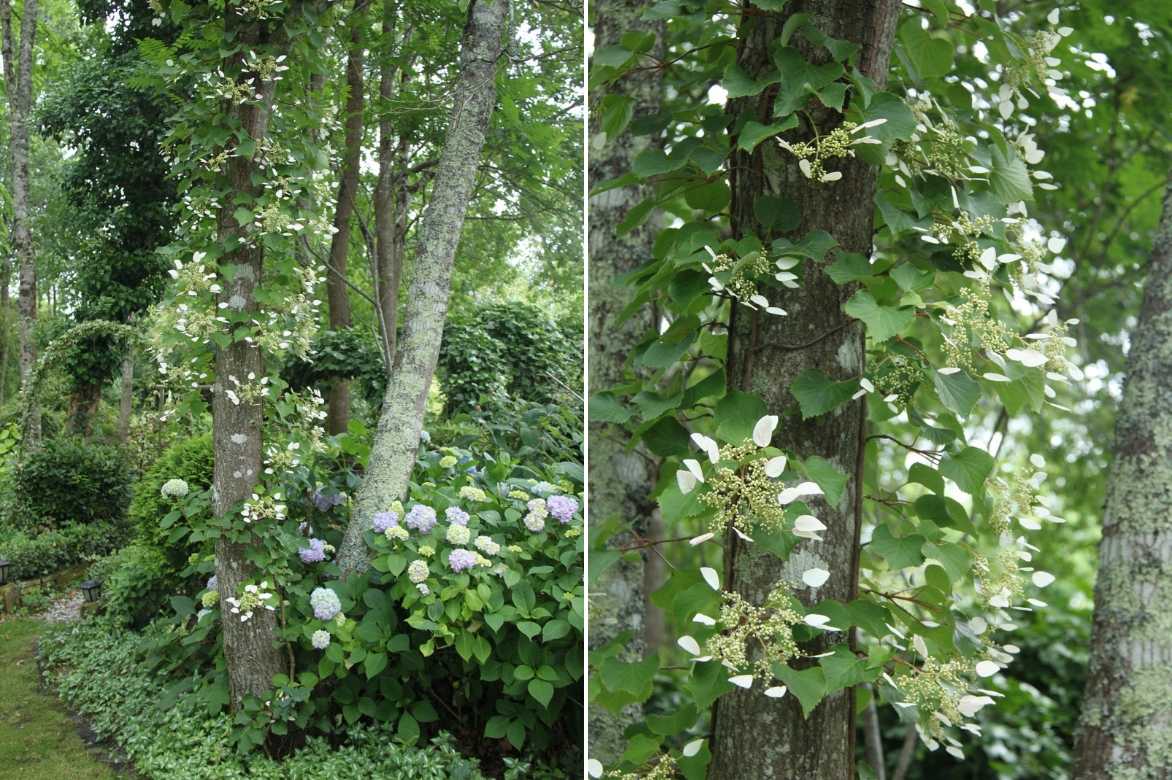
An example of an understorey association: a Schizophragma hydrangeoides climbs a tree with at its base a Hydrangea macrophylla and a carpet of lamiums as groundcover
Play contrasts of shape and texture with foliage of ivies, some of which have very attractive variegation.
In mild climates, Berberidopsis blooms at the same time in clusters of red, bell-shaped flowers.
Dress their base with hydrangeas whose inflorescences echo those of the climber. Hydrangea aspera ‘Hot Chocolate’ provides a striking contrast with its very dark foliage that turns golden in autumn.
Did you know?
The name Schizophragma comes from Ancient Greek ‘schizo’ (‘split’) and ‘phragma’ (‘screen, barrier’). The origin of its name simply refers to the shape of its fruiting structures. So don’t panic! This beautiful liana will not split the wall it climbs. Unlike other climbing plants, such as ivy, Schizophragma never damages its support.
Useful resources
Discover our range of Schizophragmas!
Other charming climbing plants, hydrangeas.
Our selection of climbing plants for shade.
Frequently asked questions
-
Why won't my Schizophragma cling?
Schizophragma is slow to establish. For the first two or three years it needs staking while it develops its climbing roots. Afterwards it becomes self-supporting and clings to its support unaided.
-
Why doesn't my Schizophragma have flowers?
Slow-growth Japanese climbing hydrangea may not begin to flower until after two or three years. Be patient; it will then reward you with increasingly beautiful flowering each year.
-
What is the difference between Schizophragma and a climbing hydrangea?
Schizophragma and Hydrangea are climbing plants of the same family. Their needs and cultivation are similar. The difference is primarily botanical. While the small greenish-white flowers of Hydrangea petiolaris are surrounded by pseudo-flowers (sterile flowers) composed of four petaloids, Schizophragma bears larger, solitary bracts that are elongate and tear-shaped, making the flowering more spectacular. Schizophragma bracts also retain a crisper appearance when dried and therefore remain decorative for longer.
- Subscribe!
- Contents
This form is protected by reCAPTCHA - the Google Privacy Policy and Terms of Service apply.

































Comments