Discover wild, graceful botanical lilies
A selection of wild species for collectors and lovers of lilies
Contents
Lily is valued for its sophisticated look, elegance and incomparable fragrance, filling the home when used in bouquets.
Alongside hybrid or Asiatic lilies, so refined, others less well known, the botanical lilies, deserve our attention. There are, in this category alone, more than a hundred, originating from various regions worldwide. They are very tall, all with single flowers, often nectariferous, and tolerate shadier conditions well.
We present about ten of the most beautiful to tempt you to add a few to your garden!

Madonna lily
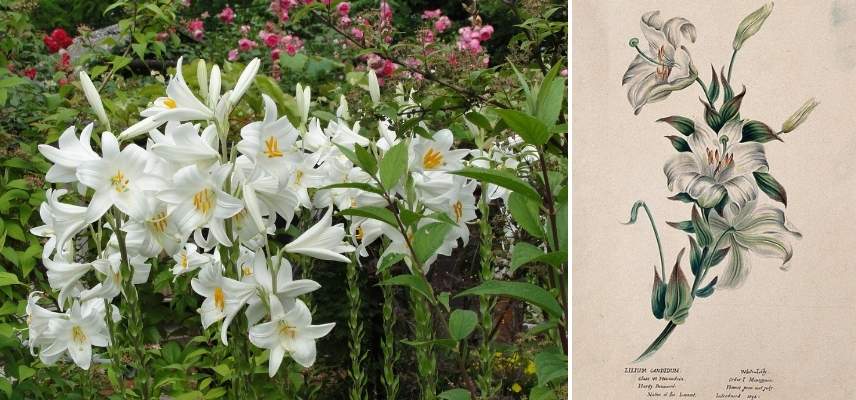
Lilium candidum, also known as Madonna lily, Virgin’s lily or white lily, is certainly the best-known of the botanical lilies. Originating from the Mediterranean and the Near East, it is nevertheless perfectly hardy and can establish in many regions. We love its purity, a whiteness just maculate with the yellow of the anthers at the centre of the trumpet-shaped flowers, which are grouped by the dozen at the top of the stem, as well as the scent of its large flowers (8 to 10 cm). Able to grow up to 1.50 m tall, flowering between May and July depending on region, it is the earliest lily. It is said to be somewhat difficult to establish. In reality, it does not tolerate transplanting well, but planted in good conditions at the end of summer, in full sun but with its base in shade, not deeply planted (an exception among lilies) and in alkaline or neutral soil, it returns faithfully each year. Its origins make it very tolerant of summer drought. It attracts numerous pollinating insects, drawn by its pollen and its sweet scent in the evening, two further assets for this star of the botanical lilies!
Read also
Lilies: Growing and plantingRoyal lily
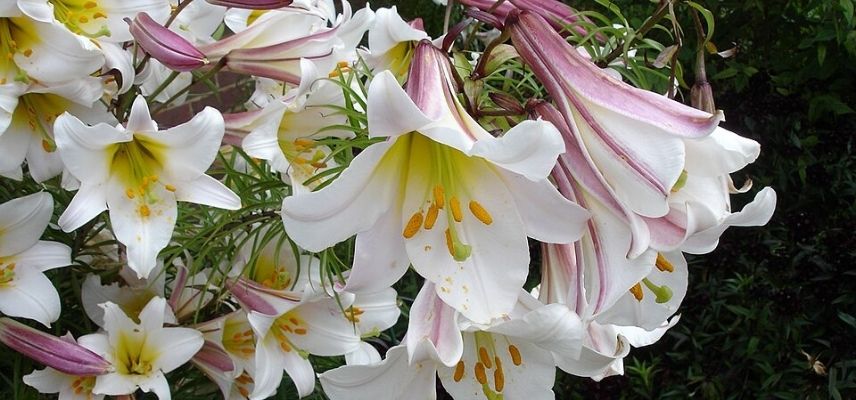
It is perhaps, along with Madonna lily, one of the best-known botanical lilies. It also blooms pure white, with large fragrant trumpet-shaped flowers (10-12 cm) borne in loose clusters. But here, the underside of the flowers is tinged with purplish-pink and the centre of the flower is sulphur-yellow. Lilium regale grows quickly like its cousin Madonna lily, reaching a height of between 1.20 and 1.80 m depending on growing conditions (soil fertility and sunlight). Like Madonna lily and Martagon lily, it prefers alkaline soils.
Martagon lily
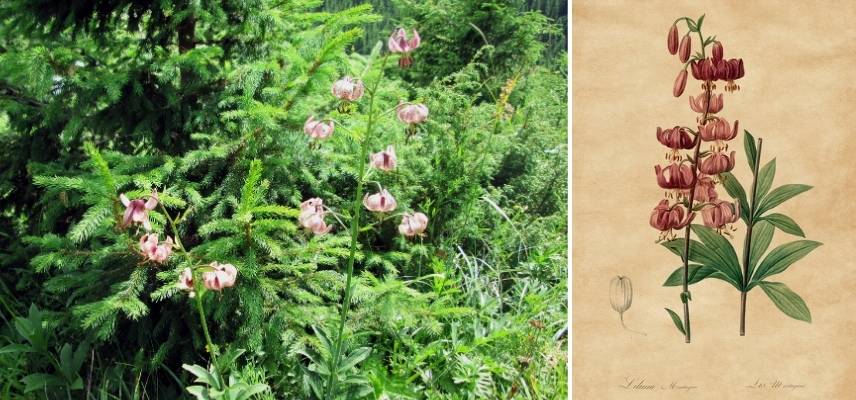
Although many hybrid varieties are now available, martagon lily is a wild lily. Reaching over 1 m in height, up to 1.5 m for the largest, martagon lilies originate from a broad geographical area, mainly southern Europe and its mountain ranges. They are still found in the wild in the Alps, where they are a protected species.
They are characterised by very recurved petals and smaller flowers than hybrid or Asiatic lilies, giving them a very charming appearance.
Where to plant it? Like all botanic lilies, it fits well into natural-style gardens, in the countryside or in the mountains, in a wilder part of the garden, at the back of a border or as background.
Read also
The white martagon lily in all its gloryLilium pumilum or turban lily
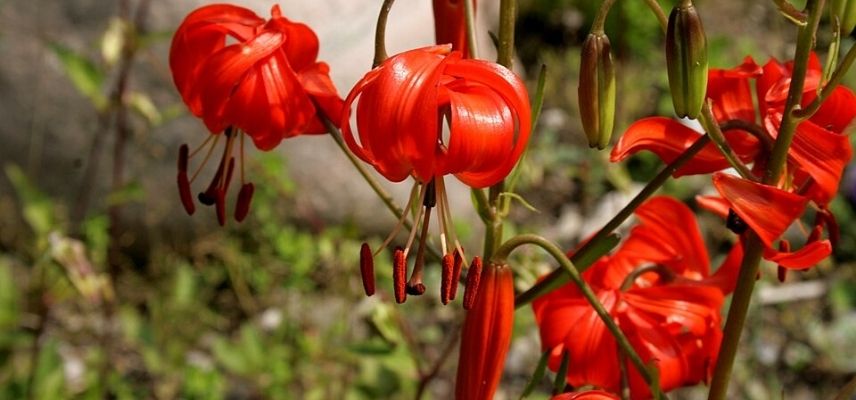
Native to Siberia and China, Lilium pumilum (syn. Lilium tenuifolium) is medium-sized, ranging from 60 cm to 1.20 m. It is relatively short‑lived but multiplies readily from seed.
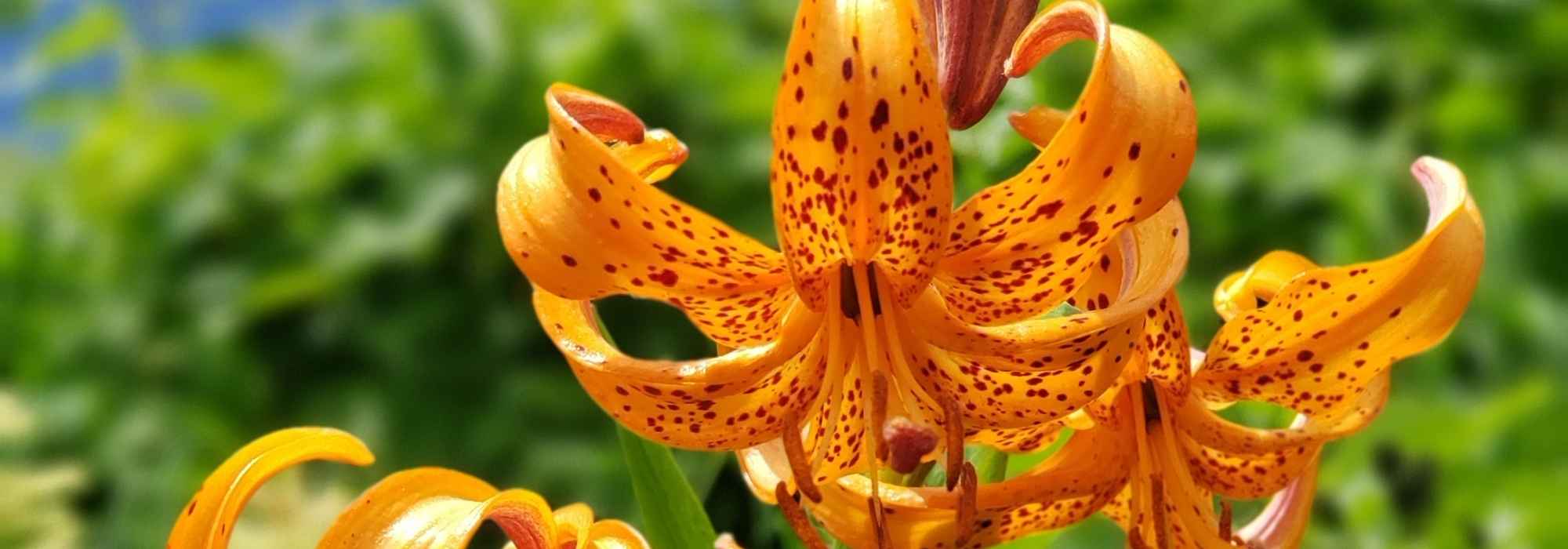
It is mainly characterised by its unique colour, a superb bright coral‑orange, and slightly smaller flowers, 3 to 5 cm across, with very strongly recurved petals that reveal the anthers laden with pollen in shades of orange. This particular form has also earned it the common name turban lily (although other botanical lilies such as Lilium pomponium also claim that picturesque nickname). It likes a sunny position and any good garden soil.
Lilium canadense or Canada lily
Native to North America, as its name suggests, this little rarity is a gem we like to have a few of in the garden. It is one of those lilies with pendulous flowers.
The Canada lily will thrive in any humus-bearing soil. Woodland and partial shade suit it well. This botanical species produces stolons and flowers from July, offering beautiful pendulous, recurved flowers 5 to 8 cm long. Flowering is generally yellow or orange, maculate with brown or purple spots. It grows between 1 m and 1.80 m, making it a good candidate for the back of a partially shaded border.
N.B.: its adventitious roots make it easy to propagate.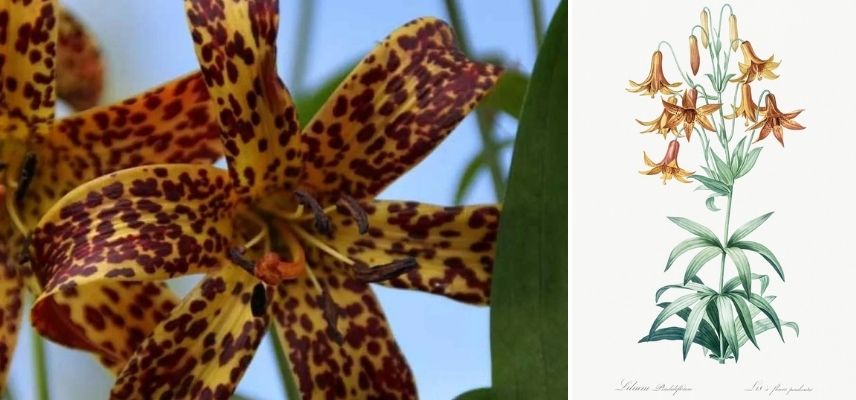
Giant Himalayan lily
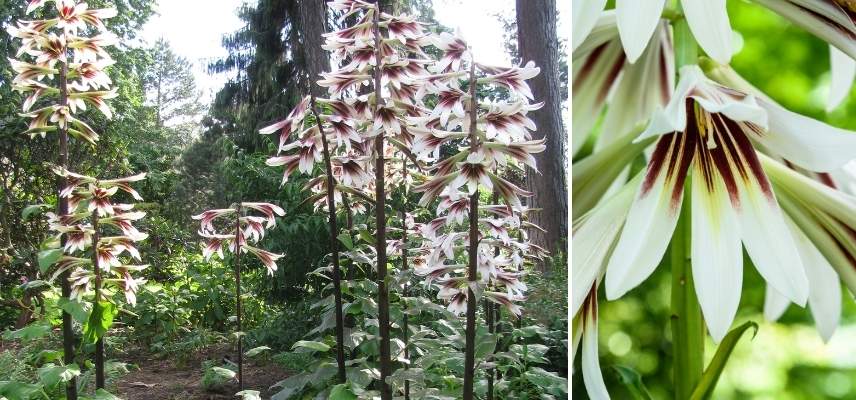
Part of the large family Liliaceae but not belonging to genus Lilium, giant Himalayan lily is actually a Cardiocrinum giganteum. Immense, its scape can reach up to 3.5 m in height in the best natural conditions. This giant lily prefers shaded areas, making it an excellent woodland or woodland-edge garden plant. Its requirements are a very humus-bearing soil, partial or dappled shade exposure (not deep shade), and a spot sheltered from wind for protection.
NB: be patient with this large bulb, which takes a few years to develop its full display. Semelparous, it dies after flowering, having ensured its offspring by producing bulblets.
Lilium cernuum or pink Matsuba lily
Here at last is a pink botanical lily, a less common colour among these wild species, coming this time from Manchuria and Korea. It is sometimes encountered under the name Mandchurian lily. Its Latin epithet cernuum indicates the very nodding character of its flowers. The Mandchurian lily is smaller, measuring only 50 cm in height. It is, like other botanical lilies, nectariferous, attracting numerous bees and butterflies.
We recommend it for temperate gardens in France and for mountain gardens, to plant in sun to partial shade, in well-drained soil enriched with leaf mould (ideally acidic).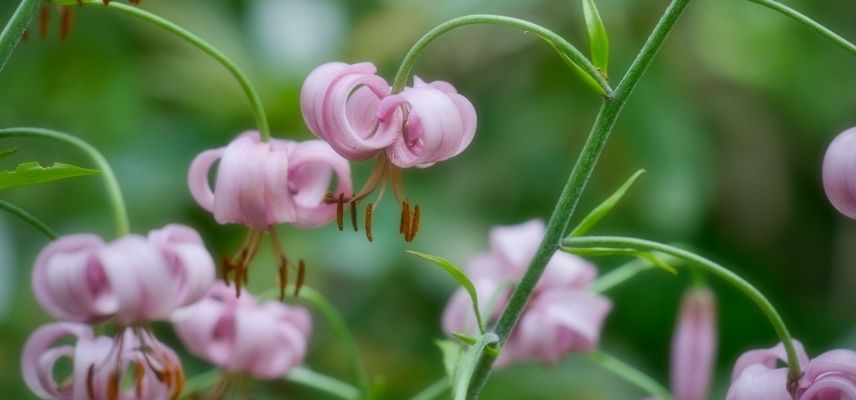
But also...
The following lilies are rare or seldom found in trade. You will encounter them in their native range, but they are no less exceptional:
Lilium auratum, or golden-rayed lily of Japan, white speckled with wine‑coloured spots and a yellow band down the centre of the petals, is simply magnificent. It also has the largest flowers among botanical lilies and prefers partial shade in non‑calcareous soil.
Lilium bulbiferum, European, mandarin‑red in colour, flowers between June and July in full sun. It grows to 80 cm–1 m tall.
Lilium nepalense, or Nepal lily, bicoloured, thrives in acidic soil. Its large purple blotch at the centre of the creamy flower is unique! Plant in partial shade.
Another notable pink botanical lily, Lilium mackliniae also displays a delicate pale pink on the reverse of the petals, white on the inside. It is found wild in Manipur state in north‑east India and in Myanmar, and is often known as the Manipur lily. It is small, about 60 cm tall, and bears nodding, bowl‑shaped flowers. A partial‑shade lily that flowers between June and July.
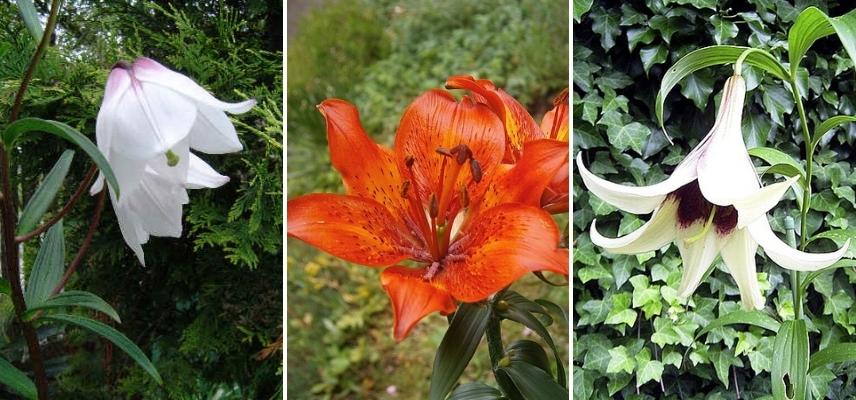
Lilium mackliniae (Wikimedia Commons, copyright Thorkild Pulsen), Lilium bulbiferum (Wikimedia Commons, copyright Meneerke Bloem) and Lilium nepalense (Wikimedia Commons, copyright Denis Barthel
What to know about planting and care of botanical lilies
Five golden rules :
- Perfectly well-drained, rich and cool but never waterlogged soil, even for montane botanical species and those of partial shade.
- Avoid windy positions for the tallest species, and south-facing walls (risk of overheating).
- Pay attention to soil type, some needing a lime-bearing soil (Madonna lily, Canada lily, Martagon lily, Regal lily…), others a more acidic soil.
- Lilies, like clematis, prefer their heads in sun but their bases in shade.
- Leave them to rest after flowering, without watering or adding fertiliser.
- Subscribe!
- Contents
This form is protected by reCAPTCHA - the Google Privacy Policy and Terms of Service apply.

































Comments