
Planting at the base of building façades in towns and cities: benefits, challenges and tips
How flowering wall bases can help tackle climate change
Contents
Facing climate change, our towns and cities are responding by increasingly greening to counter urban heat islands. Among the various options available, planting at the base of building façades is one of the growing trends. It allows residents to brighten their front entrance that opens onto dark, unattractive pavements — and, above all, pavements that act as genuine urban heat sources.
For these micro-gardens carved out of the pavement, which plants are suitable? While a list of suitable plants is often provided to local residents, we offer some ideas to help you make the best choice among plants suited to this restricted space.

Why green the base of building facades in towns?
After tree-pit greening and community gardens, many cities embraced this new urban trend around fifteen years ago. The Netherlands and Belgium were pioneers in Europe. In France, pioneers of what are known as flowered pavements or street gardens were Rennes, Lyon and Angers*: some pavements were “de-tarmacked” for the first time for reasons both aesthetic and, above all, environmental. Reducing mineral surfaces that release heat at night through these micro-ecosystems is the key aim of such greening. Using plants as natural air conditioners, even in small spaces, is becoming not only a priority in heavily built-up urban areas but a necessity for future generations. It enables cities to establish new mini green spaces and gives biodiversity a boost of greenery.
Most cities therefore now encourage these projects for obvious environmental reasons, but also for improving quality of life and creating social bonds between neighbours. This also helps address problem of managing weeds that creep between building walls and pavement, a task that is no longer the responsibility of most cities. Fewer instances of anti-social behaviour (cigarette butts, litter) have even been reported thanks to street beautification in some cities, as awareness of nature and residents’ involvement take effect.
* Rennes in 2004, Lyon in 2005 (“Passe-jardin”) and Angers in 2010. Then “Ma rue est un jardin” in Nantes, Poitiers with “Faites de votre rue un jardin”, “Fleur de trottoir” in Tours, a broader “Végétalisation Cœur de Ville” programme in Angers — all fine concrete achievements in France.
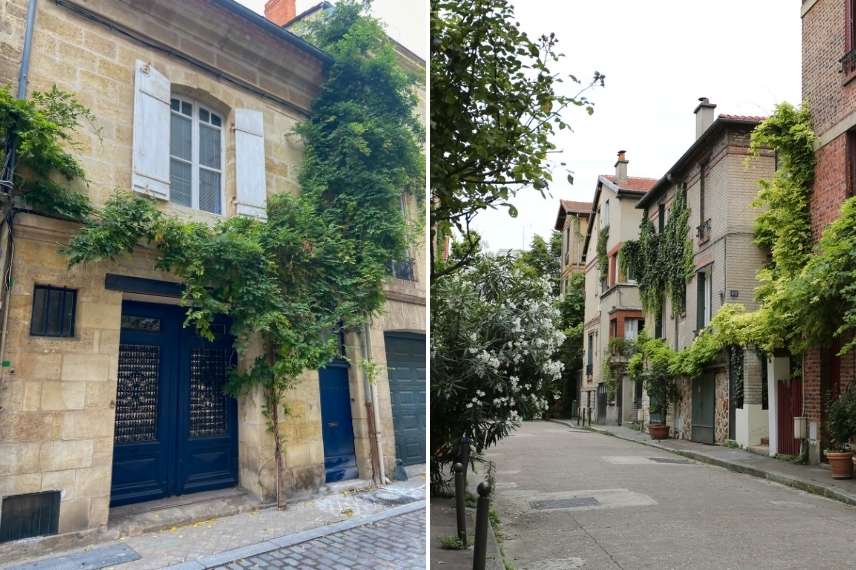
In Bordeaux or Paris, cities that are largely paved, planting at the bases of apartment blocks and houses is gaining ground…
Conditions for greening your façade
Residents may be offered, where underground services allow, a mini-planting pit at the entrance to their house or apartment block. Survey, cutting of the tarmac, addition of soil, supply of plants or seeds, everything is often provided free of charge.
Requests can be made directly by residents or by a neighbourhood collective, a shopkeeper, an association, and in some cases such as town centres it is usually initiated by the council. It is called a “greening permit”, a rather odd term when you think about it. The council then examines feasibility according to width constraints (a clear space of at least 1.40 m must remain for pedestrian movement) and the routing of underground utilities.
If you are a tenant, the request must be made by the owner. For blocks of flats, the annual general meeting (AGM) must give its approval. Having a garden is not required to be eligible.
Once the feasibility study is approved and technical constraints established, the resident must commit to carrying out maintenance (watering, pruning, hand weeding, mulching, training climbers, replacements, etc.) of this micro-garden. They are supported by their city’s Green Spaces services for planting and follow-up.
If authorisation is not granted, it remains possible to green up as is done in southern European countries, by creating one’s own mini-garden of pots lined along the façade in dead-ends or on little-used streets.
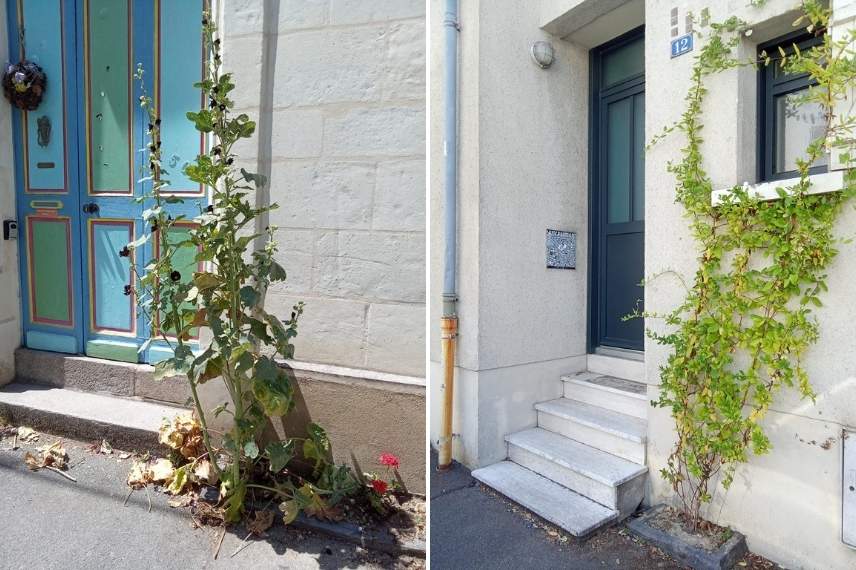
In Angers, the slate planting mini-pits here host hollyhocks on the left and a honeysuckle on the right (Photos Gwenaëlle David Authier)
Which types of plants and which planting constraints apply to these pavement gardens?
These mini-enclaves taken from the public space’s tarmac are very small to avoid obstructing pedestrian traffic (usually a rectangle about 0.15 m wide along the wall and in depth). For miniature planting pits, the council provides not only planting advice but also a specification with a preselected list of plants to use.
Plants must be both attractive aesthetically and, where possible, melliferous, to support biodiversity, and of local origin. Invasive plants are prohibited.
The biggest constraint is the volume and final size plants will reach at maturity. Focus is therefore on plants with limited spread, often climbers, which will also enliven and regulate façades’ temperature of houses or apartment blocks, or on perennial plants and small undershrubs. Arching plants that would take up too much pavement space and all thorny or toxic plants are to be avoided for obvious reasons. Seeds of annuals are also interesting, but must be sown again each year (you may prefer those that self-seed spontaneously). Always refer to your town’s specification for permitted plant height, generally up to 2.00 m.
The easiest-to-maintain climbers and perennials with high ornamental value should also be:
- drought-resistant
- water-efficient
- suited to small volumes
- suited to local climate
- tolerant of urban pollution
- undemanding in soil and care, in short, tough plants!
Key points:
- Generally favour a mix of perennial plants, low groundcovers and climbers, and deciduous/evergreen species to reduce weeding and extend interest over several months.
- Do not encroach on the 1.40 m of pavement reserved for pedestrians, prams and wheelchairs. If plants grow too much, prune them to respect this constraint.
- Respect height limits for climbing plants, which vary by town (usually up to 3.00 m, but some municipalities require plants to be under 1.80 m).
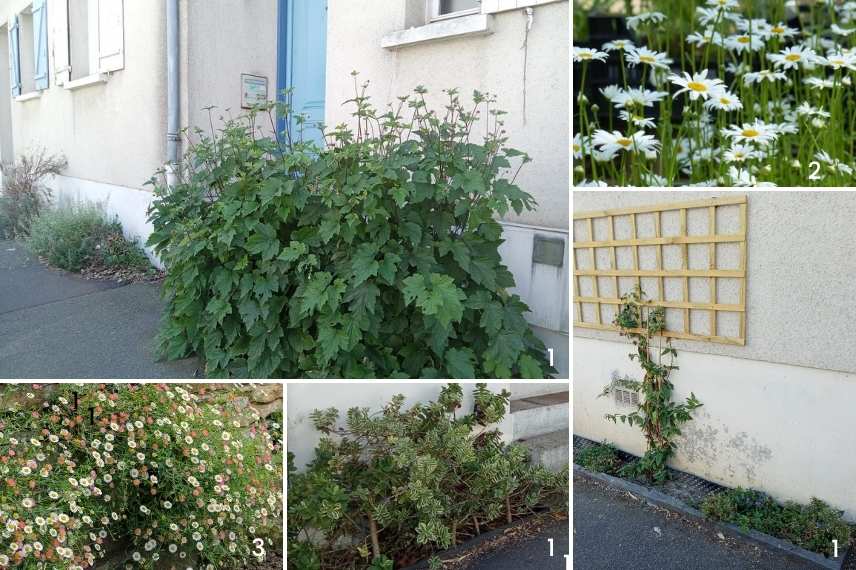
Also in Angers, Japanese anemones, shrubby and climbing veronicas to be trained on a trellis (1), photos Gwenaëlle David Authier. Oxeye daisy (2) and Erigeron karvinskianus (3)
In shade
- Ferns
- Japanese anemones
- Astilbes
- Saxifrages
- Bugle (Ajuga reptans)
- Compact hostas
In partial shade (between 3 and 6 hours of sun/day)
- Hardy geraniums
- Alchemilla mollis
- Japanese anemones
- Hellebores
- Bergenia
- Heucheras
- Climbers: honeysuckles, star jasmine
- Carex and liriopes
- Catananches
- Daisies (Leucanthemum vulgare)
- Among annuals: Antirrhinum majus (snapdragon), marigolds and nasturtiums
In full sun
This is a south-facing exposure with more than 6 hours of sun/day, perfect for:
- Hollyhocks
- Achilleas (yarrow)
- Compact lavenders such as ‘Hidcote‘
- Agapanthus
- Valerians
- Perovskia atriplicifolia ‘Blue Spire’
- Heathers
- Shrubby and herbaceous sages
- Large autumn sedums
- Agastaches
- Bearded iris
- Compact thymes
- Compact or medium Gauras such as Gaura lindheimeri ‘The Bride’
- Toadflaxes (Linaria)
- Catananches
- Erigerons
- Helichrysum, fescues and feather grass
- Oxeye daisies (Leucanthemum vulgare)
- Marigolds (Calendula)
- Common viper’s bugloss
- Climbers such as compact wisterias, star jasmine and clematis
- Annuals such as nasturtiums and tuberous nasturtiums, morning glories, sunflowers, California poppies…
For a south- or west-facing exposure, also consider aromatic plants such as oregano or lemon verbena. Many towns allow vegetable planting. Discover our ideas for creating a vertical vegetable garden!
- Subscribe!
- Contents
This form is protected by reCAPTCHA - the Google Privacy Policy and Terms of Service apply.

































Comments