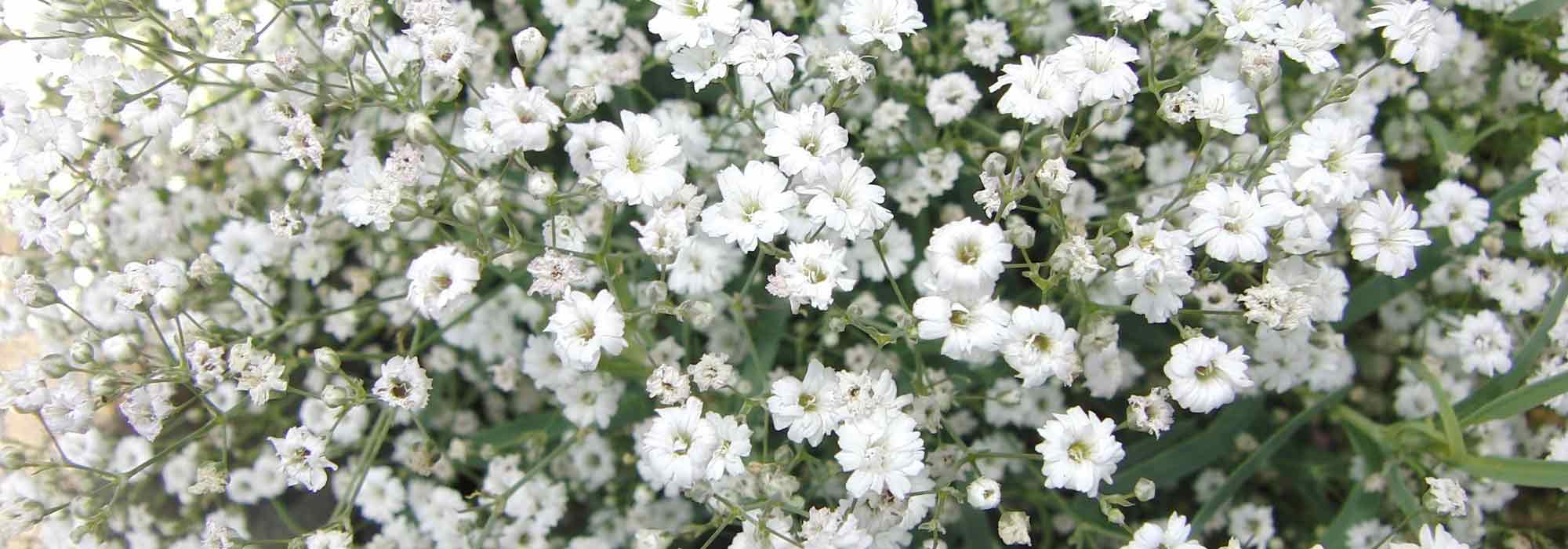
Gypsophile: planting and care
Contents
Gypsophile in a nutshell
- Gypsophila is a pretty airy plant with clouds of white or pink flowers
- Highly floriferous, you’ll enjoy its abundant flowering from late spring to early autumn
- Perfectly hardy and robust, it requires very little care once well established in full sun, in well-drained lime-bearing soil
- Tall or groundcover, it will make a striking impression in vicar’s gardens, wild gardens, in borders or rockeries
- It is also particularly prized for adding an airy touch to cut flower arrangements
A word from our expert
The Gypsophila is a pretty perennial or annual plant offering a profusion of small star-shaped flowers that give the impression of a cloud of froth or a sheet of mist.
Clouds of delicate white or pink flowers appear profusely from June to September. White Gypsophila or pink Gypsophila, tall forms such as Gypsophila paniculata, creeping forms such as Gypsophila repens or annuals such as Gypsophila muralis, all are indispensable in the season for the touch of lightness and delicacy they provide.
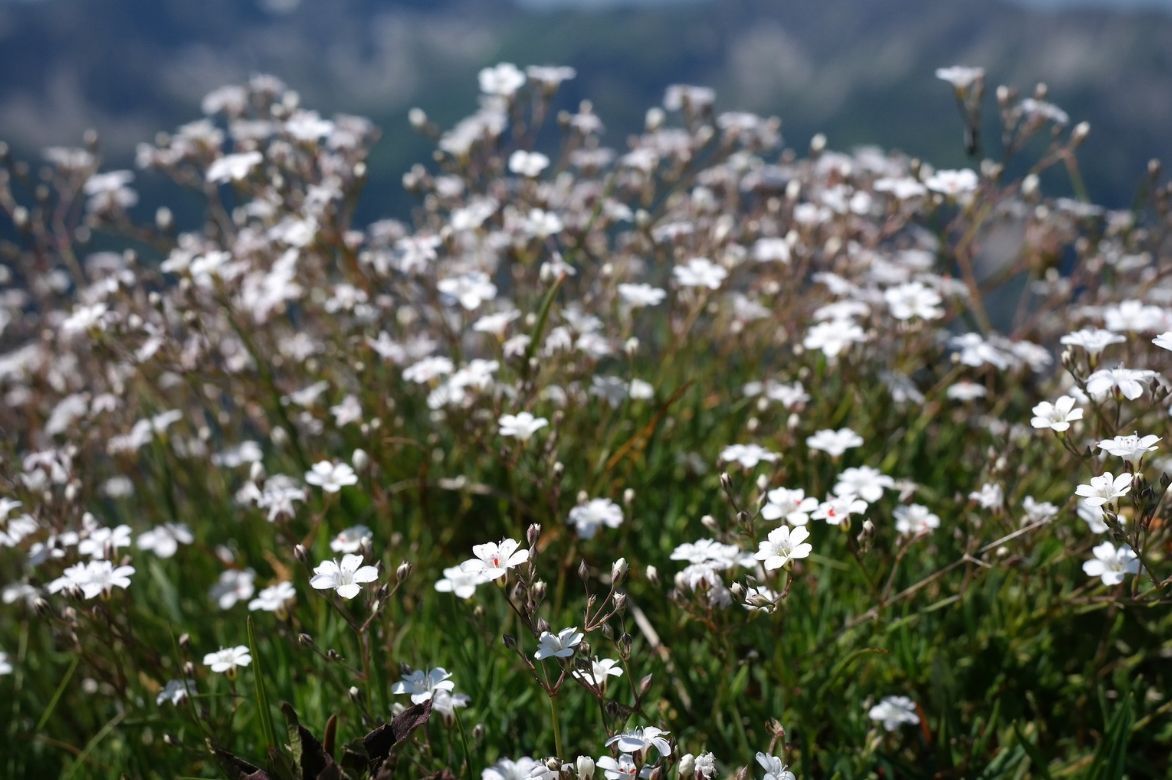
Despite its delicate appearance, Gypsophila is very hardy; favouring calcareous soil, it endures cold down to -15°C in well-drained conditions and tolerates drought.
Whether tall or a groundcover, it fits into all settings where it forms an evanescent mist in beds or borders or a mossy flowering carpet in rockeries. Indispensable in white gardens and romantic gardens, Gypsophila is also much appreciated for bringing an airy, refined volume to a wedding bouquet!
Delicate and chic, whether perennial plants or annuals, discover our Gypsophilas, in pots or as seeds, and enjoy their airy summer flowering!

Description and Botany
Botanical data
- Latin name Gypsophila
- Family Caryophyllaceae
- Common name Gypsophila (baby's breath)
- Flowering May to September
- Height 0.15 to 1 m
- Exposure Sun
- Soil type All, well-drained
- Hardiness -15°C
Gypsophila is a herbaceous plant, annual or perennial depending on species, belonging to the family Caryophyllaceae. It is found wild in high-altitude areas, on rocky ground and slopes of southern Europe, particularly the Iberian Peninsula and Central Asia.
The genus includes more than a hundred species and varieties, the most widespread being Gypsophila paniculata, often nicknamed “brouillard”, an erect form reaching 1 m tall, and Gypsophila repens, a mat-forming species. Both have given rise to hybrids such as gypsophilas ‘Rosenschleier’, ‘Flamingo’ and ‘Rosa Schönheit’.
There is also Gypsophyla cerastioides, a gypsophila that develops as a compact cushion, as well as some annual species such as Gypsophila muralis (wall gypsophila) and Gypsophila elegans, perfect for bouquets.
Plant develops from a thick, sometimes woody crown composed of deep but fragile roots. Habit varies by species, ranging from an erect, bushy form to a dense, mat-forming groundcover, sometimes even turf-forming.
Gypsophila forms a bushy, rounded, very branched clump, reaching at least 1 m in all directions, or else a spreading cushion, not exceeding 10 to 20 cm in height and about 40 cm wide at maturity.
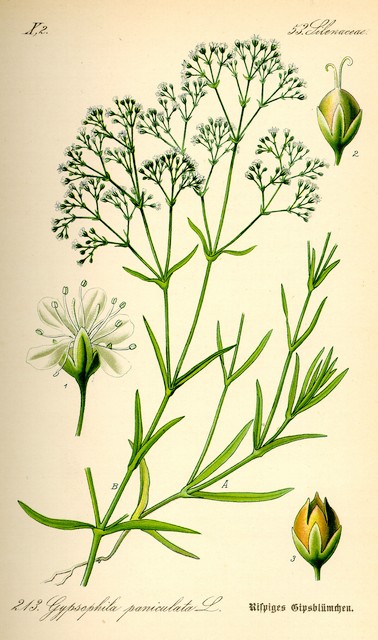
Gypsophila paniculata – botanical illustration
With normal to slow growth, it can live quite a long time in very well-drained soil; conversely, in heavy soil it will be short-lived and behave as an annual.
Foliage is fine and discreet, evergreen to semi-evergreen. Small linear, lanceolate leaves, sometimes fleshy, glabrous or hairy, 5 mm to 10 cm long, are arranged in opposite pairs on very fine, highly branched creeping or ascending stems. Leaves are medium green to slightly bluish green, glaucous.
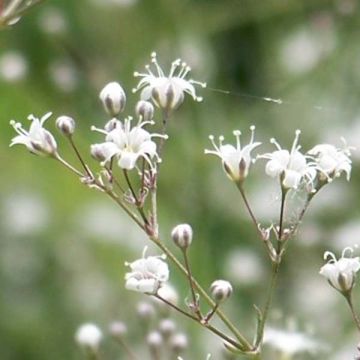
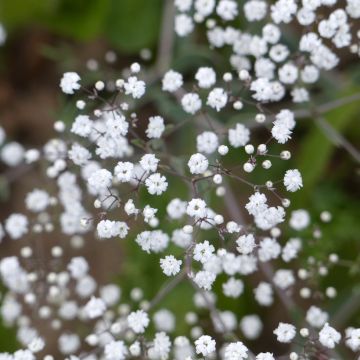
Gypsophila is remarkable for the poetry and profusion of its flowering, whether prostrate or tall. Called also “brouillard” or “baby’s breath” in English, the shrub transforms, from May to September, into a gauzy cloud of numerous small solitary inflorescences or grouped in large, airy panicles at the tips of the many stems.
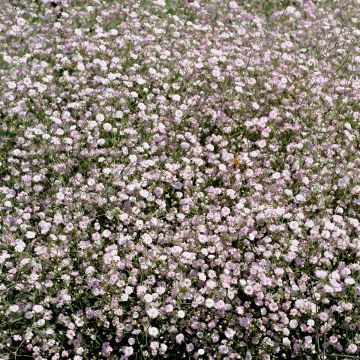
Resembling swarms, these tiny star-shaped or trumpet-shaped flowers, measuring 0.5 to 2 cm across, form an evanescent floral mist that is both attractive and extremely light. Groundcover species almost entirely disappear beneath an avalanche of small, rounded flowers.
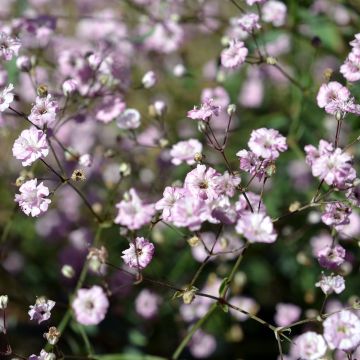
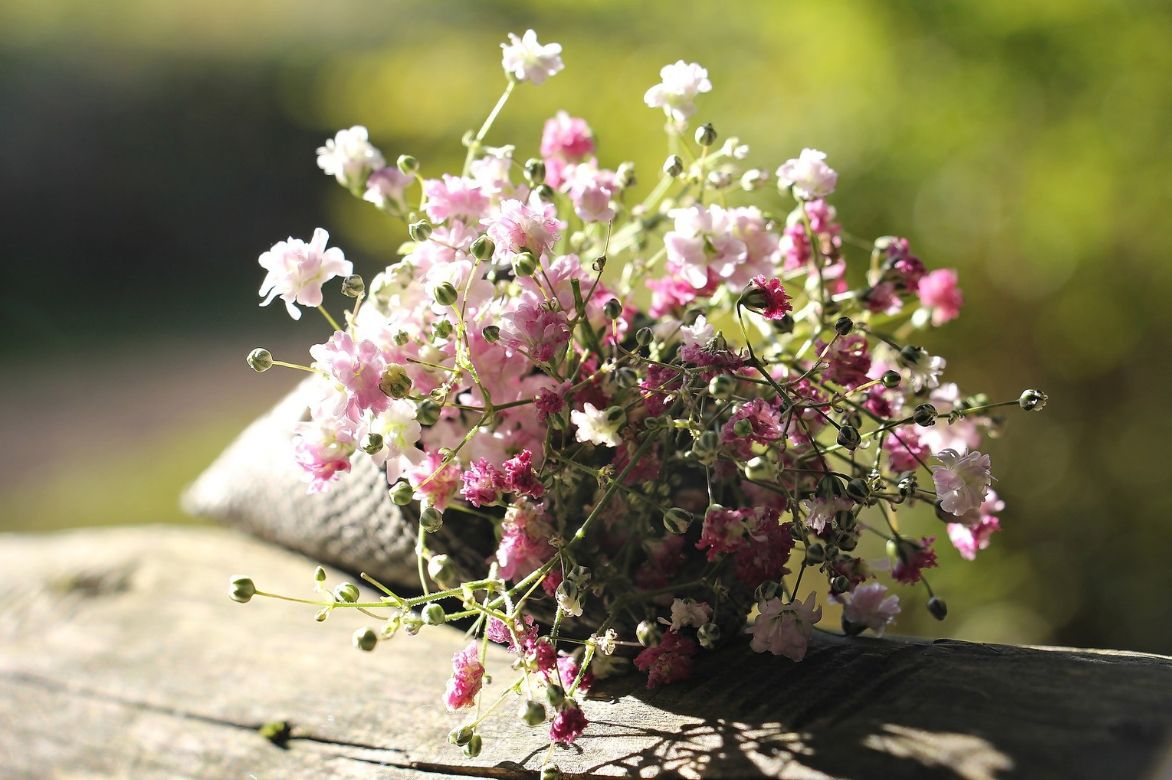
Simple or double, in the form of fluffy pom-poms, they are made up of 4 to 5 petals and display pastel shades ranging from pure white to pale or deep pink, sometimes with candy-pink and white gradations.
Delicate, they evoke tiny soft, velvety roses and bloom throughout summer.
When cut, these light flowering stems are much prized by florists for fresh or dried bouquets, to which they add delicate volume.
Hardy down to -15°C, drought-tolerant and undemanding, despite its delicate appearance, Gypsophila is truly an easy plant to grow. From its Mediterranean origins, it has retained a taste for heat and requires full sun.
Gypsophila does not like humidity. In Greek, its name means that it loves the aridity of calcareous soils: it grows in light, deep, porous soil, from dry to fresh, even stony, and above all very well drained.
Gypsophila makes a strong impression in wild gardens, dry gardens, rockeries and flowering dry-stone walls, on sunny banks to which it brings a gauzy texture. It also adapts very well to containers and flowering pots.
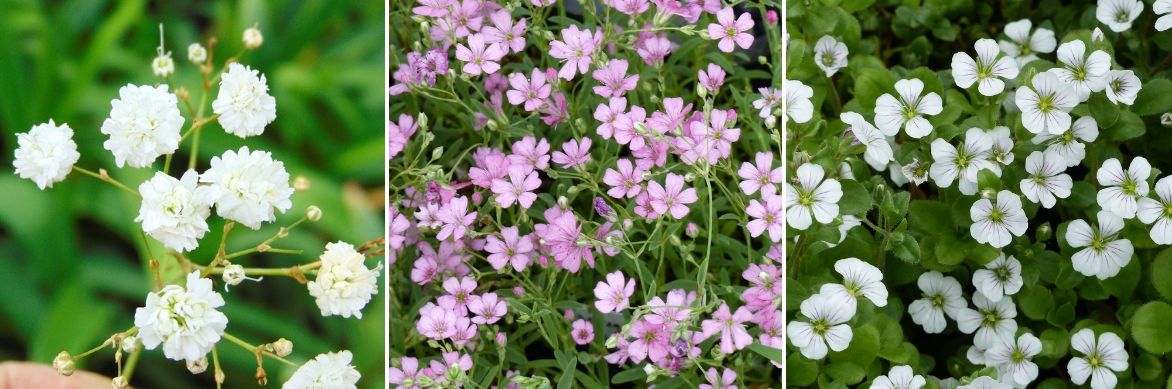
Main species and varieties
Around a hundred species and varieties of Gypsophila are distinguished, including creeping gypsophilas such as Gypsophila repens and Gypsophyla cerastioides, known as “cushion gypsophila”, and upright-growing Gypsophila paniculata, which can reach up to 1 m in height and form dense clouds of distinctive white or pink flowers. These two widely distributed perennial species have given rise to some interesting hybrid forms. There are also a few annual species such as Gypsophila muralis and Gypsophila elegans.
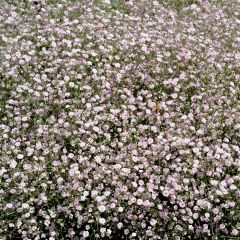
Gypsophila Rosenschleier
- Flowering time July to September
- Height at maturity 50 cm

Gypsophila repens Rosa Schönheit
- Flowering time July to September
- Height at maturity 20 cm
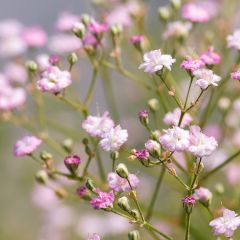
Gypsophila paniculata Flamingo
- Flowering time July to September
- Height at maturity 1 m
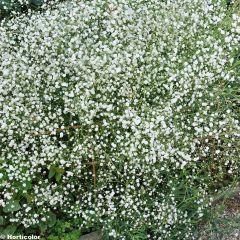
Gypsophila paniculata Bristol Fairy
- Flowering time August to October
- Height at maturity 1,50 m
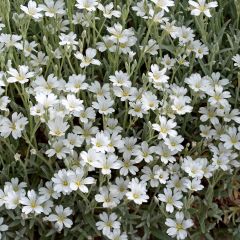
Gypsophila repens Alba
- Flowering time July to September
- Height at maturity 20 cm
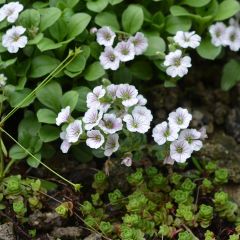
Gypsophila cerastioides
- Flowering time June to August
- Height at maturity 10 cm
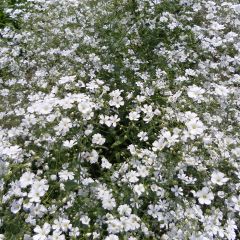
Gypsophila elegans Covent Garden Seeds
- Flowering time July to November
- Height at maturity 45 cm
Discover other Gypsophila
View all →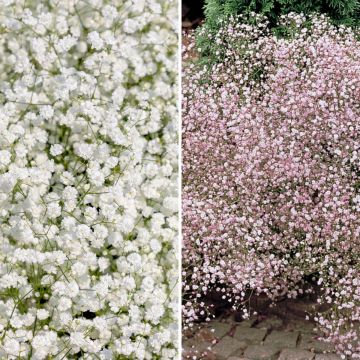
Available in 0 sizes
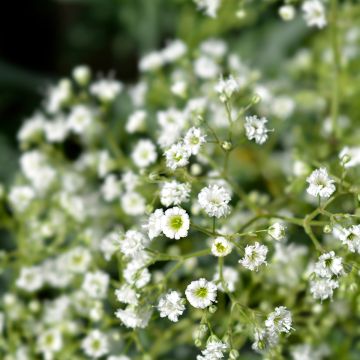
Available in 1 sizes
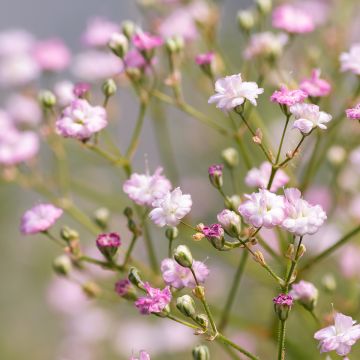
Available in 2 sizes
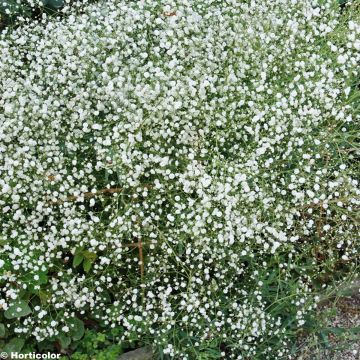
Available in 3 sizes
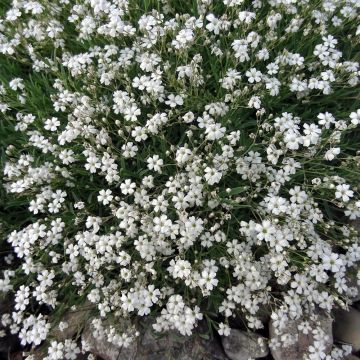
Available in 1 sizes
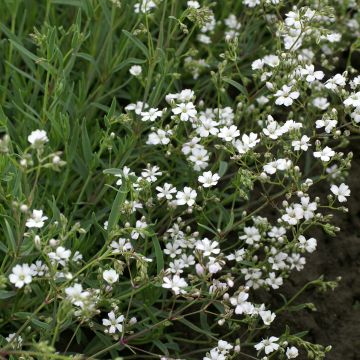
Available in 1 sizes
Available in 1 sizes
Available in 1 sizes
Available in 2 sizes
Available in 1 sizes
Planting
Where to plant Gypsophila
With very good hardiness, Gypsophila grows almost everywhere in France. It tolerates frost and endures temperatures below at least -15 °C in well-drained soil.
This perennial requires sun and warm exposures and prefers porous, rather dry soils. Well adapted to drought, this plant likes light, poor, even lime-bearing soils, and above all very free-draining soils in which it will be long-lived. It will also tolerate ordinary garden soil provided drainage is perfect.
Gypsophila hates heavy, waterlogged and poorly drained soils in winter: in waterlogged, compact, clayey soil it will behave like an annual and die the winter after planting.
Give it an open spot, because Gypsophila likes space and tends to spread. It dislikes root competition: therefore give it air and above all avoid moving it, as its very fragile roots do not like being disturbed.
In the centre or at the edge of slightly heavy perennial beds, which they lighten, the tall Gypsophila paniculata, which can reach 1 m in height, will provide a vapoury relief in wild and informal gardens. Groundcover species such as Repens can cover large areas and are perfect in rockeries, in the crevices of low walls, in scree and in pots or planters.
All are indispensable for charmingly and romantically dressing the base of shrubs, especially roses.
When to plant Gypsophila
Planting Gypsophila is preferable in spring, between March and April, after frosts. Autumn planting is also possible, from September to November in mild climates.
How to plant Gypsophila
In open ground
Gypsophila dislikes overly heavy soils: add river sand or gravel to lighten the soil. It does not like crowding or root competition: favour a well-aerated planting. This is a very airy plant that remains transparent: plant in large clumps for a nice effect in a border or herbaceous bed, allowing 5 plants per m², spaced at least 40 cm apart for groundcover species and 1 m for the tallest varieties.
- Dig a hole 2 to 3 times the width of the rootball
- Fork over the soil well and remove roots and weeds. Add large stones or gravel to a depth of 20 cm at the bottom of the hole
- Mix half river sand or pumice with the excavated soil
- Plant without breaking the rootball and backfill the hole
- Firm the soil lightly with your foot
- Water regularly during the first summer to encourage rooting
In a pot
While groundcover species such as Gypsophila repens adapt well to container growing, the larger varieties will also do well in fairly deep pots.
The substrate must be very free-draining to avoid stagnant moisture and root rot. Too clayey a soil will be detrimental to this undemanding plant’s hardiness: improve drainage with gravel or a mix of stones.
- In a pot of at least 50 cm diameter, lay a generous drain layer
- Plant in a mix of 50 % compost and 50 % coarse river sand or pumice
- Place in full sun
- Water at planting then regularly but sparingly, allowing the soil to dry between waterings
When and how to sow Gypsophila seeds?
Sowing applies to Gypsophila varieties grown as annuals and is an option if you want to flower large areas to create a flower meadow. Sow your Gypsophila seeds in early spring between April and May or in seed trays undercover in autumn to obtain earlier flowering.
In open ground
- Scatter seed on well-cleared, light, free-draining soil
- Sow seeds 3 mm deep
- Thin to about 30 cm, more for larger Gypsophila
In seed trays
- Scatter seed in a tray or in pots filled with compost mixed with sand
- Cover seeds with same mix
- Firm down lightly
- Keep moist under a cold frame until germination, which occurs within 21 days
- Thin a few seedlings at emergence
- Pot up seedlings shortly after emergence into small pots
- Plant out when soil begins to warm, in May, into light, well-drained soil
Care and maintenance
Gypsophila requires little maintenance and is undemanding in water. It is perfect in a dry garden and country gardens.
Water regularly during the first summer to encourage establishment. Once established in well-drained soil, it will become increasingly drought-tolerant and will only need watering in prolonged drought. In a pot: always let the soil dry out completely between waterings.
It is undemanding, tolerating poor soils and does not require fertiliser.
Weed regularly around its base and provide a gravel mulch to avoid that chore.
Stake tall Gypsophila with brittle stems or plant them at the base of roses so they can take support from the shrubs. If necessary, tie in the tall stems.
Remove faded flowerheads as they appear.
Creeping Gypsophila varieties are not pruned: simply remove damaged stems if necessary.
Cut back the dry stems of large species after flowering.
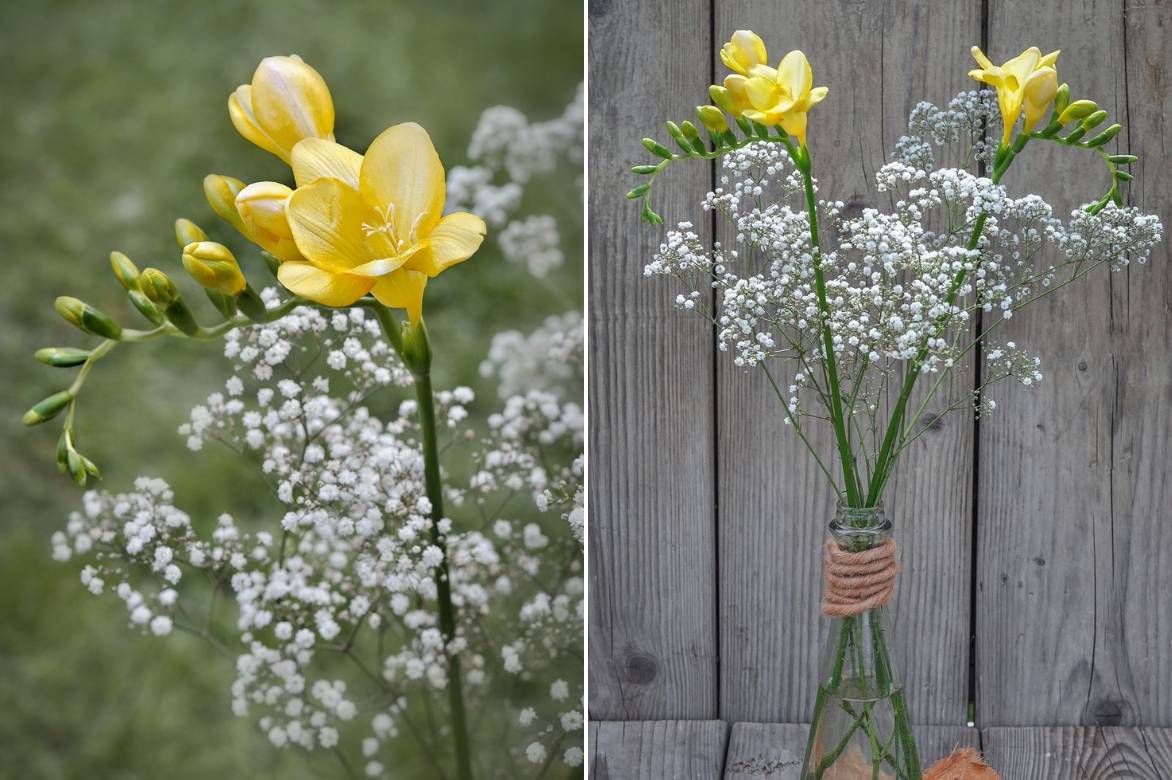
Cut flower arrangement of Freesia and Gypsophila paniculata ‘Bristol Fairy’
Potential pests and diseases
When grown in well-drained soil, Gypsophila shows good resistance to diseases. It is truly susceptible to only two things: excess water and gastropods at the start of the growing season.
Excess water in soil encourages fungal diseases leading to rotting of stems or collar: a well-drained soil will prevent fungal growth.
If young plants are eaten by slugs and snails: follow all our advice on combating these gastropods!
Multiplication: propagation by cuttings
Once well rooted, Gypsophila does not like to be disturbed; division is not recommended because the risk of damaging the root is considerable. Moreover, Gypsophila is very easy to sow. Root cuttings are possible.
How to take a Gypsophila cutting
- In spring, remove offshoots from edge of clump
- Cut these fleshy root pieces at their base
- Insert them into a bed of gravel in a mix of turf and river sand
- Water occasionally
- Pot on into a larger pot and plant out in open ground the following spring
- Replant once cutting has developed sufficient roots
→ Discover Angélique’s tutorial on propagating Gypsophila
Companion plants for Gypsophila in the garden
White or pink vaporous clouds of Gypsophila are perfect for playing with shades and gradations, softening intense colours. With its slender silhouette, delicate, airy foliage and pastel inflorescences, it transforms a simple perennial bed, a soft rockery or an unremarkable mixed-border into a poetic scene.
It is an ideal plant for filling gaps and ensuring continuity of flowering.
It is the ideal companion for old or modern roses or tree peonies, dressing their bases with which it composes romantic summer scenes. It adds charm to cottage gardens and country gardens, bringing volume, delicacy and lightness. It is a staple of white and pink gardens.
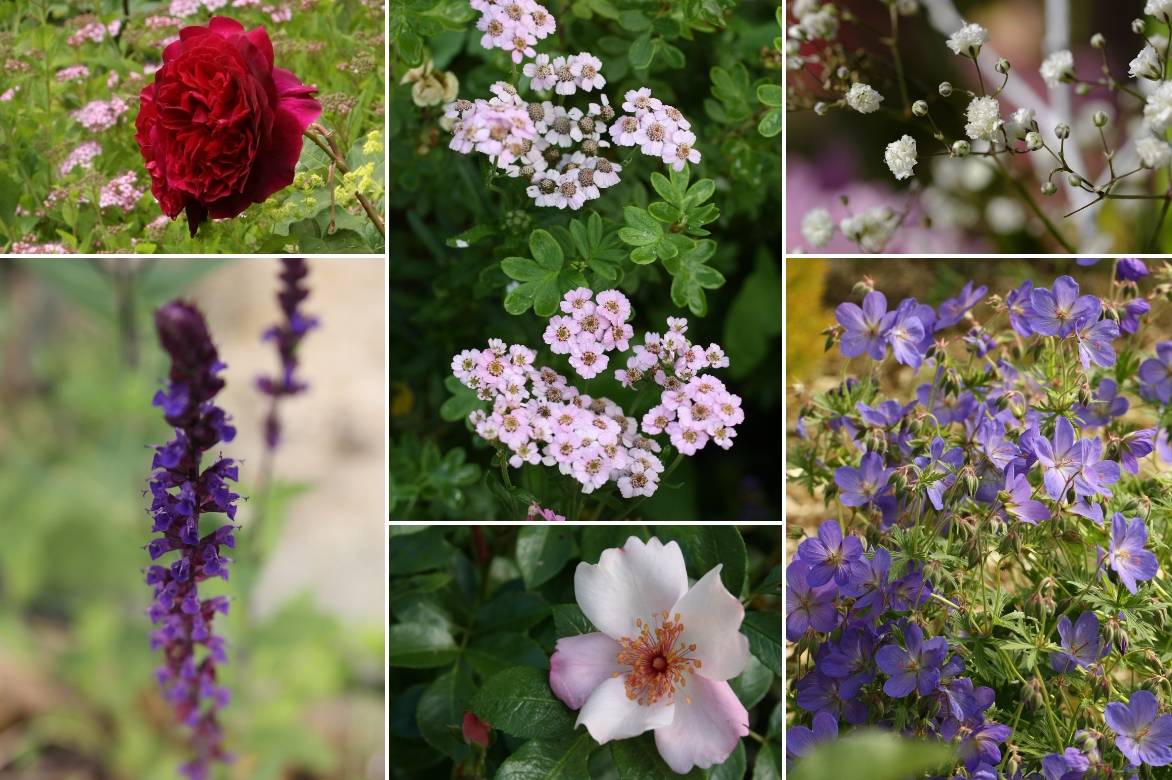
An example pairing: Rose ‘Munstead Wood’, Salvia nemorosa ‘Caradonna’, Achillea ‘Love Parade’, Rose ‘Astronomia’, Gypsophila paniculata ‘Bristol Fairy’, Geranium ‘Johnson’s Blue’
It enhances deep pink, carmine or crimson flowers of garden poppies, carnations or sages and the glaucous foliage of Achilleas millefolium, Euphorbias or even lavenders.
Its extraordinary lightness makes it ideal for heavier perennial plantings or those with large flowers, such as oriental poppies, garden irises, echinaceas, phlox, Verbascums, Hesperis matronalis or thistles.
In graceful, delicate compositions, pair it with Cosmos, gauras, delicate asters or the vaporous Thalictrums whose flowering it accompanies.
In containers, it will keep company with sedums, pelargoniums and petunias.
→ Discover other pairing ideas with Gypsophila in our advice sheet
Useful resources
- Elegant and chic, Gypsophila stands out in a white garden
- With its pastel shades, Gypsophila is a must in a romantic border; discover its companion plants!
- Its slightly airy appearance and easy maintenance make Gypsophila indispensable in country gardens
- It’s a lovely solution to dress the base of your roses
- Some tips to grow Gypsophila in pots
- Also read our advice sheet on the best long-lasting flowers and foliage for your cut flower arrangements
- Discover the qualities of different Gypsophila varieties!
- Subscribe!
- Contents
This form is protected by reCAPTCHA - the Google Privacy Policy and Terms of Service apply.

































Comments