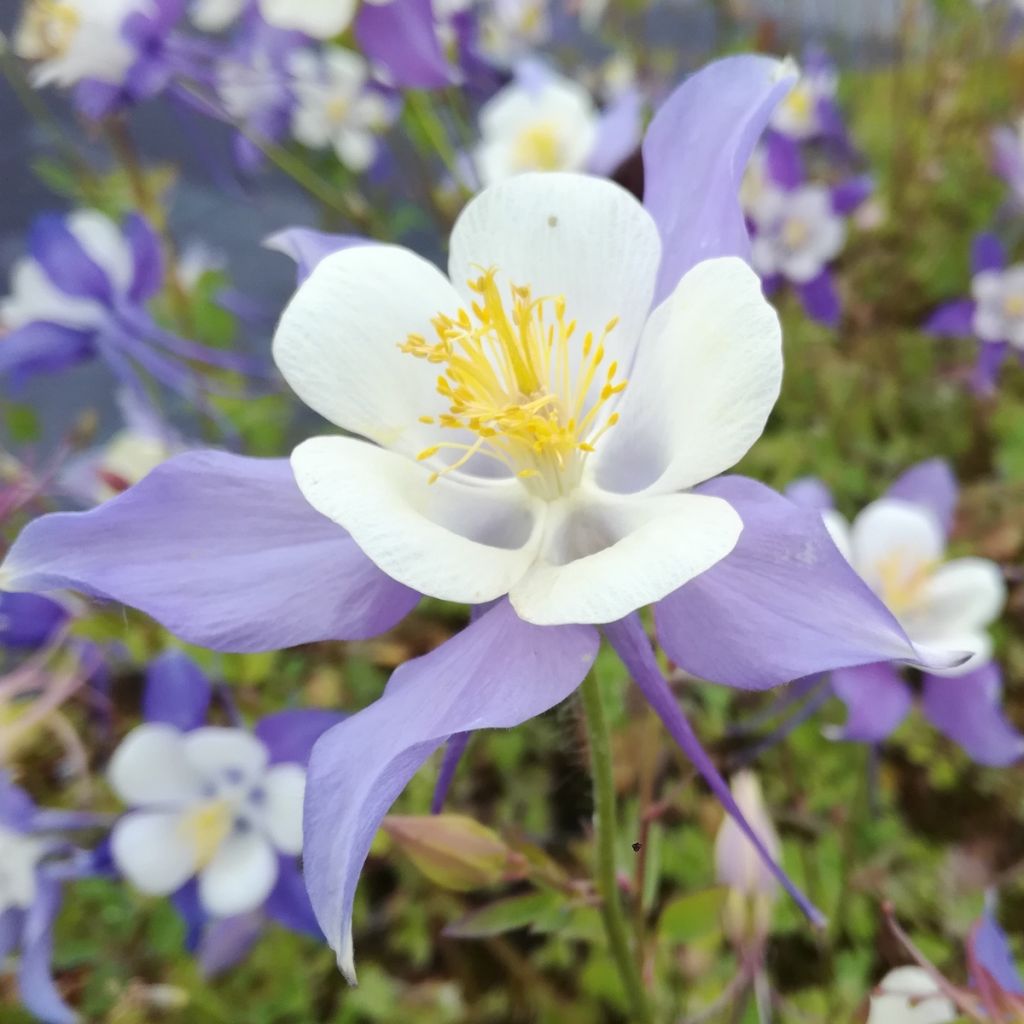
Aquilegia caerulea - Blue columbine
Aquilegia caerulea - Blue columbine
Aquilegia caerulea
Colorado Blue Columbine, Rocky Mountain Columbine
Back-to-school special offer!
Get €10 off for every €50 you spend! And get up to €40 off on a single order.
How does it work?
1. Shop your favourites
Add your favourite plants to your basket. For every €50 you spend (excluding delivery charges, store credit and the plastic-free option), you’ll receive a €10 voucher.
€50 spent = €10 voucher
€100 spent = €20 voucher
€150 spent = €30 voucher
€200 spent = €40 voucher
2. Place your order
Once your basket reaches one of the spending thresholds, place your order. You can even choose your delivery date!
3. Receive your voucher
As soon as your order has been shipped, you’ll receive an email containing your personal voucher code and its value.
4. Use it on your next order
Your voucher is valid for 90 days from the date you receive it. It can be used once only, on a new order worth at least the value of the voucher, excluding delivery charges.
Please note: Vouchers can be combined with other offers, but cannot be split or refunded.
Home or relay delivery (depending on size and destination)
Important: You may be charged customs duties by your country’s customs authorities upon delivery.
Schedule delivery date
and select date in basket
This plant carries a 12 months recovery warranty
More information
We guarantee the quality of our plants for a full growing cycle, and will replace at our expense any plant that fails to recover under normal climatic and planting conditions.
Would this plant suit my garden?
Set up your Plantfit profile →
Description
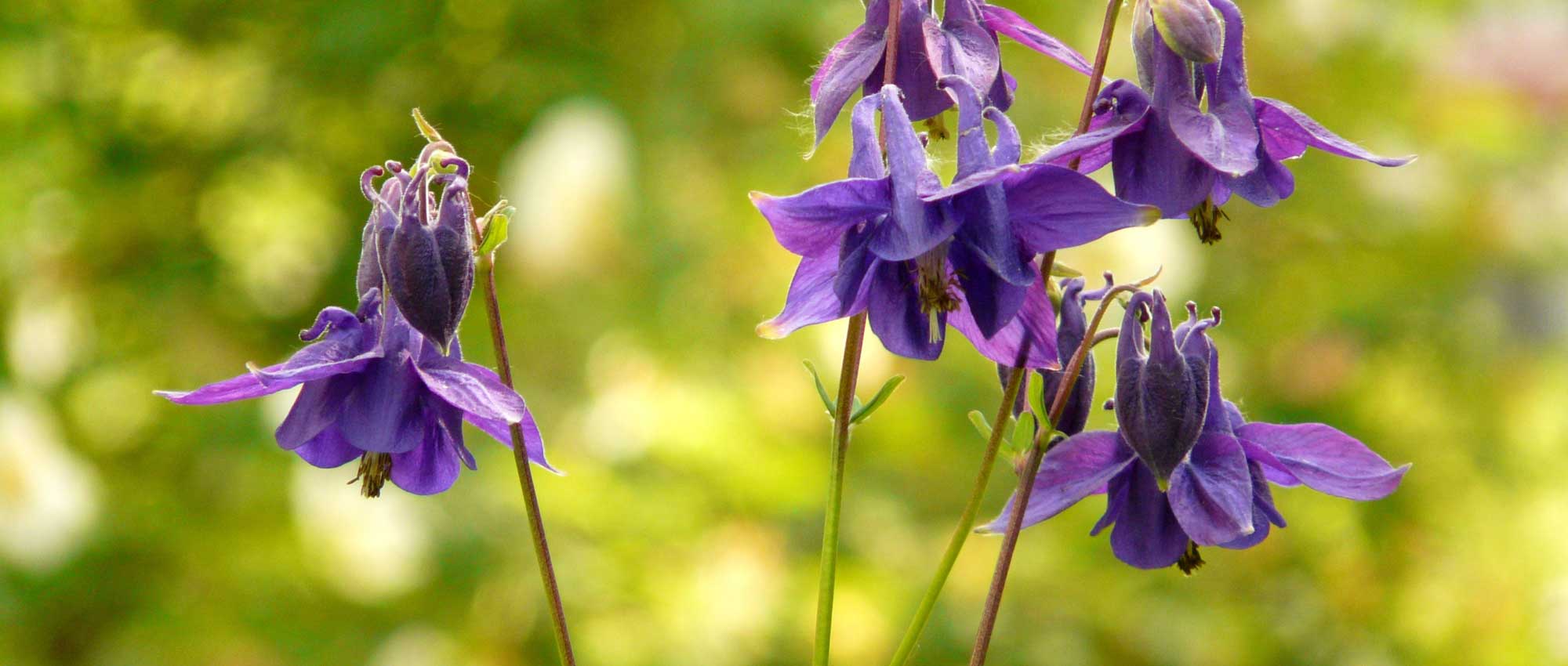
Aquilegia coerulea (or caerulea), nicknamed the Blue Columbine, is a wild plant native to North America. Its natural beauty allows it to rival horticultural varieties, both in ornamental value and ease of cultivation. This perennial forms a clump of pleasantly divided green leaves, topped in spring by flower stems that rise up to 60 cm tall, bearing very artistic flowers, sometimes entirely blue, or more often bicoloured (blue and white). Adapting to most damp, well-drained soils, it thrives in sun or partial shade, and is very hardy, down to below -20°C. It compensates for its fairly short lifespan (3-4 years) with a propensity to self-seed in the garden.
The Columbine is a member of the Ranunculaceae family, rich in many ornamental genera, such as Buttercups (Ranunculus), which obviously gave the family its name, Hellebores (Christmas Roses) and all the Clematis, superb popular climbing plants. There are about sixty wild species of Columbines. The Blue Columbine is a perennial plant native to North America and the official symbol of the State of Colorado. It grows more specifically in mountainous regions stretching from southern Montana to New Mexico, and from Idaho to Arizona. This herbaceous plant has an upright, slender silhouette, reaching between 20 and 60 cm in height. The foliage is green, usually not glaucous (bluish). The leaves are smooth on the upper surface and smooth to hairy underneath. They are prettily divided into small segments, which are themselves slightly indented, giving them undeniable grace. This slender vegetation forms a fairly low, small clump, about twenty centimetres high. In spring, long flower stems rise and branch, each bearing a few flowers, well visible above the foliage. The flowers are most often bicoloured, in white and blue, some specimens being completely blue, others sometimes incorporating pinkish-white. The calyx is formed of five blue or pale blue, elongated sepals measuring 20 to 40 mm long, spreading horizontally. The corolla consists of five white, or more rarely blue, rounded to spatulate petals, 15 to 25 mm long, forming a sort of cup that surrounds the heart of the flower. From this heart, golden yellow stamens burst outwards, while at the other end, long spurs of 30 to 45 mm give the plant its originality and its decorative geometry. The flowers, which measure 6 to 8 cm, bloom between April and June, with some years a small second flush in September. The deciduous foliage disappears in winter to return the following spring.
Columbines, formerly called cornets, already adorned flowerbeds in the Middle Ages, a tradition preserved in cottage gardens. The sculptural quality of the Blue Columbine combines a certain sophistication and a natural look that allows it to find its place in most gardens. Under light shade, you can associate them with Epimediums, which will rival them in grace, as will Bleeding Heart (Dicentra) with its original and equally slender flowers. Foxgloves will also be good companions, adding a touch of height to your scene, as will Veronicastrums which will be ideal in the background and extend the flowering period of your border.
Flowering
Foliage
Plant habit
Botanical data
Aquilegia
caerulea
Ranunculaceae
Colorado Blue Columbine, Rocky Mountain Columbine
Aquilegia caerulea
North America
Planting and care
Aquilegia coerulea appreciates well-drained, slightly moist, rich soils, and prefers a position in non-scorching sun, or under light shade in very bright climates. It tolerates limestone well. It is very resistant to diseases, but can sometimes be attacked by aphids and some caterpillars. Young plants can be attacked by slugs and snails. As Columbines self-seed readily in the garden, leave a few flower stems after flowering, so that they produce seeds. It is advisable to only keep the stems of the most vigorous plants, as this operation exhausts the plant and reduces its longevity, which is rather short for a perennial; expect 3 to 4 years.
Planting period
Intended location
Care
Planting & care advice
-
-
-
-
-
-
-
-
This item has not been reviewed yet - be the first to leave a review about it.
Recently viewed products
Haven't found what you were looking for?
Hardiness is the lowest winter temperature a plant can endure without suffering serious damage or even dying. However, hardiness is affected by location (a sheltered area, such as a patio), protection (winter cover) and soil type (hardiness is improved by well-drained soil).

The flowering period indicated on our website applies to countries and regions located in USDA zone 8 (France, the United Kingdom, Ireland, the Netherlands, etc.)
It will vary according to where you live:- In zones 9 to 10 (Italy, Spain, Greece, etc.), flowering will occur about 2 to 4 weeks earlier.
- In zones 6 to 7 (Germany, Poland, Slovenia, and lower mountainous regions), flowering will be delayed by 2 to 3 weeks.
- In zone 5 (Central Europe, Scandinavia), blooming will be delayed by 3 to 5 weeks.
In temperate climates, pruning of spring-flowering shrubs (forsythia, spireas, etc.) should be done just after flowering.
Pruning of summer-flowering shrubs (Indian Lilac, Perovskia, etc.) can be done in winter or spring.
In cold regions as well as with frost-sensitive plants, avoid pruning too early when severe frosts may still occur.
The planting period indicated on our website applies to countries and regions located in USDA zone 8 (France, United Kingdom, Ireland, Netherlands).
It will vary according to where you live:
- In Mediterranean zones (Marseille, Madrid, Milan, etc.), autumn and winter are the best planting periods.
- In continental zones (Strasbourg, Munich, Vienna, etc.), delay planting by 2 to 3 weeks in spring and bring it forward by 2 to 4 weeks in autumn.
- In mountainous regions (the Alps, Pyrenees, Carpathians, etc.), it is best to plant in late spring (May-June) or late summer (August-September).
The harvesting period indicated on our website applies to countries and regions in USDA zone 8 (France, England, Ireland, the Netherlands).
In colder areas (Scandinavia, Poland, Austria...) fruit and vegetable harvests are likely to be delayed by 3-4 weeks.
In warmer areas (Italy, Spain, Greece, etc.), harvesting will probably take place earlier, depending on weather conditions.
The sowing periods indicated on our website apply to countries and regions within USDA Zone 8 (France, UK, Ireland, Netherlands).
In colder areas (Scandinavia, Poland, Austria...), delay any outdoor sowing by 3-4 weeks, or sow under glass.
In warmer climes (Italy, Spain, Greece, etc.), bring outdoor sowing forward by a few weeks.
Shipping country and language
Your country of residence may be:
Your country of residence is:
For a better user experience on our website, you can select:
Your shipping country:
-
 Austria
-
 Belgium
-
 Bosnia & Herzegovina
-
 Bulgaria
-
 Croatia
-
 Cyprus
-
 Czechia
-
 Denmark
-
 Estonia
-
 Finland
-
 France
-
 Germany
-
 Greece
-
 Hungary
-
 Iceland
-
 Ireland
-
 Italy
Italy
-
 Latvia
-
 Liechtenstein
-
 Lithuania
-
 Luxembourg
-
 Malta
Malta
-
 Netherlands
-
 Poland
-
 Portugal
-
 Romania
-
 Serbia
-
 Slovakia
-
 Slovenia
-
 Spain
Spain
-
 Sweden
-
 Switzerland
Language:
-
French
-
 English
-
Spanish
-
Italian
-
German
-
Portuguese
-
Dutch
-
Finnish
My Account
Hello
My wish lists
My cart
Log in / Register
Existing customer?
This form is protected by reCAPTCHA - the Google Privacy Policy and Terms of Service apply.
New customer?
Create an account to track your orders, access our customer service and, if you wish, make the most of our upcoming offers.