Echinacea purpurea PowWow Wild Berry
Echinacea purpurea PowWow Wild Berry
Echinacea purpurea 'PAS702917' POWWOW WILD BERRY
Purple coneflower, Eastern purple coneflower
Back-to-school special offer!
Get €10 off for every €50 you spend! And get up to €40 off on a single order.
How does it work?
1. Shop your favourites
Add your favourite plants to your basket. For every €50 you spend (excluding delivery charges, store credit and the plastic-free option), you’ll receive a €10 voucher.
€50 spent = €10 voucher
€100 spent = €20 voucher
€150 spent = €30 voucher
€200 spent = €40 voucher
2. Place your order
Once your basket reaches one of the spending thresholds, place your order. You can even choose your delivery date!
3. Receive your voucher
As soon as your order has been shipped, you’ll receive an email containing your personal voucher code and its value.
4. Use it on your next order
Your voucher is valid for 90 days from the date you receive it. It can be used once only, on a new order worth at least the value of the voucher, excluding delivery charges.
Please note: Vouchers can be combined with other offers, but cannot be split or refunded.
Home or relay delivery (depending on size and destination)
Important: You may be charged customs duties by your country’s customs authorities upon delivery.
Schedule delivery date
and select date in basket
This plant carries a 12 months recovery warranty
More information
We guarantee the quality of our plants for a full growing cycle, and will replace at our expense any plant that fails to recover under normal climatic and planting conditions.
Would this plant suit my garden?
Set up your Plantfit profile →
Description
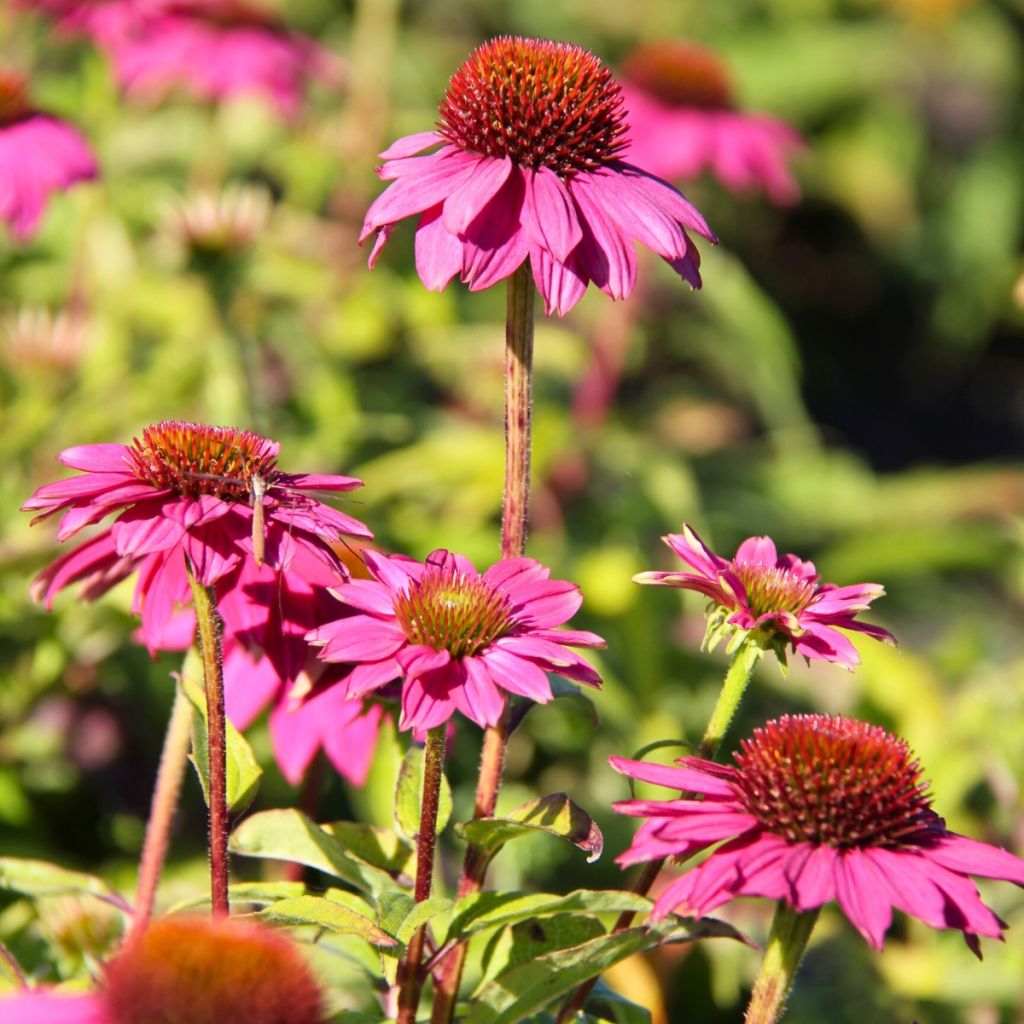
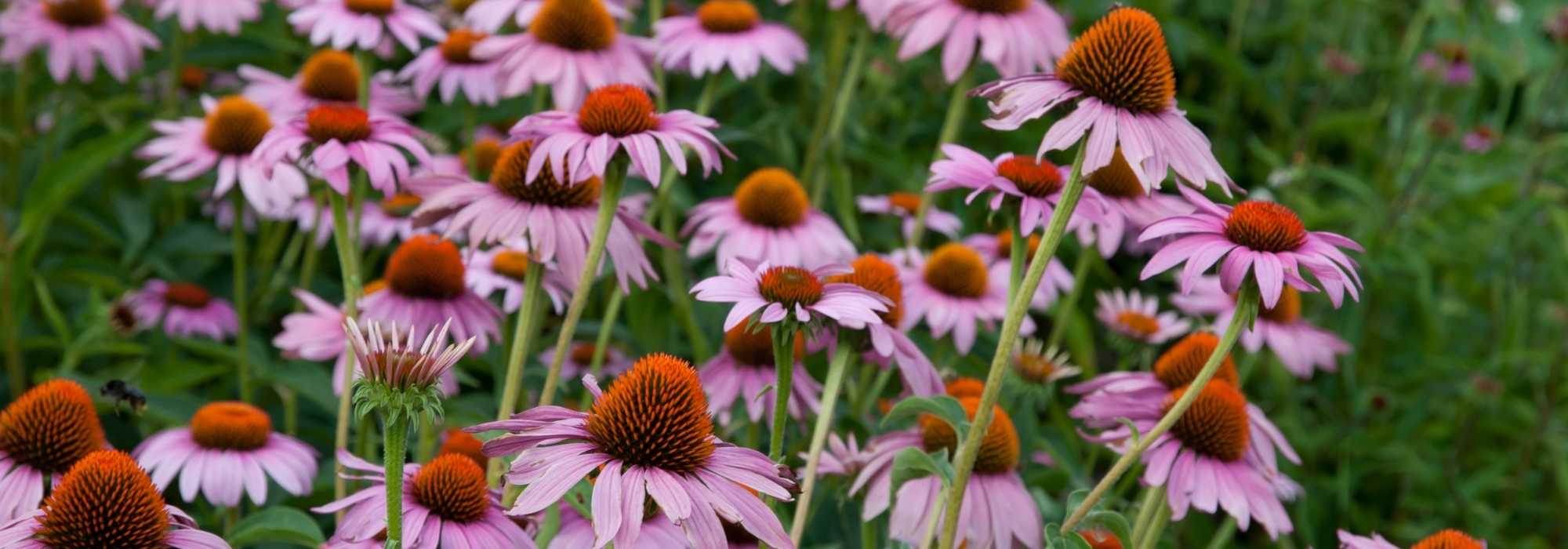
Echinacea purpurea ‘PowWow Wild Berry’ is a superb, easy-to-grow perennial, an exceptionally floriferous recent selection. The beauty of its large daisy flowers in a vibrant pink close to magenta earned it the gold medal from the prestigious All-America Selections (AAS) award in 2010. Its compact growth, with numerous low branchings, allows it to form a dense clump, whose fairly dark green foliage serves as a setting for the flowering, which renews itself throughout the summer. This variety also has the advantage of having flowers that retain their vibrant colour even as they age. Tolerant of most well-drained soils, it is very hardy and withstands heat well once established.
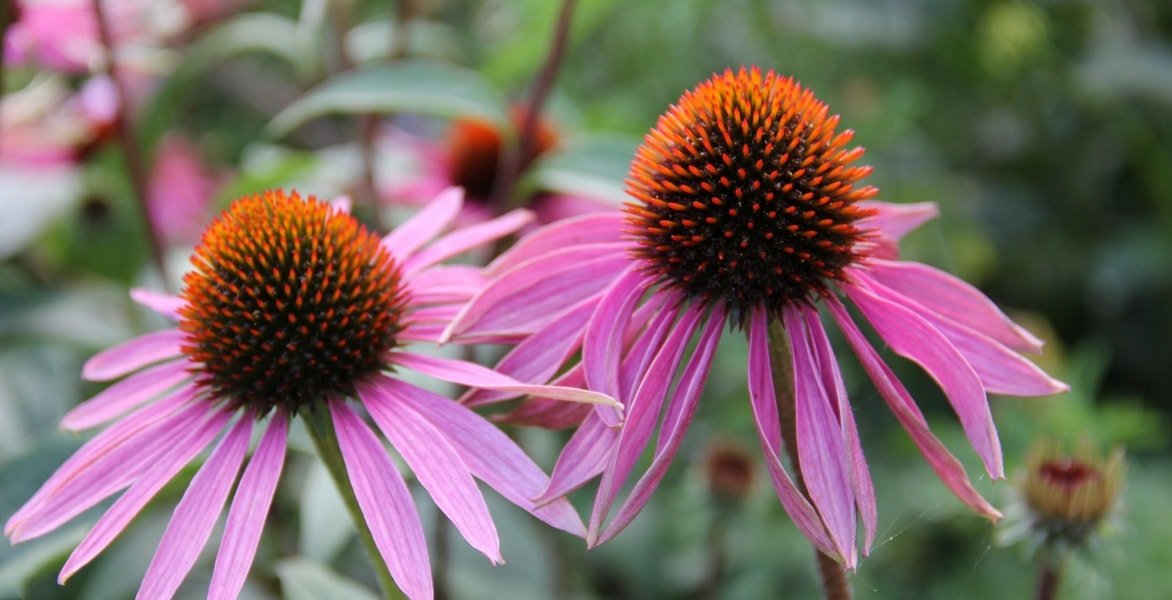
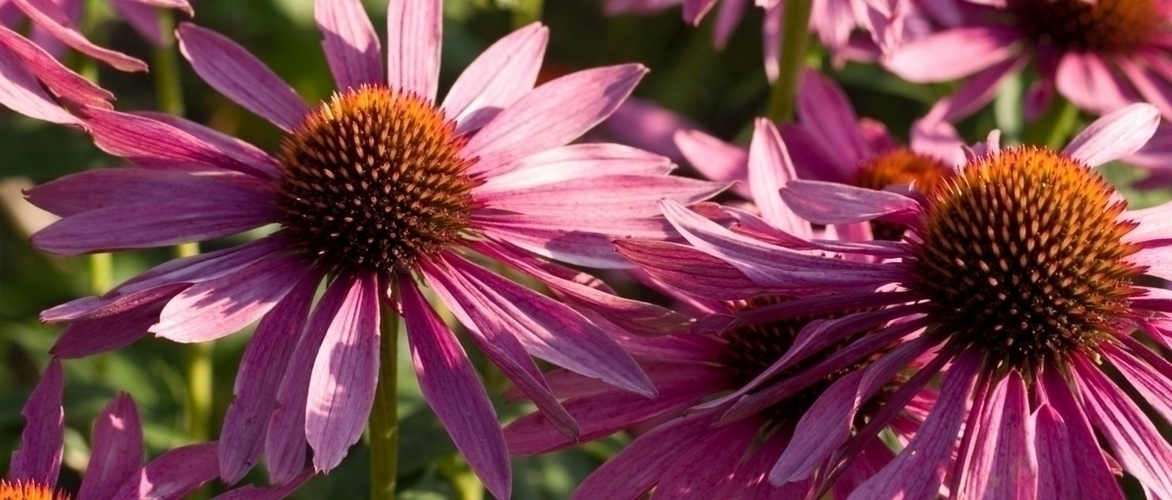
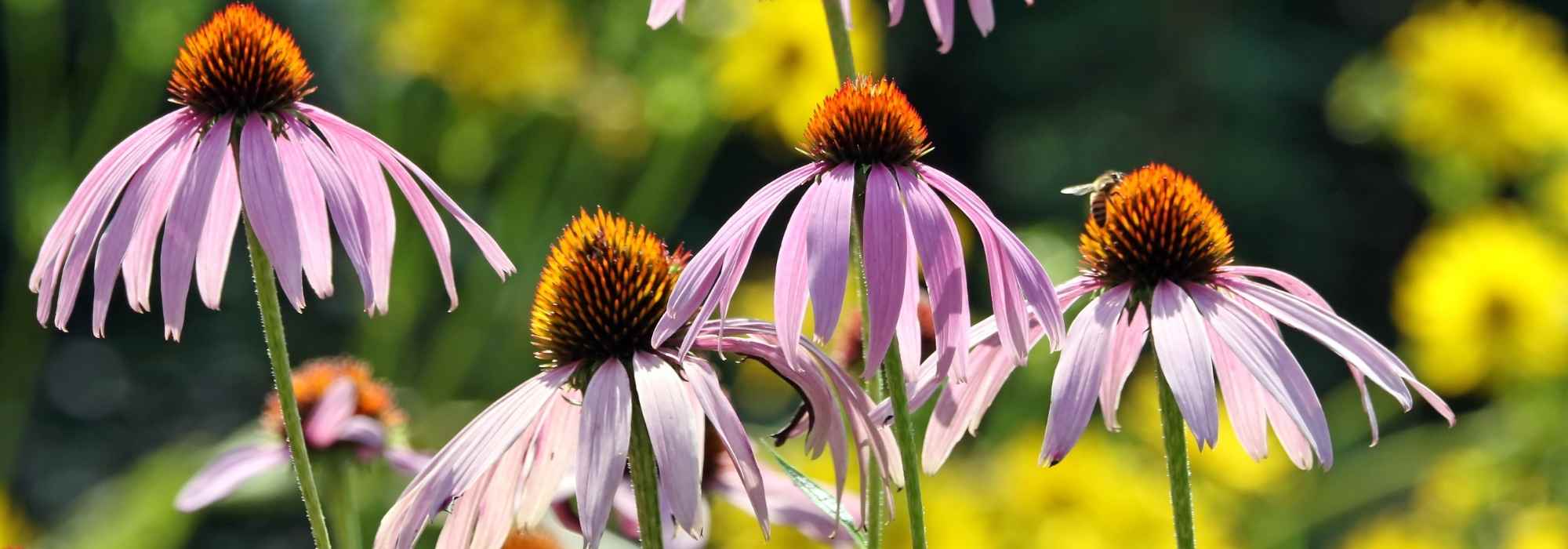
Echinacea purpurea, commonly called Purple Coneflower, is a representative of the vast Asteraceae family, formerly known as Compositae, because the inflorescences are compound, with fertile flowers in the centre surrounded by sterile flowers on the periphery (often mistaken for petals). The whole forms a recognisable head which makes it easy to identify members of this botanical family, from the popular Marigold to the imposing Ligularias. Purple Coneflower is a herbaceous perennial native to North America. It grows naturally in the vast dry plains of the eastern United States, on the edges of light woodlands, in heathlands or on agricultural soils. This large perennial, which generally reaches a height between 60 cm and 1.20 m, is distinguished by its wide inflorescences in tones from pale pink to violet, sometimes white, borne on robust, rigid, dark green stems tinged with purple, branched towards their apex. When young, the peripheral ligules spread horizontally before gradually arching downwards. The floral hues soften over time, while the centre of the inflorescence forms a prominent cone made up of rough, tubular, amber-coloured florets marked with reddish-brown, becoming darker and more prominent at maturity. This singular morphology is the origin of the name Echinacea, derived from the Greek ekhinos, meaning hedgehog. The dark green leaves are lanceolate and slightly downy, becoming sessile on the upper part of the stems.
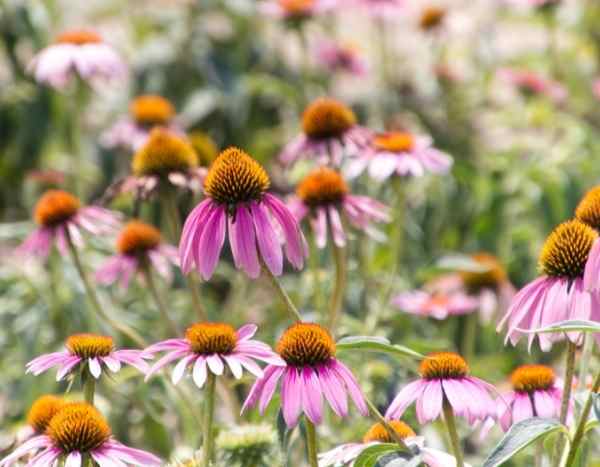
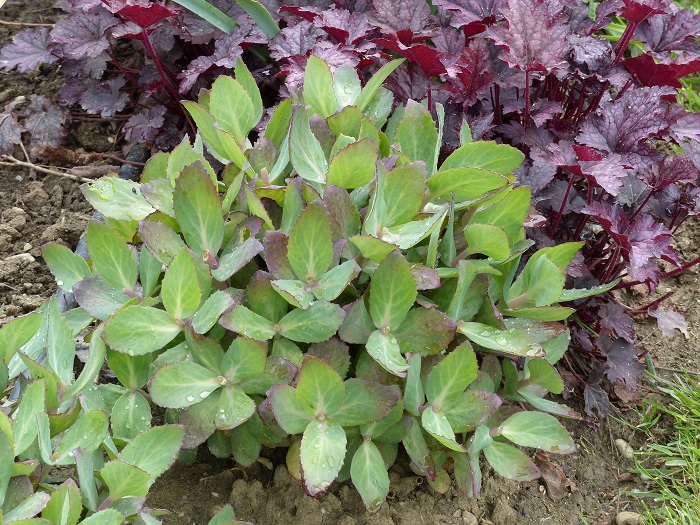
The ‘PowWow Wild Berry’ variety stands out from the botanical type by its more stocky and well-branched silhouette, promoting an even more abundant flowering from July to September. This compact selection does not exceed 60 cm in height when in flower, with a width of approximately 50 cm. Its inflorescences, about 8 cm in diameter, are distinguished by their remarkable size. The external ligules display an intense and luminous magenta that retains all its vibrancy throughout the flowering period, which, from an ornamental point of view, is an undeniable asset. Rich in nectar and honey-producing, its scent attracts many butterflies. The brightly coloured inflorescences are further enhanced by the fairly dark green foliage. The lanceolate leaves, pointed at their tip, are deciduous and fall in autumn, allowing the plant to withstand severe cold without any problem. Furthermore, it tolerates prolonged periods of drought perfectly and naturalises easily.
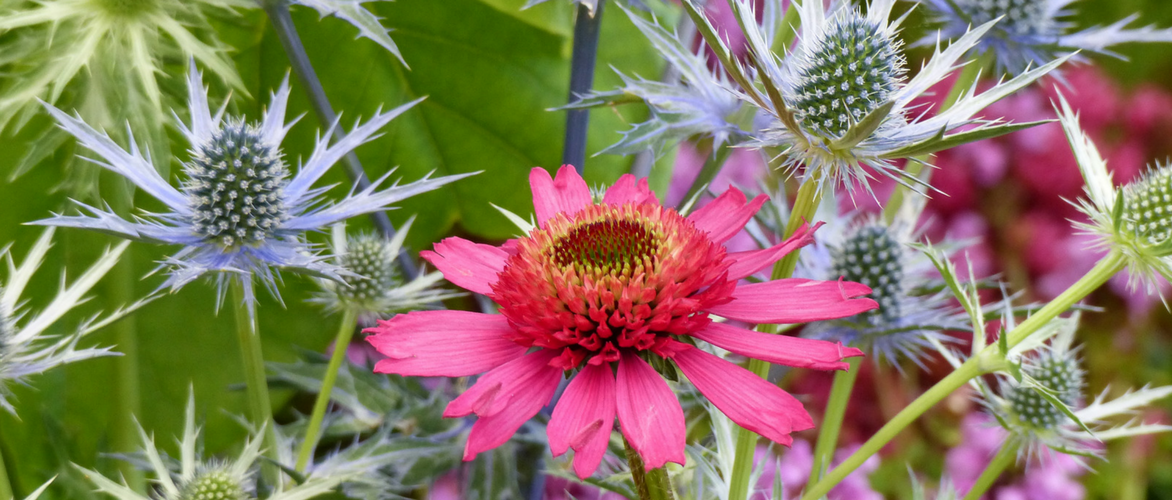
Echinacea purpurea ‘Pow Wow Wild Berry’ thrives in fertile, light, well-drained soils, with no particular requirement regarding pH. Rich in nectar and honey-producing, its scent attracts many butterflies; planted near orchards, it helps in the pollination of fruit trees. In a border, in a meadow or a rockery, this colourful daisy integrates well. To fully enjoy the summer, pair it with Gauras whose flowers, as graceful as little butterflies, will lighten your scene alongside the more massive inflorescences of the Coneflower. In the background, a clump of Switch Grass 'Purple Tears' will add an even more airy touch with its flowering that sways at the slightest breath of wind. Lavenders can also accompany your magenta-pink perennial very well with their bluish spikes.
Flowering
Foliage
Plant habit
Botanical data
Echinacea
purpurea
'PAS702917' POWWOW WILD BERRY
Asteraceae
Purple coneflower, Eastern purple coneflower
Echinacea purpurea 'PAS702917' POWWOW WILD BERRY ( POWWOW series )
Cultivar or hybrid
Planting and care
Echinacea purpurea Pow Wow 'Wild Berry' is highly disease-resistant and very undemanding. It adapts to most soils, preferably in a sunny position, or even lightly shaded in southern regions. Simply avoid over-watering once it is well established. Like other Echinaceas, this one prefers dry conditions and will give you its best if the clumps are divided every 2 to 3 years to rejuvenate them. To encourage flowering, you can cut back the dry stems, although this is not essential for this variety, which therefore requires very little maintenance. Keep only a few at the end of the season; this will provide seeds for birds over winter. You will also gain a triple benefit: spontaneous self-seeding for the following years, guaranteed bird song in spring, and the architectural appearance of a few Echinacea seed heads under the snow.
Planting period
Intended location
Care
Planting & care advice
-
-
-
-
-

-
-
-
This item has not been reviewed yet - be the first to leave a review about it.
Recently viewed products
Haven't found what you were looking for?
Hardiness is the lowest winter temperature a plant can endure without suffering serious damage or even dying. However, hardiness is affected by location (a sheltered area, such as a patio), protection (winter cover) and soil type (hardiness is improved by well-drained soil).

The flowering period indicated on our website applies to countries and regions located in USDA zone 8 (France, the United Kingdom, Ireland, the Netherlands, etc.)
It will vary according to where you live:- In zones 9 to 10 (Italy, Spain, Greece, etc.), flowering will occur about 2 to 4 weeks earlier.
- In zones 6 to 7 (Germany, Poland, Slovenia, and lower mountainous regions), flowering will be delayed by 2 to 3 weeks.
- In zone 5 (Central Europe, Scandinavia), blooming will be delayed by 3 to 5 weeks.
In temperate climates, pruning of spring-flowering shrubs (forsythia, spireas, etc.) should be done just after flowering.
Pruning of summer-flowering shrubs (Indian Lilac, Perovskia, etc.) can be done in winter or spring.
In cold regions as well as with frost-sensitive plants, avoid pruning too early when severe frosts may still occur.
The planting period indicated on our website applies to countries and regions located in USDA zone 8 (France, United Kingdom, Ireland, Netherlands).
It will vary according to where you live:
- In Mediterranean zones (Marseille, Madrid, Milan, etc.), autumn and winter are the best planting periods.
- In continental zones (Strasbourg, Munich, Vienna, etc.), delay planting by 2 to 3 weeks in spring and bring it forward by 2 to 4 weeks in autumn.
- In mountainous regions (the Alps, Pyrenees, Carpathians, etc.), it is best to plant in late spring (May-June) or late summer (August-September).
The harvesting period indicated on our website applies to countries and regions in USDA zone 8 (France, England, Ireland, the Netherlands).
In colder areas (Scandinavia, Poland, Austria...) fruit and vegetable harvests are likely to be delayed by 3-4 weeks.
In warmer areas (Italy, Spain, Greece, etc.), harvesting will probably take place earlier, depending on weather conditions.
The sowing periods indicated on our website apply to countries and regions within USDA Zone 8 (France, UK, Ireland, Netherlands).
In colder areas (Scandinavia, Poland, Austria...), delay any outdoor sowing by 3-4 weeks, or sow under glass.
In warmer climes (Italy, Spain, Greece, etc.), bring outdoor sowing forward by a few weeks.
Shipping country and language
Your country of residence may be:
Your country of residence is:
For a better user experience on our website, you can select:
Your shipping country:
-
 Austria
-
 Belgium
-
 Bosnia & Herzegovina
-
 Bulgaria
-
 Croatia
-
 Cyprus
-
 Czechia
-
 Denmark
-
 Estonia
-
 Finland
-
 France
-
 Germany
-
 Greece
-
 Hungary
-
 Iceland
-
 Ireland
-
 Italy
Italy
-
 Latvia
-
 Liechtenstein
-
 Lithuania
-
 Luxembourg
-
 Malta
Malta
-
 Netherlands
-
 Poland
-
 Portugal
-
 Romania
-
 Serbia
-
 Slovakia
-
 Slovenia
-
 Spain
Spain
-
 Sweden
-
 Switzerland
Language:
-
French
-
 English
-
Spanish
-
Italian
-
German
-
Portuguese
-
Dutch
-
Finnish
My Account
Hello
My wish lists
My cart
Log in / Register
Existing customer?
This form is protected by reCAPTCHA - the Google Privacy Policy and Terms of Service apply.
New customer?
Create an account to track your orders, access our customer service and, if you wish, make the most of our upcoming offers.