Opuntia monacantha - Prickly pear cactus
Opuntia monacantha - Prickly pear cactus

Opuntia monacantha - Prickly pear cactus
Opuntia monacantha - Prickly pear cactus

Opuntia monacantha - Prickly pear cactus
Opuntia monacantha - Prickly pear cactus
Opuntia monacantha - Prickly pear cactus
Opuntia monacantha
Common prickly pear, Barbary fig, common cactus, common Indian fig
Back-to-school special offer!
Get €10 off for every €50 you spend! And get up to €40 off on a single order.
How does it work?
1. Shop your favourites
Add your favourite plants to your basket. For every €50 you spend (excluding delivery charges, store credit and the plastic-free option), you’ll receive a €10 voucher.
€50 spent = €10 voucher
€100 spent = €20 voucher
€150 spent = €30 voucher
€200 spent = €40 voucher
2. Place your order
Once your basket reaches one of the spending thresholds, place your order. You can even choose your delivery date!
3. Receive your voucher
As soon as your order has been shipped, you’ll receive an email containing your personal voucher code and its value.
4. Use it on your next order
Your voucher is valid for 90 days from the date you receive it. It can be used once only, on a new order worth at least the value of the voucher, excluding delivery charges.
Please note: Vouchers can be combined with other offers, but cannot be split or refunded.
Why not try an alternative variety in stock?
View all →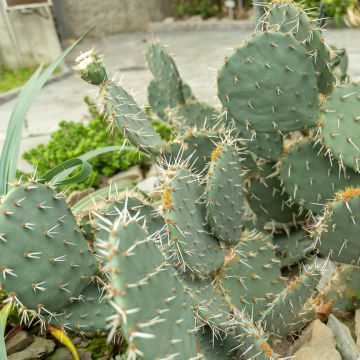
Available in 1 sizes
Available in 1 sizes
Available in 1 sizes
Available in 1 sizes
Available in 1 sizes
Available in 1 sizes
Available in 1 sizes

Available in 1 sizes
Available in 1 sizes
Available in 1 sizes
This plant carries a 12 months recovery warranty
More information
We guarantee the quality of our plants for a full growing cycle, and will replace at our expense any plant that fails to recover under normal climatic and planting conditions.
Would this plant suit my garden?
Set up your Plantfit profile →
Description
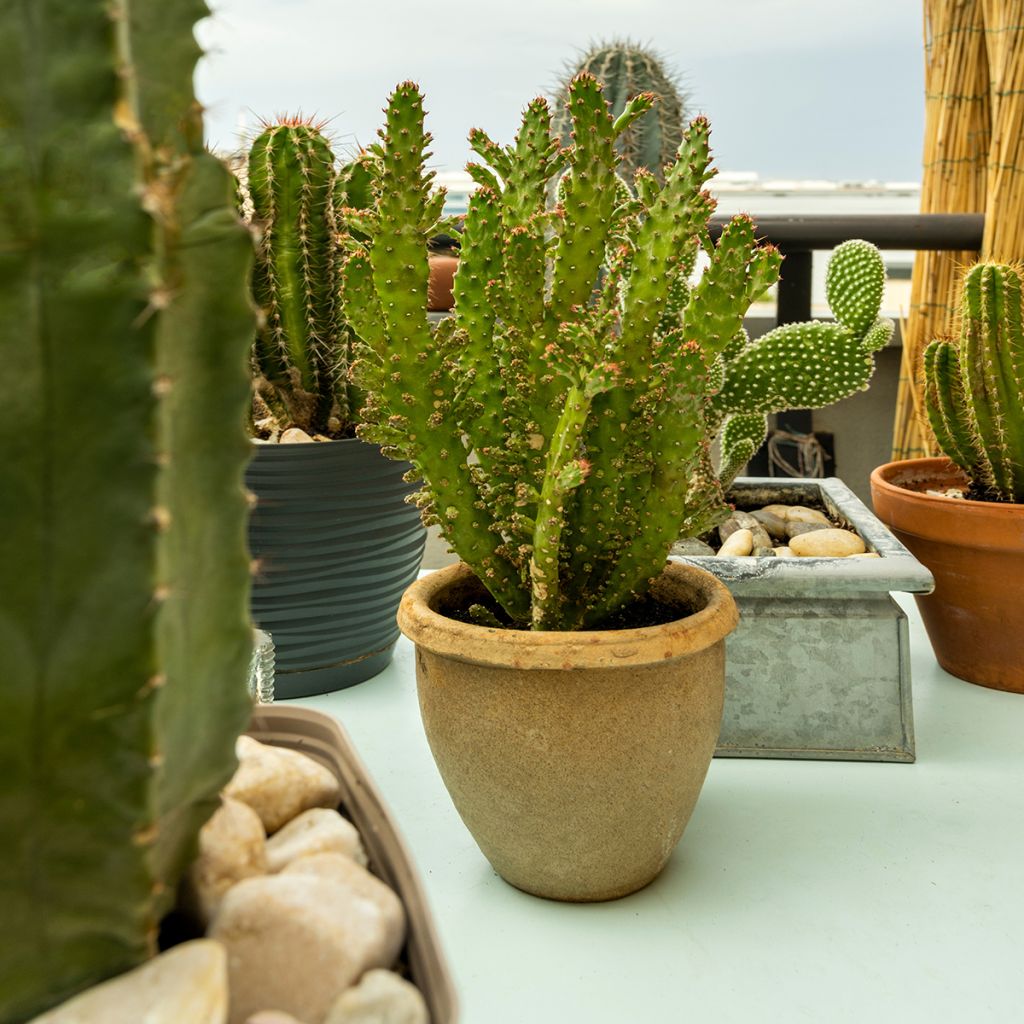
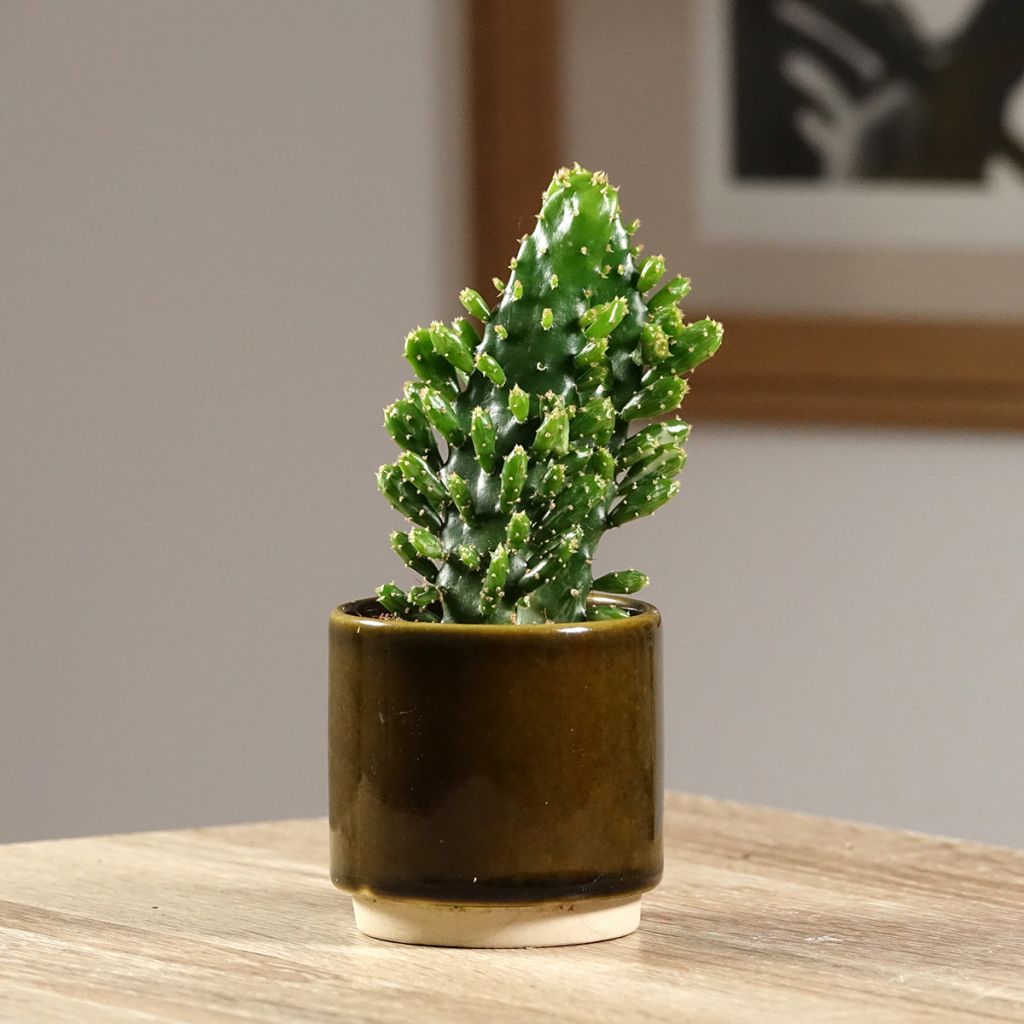
Opuntia monacantha is a fast-growing cactus that develops very elongated prickly pears. A beautiful, bright green, they provide a lovely setting for the bright yellow summer flowering. The large flowers bloom around the edges of the prickly pears, then produce pear-shaped fruits, ranging from green to red. Reaching 2 m in height in a few years, this Opuntia tolerates the mild winters of the Mediterranean coast. Elsewhere, it must be grown in a pot as an orangery plant and overwintered, sheltered from the cold.
Opuntia or Prickly Pear belongs to the large family of Cactaceae, a group of highly diverse plants that fascinates enthusiasts and collectors. This family includes nearly 90 genera with varied forms: some species adopt a spherical silhouette, like Ferocactus while others take on the appearance of candelabras, such as Trichocereus cuzcoensis, or present even more original morphologies (villous cacti...). Among all these cacti, the Opuntia genus occupies an important place with about 250 species. The most famous is undoubtedly the Prickly Pear, native to Mexico. Its fruits are widely consumed in Mediterranean regions, where the plant has gradually become naturalised. Often called "prickly pear cactus", Opuntia is easily distinguished by its architectural silhouette. It develops as flattened segments resembling prickly pears, which branch naturally as it grows.
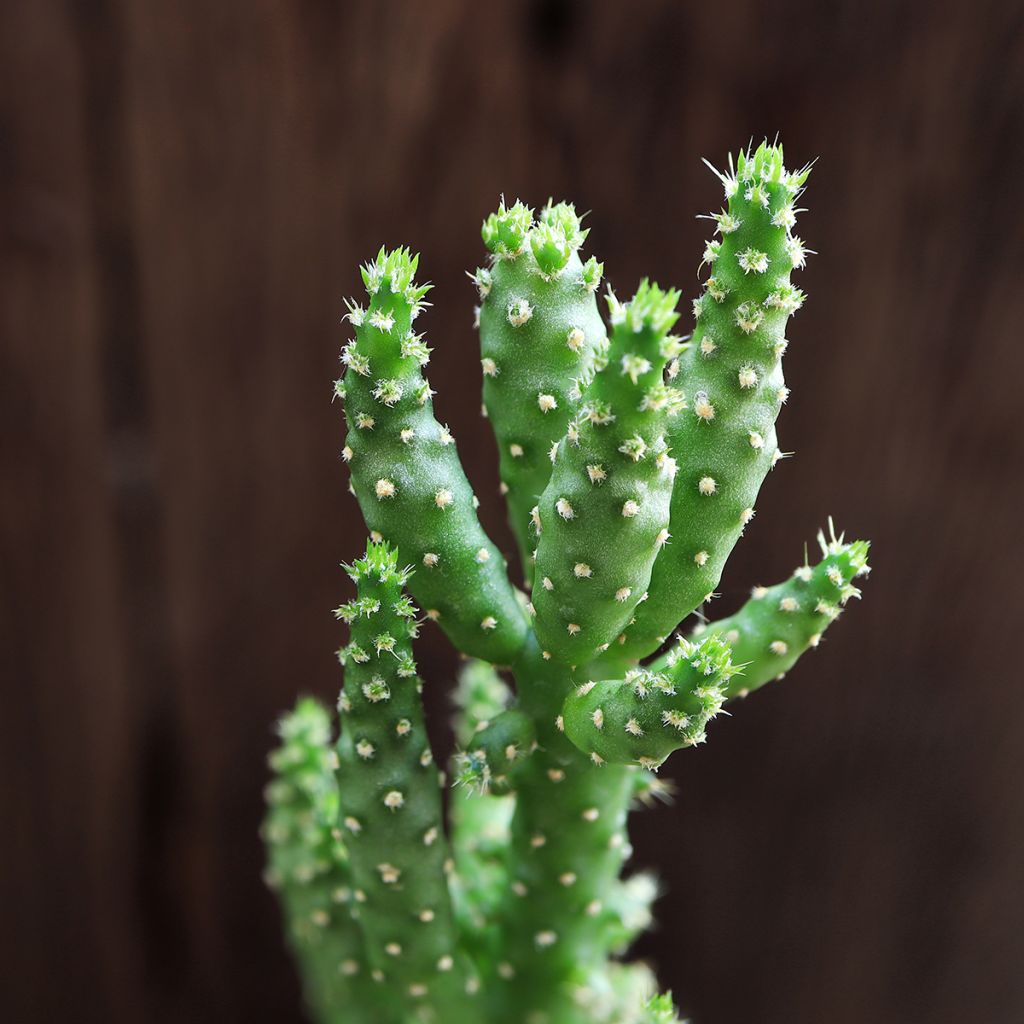
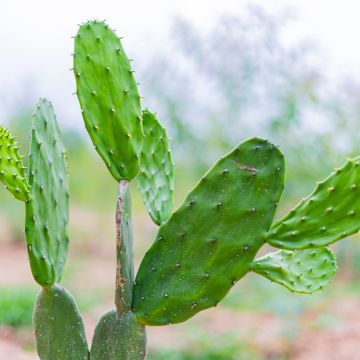
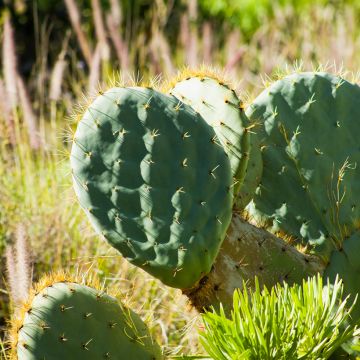
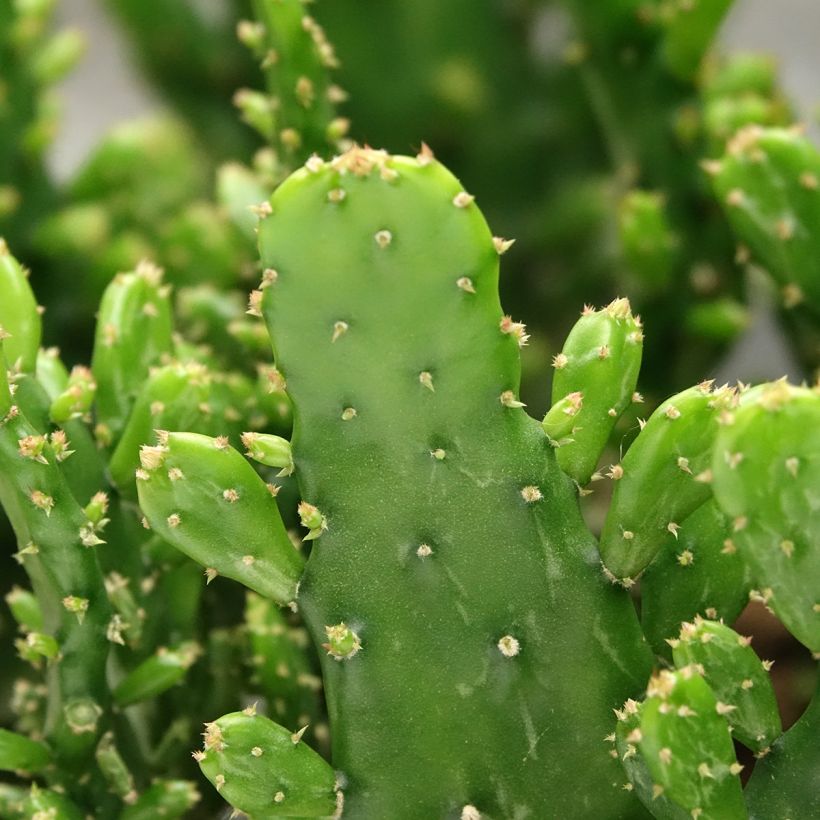
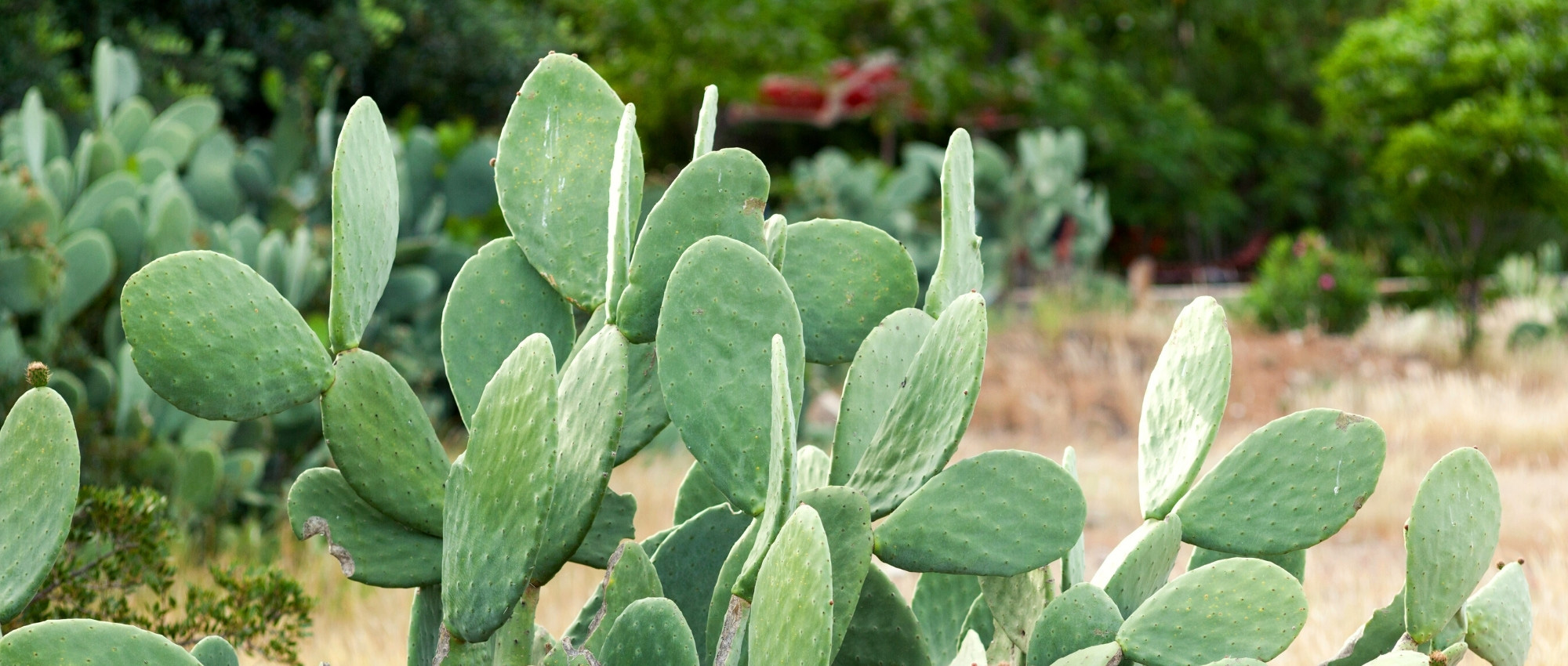
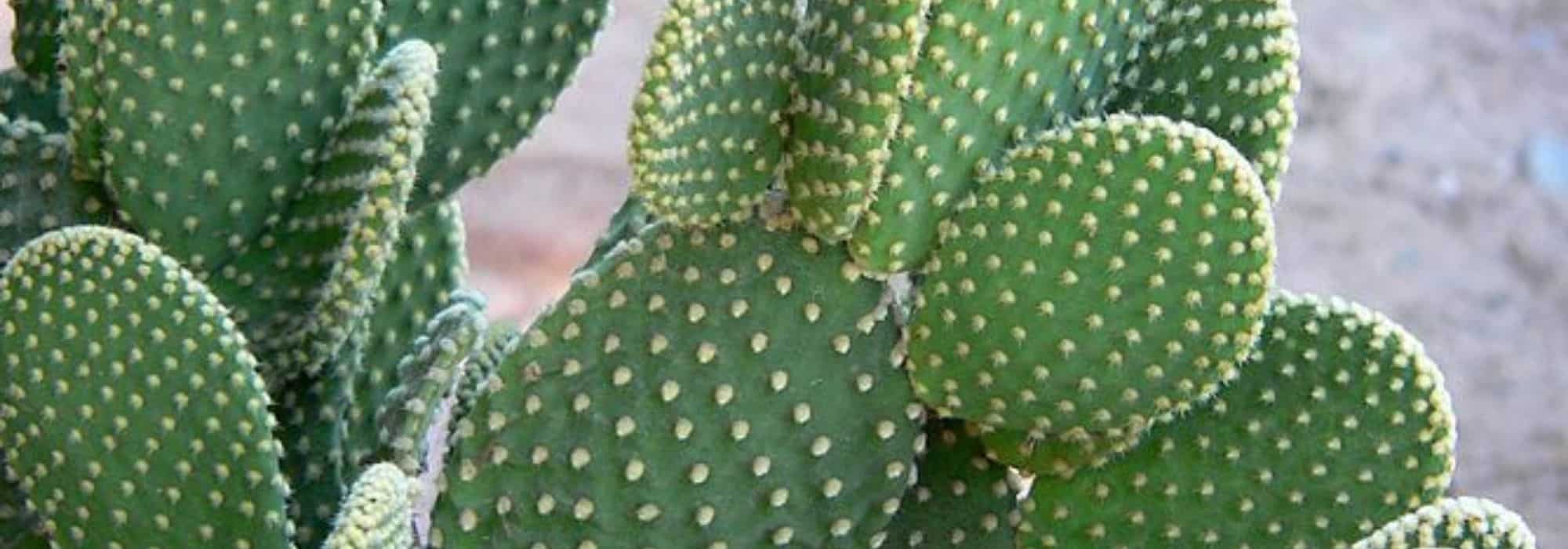
Opuntia monacantha is a species native to South America: Argentina, Uruguay, Paraguay and Brazil. It grows in humid subtropical or tropical lowland forests and on sandy shores, from sea level up to an altitude of 1,000 m. In these regions, it forms an imposing plant, developing a "trunk" up to 20 cm in diameter, which supports a mass of branched prickly pears that can reach up to 6 m in height! In our climates, it generally reaches 2 to 3 m in height when planted in the ground, and less when grown in a container in regions too cold for it to be permanently planted in the garden. Similarly, the prickly pears (called cladodes), which in its native habitat measure up to 30 cm in length and 12.5 cm in width, are usually slightly smaller. They have an obovate to elongated shape, sometimes even distinctly narrow. They are fleshy with a smooth surface and a bright green epidermis. Rather sparsely thorny, this prickly pear most often forms one to two thorns per areole (which are anatomically transformed leaves, the prickly pears themselves being stems). The areoles are scattered over the prickly pears; those located in the upper half of them are often thorny, the lower ones are not. Nevertheless, even if they are scattered, the thorns can measure 4 to 5 cm long and remain very prickly! Their colour varies from white to brown.
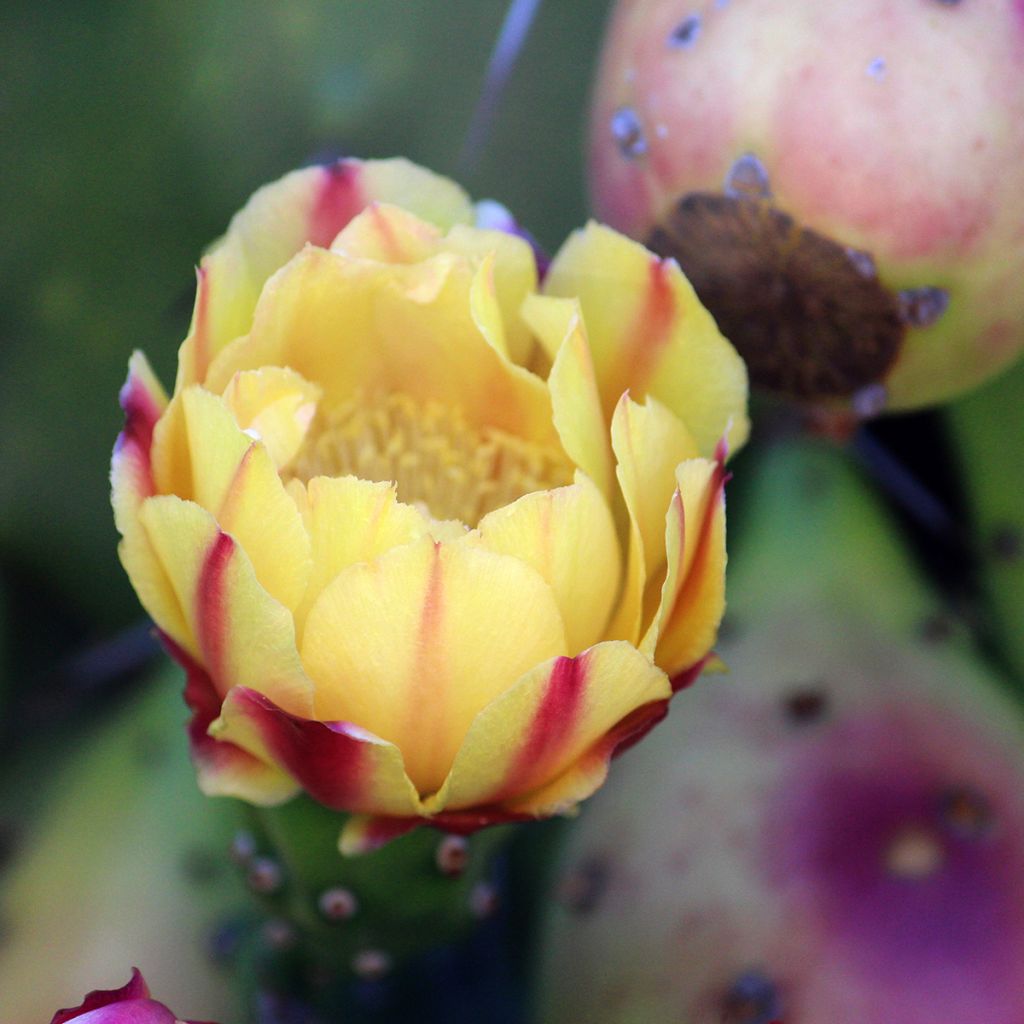
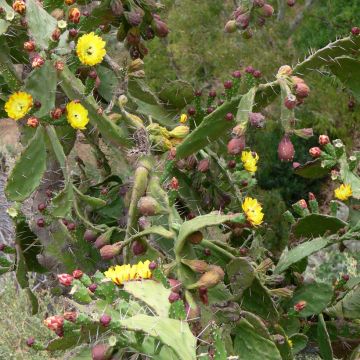
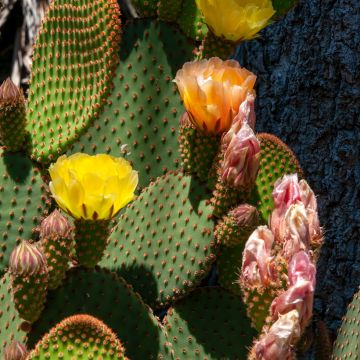
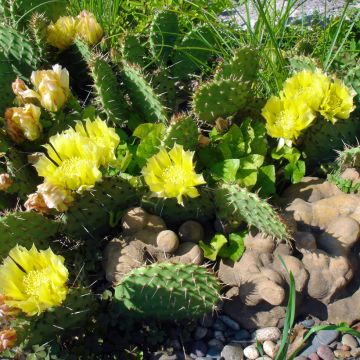
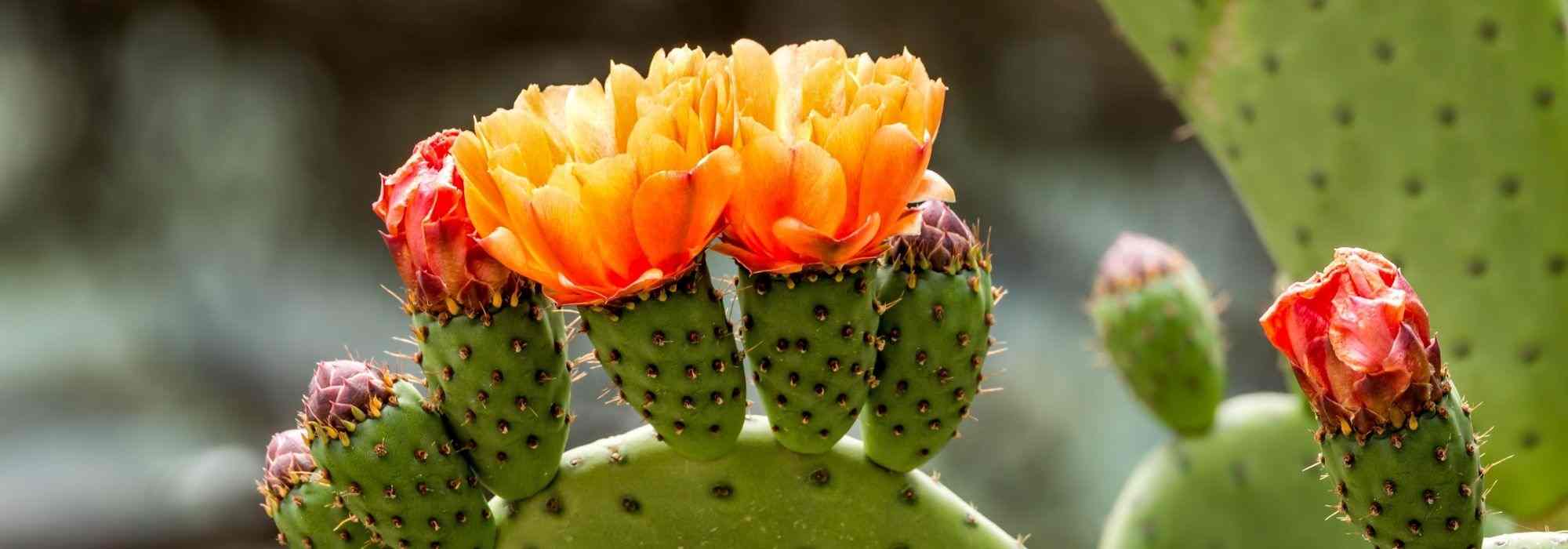
Opuntia monacantha is fast-growing (it has become invasive in Australia and South Africa after being introduced) and can form a dense shrub more than 1 m in height in 4 to 5 years, and in 10 years reach or exceed 2 m. If the climate suits it, it can indeed produce 3 to 10 prickly pears per year, branching naturally and abundantly. Young plants are therefore capable of flowering quite quickly, with beautiful, bright yellow corollas, with reddish central veins, and a dense heart of yellow stamens. The flowers measure 6 to 8 cm in diameter, and as is often the case with cacti, are particularly ornamental. They bloom in summer, appearing around the edges of the prickly pears. Once faded, they gradually transform into edible but uninteresting, pear-shaped fruits, 7 cm long and 5 cm in diameter, with a colour varying from greenish to reddish.
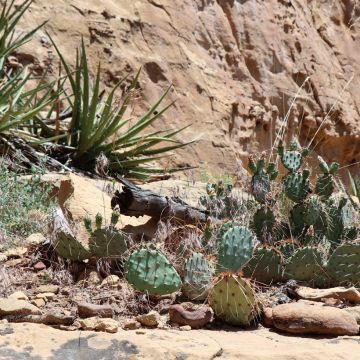
Opuntia monacantha is a species of prickly pear cactus useful for its size and superb flowering. In sheltered areas of the Mediterranean coast, it can reach a good size and thus structure a dry garden alongside slower-growing species. To vary forms, plant it with Agaves with sculptural rosettes, Yuccas with powerful trunks and generous blooms, Mother-in-law's Cushion (Echinocactus grusonii) with rounded shapes, or even Dasylirions with aesthetic thread-like leaves. In regions that are too cold, keep it in a pot to bring out only during summer, a guaranteed exotic feel!
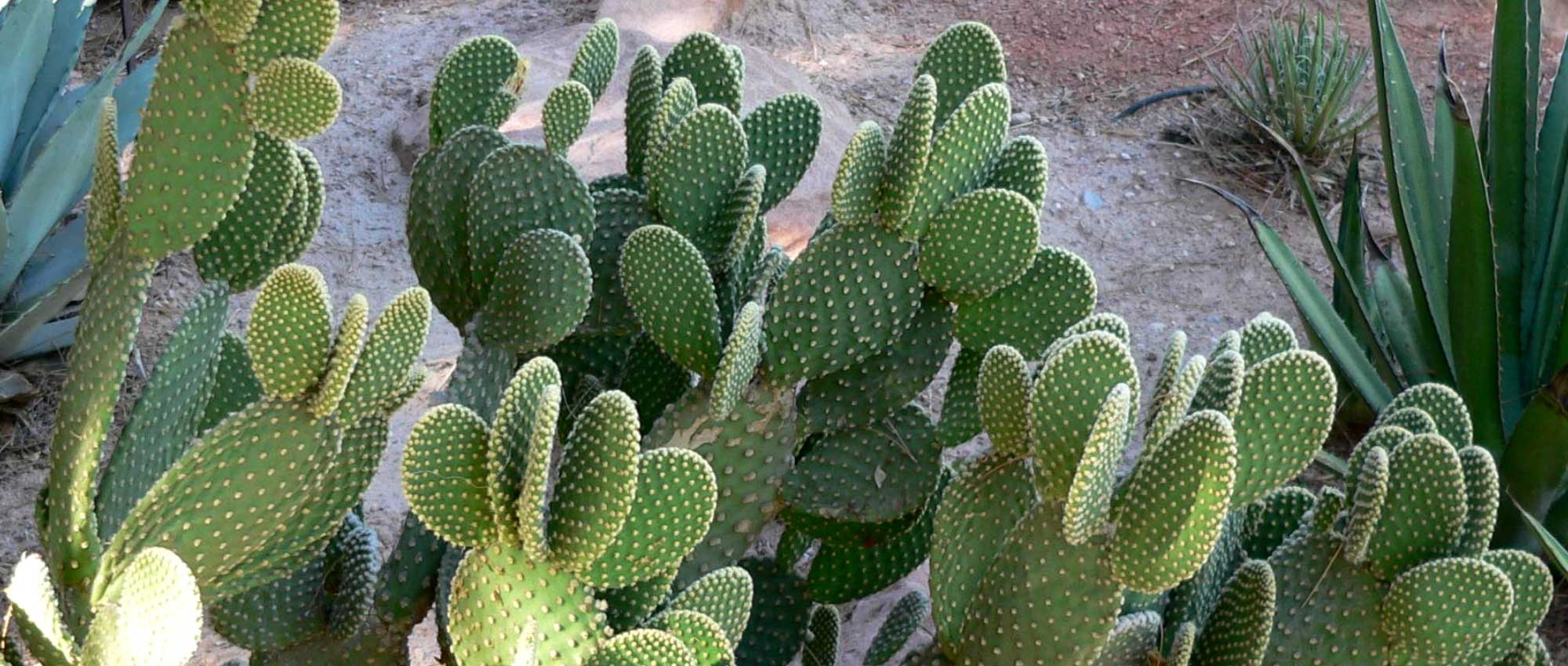
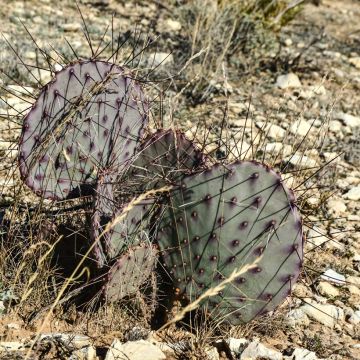
Opuntia monacantha - Prickly pear cactus in pictures
Flowering
Foliage
Plant habit
Botanical data
Opuntia
monacantha
Cactaceae
Common prickly pear, Barbary fig, common cactus, common Indian fig
South America
Planting and care
Preferably, plant Opuntia monacantha in spring.
In the ground, choose a location with maximum sunlight and very well-drained soil, ideally sandy or stony. This species theoretically tolerates temperatures down to -6°C, but it needs protection from prolonged frost and cold dampness, especially in non-Mediterranean regions. Before planting, improve drainage by incorporating coarse sand or gravel into the substrate. Dig a hole slightly wider than the root ball, place the plant in it, taking care not to damage the roots, then fill with the amended substrate. After planting, water moderately to help rooting, then space out waterings, as Opuntia monacantha is sensitive to excess moisture.
In a pot, choose a terracotta container with drainage holes at the bottom for better aeration and faster drying of the substrate. Opt for a wide, shallow pot to ensure the plant's stability. Place a drainage layer of clay pebbles or gravel at the bottom of the pot, then fill with a specific cactus mix or a substrate consisting of universal potting soil lightened with an equal part of coarse sand. Place the plant in the centre, add substrate around the roots without compacting too much, then water lightly. Place the pot in a very bright location, ideally in full sun. During the growing period, water moderately when the substrate is dry on the surface, spacing out waterings in autumn and winter to avoid any risk of rot. Repotting every 2 to 3 years in spring is recommended to support the plant's growth and renew the depleted substrate.
Propagation: by propagation by cuttings of 'prickly pear', easy: take a segment at a joint, place it on a cactus soil substrate for a few days, until a callus forms. Then push the base of the cutting a little deeper into the soil and water regularly. The plant will not flower or fruit until it is 3 years old.
Planting period
Intended location
Care
Planting & care advice
-
-
-

-
-
-
-
-
This item has not been reviewed yet - be the first to leave a review about it.
Recently viewed products
Haven't found what you were looking for?
Hardiness is the lowest winter temperature a plant can endure without suffering serious damage or even dying. However, hardiness is affected by location (a sheltered area, such as a patio), protection (winter cover) and soil type (hardiness is improved by well-drained soil).

The flowering period indicated on our website applies to countries and regions located in USDA zone 8 (France, the United Kingdom, Ireland, the Netherlands, etc.)
It will vary according to where you live:- In zones 9 to 10 (Italy, Spain, Greece, etc.), flowering will occur about 2 to 4 weeks earlier.
- In zones 6 to 7 (Germany, Poland, Slovenia, and lower mountainous regions), flowering will be delayed by 2 to 3 weeks.
- In zone 5 (Central Europe, Scandinavia), blooming will be delayed by 3 to 5 weeks.
In temperate climates, pruning of spring-flowering shrubs (forsythia, spireas, etc.) should be done just after flowering.
Pruning of summer-flowering shrubs (Indian Lilac, Perovskia, etc.) can be done in winter or spring.
In cold regions as well as with frost-sensitive plants, avoid pruning too early when severe frosts may still occur.
The planting period indicated on our website applies to countries and regions located in USDA zone 8 (France, United Kingdom, Ireland, Netherlands).
It will vary according to where you live:
- In Mediterranean zones (Marseille, Madrid, Milan, etc.), autumn and winter are the best planting periods.
- In continental zones (Strasbourg, Munich, Vienna, etc.), delay planting by 2 to 3 weeks in spring and bring it forward by 2 to 4 weeks in autumn.
- In mountainous regions (the Alps, Pyrenees, Carpathians, etc.), it is best to plant in late spring (May-June) or late summer (August-September).
The harvesting period indicated on our website applies to countries and regions in USDA zone 8 (France, England, Ireland, the Netherlands).
In colder areas (Scandinavia, Poland, Austria...) fruit and vegetable harvests are likely to be delayed by 3-4 weeks.
In warmer areas (Italy, Spain, Greece, etc.), harvesting will probably take place earlier, depending on weather conditions.
The sowing periods indicated on our website apply to countries and regions within USDA Zone 8 (France, UK, Ireland, Netherlands).
In colder areas (Scandinavia, Poland, Austria...), delay any outdoor sowing by 3-4 weeks, or sow under glass.
In warmer climes (Italy, Spain, Greece, etc.), bring outdoor sowing forward by a few weeks.
Shipping country and language
Your country of residence may be:
Your country of residence is:
For a better user experience on our website, you can select:
Your shipping country:
-
 Austria
-
 Belgium
-
 Bosnia & Herzegovina
-
 Bulgaria
-
 Croatia
-
 Cyprus
-
 Czechia
-
 Denmark
-
 Estonia
-
 Finland
-
 France
-
 Germany
-
 Greece
-
 Hungary
-
 Iceland
-
 Ireland
-
 Italy
Italy
-
 Latvia
-
 Liechtenstein
-
 Lithuania
-
 Luxembourg
-
 Malta
Malta
-
 Netherlands
-
 Poland
-
 Portugal
-
 Romania
-
 Serbia
-
 Slovakia
-
 Slovenia
-
 Spain
Spain
-
 Sweden
-
 Switzerland
Language:
-
French
-
 English
-
Spanish
-
Italian
-
German
-
Portuguese
-
Dutch
-
Finnish
My Account
Hello
My wish lists
My cart
Log in / Register
Existing customer?
This form is protected by reCAPTCHA - the Google Privacy Policy and Terms of Service apply.
New customer?
Create an account to track your orders, access our customer service and, if you wish, make the most of our upcoming offers.