Escallonia Pinky Carpet®
Escallonia Pinky Carpet®
Escallonia Pinky Carpet®
Escallonia Pinky Carpet®
Escallonia ‘ILVOCAR’ Pinky Carpet®
Redclaws
Back-to-school special offer!
Get €10 off for every €50 you spend! And get up to €40 off on a single order.
How does it work?
1. Shop your favourites
Add your favourite plants to your basket. For every €50 you spend (excluding delivery charges, store credit and the plastic-free option), you’ll receive a €10 voucher.
€50 spent = €10 voucher
€100 spent = €20 voucher
€150 spent = €30 voucher
€200 spent = €40 voucher
2. Place your order
Once your basket reaches one of the spending thresholds, place your order. You can even choose your delivery date!
3. Receive your voucher
As soon as your order has been shipped, you’ll receive an email containing your personal voucher code and its value.
4. Use it on your next order
Your voucher is valid for 90 days from the date you receive it. It can be used once only, on a new order worth at least the value of the voucher, excluding delivery charges.
Please note: Vouchers can be combined with other offers, but cannot be split or refunded.
Home or relay delivery (depending on size and destination)
Important: You may be charged customs duties by your country’s customs authorities upon delivery.
Schedule delivery date,
and select date in basket
This plant carries a 24 months recovery warranty
More information
We guarantee the quality of our plants for a full growing cycle, and will replace at our expense any plant that fails to recover under normal climatic and planting conditions.
Would this plant suit my garden?
Set up your Plantfit profile →
Description
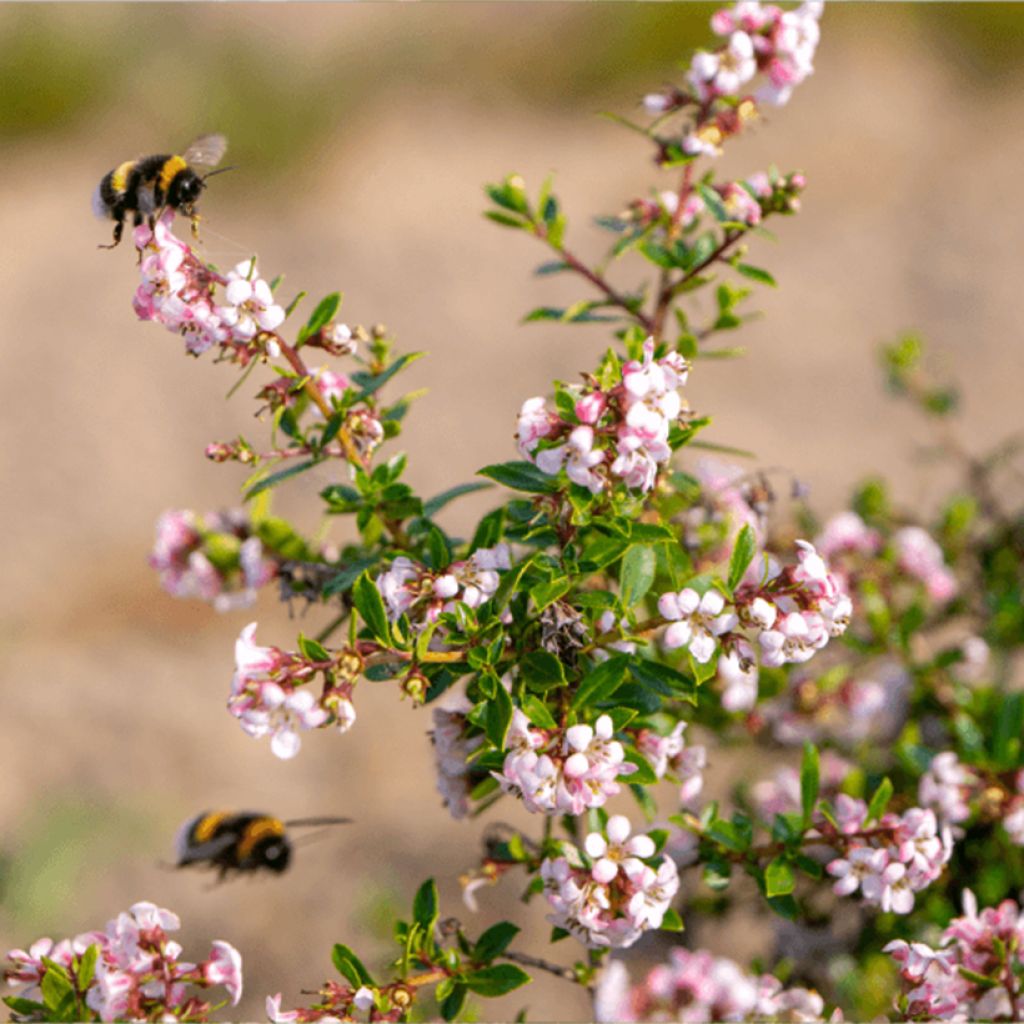
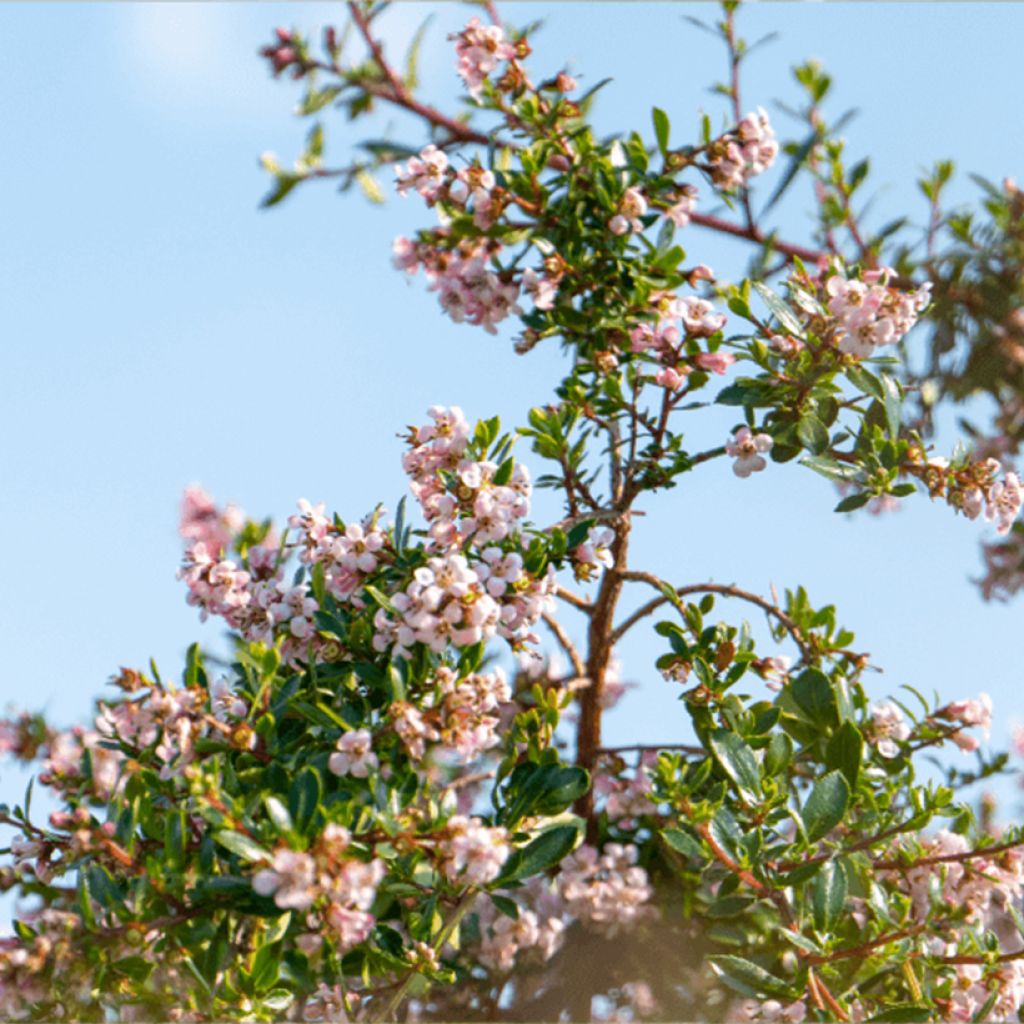
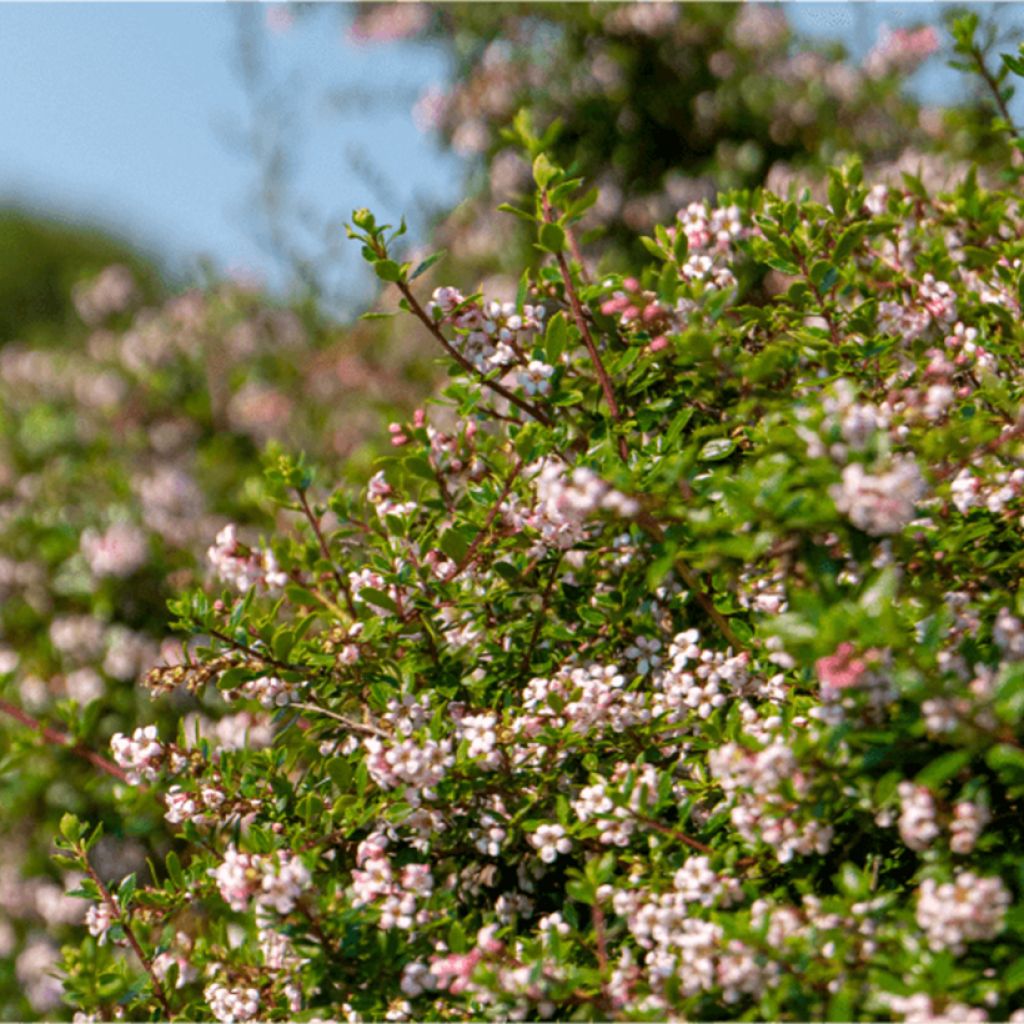
Escallonia Pinky Carpet is an evergreen bush that develops into a good groundcover and tolerates coastal climates well. Its irregular vegetation, which does not exceed 40 to 50 cm in height, covers a width at least twice as large. In late spring, it produces a light pink flowering which renews regularly until August and harmonises very well with the bright green foliage. Its limited hardiness restricts its planting to southern regions, in a warm situation sheltered from cold winter winds.
Formerly classified in the Saxifragaceae family, alongside Heucheras, Escallonia is now the main genus of the Escalloniaceae family, which includes only seven or eight other genera. There are about sixty wild species of Escallonia, all native to South America (notably Chile and the Andes mountain range). Growing in mild climates, most cannot tolerate frost, but a few hardier species can survive colder climates. They are more often shrubs, sometimes trees, generally with evergreen foliage, although a few deciduous ones exist. The plant was discovered in the Andes in the 18th century by a Spanish traveller named Escallon, and named in his honour by his compatriot, the botanist Don José Celestino Mutis.
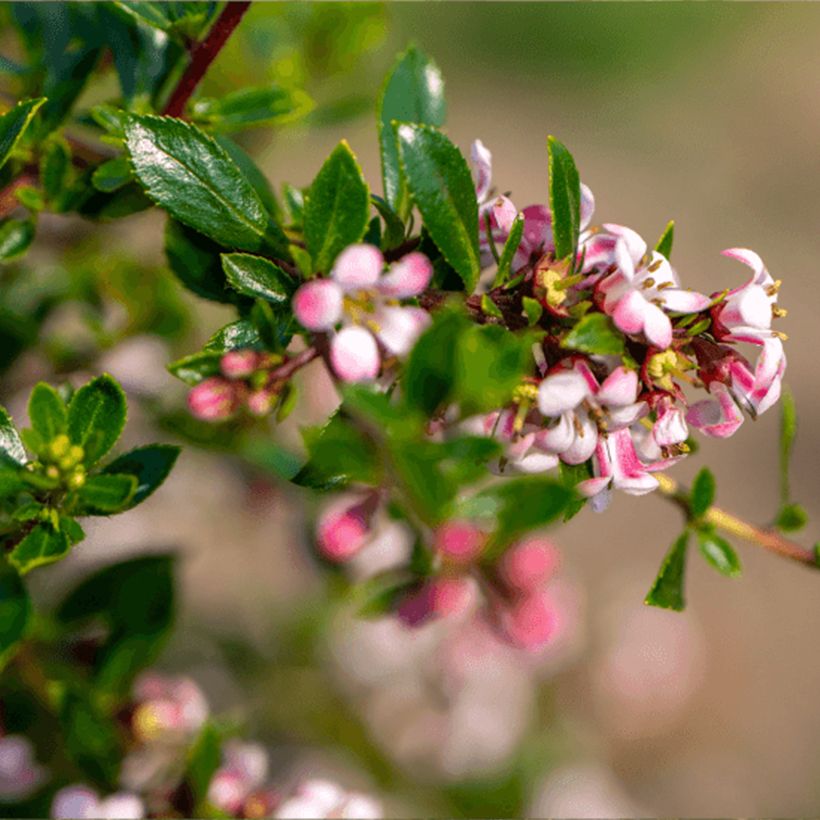
Escallonia x ‘ILVOCAR’ Pinky Carpet is a hybrid of unknown parentage, distinguished by above-average hardiness; a well-rooted plant in good conditions can withstand frosts down to -10°C. It fairly rapidly forms a spreading cushion 40 to 50 cm in height and 1 m or more in spread. Its growth is somewhat untidy; it sends out branches left and right that arch towards the ground as they grow, giving it a slightly gangly appearance. It integrates easily into a natural garden, especially since its flowers are smaller than those of many horticultural varieties. Its evergreen foliage, sometimes semi-evergreen in cold climates at the limit of its hardiness, is a beautiful bright green. The small alternate leaves, measuring roughly 3 cm long, are elliptical to lanceolate, and their texture is leathery, which allows them to adapt well to heat as well as sea spray. They contrast pleasantly with the brown-red of the stems. Towards the end of May, depending on the region, tubular flowers open into small, 1 to 1.5 cm long trumpets. They are a pretty light pink, grouped at the ends of the twigs. They renew until early August generally, adorning the darker foliage with their presence.
Escallonia Pinky Carpet will find a place on slopes or in the foreground of borders in coastal gardens, where it will be useful to bees and other pollinators. Its limited size also allows it to be grown in containers in cold regions to overwinter under shelter, although other, more ornamental plants may be preferred, such as Cassia floribunda with its brilliant yellow flowering. In neutral (non-calcareous) soil, you can pair it with Helianthemum 'The Bride', whose silvery-green foliage and simple white flowers with a yellow centre will combine well. To add a touch of height, choose Liatris spicata, a perennial with long feathery purple spikes that also bloom in summer.
Escallonia Pinky Carpet® in pictures
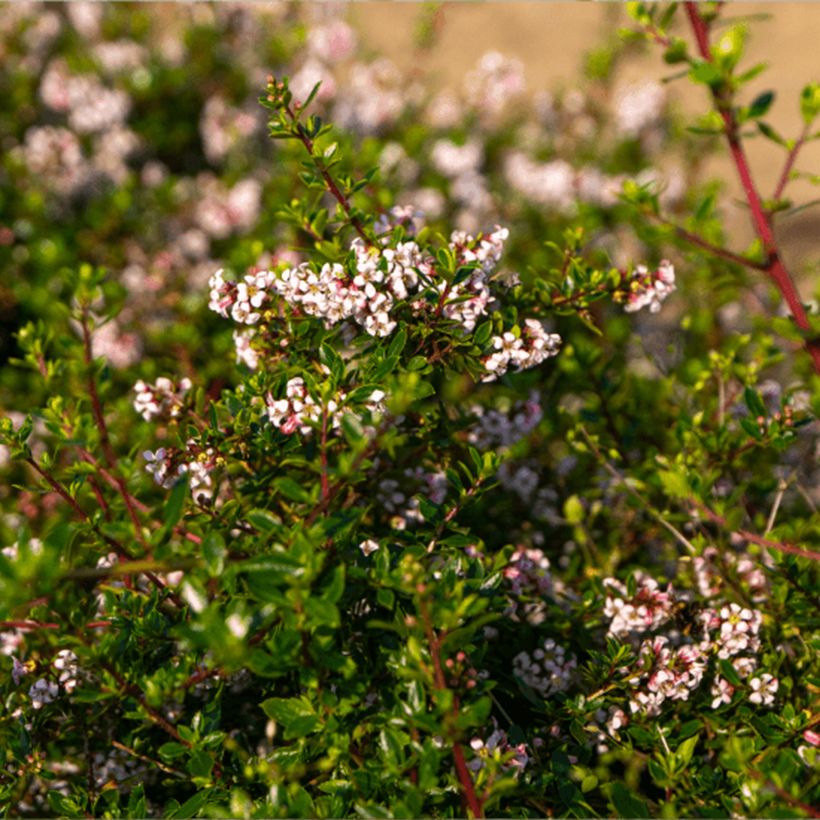
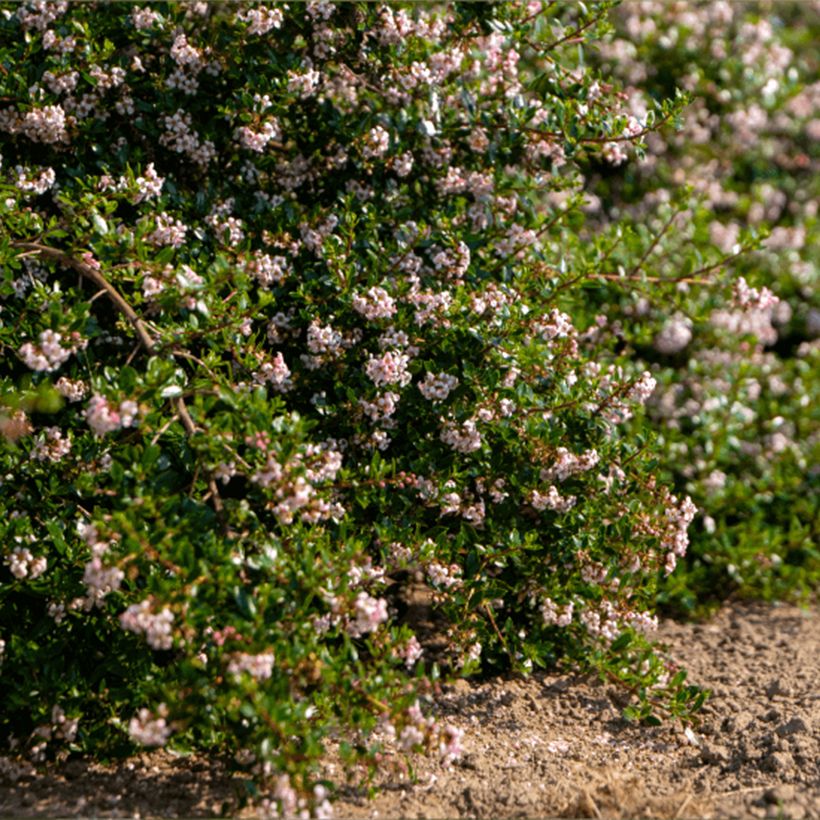
Plant habit
Flowering
Foliage
Botanical data
Escallonia
‘ILVOCAR’ Pinky Carpet®
Escalloniaceae
Redclaws
Escallonia ‘ILVOCAR’, Escallonia Pinky Carpet
Cultivar or hybrid
Planting and care
Escallonia Pinky Carpet is best planted in spring in well-drained, moist soil, preferably slightly acidic or neutral, in a sunny and warm location. In the south, autumn planting allows it to benefit from winter rainfall. It tolerates sea spray but not cold winter winds. Apply rose fertiliser in spring. Prune to shape the silhouette in February and September. Mulch the base in winter. It dislikes very heavy and limestone soils and does not like stagnant moisture, especially in winter. If the soil is too limestone, it may suffer from chlorosis. Very easy to grow. Prune to one-third of their height in the first years during establishment to encourage compact and dense growth. You can prune it into a ball shape. In cold regions, plant it in a sheltered position, south-facing against a wall or in a west-facing border.
Planting period
Intended location
Care
Planting & care advice
-

-

-

-

-

-

-

-

This item has not been reviewed yet - be the first to leave a review about it.
Recently viewed products
Haven't found what you were looking for?
Hardiness is the lowest winter temperature a plant can endure without suffering serious damage or even dying. However, hardiness is affected by location (a sheltered area, such as a patio), protection (winter cover) and soil type (hardiness is improved by well-drained soil).

The flowering period indicated on our website applies to countries and regions located in USDA zone 8 (France, the United Kingdom, Ireland, the Netherlands, etc.)
It will vary according to where you live:- In zones 9 to 10 (Italy, Spain, Greece, etc.), flowering will occur about 2 to 4 weeks earlier.
- In zones 6 to 7 (Germany, Poland, Slovenia, and lower mountainous regions), flowering will be delayed by 2 to 3 weeks.
- In zone 5 (Central Europe, Scandinavia), blooming will be delayed by 3 to 5 weeks.
In temperate climates, pruning of spring-flowering shrubs (forsythia, spireas, etc.) should be done just after flowering.
Pruning of summer-flowering shrubs (Indian Lilac, Perovskia, etc.) can be done in winter or spring.
In cold regions as well as with frost-sensitive plants, avoid pruning too early when severe frosts may still occur.
The planting period indicated on our website applies to countries and regions located in USDA zone 8 (France, United Kingdom, Ireland, Netherlands).
It will vary according to where you live:
- In Mediterranean zones (Marseille, Madrid, Milan, etc.), autumn and winter are the best planting periods.
- In continental zones (Strasbourg, Munich, Vienna, etc.), delay planting by 2 to 3 weeks in spring and bring it forward by 2 to 4 weeks in autumn.
- In mountainous regions (the Alps, Pyrenees, Carpathians, etc.), it is best to plant in late spring (May-June) or late summer (August-September).
The harvesting period indicated on our website applies to countries and regions in USDA zone 8 (France, England, Ireland, the Netherlands).
In colder areas (Scandinavia, Poland, Austria...) fruit and vegetable harvests are likely to be delayed by 3-4 weeks.
In warmer areas (Italy, Spain, Greece, etc.), harvesting will probably take place earlier, depending on weather conditions.
The sowing periods indicated on our website apply to countries and regions within USDA Zone 8 (France, UK, Ireland, Netherlands).
In colder areas (Scandinavia, Poland, Austria...), delay any outdoor sowing by 3-4 weeks, or sow under glass.
In warmer climes (Italy, Spain, Greece, etc.), bring outdoor sowing forward by a few weeks.
Shipping country and language
Your country of residence may be:
Your country of residence is:
For a better user experience on our website, you can select:
Your shipping country:
-
 Austria
-
 Belgium
-
 Bosnia & Herzegovina
-
 Bulgaria
-
 Croatia
-
 Cyprus
-
 Czechia
-
 Denmark
-
 Estonia
-
 Finland
-
 France
-
 Germany
-
 Greece
-
 Hungary
-
 Iceland
-
 Ireland
-
 Italy
Italy
-
 Latvia
-
 Liechtenstein
-
 Lithuania
-
 Luxembourg
-
 Malta
Malta
-
 Netherlands
-
 Poland
-
 Portugal
-
 Romania
-
 Serbia
-
 Slovakia
-
 Slovenia
-
 Spain
Spain
-
 Sweden
-
 Switzerland
Language:
-
French
-
 English
-
Spanish
-
Italian
-
German
-
Portuguese
-
Dutch
-
Finnish
My Account
Hello
My wish lists
My cart
Log in / Register
Existing customer?
This form is protected by reCAPTCHA - the Google Privacy Policy and Terms of Service apply.
New customer?
Create an account to track your orders, access our customer service and, if you wish, make the most of our upcoming offers.