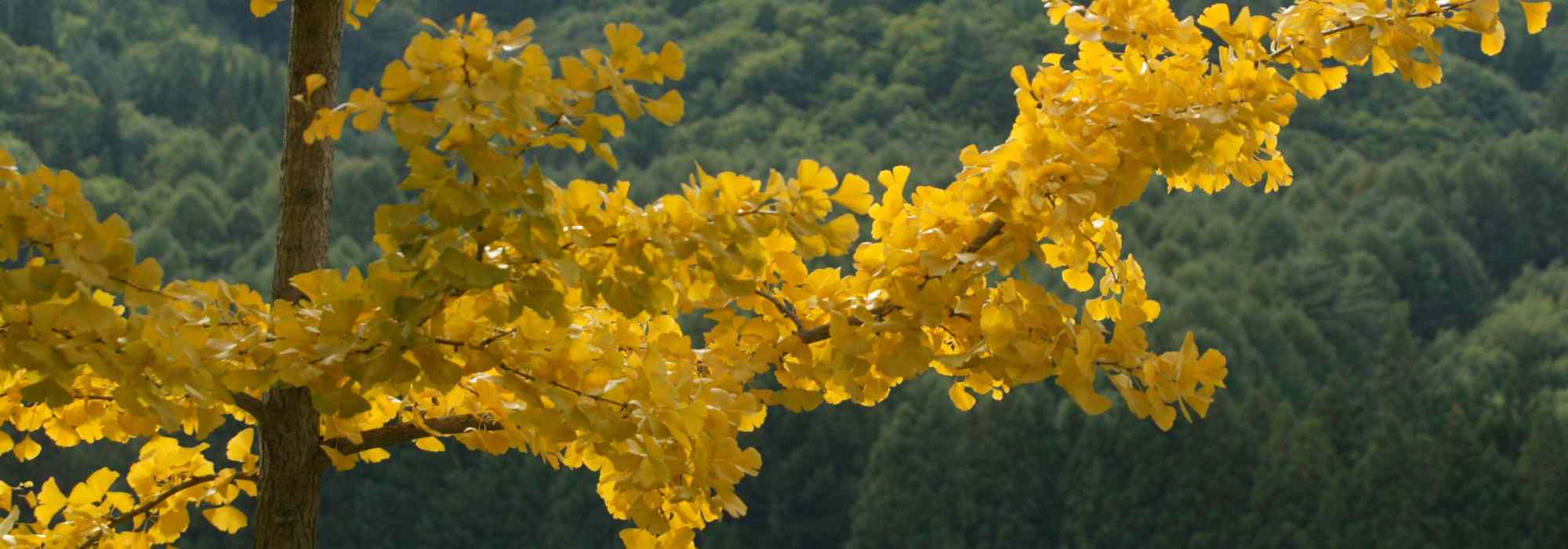
5 great ideas for pairing ginkgo
Ornamental when solitary, Ginkgo also likes to be surrounded by unusual plants in a garden.
Contents
A tree apart in the plant world, remarkable for its bilobed foliage that it alone bears, Ginkgo biloba enchants gardens all year round, and even in autumn, before taking its leave as it turns to gold! Although often planted as a specimen in large gardens, the maidenhair tree can, thanks to certain smaller or narrower varieties, fit into more modestly sized gardens. Discover five ways to showcase this splendid tree.
In a Japanese-inspired garden
Venerated by the Japanese, Ginkgo has become in the Land of the Rising Sun a symbol of longevity, toughness and resilience. This sacred tree, which survived Hiroshima during Second World War, inevitably invites us to imagine it in a Japanese-style scene where the originality of its foliage is showcased. Ideally, have or create a water feature and add a few large stones, two elements essential to atmosphere of a Japanese garden.
For example, choose a medium-sized Ginkgo whose crown will form a rounded shape, such as Ginkgo ‘Globus’, or opt for a Ginkgo ‘Autumn Gold’, a spreading form like Ginkgo horizontalis, or a dwarf form such as ‘Troll‘ if space is limited. Surround it with evergreen plants and a low-growing layer thanks to a dwarf or prostrate pine (in our example, Pinus mugo ‘Lilliput’), and some sacred bamboos (Nandina domestica). Bamboos with yellow-orange canes such as Phyllostachys aureocaulis will echo autumnal hues of Ginkgo foliage. Finally, a handsome tree or shrub with a tiered habit will complete the scene evoking Japanese gardens, such as Cornus controversa or a viburnum plicatum, which will offer, as well as its graceful silhouette, magnificent autumn colour.
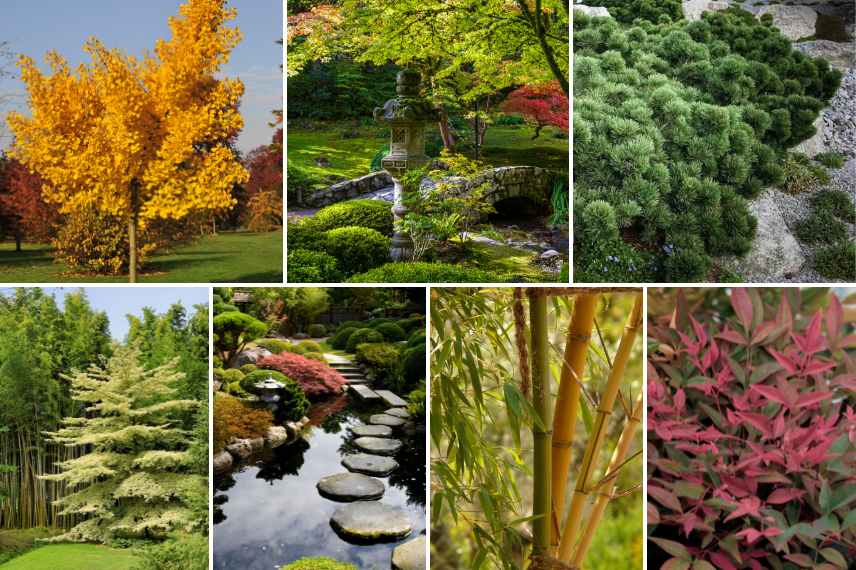
Ginkgo ‘Autumn Gold’, Pinus mugo ‘Lilliput’, Cornus contorversa ‘Variegata’, Phyllostachys aureocaulis and Nandina ‘Obsessed Seika’
Read also
Sacred plants and trees around the worldIn a magical autumnal scene!
The Ginkgo’s splendid autumn colours enchant the garden in a scene where autumn is at its most powerful. Pairing it with trees and shrubs of autumn interest for their blaze of colour, or in the same golden-yellow tones, is the key idea for this warm scene.
To accompany Ginkgo, we have at our disposal some very fine shrubs whose foliage turns colour in autumn, but also superb trees that redden or yellow like the Ginkgo: Liquidambar, Gleditsia triacanthos echoing the same golden colouring, Rhus typhina (Virginia sumac) with its finely divided leaves blazing in the sun… A Japanese maple will also fit well, such as Acer palamatum ‘Bloodgood’, planted a little further into partial shade.
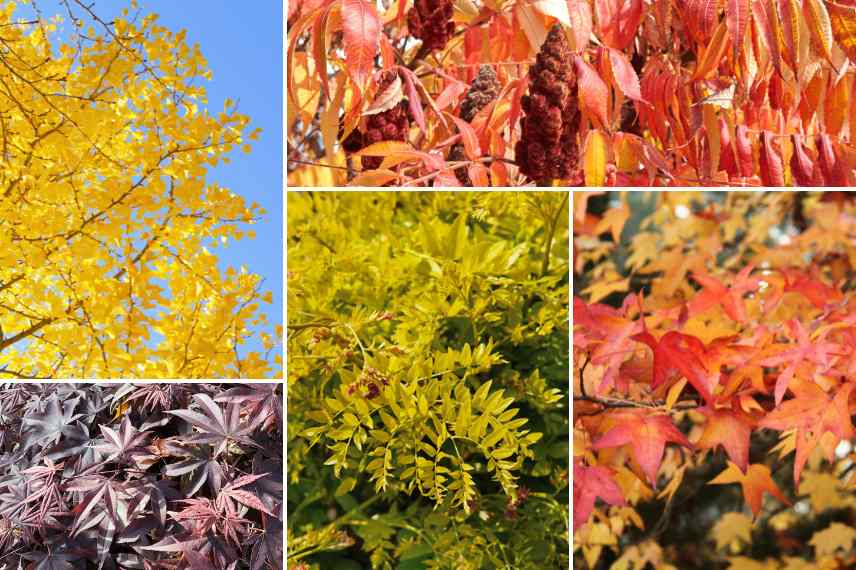
Ginkgo biloba, Rhus typhina, Acer palmatum ‘Bloodgood’, Gleditsia triacanthos and Liquidambar
In an exotic garden
To feel as if you’re at the other end of the world, we often encourage adding exceptional foliage to your garden. Yes, but with Ginkgo, not just any!
A true living fossil, Ginkgo is literally sublime when paired with other plants as ancient as it. As in the plant park Terra Botanica in Anjou, where Ginkgos join in a grand scene with other fossil trees such as Cycas and tree ferns.
You can push the theme further to evoke an idealised Jurassic Park and add a few other species dating from prehistory, so‑called primitive species whose remarkable foliage will fit perfectly into this exotic vision: Araucaria, Podocarpus macrophyllus, and as groundcover Ephedra monosperma. Finally, a Magnolia grandiflora with its large glossy leaves, also hailing from the remotest times, can join these botanical beauties.
In this atypical and unquestionably transportive scene, opt for a semi‑shaded position, since other conifers and trees prefer that aspect.
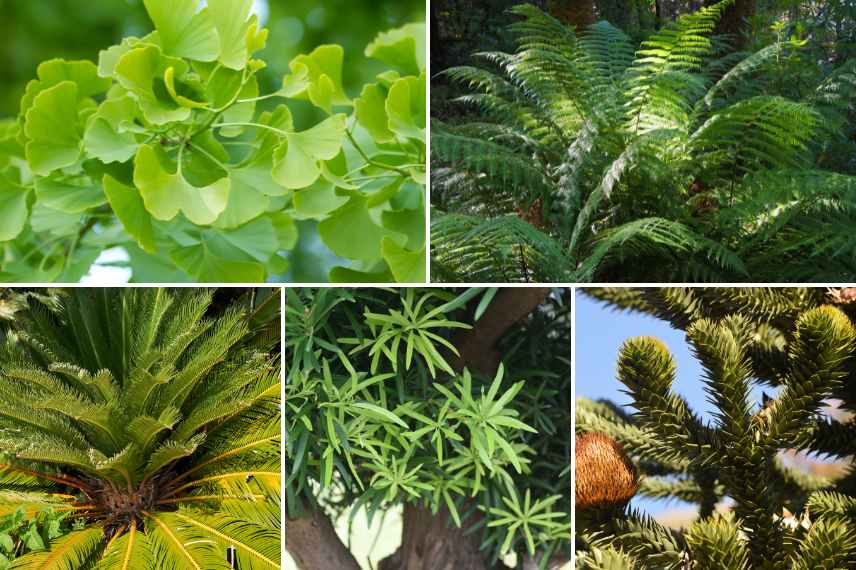
Ginkgo biloba, Dicksonia antartica, Cycas revoluta, Podocarpus and Araucaria
Potted on the terrace
By choosing a compact variety, it is quite possible to grow a Ginkgo in a large pot. You can therefore enjoy it on a terrace or a large balcony, Ginkgo growing relatively slowly in containers. To complement such a small, distinctive tree, look especially for plants with an original habit or foliage, relying on a few evergreen shrubs to provide a permanent backdrop, Ginkgo having a late bud burst period in spring.
Among the options, you can opt for the classic Ginkgo ‘Mariken’ not exceeding 1.50 m in a pot or ‘Troll’. Pair it with a few striking silhouettes such as a Japanese cherry, Prunus incisa ‘Kojo No Mai’, which evokes oriental origins and heralds spring early and elegantly with flowering on bare wood and twisted branches. It has the advantage of taking beautiful colours in autumn.
Joining them on the terrace could be Camelia japonica ‘Virginia Robinson’ with delicate flowering to follow the small cherry, taking care to shelter it from blazing sun, a small characterful conifer such as dwarf Weymouth pine ‘Green Twist’ and Choisya ‘Aztec Pearl’, recognisable for its fine foliage. Flowering will thus extend from March to June, and foliage will be interesting all year round… well, almost!
→ Read also: How to grow a Ginkgo biloba in a pot? and Which plants for a zen balcony?
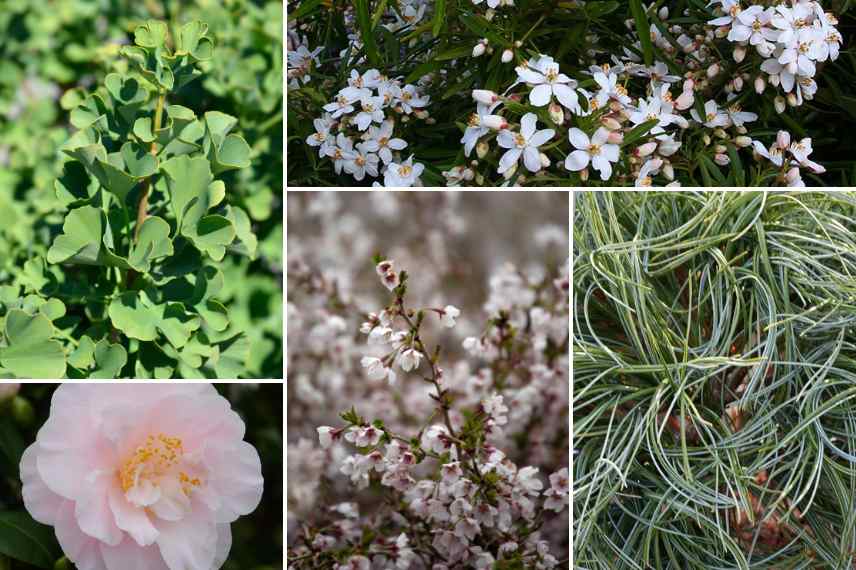
Ginkgo biloba ‘Mariken’, Choisya ‘Aztec Pearl’, Camelia ‘Virginia Robinson’, Prunus incisa ‘Kojo No Mai’ and Pinus strobus ‘Green Twist’
In a clump of trees in a large garden
Finally, for this use, return to type species Ginkgo biloba or to a smaller variety truly easy to place in any garden such as ‘Blagon‘ and its lovely fastigiate form. This wonderful tree encourages us to bring together around it several other remarkable trees, whether for their outline, changing foliage or autumn colours, to create a scene at the back of a large garden.
A grove bringing together, for example, around it a Sophora japonica, in a weeping habit, another conifer (Ginkgo is one!) such as Pinus wallichiana and its broad, blue-tinged sprays, but also an Ulmus pumila, that elm with a wild, slightly tousled habit whose yellowing foliage will harmonise with Ginkgo’s autumn colours. A hardy tree, Parrotia persica, will suffice to add a glowing red touch in the heart of Indian summer.
→ Also read: Creating a woodland garden and Taking on a large garden.
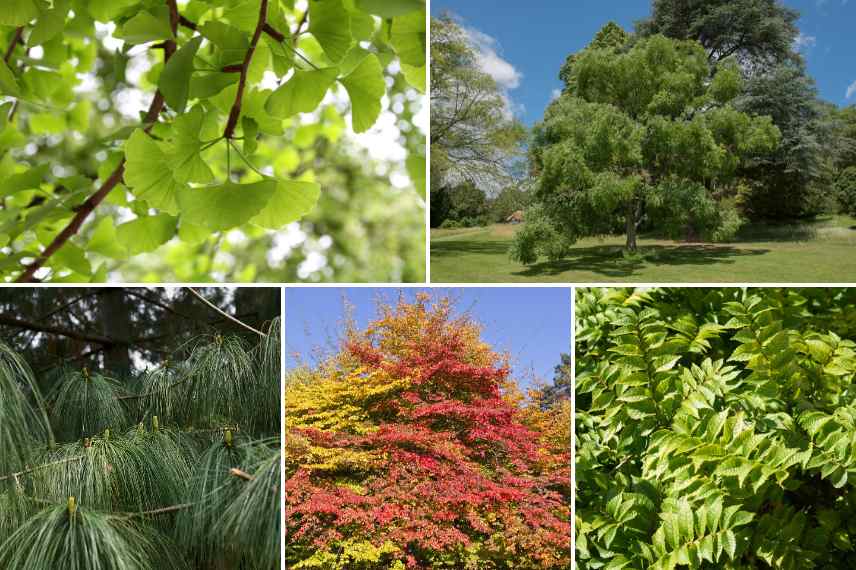
Ginkgo biloba, Sophora japonica ‘Pendula’, Pinus wallichiana, Parrotia persica and Ulmus pumila
- Subscribe!
- Contents
This form is protected by reCAPTCHA - the Google Privacy Policy and Terms of Service apply.

































Comments