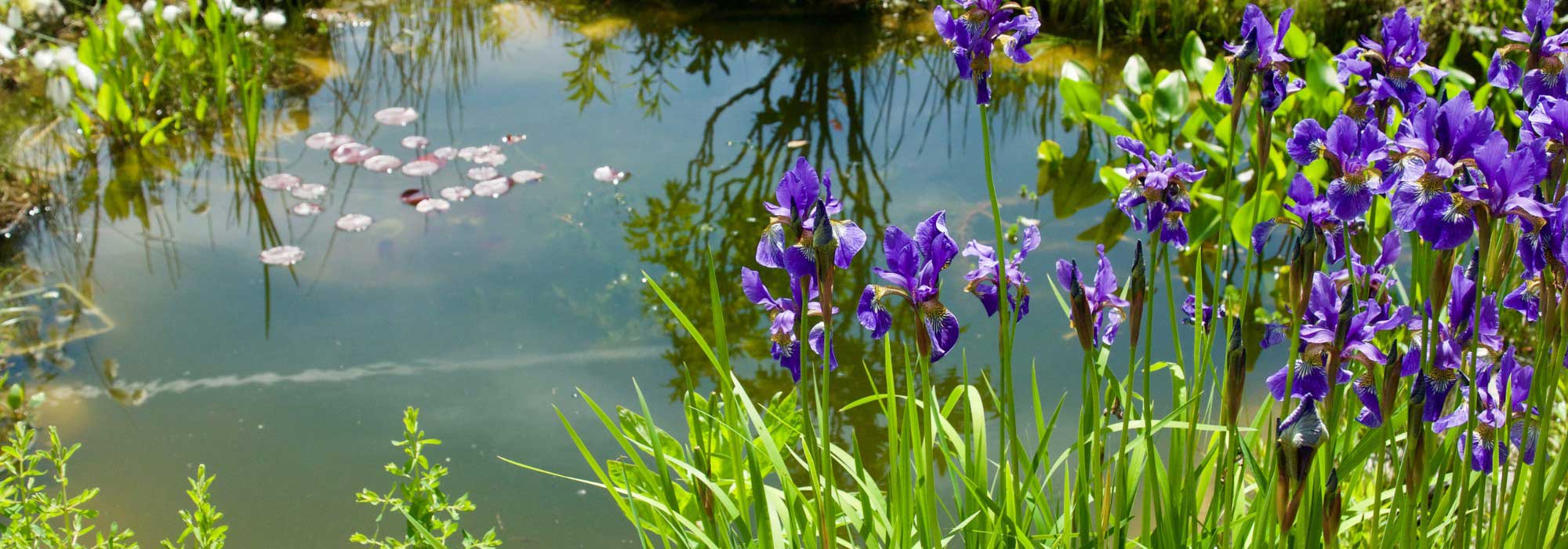
Creating a natural pond without a pump or filter: is it possible?
Create a naturally balanced pond
Contents
Creating a natural pond without pump or filter is an ecological, aesthetic and economical solution, perfectly achievable provided certain basic rules are followed. Rather than relying on mechanical systems, this type of pond depends on a natural biological balance, notably thanks to aquatic plants, microfauna and a thoughtful layout. It is entirely possible to obtain clear, living and stable water throughout the year. This kind of pond does require a little patience at first, while the ecosystem establishes itself, but once in place it operates with great autonomy and provides a valuable refuge for local biodiversity. Here’s how to create a self-sufficient, sustainable and thriving pond!

Pond without pump or filter: 6 steps to follow
| Step | Objective | Detail |
|---|---|---|
| 1. Prepare substrate | Biological filtration | Lay a layer of lava rock or washed gravel to host filtering bacteria. |
| 2. Structure pond in tiers | Plant diversity | Provide several depth zones to accommodate different plants (submerged, floating, marginal). |
| 3. Plant wisely | Oxygenation and balance | Install a wide variety of plants suited to each zone to oxygenate, filter and stabilise water. |
| 4. Create a polishing zone | Natural purification | Add a shallow, densely vegetated area to promote sedimentation and gentle filtration. |
| 5. Limit organic inputs | Preserve oxygen | Reduce fish stocking, remove dead leaves, avoid overloading with organic matter. |
| 6. Maintain light monitoring | Maintenance | Observe the pond, prune plants if necessary, top up bacteria in spring and autumn. |
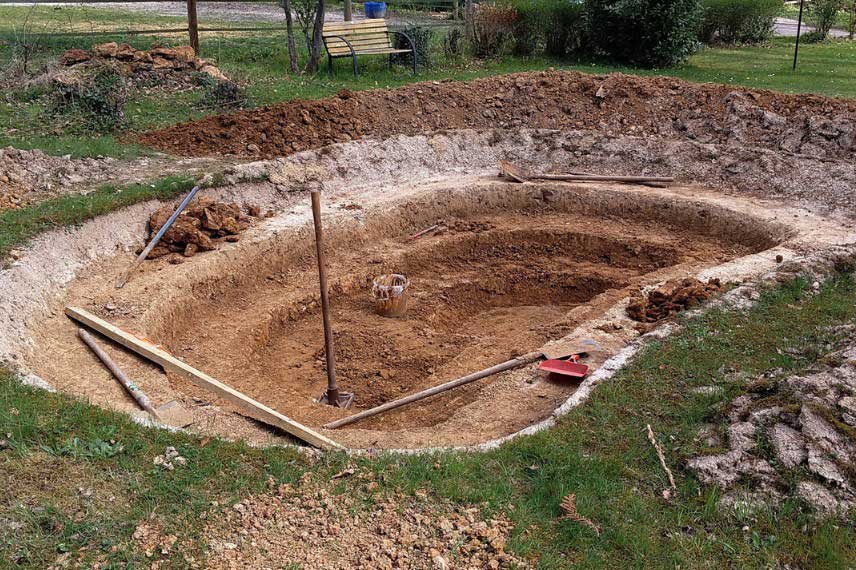
To create a natural pond, it is important to structure it in tiers of different depths.
Read also
10 aquatic plants, submerged or floatingWhat is a natural pond?
A natural pond is a water body that operates without technical equipment (pump, filter, chemicals). Its balance depends on simple biological processes: photosynthesis by aquatic plants, breakdown of organic matter by micro-organisms, thermal regulation by vegetation and careful management of external inputs. This type of pond resembles a wild pond and naturally supports rich biodiversity (insects, amphibians, birds…).
Plants absorb nutrients, preventing algae from developing. Bacteria present in the substrate transform waste into assimilable elements. Water sometimes circulates very slowly, but sufficiently to avoid excessive stagnation.
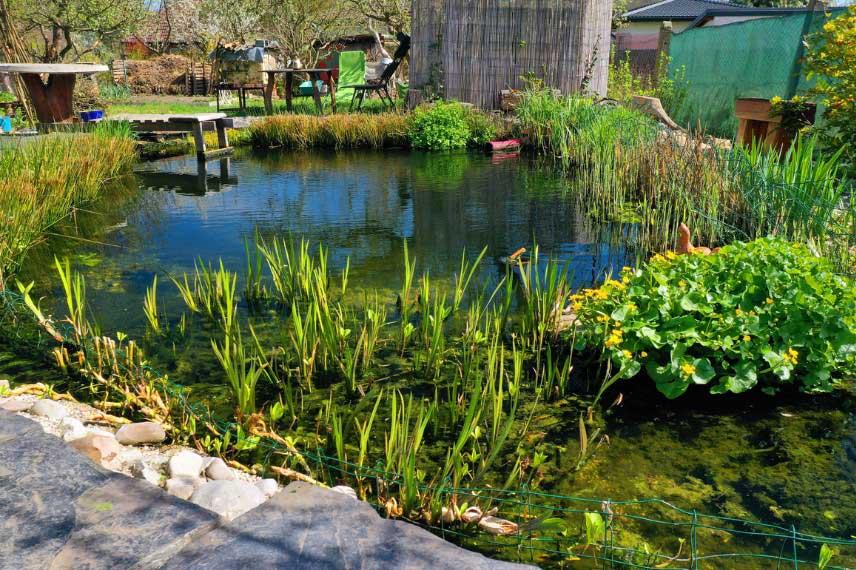
How to build a pond without a pump or filter?
To create a self-sustaining pond, the first step is to establish a favourable ecosystem.
Install pond substrate
By laying a layer of gravel or porous rock on the pond bottom, a stable support is provided for beneficial bacteria involved in water purification. This substrate becomes a living biological filter. The base layer can be made of pumice (very porous volcanic rock), washed gravel (10/20 or 20/40 mm depending on area), or coarse sand as a supplement, particularly in the lagooning zone. This substrate must be stabilised, i.e. well distributed to a depth of at least 10 to 15 cm, especially in planted areas, to provide both good anchorage for roots and sufficient filtration volume.
Introduce filtration bacteria
Once pond is filled, it can be useful to add an initial dose of natural bacteria to kick-start the biological cycle. In a natural pond these bacteria may establish naturally, but that can take time — sometimes several months. To speed up the process, live bacterial cultures (denitrifying and nitrifying bacteria, naturally present in aquatic environments) can be purchased, sold as powders, granules or liquids. They will colonise porous substrate, particularly volcanic rock granules or washed gravel, and develop filtering activity. They actively break down organic matter, reduce nutrient excess and help produce clearer water. To maintain this balance, an additional bacterial dose can be applied in spring and autumn, when biological activity in pond varies markedly.
Plant oxygenating and filtering plants
In a natural pond, certain plants play a particularly active role in water purification: these are phyto-purifying plants. By absorbing dissolved nutrients (nitrates, phosphates) and capturing heavy metals or pollutants in water, they help limit algal blooms and maintain healthy water. Their roots also provide valuable support for filtering micro-organisms. They are found mainly in lagooning or shallow marginal areas. Most effective are yellow flag iris, bulrush, common reed (Phragmites australis), water mint and horsetail. In addition, oxygenating plants submerged, such as elodea or Ceratophyllum, provide food and numerous refuges for fry and actively produce oxygen in water by photosynthesis. They are generally placed in full sun in open water, well anchored in substrate.
Create a lagooning zone
This is part of the pond, often shallower, densely planted with filtering vegetation. Water circulates slowly there, allowing natural sedimentation and gradual purification. This zone acts like a biological kidney — no noise, no mechanical maintenance, yet highly effective.
À lire aussi : “Create a natural pond in your garden”
Oxygéner l’eau sans pompe est tout à fait possible — voici les solutions pratiques, leurs avantages et précautions, selon le cas (aquarium, bassin, réservoir hydroponique). Principes rapides - L’oxygène dissous se renouvelle surtout par échange à la surface et par photosynthèse des plantes. Agir sur ces deux leviers est la clé. - La nuit, les plantes consomment de l’O2 : garantir des réserves et limiter la consommation est important pour les aquariums peu oxygénés. Méthodes efficaces 1) Plantes oxygénantes - Introduire plantes à forte production d’O2 : Elodea/Egeria, Ceratophyllum demersum (cornifle), Myriophyllum, Vallisneria, Najas. - Avantage : production continue en journée, filtrage naturel des nitrates. - Limite : baisse d’O2 la nuit ; ne suffit pas toujours pour populations très chargées. 2) Agitation manuelle / retombée d’eau par gravité - Verser l’eau d’un seau en hauteur pour créer une chute et briser la surface ; arroser en jet depuis une petite hauteur. - Utiliser un bac surélevé pour laisser l’eau s’écouler vers le bassin (sans pompe électrique). - Très utile en dépannage ou pour petits volumes. 3) Remplacements partiels fréquents - Effectuer des changements d’eau partiels avec eau fraîche, déchlorée et à température adaptée : augmente immédiatement O2 dissous et dilue polluants. - Pratique pour aquariums et petits bassins. 4) Augmenter l’échange de surface - Élargir la surface libre (bacs plus larges, enlever couvercles hermétiques). - Limiter plantes très couvrantes en surface (lentilles d’eau, nénuphars en excès) qui empêchent l’échange gazeux. 5) Refroidir l’eau / ombrage - Eau plus froide contient plus d’O2 : ombrer le bassin en période chaude (voile d’ombrage, plantes émergentes) pour réduire consommation d’O2 par faune et algues. - Baisser la température réduit le métabolisme des poissons et leur besoin en O2. 6) Réduire la demande en oxygène - Diminuer densité de poissons, réduire ration alimentaire (moins de déchets), nettoyer sédiments et débris organiques qui consument O2 lors de décomposition. 7) Solutions d’urgence chimiques (à utiliser avec précaution) - Peroxyde d’hydrogène (H2O2) dilué peut libérer oxygène rapidement ; n’utiliser qu’en dernier recours, en respectant strictement les recommandations fabricant et en évitant surdosage qui brûle plantes/poissons. Si incertain, consulter un spécialiste aquariophile. - Éviter produits non recommandés ou toxiques. 8) Alternatives sans prise secteur - Aération solaire ou à batterie (pompes/compresseurs portables) si absence totale d’électricité — ce sont des pompes mais fonctionnent sans alimentation secteur. Surveillance et sécurité - Surveiller comportement des poissons (respiration rapide, nage en surface), présence de mousse/algues, température. - Si possible, mesurer O2 dissous avec un testeur pour évaluer efficacité des mesures. - En bassin avec poissons importants, combiner plusieurs solutions (plantes + changements d’eau + amélioration surface) pour sécurité nocturne. Conclusion Pour de petits volumes, plantes oxygénantes + changements d’eau et agitation manuelle suffisent souvent. Pour bassins ou populations élevées, envisagez solutions complémentaires (ombrage, réduction de la densité) ou appareils indépendants (solaire/batterie). En cas de doute grave (mort de poissons, chute rapide d’O2), demander conseil à un professionnel aquariophile avant d’employer produits chimiques.
In a natural pond, oxygen does not come from a machine, but results from a carefully established ecosystem. Physical and biological balances allow water to remain breathable for wildlife and favourable to microbial life. Photosynthesis plays a central role: when stimulated by sufficient light, it enriches water with oxygen, especially during daytime. This process is provided mainly by submerged aquatic plants known as “oxygenators”, which form natural engine of pond aeration.
However, this process is not enough on its own. For oxygen to remain available, water must be able to retain it. Warm or stagnant water quickly loses its capacity to hold oxygen. That is why pond location should favour cool, partially shaded areas and natural micro‑currents. Simple temperature differences between sunny and cooler zones can generate slight internal circulation, beneficial to water aeration. Ideally, pond should be sited near a wall or hedge able to provide shade during hottest hours of summer, particularly between 3pm and 6pm.
Another often underestimated point: control of organic inputs. Too much decomposing matter – dead leaves, excess food, high fish population – leads to significant oxygen consumption during decomposition. Regular maintenance, removal of debris and control of fauna help limit this pressure on ecosystem.
Thus, in absence of a pump, it is overall coherence of pond – its shape, depth, exposure and biological load – that guarantees effective, stable and entirely natural oxygenation.
Which plants for a pond without a pump or filter?
The key is to ensure installation of aquatic plants so the system can self-regulate, without excess or deficiency. Success of a natural pond also relies on a coherent planting scheme that must suit the specific needs of each species. Not all aquatic plants have the same requirements: some grow in open water, others prefer their roots just submerged, while some make do with moist soils at the edge.
It is therefore essential to design a pond with multiple depths or levels, to provide each plant type with a suitable location. These differentiated zones not only allow a wider palette of vegetation, but also create natural, harmonious visual transitions.
- Submerged oxygenating plants enrich the water with oxygen and absorb excess nutrients. These plants must be well anchored in the substrate and receive sufficient light to ensure healthy development.
- At the surface, floating plants provide welcome shade that regulates temperature and limits algal growth. Their rooting is often absent, allowing them to move with the wind and form an evolving vegetative cover.
- On the banks or in shallow wet zones, you find perennials for wet margins. These robust species act as a living filter and stabilise banks while adding a highly appreciated decorative aspect. Some, such as horsetail or papyrus, also bring a striking, architectural touch to the pond.
Here is a selection of effective, easy-to-integrate plants, classified according to their position and role in water balance:
Submerged oxygenating plants
See also: 8 oxygenating aquatic plants for ponds or pools
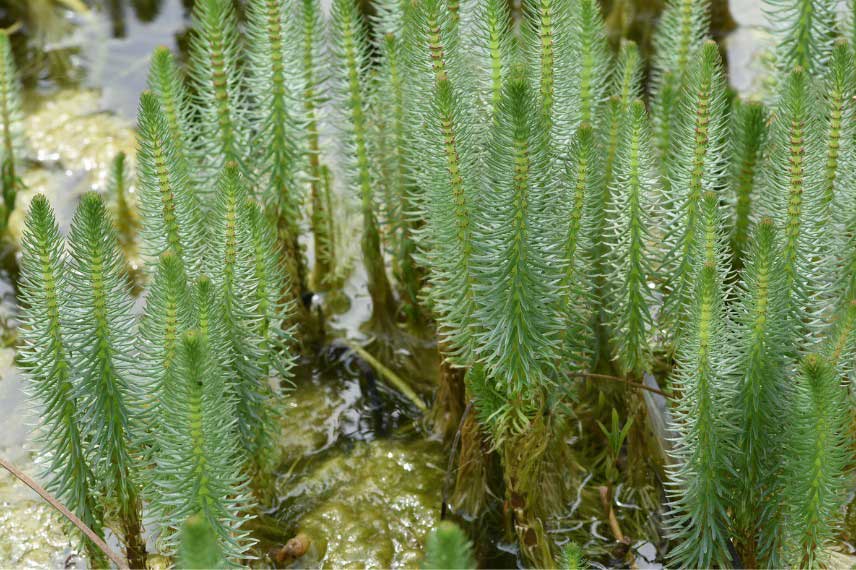
L’Hippuris vulgaris is very effective at oxygenating and cleansing water.
Floating plants
- Water hyacinth (Eichhorna crassipes)
- Ceratophyllum demersum, floating hornwort
- Water lilies
- Lemma minor (duckweed)
- Utricularia vulgaris
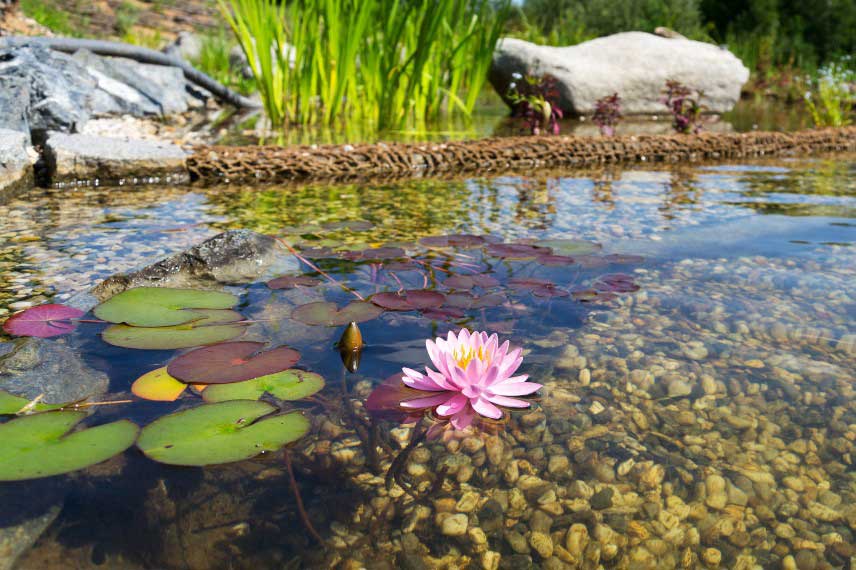
As well as being highly decorative, Nymphaea are perfect for shading a pond.
Perennials for wet banks
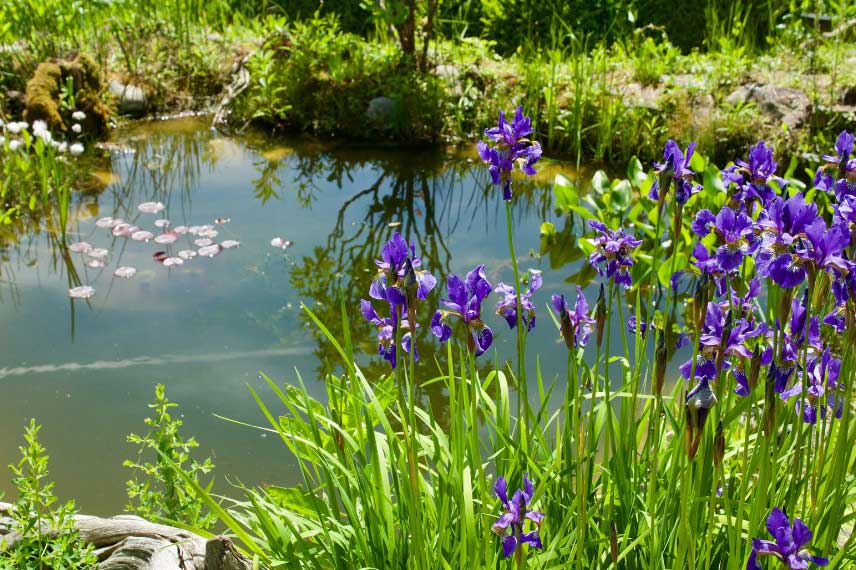
- Japanese iris and yellow flag iris
- Water mint
- Typha latifolia
- Rush
- Caltha palustris Plena
- Horsetails
- Reed
- Purple loosestrife (Lythrum)
And, discover All our aquatic plants for ponds, pools and water features.
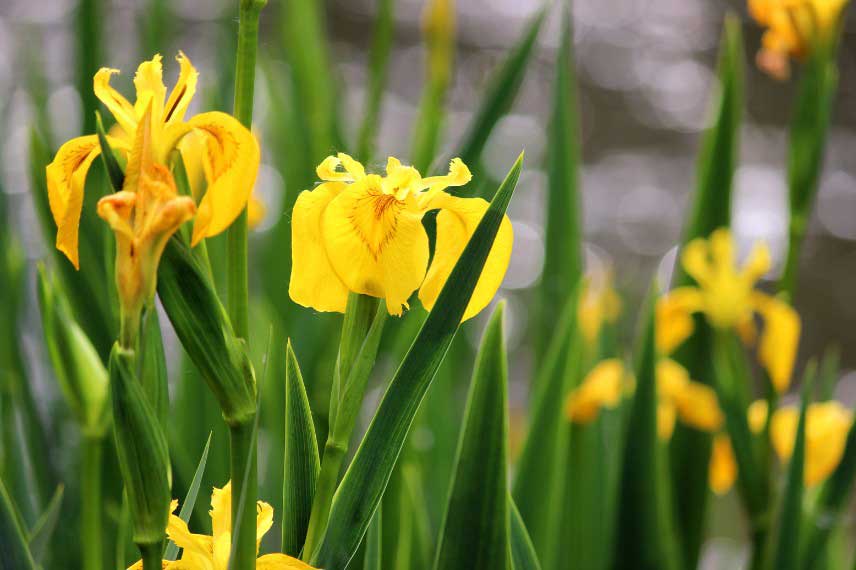
Yellow flag iris (Iris pseudacorus) is a superb marginal plant.
Maintaining a natural pond
One of the major advantages of a natural pond is that it requires little maintenance once biological balance is established. However, regular monitoring remains necessary to support pond life through the seasons. Above all, it is about observing, correcting gently, and preventing imbalances:
- Remove dead leaves in autumn to prevent them accumulating on the bottom and to limit production of organic matter.
- Prune or divide aquatic plants in spring if they become too invasive, to preserve light and pond balance.
- Remove plant debris from the surface or edges when the pond restarts in spring.
- Monitor water level in summer, especially during hot spells, and top up to compensate for evaporation if necessary with rainwater or unchlorinated water.
- Avoid topping up too frequently or too abruptly, which could disturb the pond’s biological stability.
- Regularly check condition of water and plants
- Add natural bacteria in spring and autumn if necessary to support biological filtration.
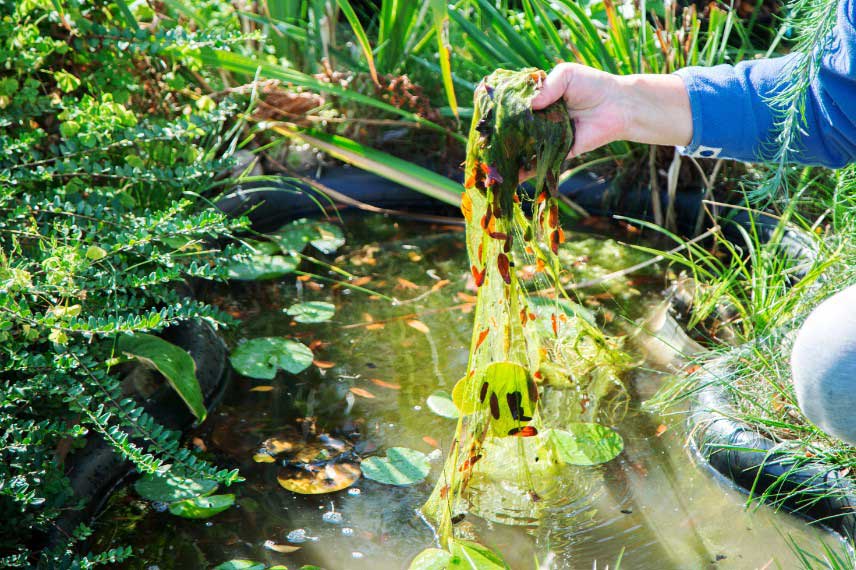
It is important to maintain the pond by removing dead leaves, plant debris and algae.
- Subscribe!
- Contents
This form is protected by reCAPTCHA - the Google Privacy Policy and Terms of Service apply.

































Comments