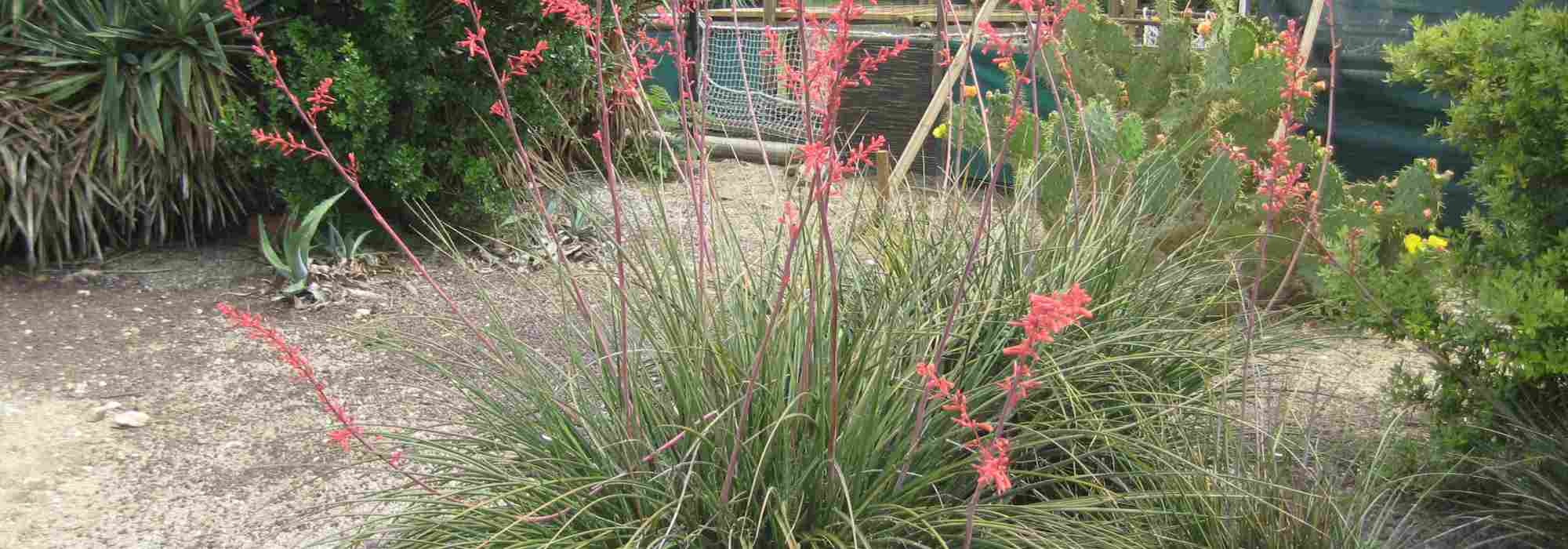
Hesperaloe - Red Yucca: planting, cultivation and care
Contents
Hesperaloe in a nutshell
- Hesperaloe is a drought-tolerant succulent perennial native to desert regions of the southern United States and Mexico.
- It forms a dense clump of long, slender, incurved leaves, with spectacular flower spikes in summer.
- Its tubular red or pink flowers attract both the eye and pollinators.
- Quite hardy, Hesperaloe tolerates temperatures down to -15°C and thrives in full sun in well-drained soil.
- Easy to care for, it is ideal for dry gardens, rockeries and xerophilous landscapes.
A word from our expert
Hesperaloe parviflora, sometimes called “red yucca” or “false yucca”, is a magnificent plant that deserves the attention of gardeners who appreciate hardy, ornamental plants. Native to desert regions of the southern United States and northern Mexico, this perennial succulent belongs to the family Xanthorrhoeaceae, like kniphofias or Eremurus, but above all aloes.
Genus Hesperaloe includes several species, but Hesperaloe parviflora is by far the most cultivated and popular. Its specific epithet, “parviflora”, meaning “small-flowered”, may raise a smile, because although its flowers are modest in size, their abundance and vivid colour more than make up for that. In summer, plant produces flowering spikes up to 1.5 to 2 metres tall, bearing breathtaking coral-red tubular flowers. These flowers do more than please the eye: they also attract hummingbirds (in their native habitat!), bees and other pollinators, adding a lively dimension to the garden.
With its long, narrow, stiff, arching leaves, the coral yucca forms a dense clump, somewhat like a fountain of foliage. Foliage is evergreen, with a bluish-green colour that stays fresh throughout the year. Leaf margins are sometimes adorned with white filaments, a delicate detail that recalls its kinship with Agaves and Yuccas, although it stands out by a more graceful appearance and easier cultivation.
Speaking of cultivation, suited to dry, well-drained soils, it needs minimal water and prefers full sun. In fact, the more light it receives, the happier it is. This plant also tolerates temperatures down to -15°C in well-drained soil. Whether in a rock garden, a xerophilous garden or even in a pot on a sunny patio, Hesperaloe parviflora thrives with astonishing vigour. As a long-lived perennial, it can remain in place for years, providing permanent structure and repeat flowering to your garden.
In short, despite distant origins and desert-like appearance, hesperaloes are perennials worth trying in (almost) any garden.

Botany and description
Botanical data
- Latin name Hesperaloe parviflora
- Family Xanthorrhoeaceae
- Common name Red yucca, Coral yucca, False yucca
- Flowering June to August
- Height 120 cm
- Exposure sun
- Soil type light and well-drained, even poor
- Hardiness -15°C
Hesperaloe belongs to family Xanthorrhoeaceae (like aloes, phormiums or even daylilies). The genus Hesperaloe originates from the desert regions of the southern United States and northern Mexico. It comprises seven species, including:
- Hesperaloe parviflora: the most widely cultivated species, known for its long red or pink flower spikes.
- Hesperaloe funifera: noted for its filamentous leaves and cream-coloured flowers.
- Hesperaloe campanulata: a rarer species with bell-shaped yellow flowers.
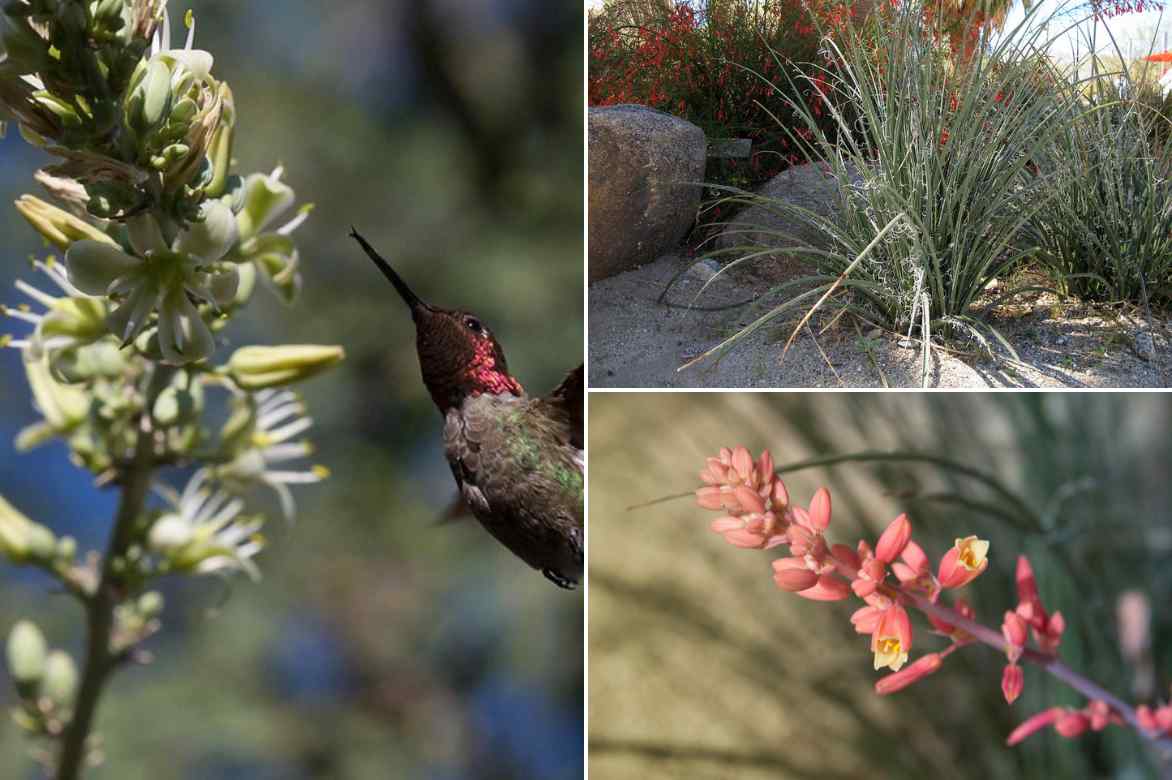
On the left, flowering of Hesperaloe funifera (© Anne Reeves), and on the right Hesperaloe parviflora: foliage (© Megan Hansen) and flowering.
In the wild, these plants grow in arid environments, mainly deserts, rocky hillsides and dry grasslands. They are well adapted to drought thanks to their fleshy leaves that store water and they thrive in full sun in well-drained soils.
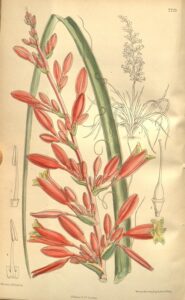
The most commonly grown species is Hesperaloe parviflora. The name “parviflora” means “small-flowered”, referring to the relatively modest size of its tubular flowers, although their abundance and vivid colour make them highly attractive. This species is prized for its minimal maintenance and great drought tolerance, making it a popular ornamental in dry gardens and rockeries. In addition to drought tolerance, Hesperaloe is also frost-hardy,
Common names for Hesperaloe parviflora include “red yucca”, “false yucca” or “coral yucca”, due to its resemblance to yuccas and the colour of its flowers.
Hesperaloe is an evergreen perennial distinguished by a dense, spreading clump habit. Plant forms a basal rosette of linear, lanceolate leaves, which can reach between 60 cm and 1 m in length, depending on species. Leaves are often curved, stiff and narrow, with toothed margins and sometimes fringed with white filaments. Colour ranges from green to blue‑green, and foliage retains its interest year‑round.
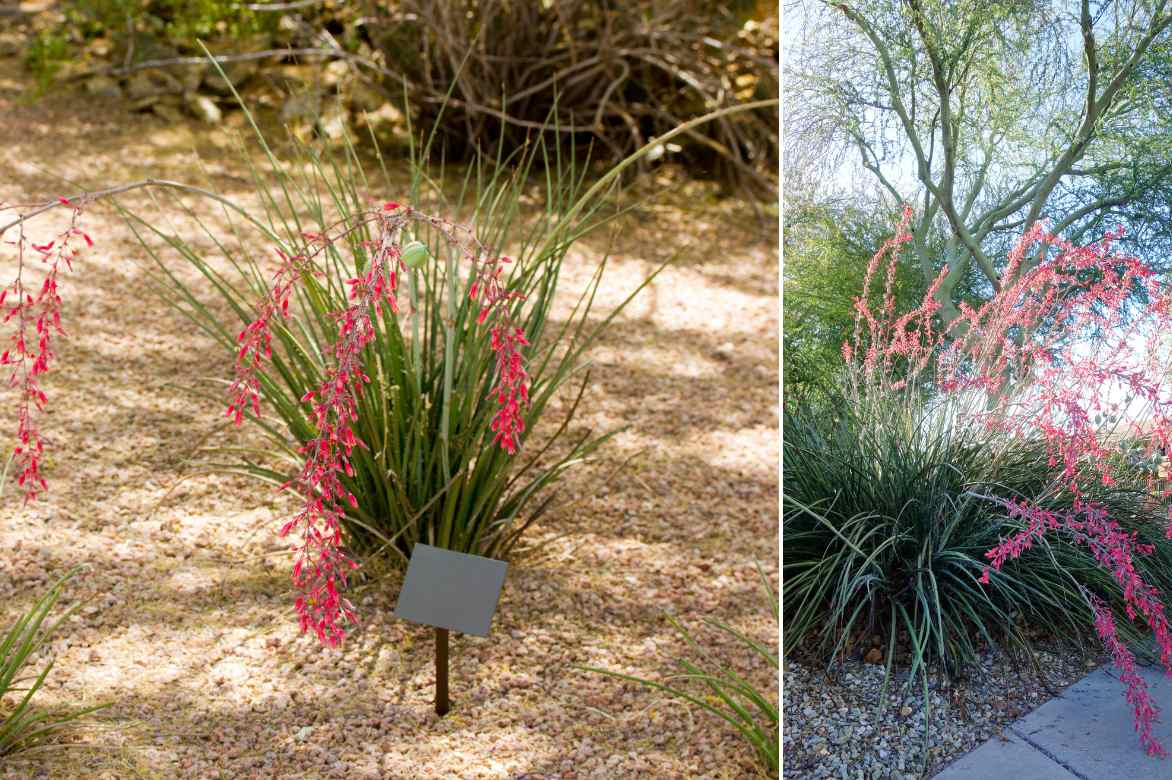
Hesperaloe parviflora: a very pronounced tufted habit.
Root system of Hesperaloe consists of fleshy, deep roots well adapted to capture water in arid soils. These roots enable the plant to withstand drought and to anchor in stony or sandy ground.
Flowering is one of Hesperaloe’s most striking features. In summer (June to August), plant produces long flower spikes that rise well above the foliage, sometimes reaching 1.5 to 2 m in height. These spikes are covered with tubular flowers arranged in clusters, with colours ranging from bright red to pink, or yellow depending on species. Flowers attract many pollinators, notably hummingbirds in their native range and bees locally.
After flowering, Hesperaloe produces fruit capsules containing numerous small black seeds. These capsules dry and split open to release the seeds, which can be collected for propagation by sowing. Seeds are light and winged, allowing wind dispersal in their natural habitat.
Note that Hesperaloe is a long‑lived perennial, able to thrive for many years with minimal care.
Hesperaloe is particularly valued for dry garden schemes, rockeries and xerophytic plants landscapes.
Our best varieties
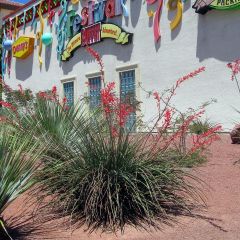
Hesperaloe parviflora - Red Yucca
- Flowering time July to September
- Height at maturity 1,20 m
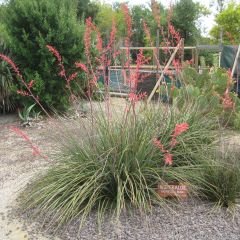
Hesperaloe parviflora Rubra - Red Yucca
- Flowering time July to September
- Height at maturity 1,20 m
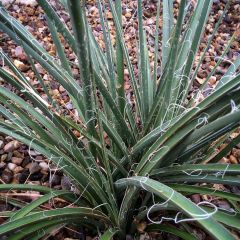
Hesperaloe parviflora Rose des Sables - Red Yucca
- Flowering time July to September
- Height at maturity 1 m
Planting hesperaloe
Where to plant?
Hesperaloe parviflora is a succulent plant ideal for dry, sunny gardens. Native to southern United States and Mexico, it prefers hot, arid climates but can also withstand cooler temperatures down to -15°C. To ensure optimal growth, choose a location in full sun, as this plant likes direct light and tolerates intense heat well.
Soil should be well drained, light and poor in organic matter. Sandy or stony soils are ideal, but if your soil is heavier you can amend it with gravel to improve drainage. Avoid areas where water stands, as excess moisture can cause root rot.
Hesperaloe thrives in rockeries, dry gardens or even in a pot on a sunny terrace.
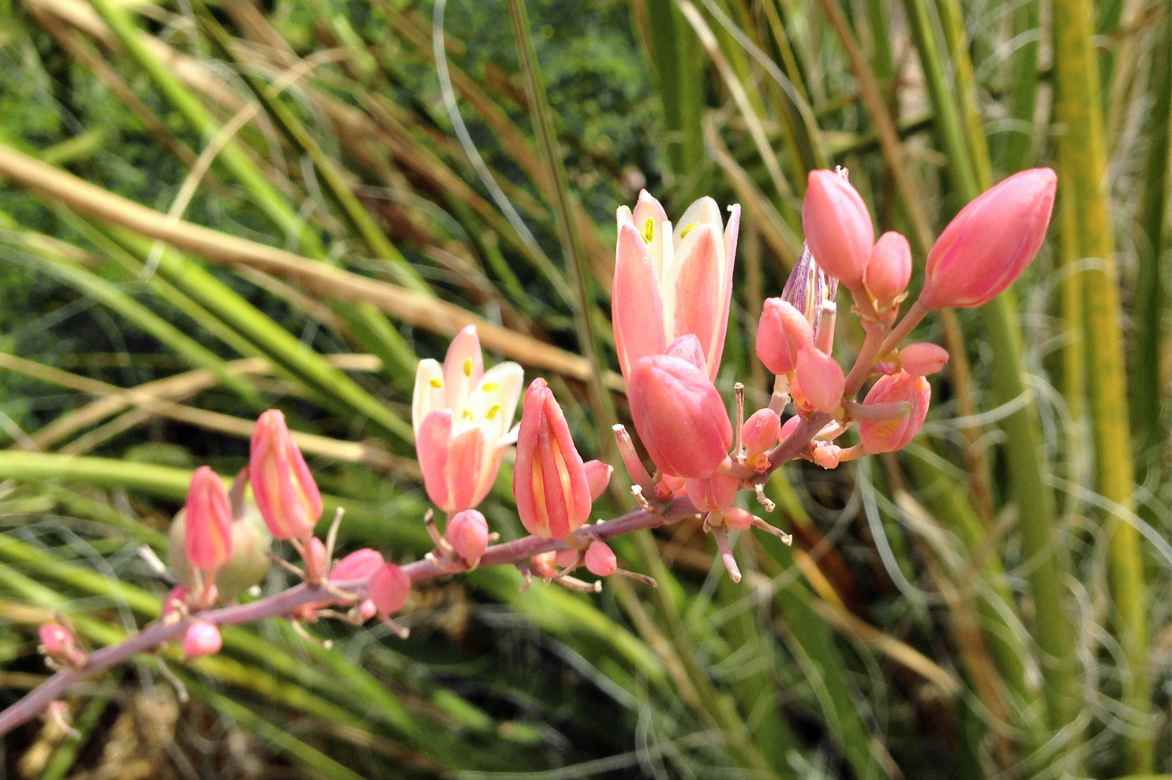
Spectacular flowering of Hesperaloe parviflora.
When to plant?
Plant Hesperaloe parviflora in spring (March–April) or in late summer (September) to allow it to become well established before winter.
How to plant?
In open ground
- Dig a hole about twice the size of the rootball. If your soil is heavy or clayey, mix gravel and compost into the excavated soil to improve drainage.
- Place plant at the centre of the hole, ensuring the top of the rootball sits level with the surrounding soil.
- Then backfill the hole with the soil and gravel mix, firming gently with your hands.
- Water well after planting to help plant establish and remove any air pockets between roots and soil.
In a pot
- Choose a container sufficiently wide and deep (at least 30–40 cm diameter and depth) with a drainage hole.
- Fill base of pot with a layer of gravel or clay balls to aid water drainage.
- Use a well-draining compost, such as cactus compost or potting mix blended with sand.
- Place plant at the centre of the pot, adjusting the height of the rootball so its top sits slightly below the rim of the pot.
- Fill the pot with the mix around the rootball, firm lightly, then water moderately to aid rooting.
- Place the pot in a sunny spot and allow soil to dry between waterings to avoid excess moisture.
→ Find out more at: Growing Hesperaloe in a pot.
Read also
10 hardy plants for an exotic dry gardenCare and maintenance
Maintenance of Hesperaloe parviflora is relatively simple, because it is a very hardy and undemanding plant.
Water moderately during its growth period in spring and summer, allowing the soil to dry out between waterings. In winter, greatly reduce watering, or stop it completely, especially if the plant is grown outdoors.
Red false yucca does not need regular feeding, but you can give it a little cactus fertiliser in early spring to encourage flowering. Fertiliser is more important if you grow it in a pot.
Cut back flowering stems once they have faded to encourage further flowering. Also remove dry or damaged leaves at the base of the plant to maintain a clean, healthy appearance.
Finally, if you grow Hesperaloe in a pot, consider repotting every 2–3 years to refresh the potting compost and provide more room for the roots.
Potential diseases and pests
Hesperaloe parviflora is generally resistant to pests and diseases, making it an excellent choice for dry, sunny gardens. However, it can be susceptible to a few problems, mainly related to excess moisture. Root rot is the main risk, especially if the plant is exposed to poorly drained soil or to overwatering.
As for pests, Hesperaloe is rarely attacked, but it can sometimes be targeted by mealybugs, particularly when grown indoors or in a greenhouse. Mealybugs appear as small, cottony white clusters on leaves. To remove them, you can use a cloth soaked in 70% alcohol to wipe them off manually, or apply an organic insecticide based on neem oil if the infestation is more severe.
Propagation of Hesperaloe
Hesperaloes are mainly propagated by clump division or by sowing.
For division, wait until plant is well established, generally after several years of growth. In spring, carefully lift the plant and separate the offshoots or new shoots that form around the parent plant. Ensure each division has enough roots to establish. Replant these divisions immediately in well-drained soil or in a pot and water moderately to aid rooting.
Propagation by sowing is also possible, although slower. Harvest seeds after flowering and sow them in spring in a light, well-drained substrate. Keep substrate slightly moist until germination, which can take several weeks. Once young plants are sufficiently developed, pot on into individual pots or plant out directly in ground.
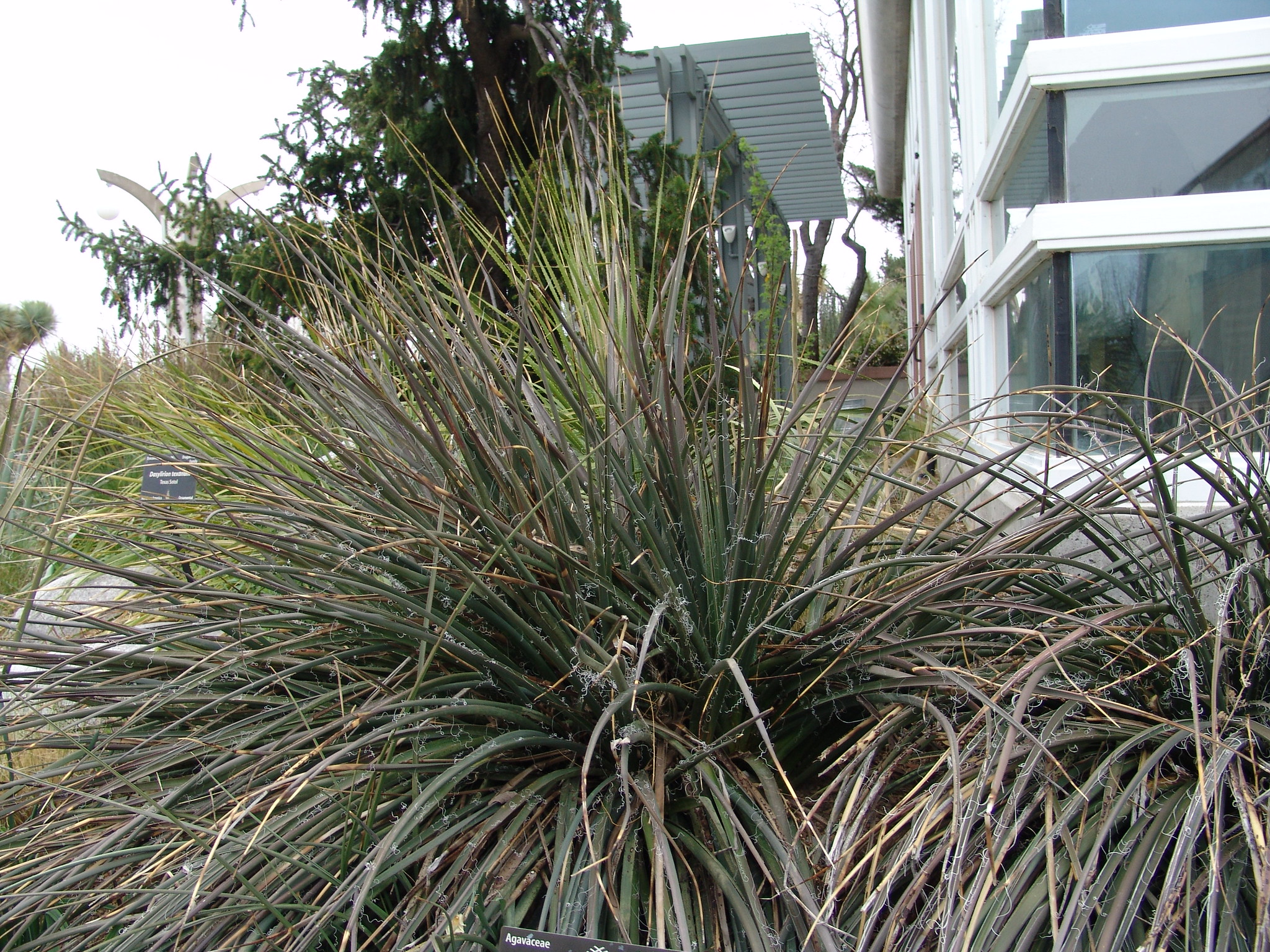
Hesperaloe parviflora at Denver Botanic Garden (USA) © Drew Avery: plant should be divided into clumps when it begins to get too large.
Companion plants for Hesperaloe
To create a border around Hesperaloe parviflora ‘Rose des sables’, choose plants that highlight its slender foliage and spectacular flowering while respecting soil and sunlight conditions. To accompany it, you could plant a few clumps of Kniphofia ‘Banana Popsicle’, also called torch lily; this perennial produces spikes of warm yellow flowers, creating a striking contrast with Hesperaloe’s flower spikes. Its long flowering period and drought tolerance make it an excellent choice.
Among other flowering perennials, blooms in warm tones will echo Hesperaloe’s flowering. Choose Echinacea purpurea ‘Tomato Soup’, with large red‑orange daisy-like flowers, and Achillea ‘Paprika’, with corymbs of small orange‑red flowers with yellow centres. People rarely think of Peruvian lilies in open ground, but some are hardy enough to survive winter in well‑drained soil: Alstroemeria aurantiaca is superb with its yellow‑to‑orange flowers.
A few small Stipa tenuifolia, a light, graceful feather grass with soft green foliage, will bring movement and texture to the border. Its feathery, soft look contrasts with the stiffness of other plants while remaining harmonious overall. In poor, dry, full‑sun soil, one of the most beautiful ornamental grasses in summer and into autumn is clearly Andropogon gerardii ‘Red October’ — a must‑try!
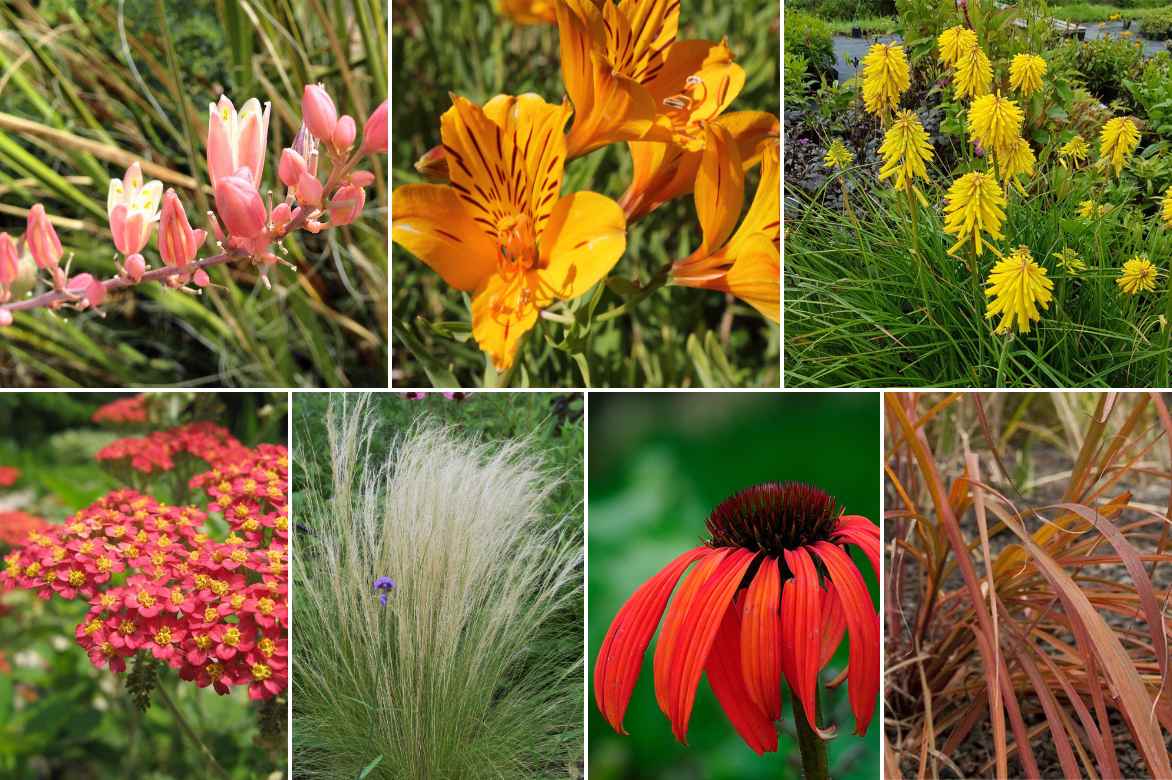
Hesperaloe parviflora, Alstroemeria aurantiaca, Kniphofia ‘Banana Popsicle’, Achillea millefolium ‘Paprika’, Stipa tenuifolia, Echinacea ‘Tomato Soup’ and Andropogon gerardii ‘Red October’.
Related articles
→ How to design a dry exotic garden? Follow Gwenaëlle’s helpful tips.
→ Discover other hardy plants for a dry exotic garden by reading: 10 hardy plants for a dry exotic garden.
♥ Is your garden sunny and very dry? Don’t worry, there are many plants that thrive in these conditions.
♥ The world of cacti and succulents is vast, find a wide selection in our online nursery.
- Subscribe!
- Contents
This form is protected by reCAPTCHA - the Google Privacy Policy and Terms of Service apply.

































Comments