Prunus cerasifera Hessei - Cherry plum
Prunus cerasifera Hessei - Cherry plum
Prunus cerasifera 'Hessei'
Cherry Plum, Myrobalan Plum
Back-to-school special offer!
Get €10 off for every €50 you spend! And get up to €40 off on a single order.
How does it work?
1. Shop your favourites
Add your favourite plants to your basket. For every €50 you spend (excluding delivery charges, store credit and the plastic-free option), you’ll receive a €10 voucher.
€50 spent = €10 voucher
€100 spent = €20 voucher
€150 spent = €30 voucher
€200 spent = €40 voucher
2. Place your order
Once your basket reaches one of the spending thresholds, place your order. You can even choose your delivery date!
3. Receive your voucher
As soon as your order has been shipped, you’ll receive an email containing your personal voucher code and its value.
4. Use it on your next order
Your voucher is valid for 90 days from the date you receive it. It can be used once only, on a new order worth at least the value of the voucher, excluding delivery charges.
Please note: Vouchers can be combined with other offers, but cannot be split or refunded.
Why not try an alternative variety in stock?
View all →
Available in 3 sizes
Available in 5 sizes
Available in 1 sizes
Available in 3 sizes
Available in 1 sizes
Available in 1 sizes
Available in 1 sizes
Available in 3 sizes
Available in 2 sizes
Available in 1 sizes
This plant carries a 24 months recovery warranty
More information
We guarantee the quality of our plants for a full growing cycle, and will replace at our expense any plant that fails to recover under normal climatic and planting conditions.
Would this plant suit my garden?
Set up your Plantfit profile →
Description
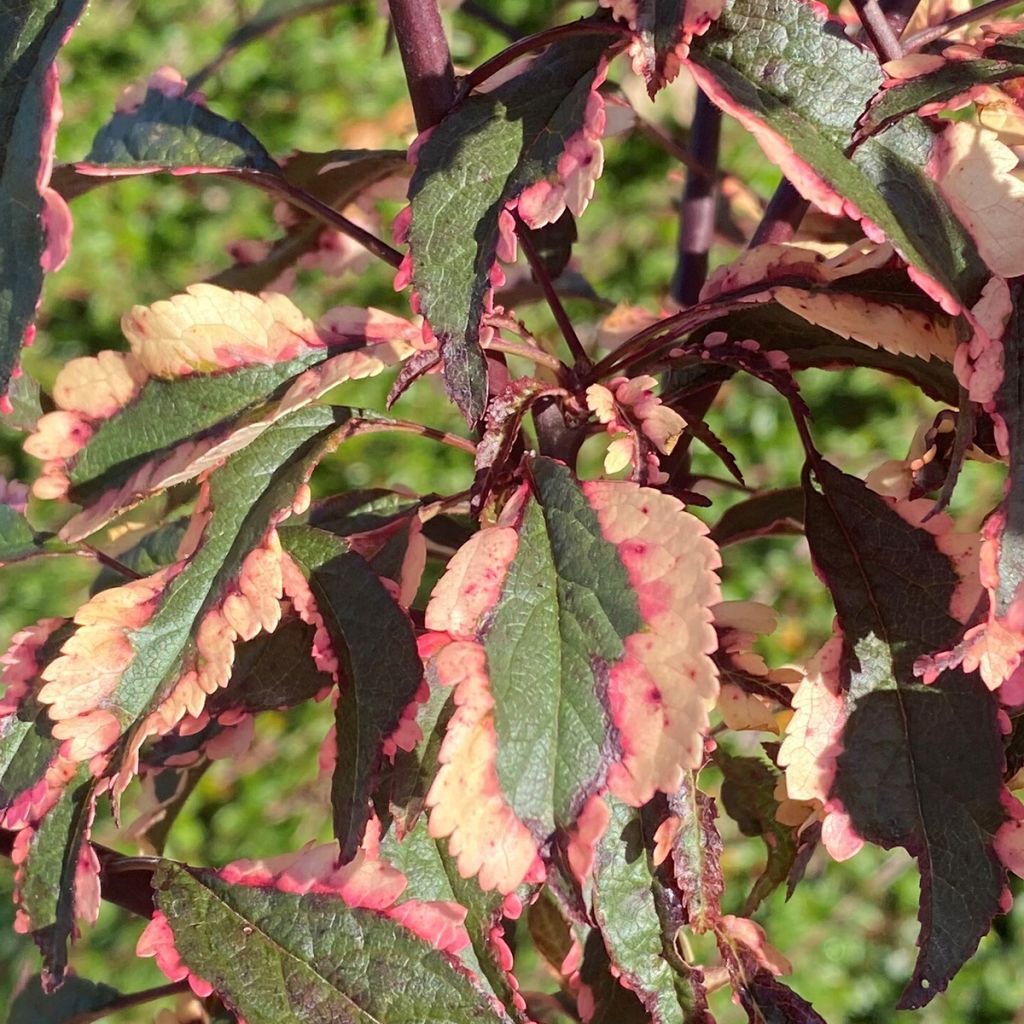
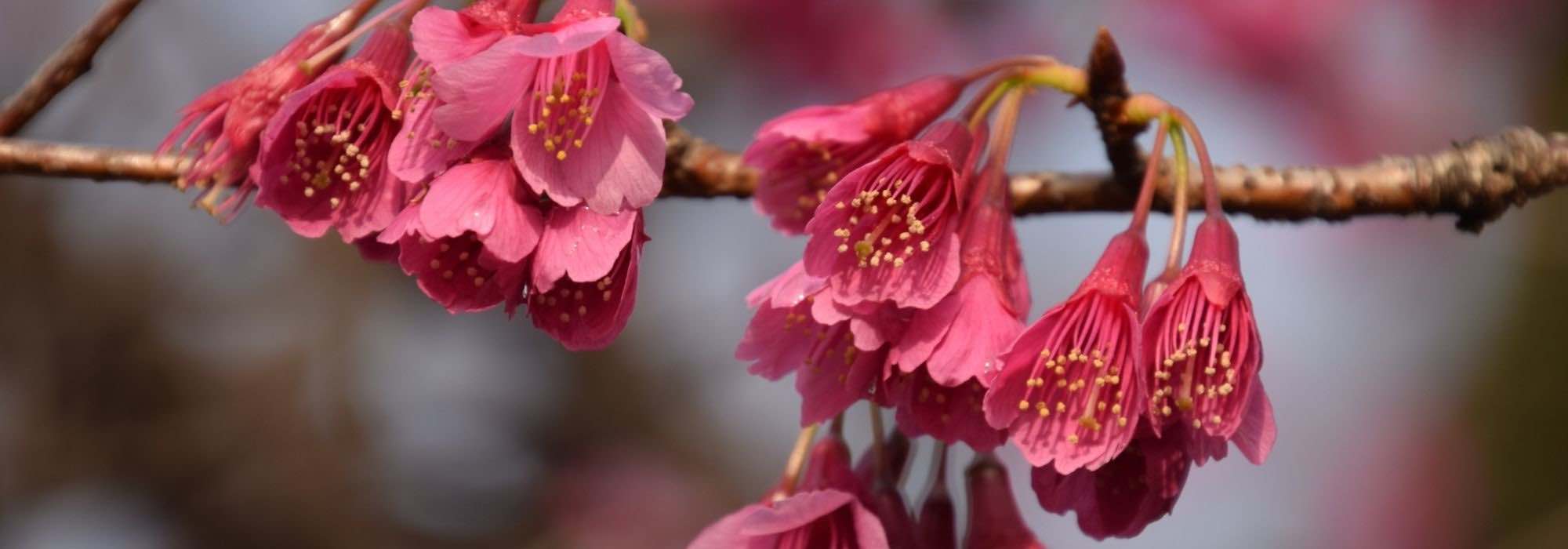
The Cherry Plum, Prunus cerasifera Hessei, also known as the variegated myrobalan, captivates with its early flowering and its variegated leaves, which evolve through the seasons. Its naturally compact growth makes it very suitable for small gardens and for growing in a large container on the terrace. It is valued for its delicately pinkish flowers in March-April and its bronze-purple leaves edged with cream to pink, which take on beautiful colours in autumn. This easy-to-grow, deciduous bush mainly requires well-drained soil and a sunny position.
Belonging to the Rosaceae family, this 'Hessei' cultivar of Prunus cerasifera (myrobalan or myrobalan plum) is a variegated and dwarf form selected in Germany, presumably by the Hesse nurseries (Weener) in the early 20th century. The botanical species originates from the Caucasus and Western Asia, naturalised in many regions of Europe; it is found on woodland edges, in hedges and along paths. It is among the first trees to flower in spring.
'Hessei', with rather slow growth, reaches 2 m to 2.50 m in height with a 2 m spread at 10 years old, rarely more than 3–4 m at maturity, which classifies it among small trees. In a container, the height is often kept between 1.5 and 2 m. This prunus is naturally bushy, but it is often grafted and trained as a small tree with a trunk (half-standard of 80 to 120 cm or standard of 180 to 200 cm) and a rounded, compact crown.
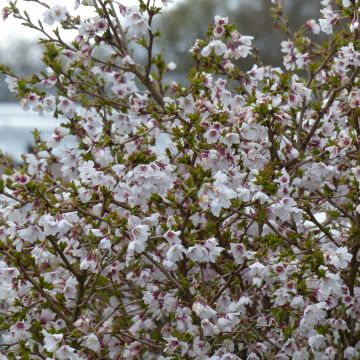
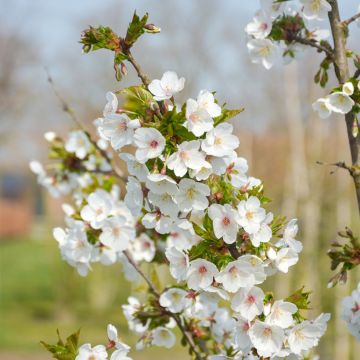
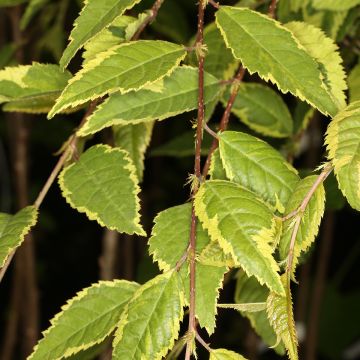
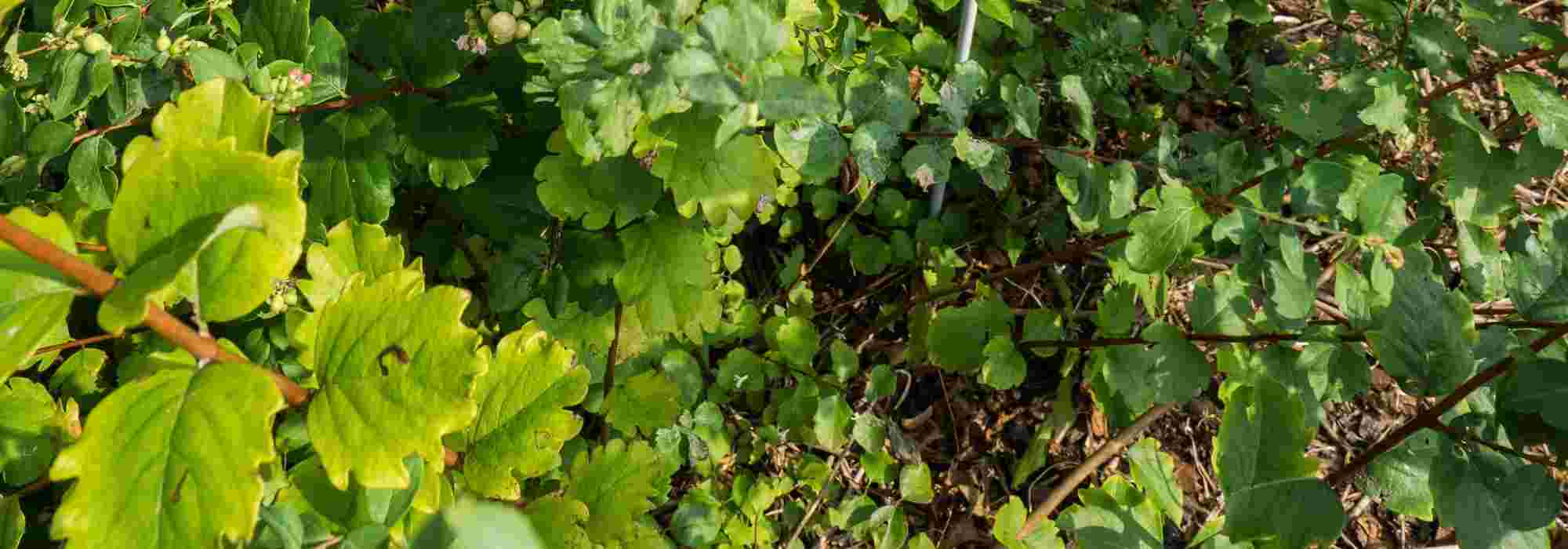
The young, ovate leaves, about 4–6 cm long, emerge pale green then turn bronze-purple with irregular margins ranging from creamy yellow to pink; at the end of the season, before falling, they take on red, purple and yellow hues. The year's shoots are brown-purple, and the bark of mature specimens is grey-brown to blackish. Flowering occurs from March to early April, depending on the region. The single, 1.5 to 2 cm diameter, nectar-rich flowers are white with a purple heart, emerging from purple buds. From a distance, the flowering crown of this tree looks slightly pink. These five-petalled corollas with numerous stamens are borne on short shoots from the previous year. The fruiting, variable from year to year and depending on exposure, is in the form of small globular drupes of 2–3 cm, red to purple when ripe. These are edible, but best for culinary uses (jams, sauces) and very popular with birds. The root system is mostly shallow and spreading, as with many Prunus. This variety is hardy down to −20 °C.
Prunus Hessei can be grown in many regions, but it dislikes compact and clayey soils or arid situations. With its small size, its colourful, variegated leaves and its early flowering, it has many attributes. It can be placed as a standalone specimen, in a fruiting hedge or in a large shrub border. To accompany it, choose small trees or large, easy-going bushes, for example, ornamental crab apple Malus Evereste, hawthorn Crataegus lavallei Carrierei, Amelanchier lamarckii, or a common lilac Syringa vulgaris Mme Lemoine.
The plums of the wild myrobalan are traditionally used in the Caucasus to prepare the Georgian tkemali sauce.
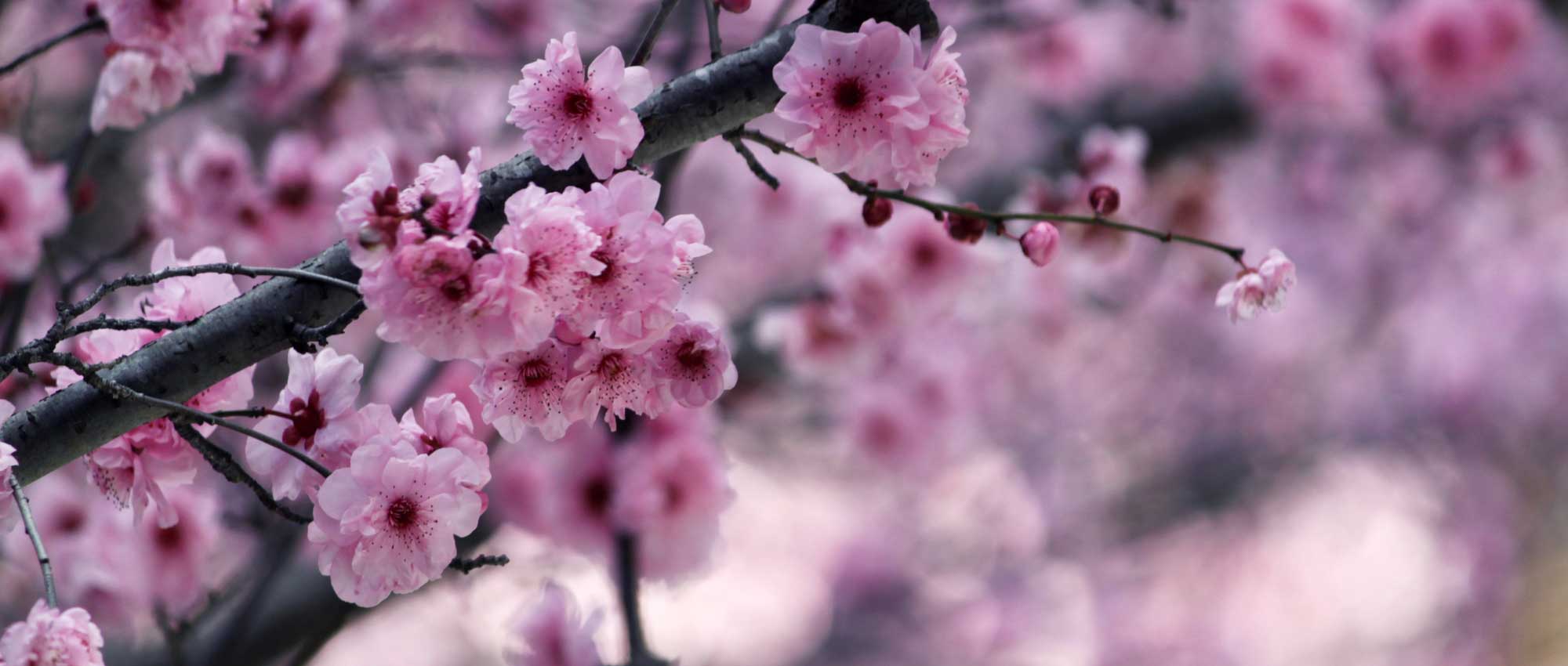
Prunus cerasifera Hessei - Cherry plum in pictures
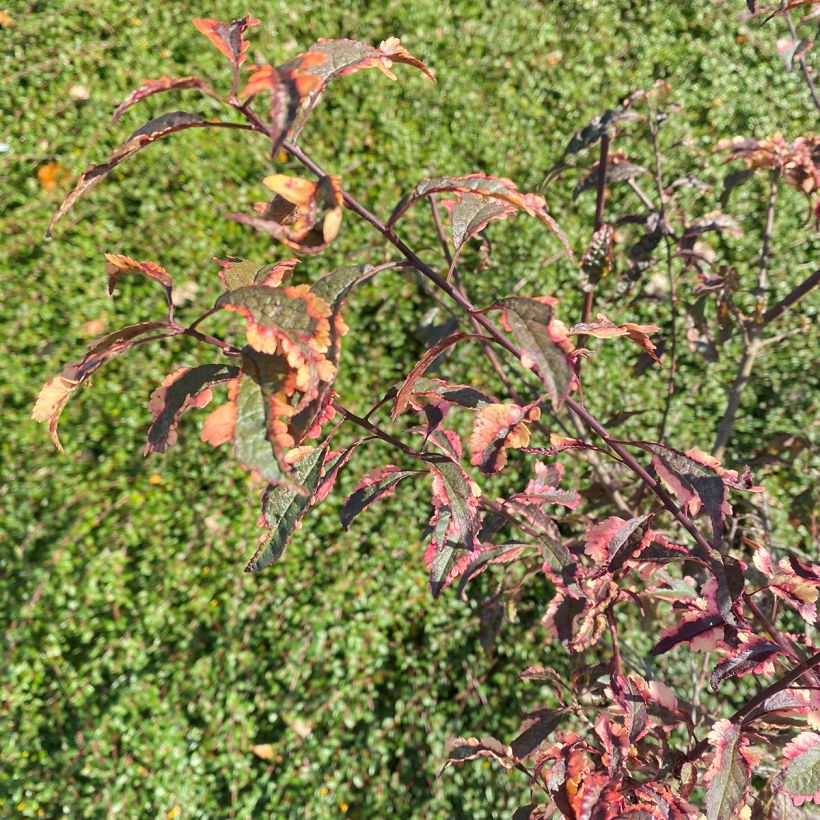
Plant habit
Flowering
Foliage
Botanical data
Prunus
cerasifera
'Hessei'
Rosaceae
Cherry Plum, Myrobalan Plum
Cultivar or hybrid
Planting and care
Prunus cerasifera Hessei thrives in full sun or partial shade in any reasonably deep, moist, but well-drained soil, neither excessively wet nor excessively dry. It develops rather poorly in very acidic soils. Water only during abnormally dry and hot weather. When planting, mix garden soil with compost in a ratio of 50%. Dig a large planting hole. Apply a fertiliser for flowering shrubs every year in spring. Position the prunus in a spot sheltered from dry, cold winds to enjoy its early flowering.
Planting period
Intended location
Care
Planting & care advice
-

-

-
-

-
-
-

-
This item has not been reviewed yet - be the first to leave a review about it.
Recently viewed products
Haven't found what you were looking for?
Hardiness is the lowest winter temperature a plant can endure without suffering serious damage or even dying. However, hardiness is affected by location (a sheltered area, such as a patio), protection (winter cover) and soil type (hardiness is improved by well-drained soil).

The flowering period indicated on our website applies to countries and regions located in USDA zone 8 (France, the United Kingdom, Ireland, the Netherlands, etc.)
It will vary according to where you live:- In zones 9 to 10 (Italy, Spain, Greece, etc.), flowering will occur about 2 to 4 weeks earlier.
- In zones 6 to 7 (Germany, Poland, Slovenia, and lower mountainous regions), flowering will be delayed by 2 to 3 weeks.
- In zone 5 (Central Europe, Scandinavia), blooming will be delayed by 3 to 5 weeks.
In temperate climates, pruning of spring-flowering shrubs (forsythia, spireas, etc.) should be done just after flowering.
Pruning of summer-flowering shrubs (Indian Lilac, Perovskia, etc.) can be done in winter or spring.
In cold regions as well as with frost-sensitive plants, avoid pruning too early when severe frosts may still occur.
The planting period indicated on our website applies to countries and regions located in USDA zone 8 (France, United Kingdom, Ireland, Netherlands).
It will vary according to where you live:
- In Mediterranean zones (Marseille, Madrid, Milan, etc.), autumn and winter are the best planting periods.
- In continental zones (Strasbourg, Munich, Vienna, etc.), delay planting by 2 to 3 weeks in spring and bring it forward by 2 to 4 weeks in autumn.
- In mountainous regions (the Alps, Pyrenees, Carpathians, etc.), it is best to plant in late spring (May-June) or late summer (August-September).
The harvesting period indicated on our website applies to countries and regions in USDA zone 8 (France, England, Ireland, the Netherlands).
In colder areas (Scandinavia, Poland, Austria...) fruit and vegetable harvests are likely to be delayed by 3-4 weeks.
In warmer areas (Italy, Spain, Greece, etc.), harvesting will probably take place earlier, depending on weather conditions.
The sowing periods indicated on our website apply to countries and regions within USDA Zone 8 (France, UK, Ireland, Netherlands).
In colder areas (Scandinavia, Poland, Austria...), delay any outdoor sowing by 3-4 weeks, or sow under glass.
In warmer climes (Italy, Spain, Greece, etc.), bring outdoor sowing forward by a few weeks.
Shipping country and language
Your country of residence may be:
Your country of residence is:
For a better user experience on our website, you can select:
Your shipping country:
-
 Austria
-
 Belgium
-
 Bosnia & Herzegovina
-
 Bulgaria
-
 Croatia
-
 Cyprus
-
 Czechia
-
 Denmark
-
 Estonia
-
 Finland
-
 France
-
 Germany
-
 Greece
-
 Hungary
-
 Iceland
-
 Ireland
-
 Italy
Italy
-
 Latvia
-
 Liechtenstein
-
 Lithuania
-
 Luxembourg
-
 Malta
Malta
-
 Netherlands
-
 Poland
-
 Portugal
-
 Romania
-
 Serbia
-
 Slovakia
-
 Slovenia
-
 Spain
Spain
-
 Sweden
-
 Switzerland
Language:
-
French
-
 English
-
Spanish
-
Italian
-
German
-
Portuguese
-
Dutch
-
Finnish
My Account
Hello
My wish lists
My cart
Log in / Register
Existing customer?
This form is protected by reCAPTCHA - the Google Privacy Policy and Terms of Service apply.
New customer?
Create an account to track your orders, access our customer service and, if you wish, make the most of our upcoming offers.