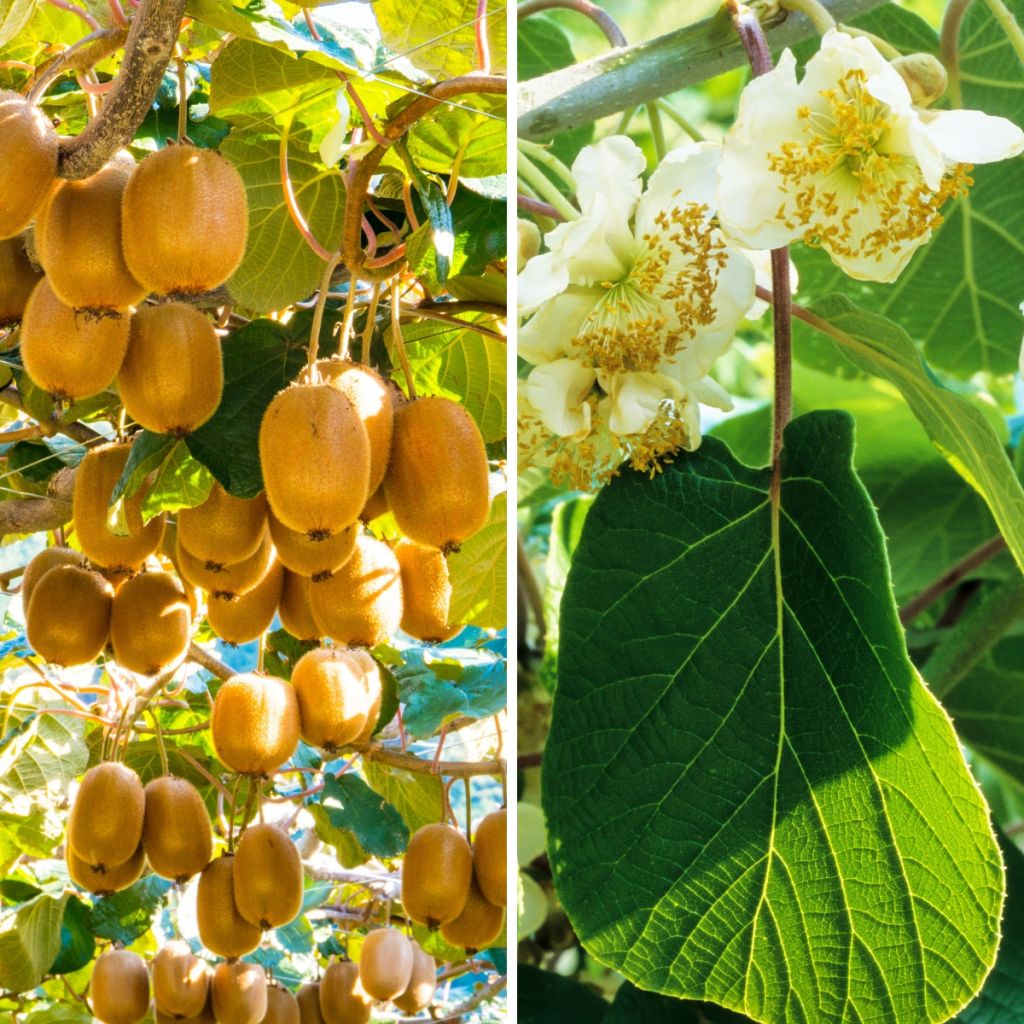
Duo of Kiwi plants: Montcap (female) and Tomuri (male pollinator)
Duo of Kiwi plants: Montcap (female) and Tomuri (male pollinator)
Actinidia deliciosa
Kiwi, Fuzzy Kiwifruit, Chinese Gooseberry, Yangtao
Second time we've ordered a male-female pair. But barely planted, it didn't take, despite a young plant that seemed healthy upon arrival and following the instructions. Disappointed ????
Eric, 17/05/2025
Back-to-school special offer!
Get €10 off for every €50 you spend! And get up to €40 off on a single order.
How does it work?
1. Shop your favourites
Add your favourite plants to your basket. For every €50 you spend (excluding delivery charges, store credit and the plastic-free option), you’ll receive a €10 voucher.
€50 spent = €10 voucher
€100 spent = €20 voucher
€150 spent = €30 voucher
€200 spent = €40 voucher
2. Place your order
Once your basket reaches one of the spending thresholds, place your order. You can even choose your delivery date!
3. Receive your voucher
As soon as your order has been shipped, you’ll receive an email containing your personal voucher code and its value.
4. Use it on your next order
Your voucher is valid for 90 days from the date you receive it. It can be used once only, on a new order worth at least the value of the voucher, excluding delivery charges.
Please note: Vouchers can be combined with other offers, but cannot be split or refunded.
Home or relay delivery (depending on size and destination)
Important: You may be charged customs duties by your country’s customs authorities upon delivery.
Schedule delivery date,
and select date in basket
This plant carries a 12 months recovery warranty
More information
We guarantee the quality of our plants for a full growing cycle, and will replace at our expense any plant that fails to recover under normal climatic and planting conditions.
Description
This Duo of Kiwi plants (Actinidia deliciosa) brings together a female variety, Montcap, and a male variety, Tomuri, with the latter allowing the female plant to bear fruit. The Montcap kiwi ripens earlier than the Hayward kiwi, which is an advantage in regions where autumn comes earlier. The plant produces fuzzy, oval-shaped fruits that are larger than those of Hayward variety and have a sweeter taste. This lovely vine can be trained along a pergola or trellis. Ideally planted in autumn or anytime throughout the year, outside of frost periods, for harvest around October, starting from the 4th or 5th year.
The Kiwi (Actinidia chinensis or deliciosa), also known as Chinese gooseberry or Yangtao is the fruit of the Actinidia plant. It belongs to the Actinidiaceae family, just like its cousin the Kiwaï (Actinidia arguta). Originating from China, the kiwi is a vigorous climbing liana that can grow up to 3 m (10ft) per year under favourable conditions. This climbing plant should be trained on a sturdy support, such as a wall with strong wires, a trellis, a pergola, a tree trunk, or a fence. It can reach a height of 6 m (20ft) and a spread of 4 m (13ft), and requires pruning to control its growth.
Some varieties are self-fertile (male and female flowers on the same plant) and can be planted as a single specimen. Other varieties have either male flowers (like Tomuri) or female flowers (like Montcap) and require the presence of a plant of the opposite sex for pollination. One male plant can pollinate around 5 to 6 female plants. Only female plants produce fruits. Note that 'Montcap' and 'Tomuri' flower at the same time as the 'Atlas' and 'Hayward' varieties. It is the ripening time of the fruits that is shorter in the female Montcap variety.
The female Montcap Kiwi was selected in an agricultural research facility in Capou, Tarn-et-Garonne by Jocelyne Chartier and Patrice Blanchet. This variety can withstand temperatures as low as -12 °C (10.4°F) at its adult size, but it is sensitive to late frosts as the buds freeze at -5 °C (23°F). Its foliage is deciduous. The stems bear large, ovate, and entire leaves, dark matte green on the top and lighter underneath, covered, like the stems, with small red hairs. From the third or fourth year of cultivation, clusters of flowers appear in May-June on the previous year's branches. These are fragrant flowers with broad cream-white petals. Male flowers have numerous yellow stamens, while female flowers have white stigmas.
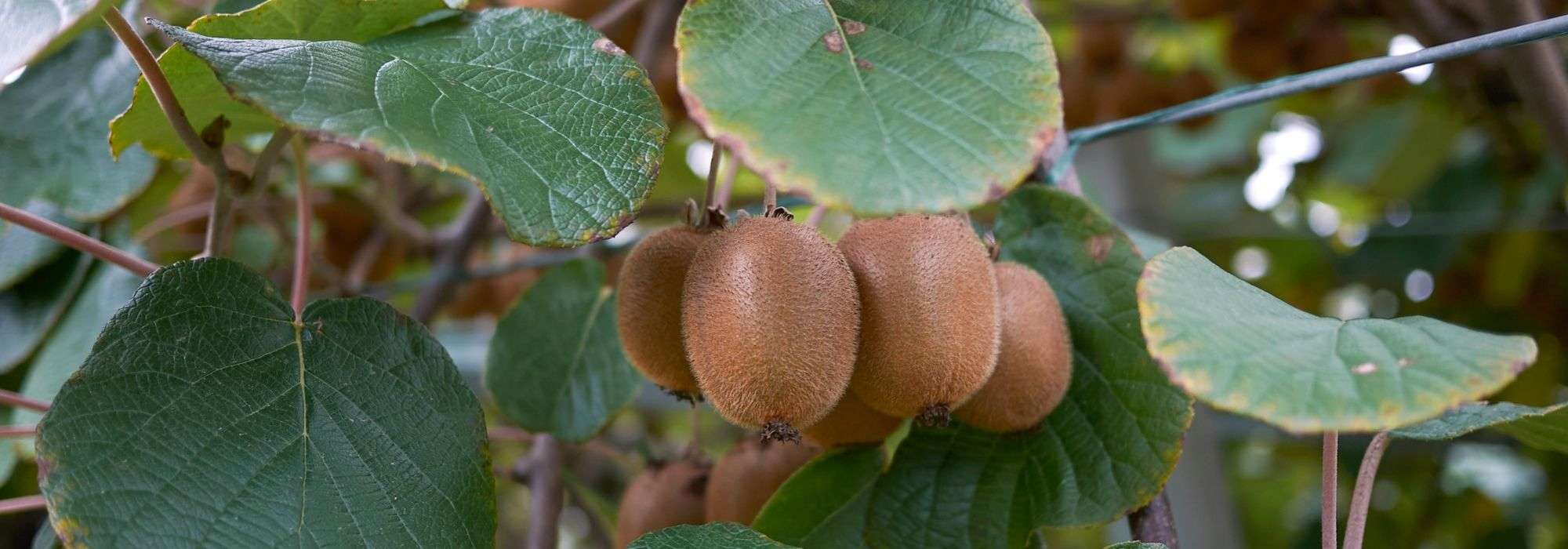
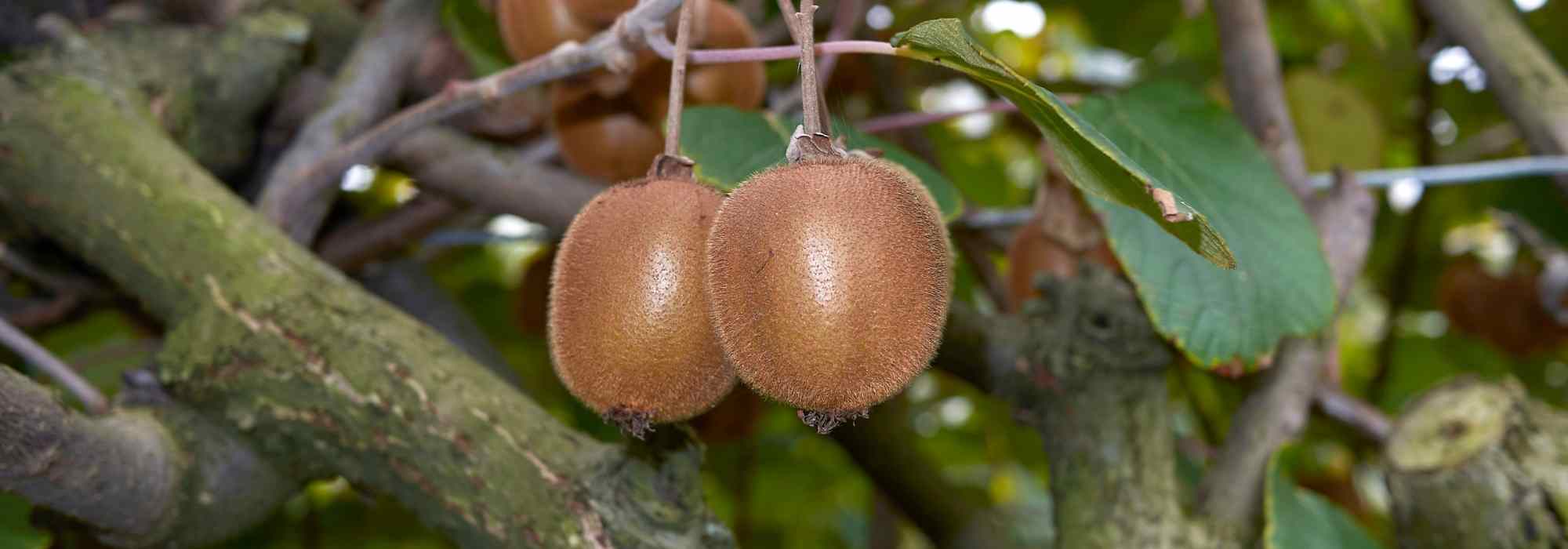
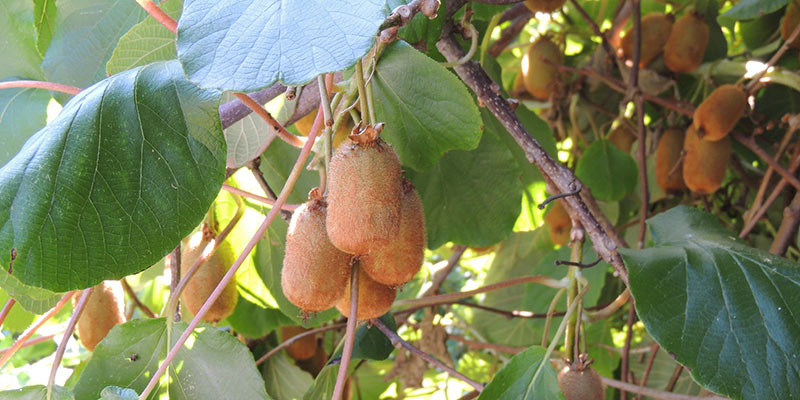
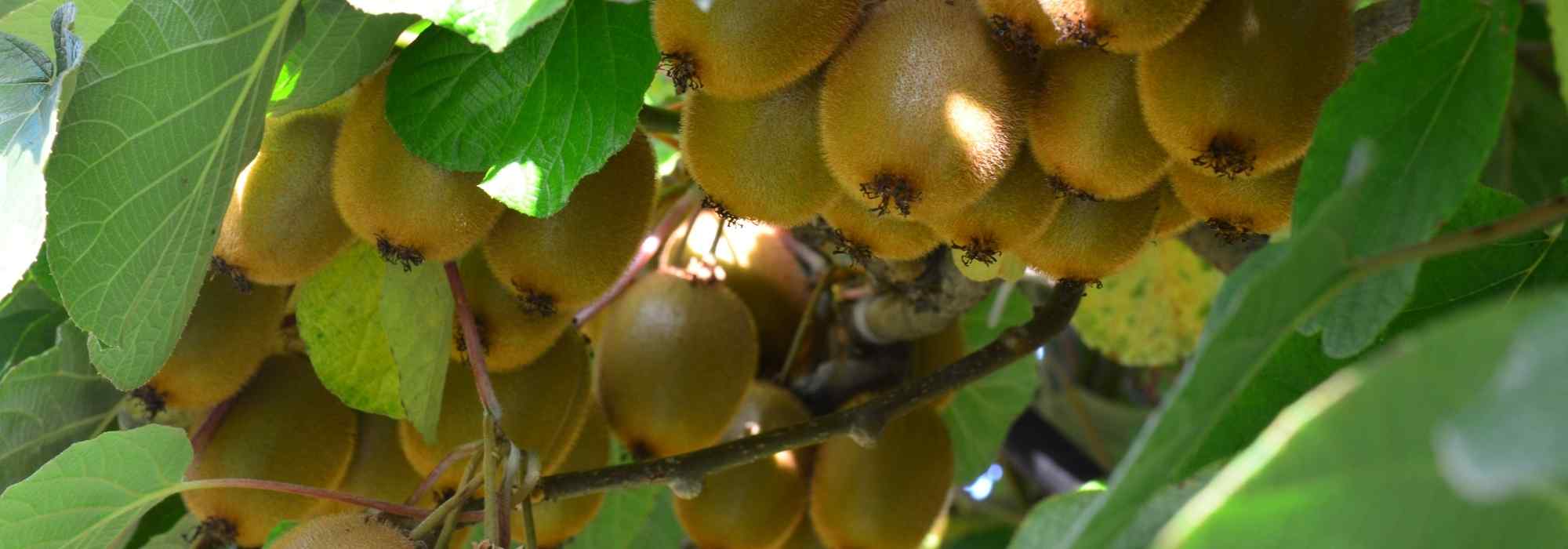
On the female Montcap plant, flowering is followed by the formation of large, fleshy, ovoid berries weighing approximately 100 to 150 grams. The thin skin is velvety, greenish to light brown. The flesh is green, juicy, slightly sweet, but deliciously tangy and filled with numerous, small, black seeds. The Kiwi fruit is rich in vitamin C, fibre, and minerals such as potassium, magnesium, and calcium. The harvest takes place 30 days before that of the Hayward kiwi, around October, before the first frosts. The fruits can be harvested even when they are still green as they continue to ripen after harvest. They can be stored in a cool location at 5 °C (41°F), such as a cellar, for over a month. The kiwi is ripe when it is soft to the touch. Place kiwis next to apples or bananas to speed up their ripening. Once peeled, the kiwi can be enjoyed on its own or mixed with other autumn fruits, used in jams, or used as decoration on pies and even in savoury dishes.
To save space, plant the male Tomuri at the base of a pole or pylon: it will climb and grow upwards without occupying too much ground space.
Plant habit
Fruit
Flowering
Foliage
Botanical data
Actinidia
deliciosa
Actinidiaceae
Kiwi, Fuzzy Kiwifruit, Chinese Gooseberry, Yangtao
Cultivar or hybrid
Planting and care
Planting is preferably done in autumn, but can be done all year round outside of frost periods. The Kiwi plant thrives in a fresh, fertile, light and well-drained soil, non-calcareous, neutral to slightly acidic. The plant fears stagnant humidity. Place it in a sunny position, sheltered from strong winds. Space the plants 3 to 4 m (10 to 13ft) apart. It appreciates the semi-oceanic climate of southwestern France, where it is grown on a large scale.
Dig a hole 50 cm (20in) in all directions. Spread a layer of gravel in the bottom, then a layer of soil mixed with peat or compost. Place the root ball (the root collar of the plant should be at ground level) and cover with soil. Provide it with a solid support to help its voluble branches climb. Firmly press down and water generously. The Kiwi has trailing roots, which develop horizontally below the surface of the soil, requiring, if necessary, only a light surface hoeing. Mulch the plants for the first three winters.
The Kiwi requires little maintenance, simply provide regular watering. During periods of high heat, water it 1 to 2 times a week. Once established and rooted, the plant will manage on its own and will be less water-hungry, in deep soil. In late winter, bury an organic fertiliser or well-decomposed manure at the base of the plant, by hoeing lightly. Train the stems as they grow by tying them loosely. They will wrap around their support.
Not particularly sensitive to insects and pests, the Kiwi can nevertheless be affected by red spider mites in a hot and dry environment. To eliminate them, lightly but regularly mist the foliage and soil.
Planting period
Intended location
Care
Planting & care advice
-
-
-
-
-
-
-
-
-
, onOrder confirmed
Reply from on Promesse de fleurs
Recently viewed products
Haven't found what you were looking for?
Hardiness is the lowest winter temperature a plant can endure without suffering serious damage or even dying. However, hardiness is affected by location (a sheltered area, such as a patio), protection (winter cover) and soil type (hardiness is improved by well-drained soil).

The flowering period indicated on our website applies to countries and regions located in USDA zone 8 (France, the United Kingdom, Ireland, the Netherlands, etc.)
It will vary according to where you live:- In zones 9 to 10 (Italy, Spain, Greece, etc.), flowering will occur about 2 to 4 weeks earlier.
- In zones 6 to 7 (Germany, Poland, Slovenia, and lower mountainous regions), flowering will be delayed by 2 to 3 weeks.
- In zone 5 (Central Europe, Scandinavia), blooming will be delayed by 3 to 5 weeks.
In temperate climates, pruning of spring-flowering shrubs (forsythia, spireas, etc.) should be done just after flowering.
Pruning of summer-flowering shrubs (Indian Lilac, Perovskia, etc.) can be done in winter or spring.
In cold regions as well as with frost-sensitive plants, avoid pruning too early when severe frosts may still occur.
The planting period indicated on our website applies to countries and regions located in USDA zone 8 (France, United Kingdom, Ireland, Netherlands).
It will vary according to where you live:
- In Mediterranean zones (Marseille, Madrid, Milan, etc.), autumn and winter are the best planting periods.
- In continental zones (Strasbourg, Munich, Vienna, etc.), delay planting by 2 to 3 weeks in spring and bring it forward by 2 to 4 weeks in autumn.
- In mountainous regions (the Alps, Pyrenees, Carpathians, etc.), it is best to plant in late spring (May-June) or late summer (August-September).
The harvesting period indicated on our website applies to countries and regions in USDA zone 8 (France, England, Ireland, the Netherlands).
In colder areas (Scandinavia, Poland, Austria...) fruit and vegetable harvests are likely to be delayed by 3-4 weeks.
In warmer areas (Italy, Spain, Greece, etc.), harvesting will probably take place earlier, depending on weather conditions.
The sowing periods indicated on our website apply to countries and regions within USDA Zone 8 (France, UK, Ireland, Netherlands).
In colder areas (Scandinavia, Poland, Austria...), delay any outdoor sowing by 3-4 weeks, or sow under glass.
In warmer climes (Italy, Spain, Greece, etc.), bring outdoor sowing forward by a few weeks.
Shipping country and language
Your country of residence may be:
Your country of residence is:
For a better user experience on our website, you can select:
Your shipping country:
-
 Austria
-
 Belgium
-
 Bosnia & Herzegovina
-
 Bulgaria
-
 Croatia
-
 Cyprus
-
 Czechia
-
 Denmark
-
 Estonia
-
 Finland
-
 France
-
 Germany
-
 Greece
-
 Hungary
-
 Iceland
-
 Ireland
-
 Italy
Italy
-
 Latvia
-
 Liechtenstein
-
 Lithuania
-
 Luxembourg
-
 Malta
Malta
-
 Netherlands
-
 Poland
-
 Portugal
-
 Romania
-
 Serbia
-
 Slovakia
-
 Slovenia
-
 Spain
Spain
-
 Sweden
-
 Switzerland
Language:
-
French
-
 English
-
Spanish
-
Italian
-
German
-
Portuguese
-
Dutch
-
Finnish
My Account
Hello
My wish lists
My cart
Log in / Register
Existing customer?
This form is protected by reCAPTCHA - the Google Privacy Policy and Terms of Service apply.
New customer?
Create an account to track your orders, access our customer service and, if you wish, make the most of our upcoming offers.