How to grow a citrus tree in open ground to optimise fruiting?
Tips for planting and caring for a citrus tree in open ground
Contents
A lemon tree with bright yellow fruit, a generous orange tree, a mandarin tree bearing an abundant crop… To grow a citrus tree in open ground is undoubtedly the dream of many gardeners. Planting in open ground brings vigour and fruiting that growing in a pot can never match. However, to obtain a plentiful harvest, simply digging a hole is not enough! Planting and caring for a citrus tree in open ground require care and attention.
Discover all our tips to grow a citrus tree successfully in your garden.

Choosing a citrus tree: the basis for fruit set
Even before you lift a spade, success in your project to grow a citrus tree in open ground hinges on two fundamental selection criteria: variety and rootstock. It is not enough to choose the fruit you prefer to eat; you must select a species capable of adapting to the constraints of your soil and the rigours of your local climate. A mistake at this stage can condemn the tree to stunted growth or to a fatal frost in its first winter.
Importance of rootstock
For cultivation in open ground, the rootstock is the true engine of the tree, its foundation and base. It governs the root system, resistance to soil-borne diseases and, above all, tolerance to cold and lime. Several rootstocks are used for citrus trees :
- Poncirus trifoliata or trifoliate orange : it is the undisputed king for open-ground growing in northern areas. Its deciduous habit allows the tree to enter deep dormancy, increasing frost resistance to -15 °C. It also induces earlier fruiting and often produces sweeter fruits.
- Citrange Carrizo or Troyer : widely used, these offer excellent vigour and high productivity. They are, however, more sensitive to calcareous soils, which can cause chlorosis that limits fruiting.
- Poncirus ‘Flying Dragon’ : a dwarfing variant of Poncirus trifoliata, ideal if space is limited. It reduces tree development while retaining excellent hardiness, making harvest and winter protection easier.
- Citrus volkameriana : preferred for poor or sandy soils, it provides exceptional vigour, though fruit flavour is slightly inferior to the two previous choices. It is also fairly cold-hardy.
For further reading, consult Olivier’s article: Which rootstock should I choose for healthy and productive citrus trees?
Choosing the right variety
The choice of variety determines your harvest calendar. To optimise fruiting, it is wise to choose varieties whose ripening coincides with peaks of sunshine in your region :
- the Meyer lemon tree : hardy to -11 °C, flowers generously twice a year. It produces very flavoursome lemons with smooth skin.
- the Satsuma mandarin tree : robust and interesting for its hardiness to -10 to -12 °C, yielding juicy, seedless fruit with a relatively early ripening between September and October.
- the Kumquat ‘Nagami’ : very self-fertile, it bears small fruits that can be eaten whole, skin and all. Hardy to -10 °C.
- Yuzu : a star citrus for top chefs thanks to the unique, powerful aroma of the peel of its large fruits. Hardy to -10 to -12 °C.
- Four Seasons lemon tree : the classic lemon tree of Mediterranean gardens, hardy to -4 °C.
- the trifoliate orange (Poncirus trifoliata) : hardy to -15 °C and producing fruits that should only be eaten cooked.
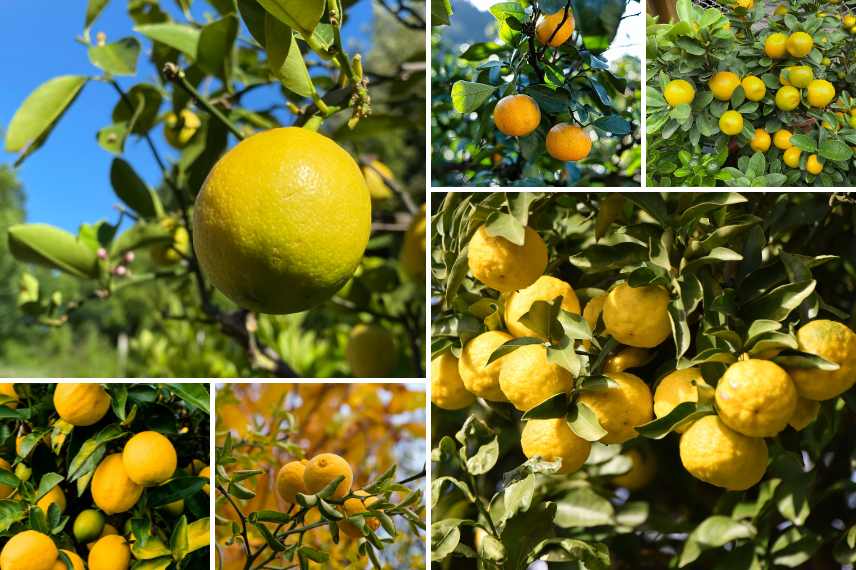
Most cold-hardy citrus trees
For further reading, consult our article: 6 cold-hardy citrus trees.
Choosing the location
Citrus trees are sun-loving trees. In open ground they are immobile against elements; choice of location is therefore crucial :
- Very sunny exposure : a minimum of 8 hours of direct sunlight per day, especially during growing period, in spring and summer, is necessary for synthesis of sugars. In marginal growing areas, a south-facing wall acts as a thermal radiator, releasing at night the heat accumulated during the day. This gain of 2 to 3 degrees can make the difference.
- Protection from wind : Wind is the invisible enemy. A cold wind dries out leaves and causes flowers to drop. You can plant behind a protective screen made of an evergreen hedge, such as cypresses or laurustinus, or if not possible use reed screens or windbreak nets.
- Absolute drainage : Citrus trees hate having “wet feet”. Waterlogged soil in winter causes root rot and immediate cessation of production.
Careful planting to lay foundations
If soil on your site is naturally light and sandy or has perfect drainage, dig a hole about two to three times wider than the root ball. This will allow you to loosen compacted soil around the perimeter and facilitate horizontal development of the roots, essential for anchoring and nutrition of the tree. You can create a temporary watering basin all around the tree’s perimeter; this channels water directly to the deep root system during the first summers, ensuring vigorous establishment without wasting resources.
If soil is a little heavy, planting on a mound is ideal :
- Create a mound 20 to 30 cm high. This helps drain excess water and allows it to flow away from the collar of the tree.
- Dig a hole with a volume three times larger than the root ball, but not necessarily deeper.
- Mix garden soil with well-rotted compost and a little river sand. Avoid pure potting compost, which shrinks too much.
- Plant your citrus tree taking care with collar positioning. The graft, that is the swelling at the base of the trunk, must remain 5 to 10 cm above soil level. If buried, the tree may lose hardiness or rot.
Fertilisation to increase yields
A citrus tree planted in the ground is a “heavy feeder”. To produce kilograms of fruit, it needs regular, balanced feeding, different from a citrus tree grown in a pot. In the ground, the tree has access to more resources, but it also needs a solid organic base to feed the soil over the long term. Requirements vary by season:
Fertilisation calendar
- Late winter, early spring (February–March) : spread two or three spadefuls of well‑rotted compost or manure over whole surface of the crown. You can add horn meal, an organic base fertiliser rich in Nitrogen, which releases over several months. Ideal to support spring growth without burning roots.
- March to September, during period of growth and fruiting, it is possible to use a special fertiliser for citrus trees or a fruit-tree fertiliser of NPK 12-10-15 or 15-10-15 type. The key is that Potassium (K) level is equal to or higher than Nitrogen (N) once fruits have formed, to favour sugar content. In the ground, three applications per year suffice: one in March, one in June and one in August or September.
Trace elements
Citrus trees often suffer from iron chlorosis, recognisable by yellowing leaves with green veins. An application of iron chelate twice a year ensures optimal photosynthesis, essential for flower production.
Good water management
Irrigation is the main driver of fruiting. A lack of water at the wrong time causes water stress and the tree sacrifices its fruit to survive.
- In summer: water deeply once or twice a week rather than a little every day. Water must penetrate deeply to encourage roots to anchor deeper, away from the sun.
- Mulching: essential in open ground. A 10 cm layer of pine bark or straw helps retain moisture and protects shallow roots from heat.
- Sign of thirst: if leaves curl slightly upwards in the evening, the tree needs water. If leaves turn yellow and drop, the tree is overwatered.
Pruning for fruiting to channel vigour
Unlike conventional fruit trees, pruning citrus trees is not strictly necessary to obtain fruit, but it helps improve quality.
Open up the centre
The aim is to let light reach the heart of the tree. Remove suckers (vigorous upright shoots that siphon off energy without producing fruit) and dead wood.
Thinning
If your tree produces too many small fruits, especially in mandarin trees, remove a few when they are the size of a hazelnut. This prevents the tree from becoming exhausted and ensures larger, more flavoursome fruit.
Winter protection
Even if your tree survives frost, a sudden temperature drop can destroy already formed flower buds or cause ripening fruit to drop. A few simple measures are essential :
- Fitting a winter fleece : use two or three layers over branches on nights when frost is forecast. Do not wrap it too tightly so air can circulate.
- Ground protection : a thick mulch (20 cm) of dead leaves or straw protects root system and rootstock.
- Winter watering : a citrus tree can die of thirst in winter, especially if protected by a fleece that prevents rain from getting through. Check soil moisture during mild spells.
Vigilance to prevent diseases and pests
To bear fruit, tree must be healthy. In open ground, ecosystem is often more balanced than in a pot, but stay vigilant as pests are never far away:
- Citrus tree leaf miner: it creates silvery tunnels in young summer leaves. Treat with neem oil or leave natural predators, parasitic wasps, to deal with it if attack is light.
- Mealybugs: often accompanied by sooty mould or black soot on leaves. A spray of water, black soap and a little methylated spirits will deal with infestations.
- Aphids: they attack young spring shoots, where flowers form. Encouraging presence of ladybirds helps limit them.
- Subscribe!
- Contents
This form is protected by reCAPTCHA - the Google Privacy Policy and Terms of Service apply.


































Comments