8 landscape gardener tips for designing an orange-and-purple flowerbed
Our ideas and inspiration for designing vibrant flower beds
Contents
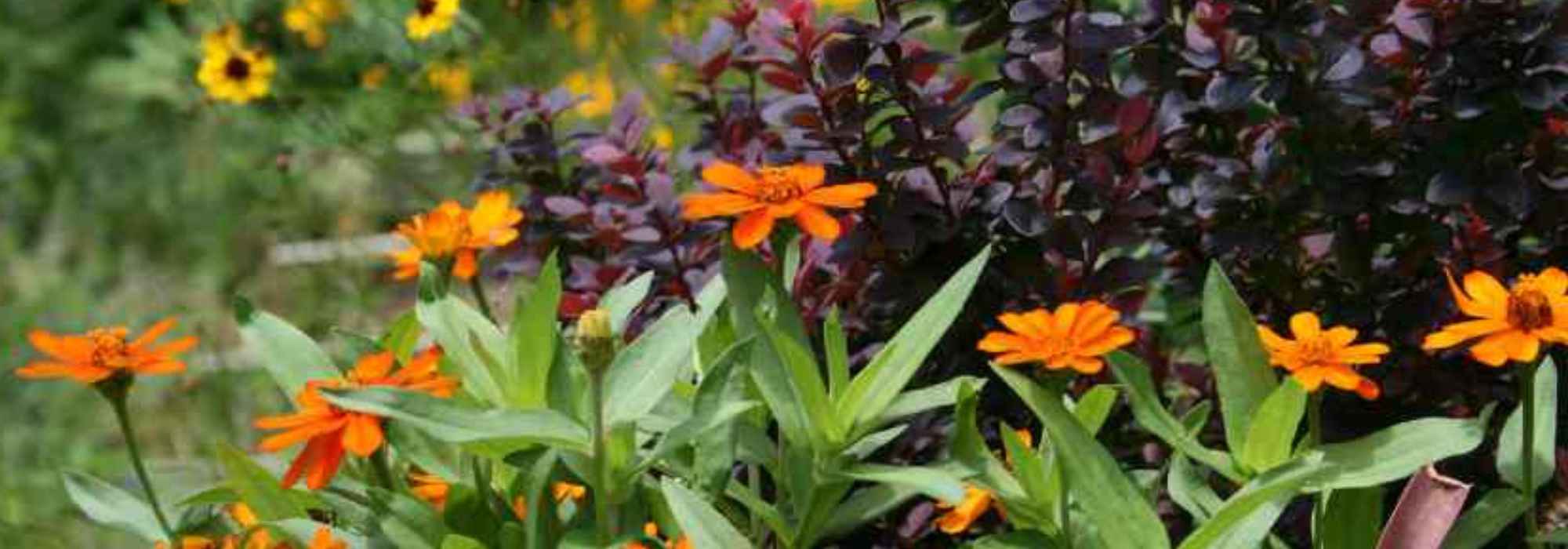
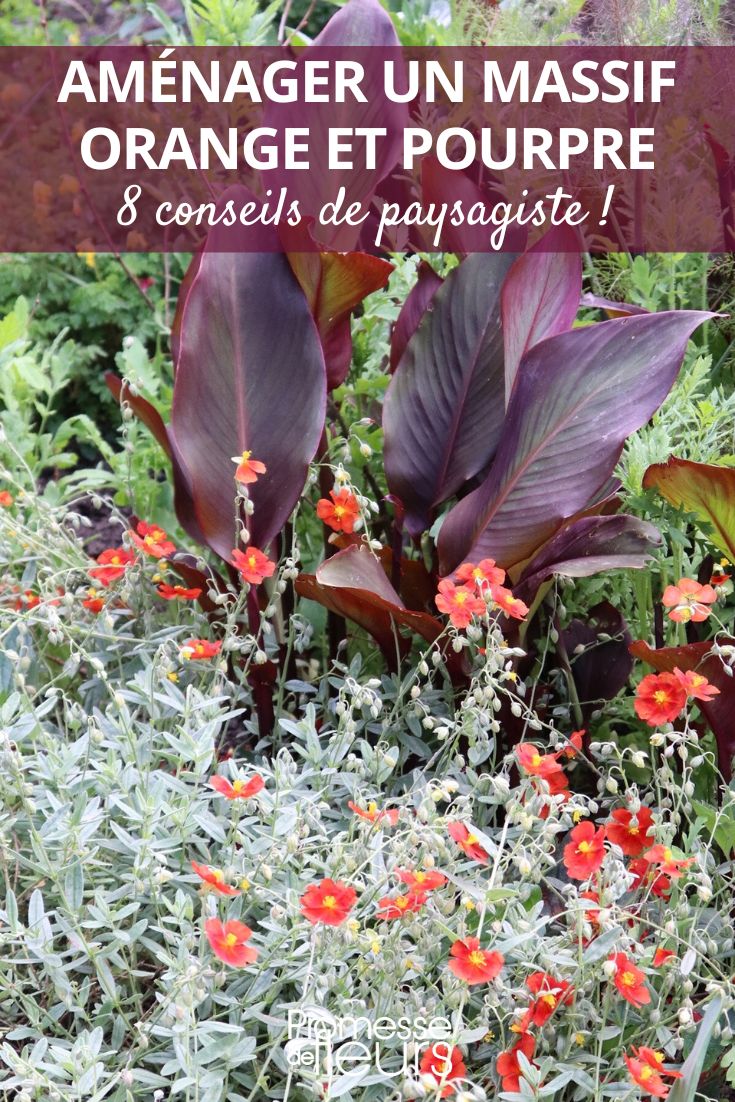
One of the most attractive trends in the garden this year is pairing orange and purple in our borders. While orange-and-violet or orange-and-blue pairings are often seen, the more striking orange-and-purple duo is sure to be a showstopper in gardens. What a lovely idea to marry these two strong, glowing colours! To achieve successful combinations without one colour overpowering the other, find the right proportion and the perfect shade of orange!
Purple will mainly be provided by foliage, from violet-tinged to chocolate-bronze, while orange, in its many shades, allows for numerous pairings.
How to design a striking orange-and-purple border? Which plants to choose and how to combine them? We give you some tips and examples to inspire you!
→ Find the ‘orange and purple’ trend on pages 42 and 43 of our Spring–Summer 2023 catalogue

Understanding these warm colours
Orange immediately evokes a cheerful, invigorating atmosphere; it is a warm, energising shade. It actually embraces a wide palette of tones, from soft pastel peach and apricot, through rosier coral and mandarin, to amber and rust. In flowers, orange is not always easy to pair, so some gardeners prefer not to introduce it.
Bordering on violet, purple stands apart through its touch of red, which gives it a more pronounced vibrancy and a warmer tone. Just before violet, it is one of the darkest colours found in foliage as well as in flowers. It ranges from plum to much darker aubergine and chocolate, sometimes flirting in plants with bronze and crimson nuances. Depending on proportion of purple, effect will be more or less sombre, and proper balancing is necessary to retain its enveloping character.
When used together, these two colours complement and support each other: orange warms purple’s coolness, and purple adds theatricality and brings depth. The colder the purple, the gentler the orange pairing will be. We will also see that proportions between them and desired ambience will influence final result.
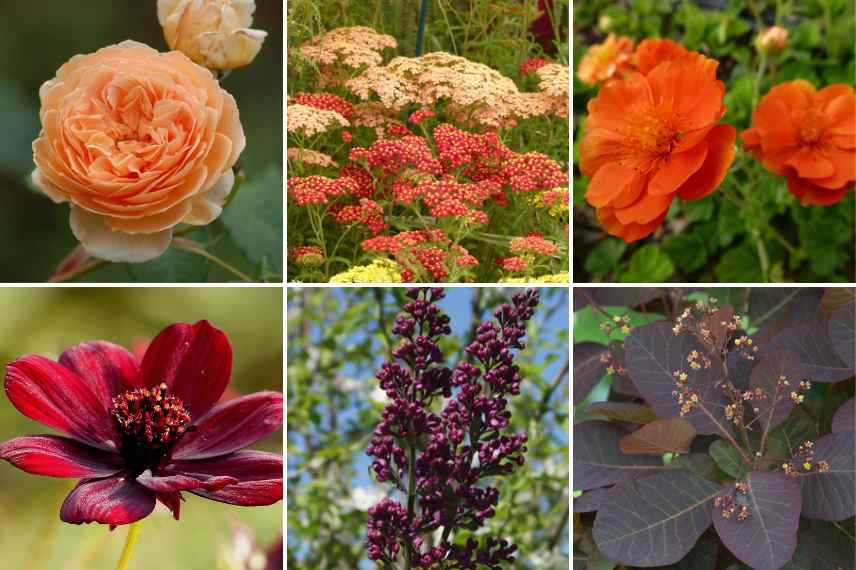
Shades of orange and purple are numerous: orange may be paler or deeper, purple may be more or less red
Playing with purple foliage
It’s essentially foliage that provides the purple tone. There are plenty of specimens to create original, often exotic scenes, such is this colour’s association with tropical gardens, though some purple foliage is much more traditional.
Standout purple-leaf plants are mainly found among shrubs such as Physocarpus, smokebushes such as Cotinus ‘Royal Purple’, Loropetalum, Phormium and Cordyline, Berberis and Japanese maples, the best known in this hue being Acer dissectum ‘Atropurpureum’.
Among trees, ornamental cherries, some hazels and Albizia julibirissin, and maples such as Acer ‘Crimson King’ most strikingly display purple colour.
Among perennial plants, several lovely options are available in bronze to purple shades with certain varieties of heucheras and euphorbias, but also a few hardy geraniums such as Geranium pratense ‘Black’n White Army’, Persicaria ‘Red Dragon’, and some Cannas, to name only the best known.
Don’t forget seasonal foliage that takes on a purple hue in autumn or winter… or at bud burst in spring: Cotinus, Nandina domestica or heavenly bamboo, Pseudowintera colorata, Liquidambar styraciflua ‘Worplesdon’, ‘Bergenia Bressingham Ruby’ or ‘Dark Margin’…
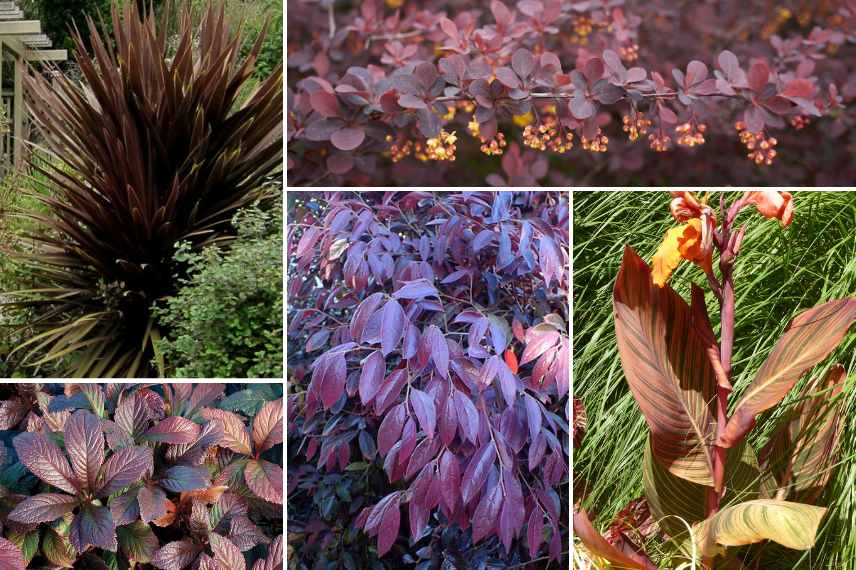
Cordyline australis ‘Red Star’ (© cultivar 413), Berberis ottawensis, Rodgersia pinnata ‘Bronze Peacock’, Loropetalum ‘Pipa’s Red’ and Canna ‘Durban’ (© Gwenaëlle David Authier)
Select the most beautiful purple flowerings
Dare to punctuate easy-to-find orange blooms with a few elegant, rarer purple ones. In flowers, purple often displays red-brown pigments, shades ranging from garnet to coppery and almost black, allowing for the boldest contrasts. Adding these sophisticated flowers makes a striking statement in borders!
If Cosmos atrosanguinea ‘Chocolat’ is a go-to for adding lightness, you can also opt for the charming columbines such as ‘Chocolate Soldier’, a rare variety, or the more classic ‘Black Barlow’ or ‘Clementine Dark Purple’, or the darkish columbine (Aquilegia atrata), the cult-favourite tulip ‘Queen of Night’, or the rose ‘Black Baccara’ with its intensely velvety purple. Persian fritillaries and certain gladioli can be used as structural plants for their impressive size: Gladioli ‘Black Surprise’, Fritillaria persica ‘Adiyaman’. Some shrubs, such as the striking Euonymus clivicolus, Syringa ‘Charles Joly’ and Akebia quinata, are all delightful surprises in the garden.
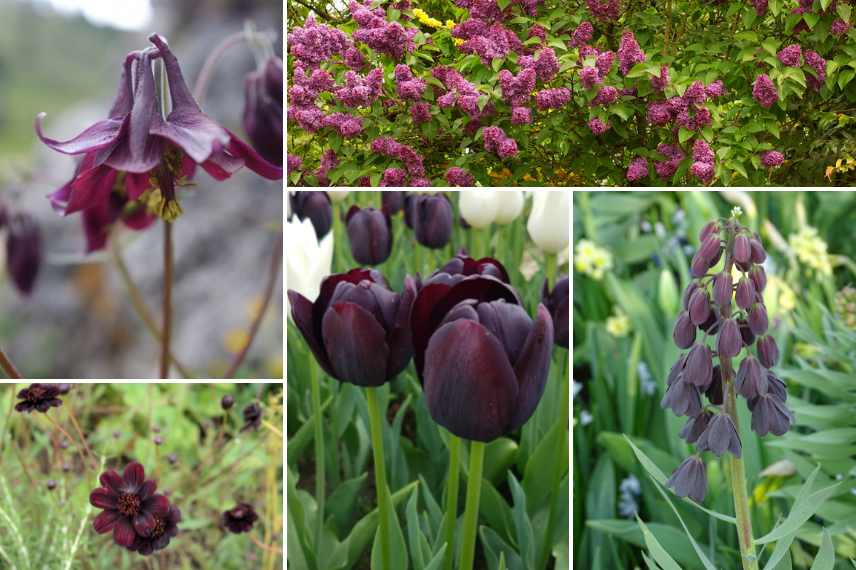
Darkish columbine, Lilac ‘Charles Joly’, Cosmos atrosanguinea ‘Chocolat’, Tulip ‘Queen of Night’, and Fritillaria persica ‘Adiyaman’
Get it right every time with bicolour plants
Purple foliage and orange flowers, bicoloured flowers with our two trend colours… It’s easier not to go wrong when choosing these plants, by integrating them here and there into the border, but without excess. Placed around the edge of a border, they are perfect for adding depth and creating cohesion.
Among the most sought-after: Dahlia ‘Schipper’s Bronze’ or the Landscape Dahlia ‘Sunshine’, Euphorbia polychroma ‘Bonfire’, Helenium ‘Short’n Sassy’, the picotee ranunculus ‘Café au lait’, Iris germanica ‘Cimarron Strip’ or ‘Supreme Sultan’, but also Iris ‘Marie-José Nat’ and some lilies such as martagon lilies, Coreopsis tinctoria or the Cosmidium ‘Philippine’, certain daylilies, etc.
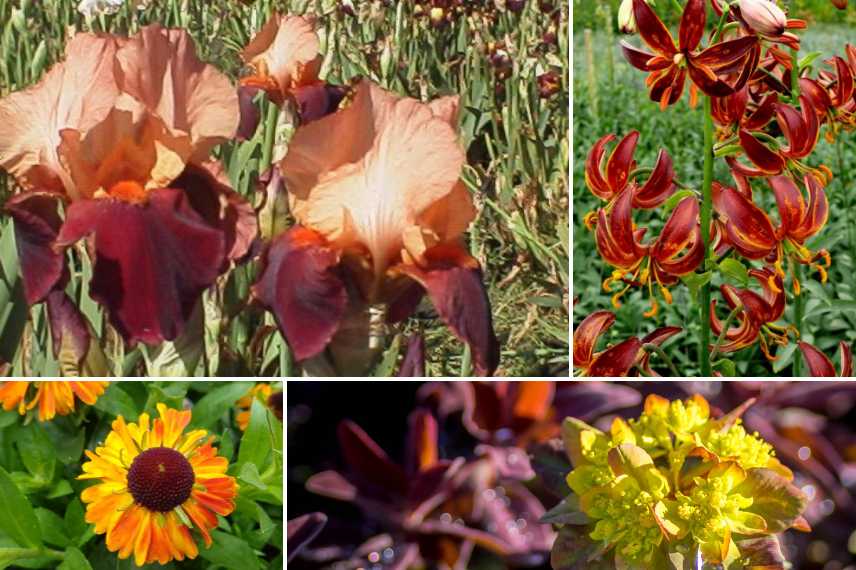
Iris ‘Cimarron Strip’, martagon lily ‘Arabian Night’, Helenium ‘Short and Sassy’, and Euphorbia polychroma ‘Bonfire’
Pay attention to proportions and light.
With these two intense colours, you need to exercise restraint, otherwise one will overpower the other. Purple is indeed a dense colour that can darken the mood despite orange’s affinity.
So don’t overdo it with too much chocolate-purple, nor with extravagant shapes and structures — one or two at most. Rather compose with different types of inflorescences, airy or light, that won’t dampen the overall effect. Ideally, pair the darkest purples with the softest oranges (salmon- or apricot-toned), and vice versa, except in an exotic garden where a fiery combination is allowed. Conversely, an amber or coppery orange will complement an unsaturated purple palette well.
Also consider introducing a third, neutral colour, for complementary balance and an indispensable touch of light (grey-green or zesty green, white or cream).
Finally, degree of shade will play a significant role for these two colours. The less light the border receives, the lighter and more red-tinged the purples should be, and the paler the oranges will be.
→ Read also The perception of flower colour
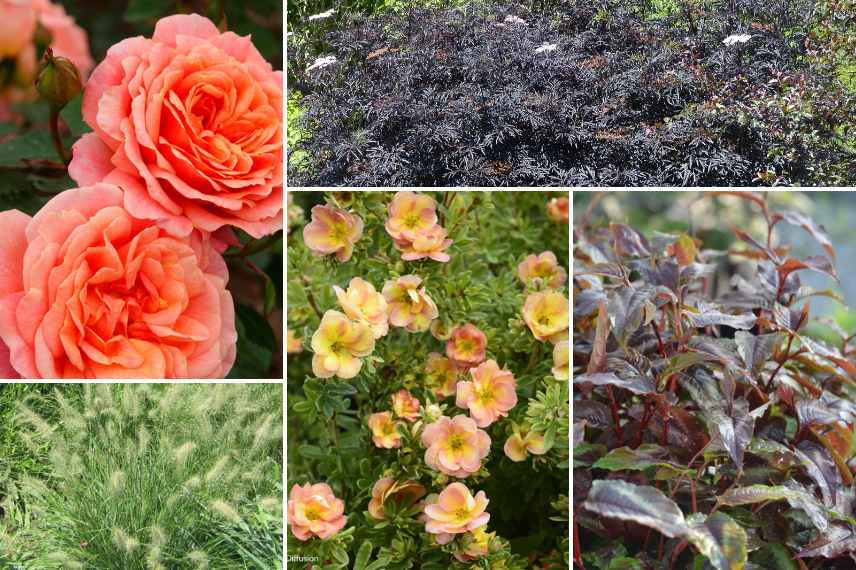
Here, alongside powerful purples (black elder and Persicaria ‘Red Dragon’), the oranges are softened by the peach, pink and salmon-yellow of Rose ‘Peach Melba’ and Potentilla ‘Double Punch Peach’. A fluffy Pennisetum further softens the border
Create the right plant combinations for each garden style
Depending on garden type, choose different orange and purple plants. With a wide palette of flowers in orange and purple shades, it is interesting to combine them using lighter or darker tones, and forms that are sometimes airy, sometimes structural.
Un jardin graphique
Contemporary or graphic garden favours singular plants, upright habits contrasting with some globose habits, and exceptional foliage. Choose architectural flowers and handsome foliage, rich oranges and bold purples edging on black: Fritillaria imperialis, Eucomis comosa ‘Sparkling Rosy’, Pittosporum tenuifolium ‘Tom Thumb’, Pseudopanax ‘Bronze Eagle’, some Chasmanthes and Cannas in orange or Eremurus (‘Cléopatra’ or ‘Pinnokio’), a columnar Judas tree such as Cercis canadiensis ‘Merlot’, etc.
Complete this colour palette with a few linking plants to echo tones: Eucomis bicolor, Euonymus japonicus ‘Benkomasaki’, Hakonechloa macra ‘Aureola’, Yucca, white Agapanthus…
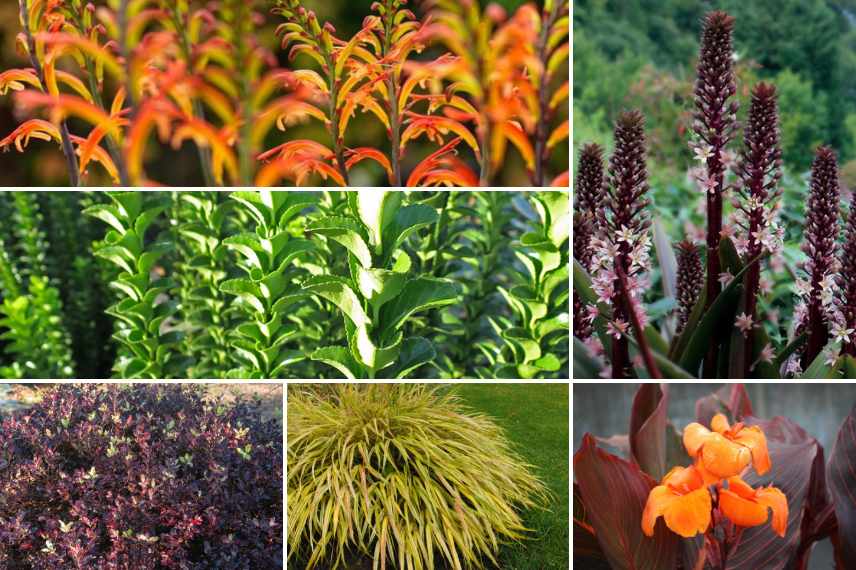
Chasmanthes, Eucomis comosa ‘Sparkling Rosy’, Euonymus ‘Benkomasaki’, Pittosporum tenuifolium ‘Tom Thumb’, Hakonechloa macra ‘Aureola’ and Canna
Un jardin de campagne
This can also be an English or cottage garden: choose softer tones, apricot to salmon, with some brighter oranges and a wider range of purples — up to crimson — to create a generous atmosphere: poppies in profusion, orange (california poppy, Iceland poppy (Papaver nudicaule), pale purple (Papaver rhoeas ‘Burgundy Bigalow’) or the dark poppy ‘Black Peony’, nasturtiums, opulent peonies (shrub peony with orange-pink tones ‘Jin Ge’ or red-purple accents such as peony ‘Françoise Ortegat’), dahlias such as ‘Neo’ with orange-striped petals, and dahlia semi-cactus ‘Hollyhill Black Beauty’, a salmon-coloured Chaenomeles (Japanese quince), Iris ‘Cimarron Strip’, a purple Cercis… and why not a more violet Cynara cardunculus?
Also consider country-style perennials: Scabiosa ‘Chile Black’, Baptisia ‘Dark Chocolate’, calendulas for light and colourful-leaved Physocarpus!
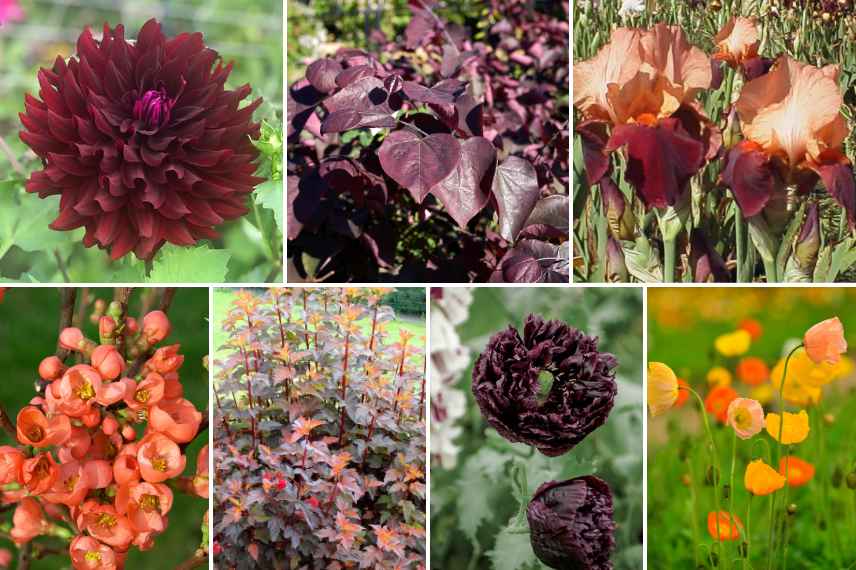
Dahlia ‘Hollyhill Black Beauty’, Cercis canadenis ‘Forest Pansy’, Iris ‘Cimarron Strip’, Chaenomeles ‘Friesdorfer’, Physocarpus opulifolius ‘Diable d’Or’, Papaver ‘Black Peony’ and Papaver nudicaule
Un jardin exotique
Exploit exotic potential of variegated or purple-striped foliage and ultra-vivid red-oranges: many Phormiums and Cordylines work well, Cannas in various shades chosen for purple-striped foliage (‘Durban’), Albizia julibrissin in chocolate forms, Hedychium (ornamental gingers) for an exotic feel, colourful banana-like plants such as Musa ensete ‘Maurelli’, Crocosmias, Alstroemerias, daylilies, Arum ‘Captain Reno’ at edges or darker Zantedeschia ‘Schwartzwalder’, Kniphofia and Eucomis… List is tempting!
Don’t hesitate to add red-pigmented blooms for a dazzling result.
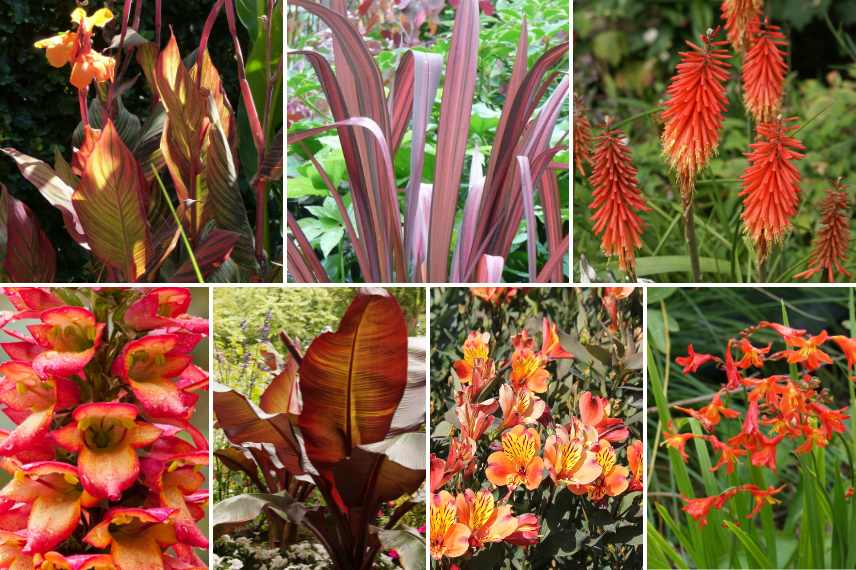
Cannas, Phormium tenax ‘Evening Glow’, Kniphofia, Digiplexis ‘Illumination Flame’, Musa ensete ”, Alstroemeria ‘Indian Summer’ and Crocosmias
Un jardin naturaliste
Naturalistic garden gives pride of place to sun-loving perennials and grasses, supple, light and colourful, spilling over into purplish or yellower tones: Sedum ‘Matrona’, Echinaceas in orange, Achillea millefolium ‘Terracota’, Helianthus ‘Crimson Queen’, Allium sphaerocephalon, Andropogon gerardii ‘Blackhawks’, Helianthus ‘Velvet Queen’, Angelica gigas, Berberis, bronze tones of Carex comans ‘Bronze Form’, Pennisetum thunbergii with purple plumes, daylilies for a naturalistic scheme, etc.
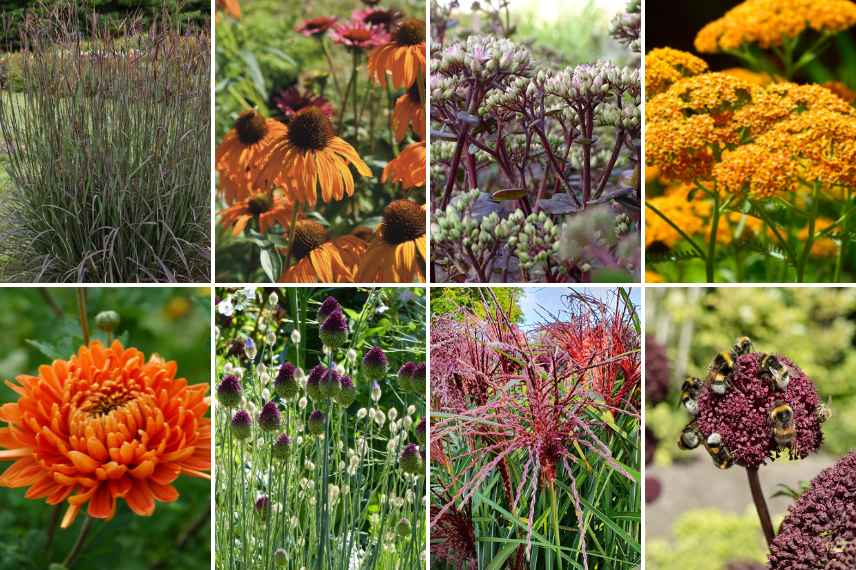
Andropogon gerardii ‘Blackhawks’, Echinacea ‘Tangerine Dream’, Sedum ‘Matrona’, Achillea ‘Terracotta’, Chrysanthemum, Allium sphaerocephalon, Miscanthus sinensis ‘Boucle’ and Angelica gigas
Un jardin de bord de mer
Seaside garden can reuse exotic palette of orange and purple as it can accommodate some tender plants, inviting mottled, pastel or stronger orange and purple tones, including beautiful purple Veronica foliage such as Hebe ‘Turkish Delight’, Dodonea viscosa ‘Purpurea’ for winter colour, darkest Agapanthus (‘Black Magic’), and for orange accents Alstroemerias, Leonotis, Leucospermums, lantanas, and other trumpet vines. Wrap this strong atmosphere with evergreen shrubs in various greens (Pittosporum, Griselinia, palms, Dasylirion glaucophyllum…).
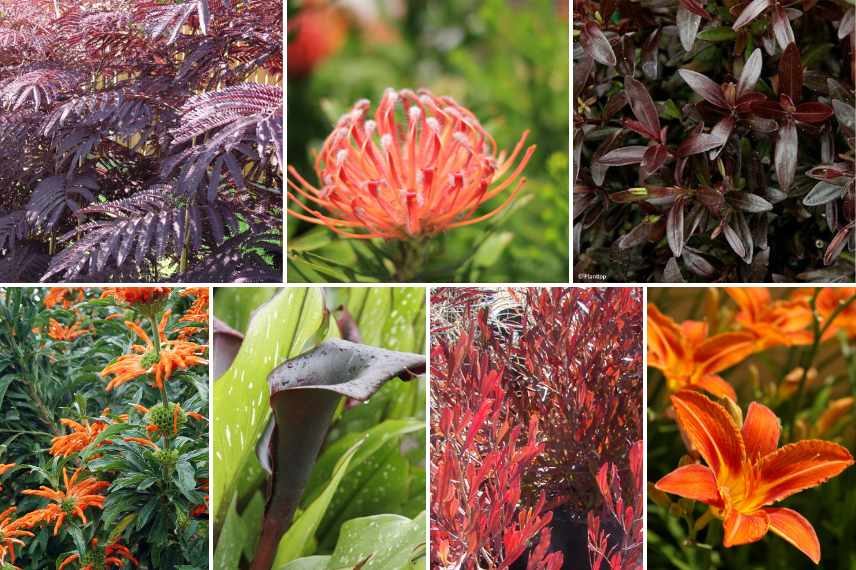
Albizia julibrissin ‘Summer Chocolate’, Leucospermum cordifolium, Hebe ‘Turkish Delight’, Leonotis leonurus, Zantedeschia ‘Schwartzwalder’, Dodonea ‘Purpurea’ and daylilies
Un jardin sec ou de rocaille
Orange and purple tones work well in dry and rock gardens, as many enjoy full sun and will highlight grey‑green foliage.
Combine with Aloes brevifolia, Helianthemums, Dianthus plumarius ‘Helen’ in salmon, Delosperma in vivid tones, Dianthus barbatus ‘Nigrescens’ and mat-forming sedums such as Sedum spurium ‘Woodoo’, Mangave ‘Mission to Mars’ which reddens in summer, an Aeonium arboreum ‘Atropurpureum’, low houseleeks (Sempervivum ‘Chick Charms’ and ‘Plum Perfect’), and Berberis thunbergii ‘Concorde’ for structure. Complete with glaucous agaves and freshness of botanical tulips in spring (Tulipa orphanidea ‘Flava’).
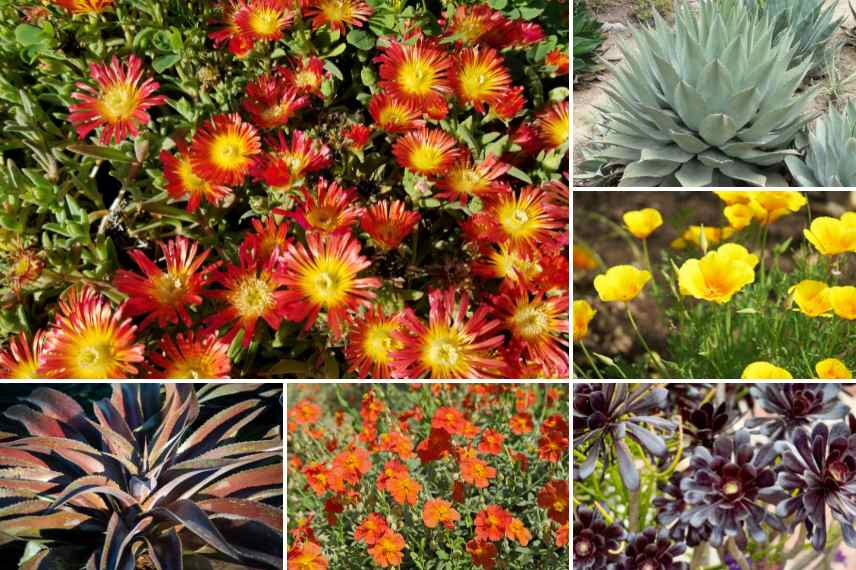
Delosperma, Agave havardiana, Eschscholzia californica, Mangave ‘Mission to Mars’, Helianthemum ‘Fire Dragon’ and Aeonium purpureum
Un jardin mi-ombragé
Shaded garden can wear orange‑purple accents, as some handsome foliage in these tones thrives in partial shade. Just avoid overusing the darkest purples, spread orange blooms well, and use chartreuse foliage as highlights once flowering is over.
Example combination: Euphorbia amygdaloides ‘Purpurea’, Epimedium warleyense, a bright azalea in spring, heucheras chosen for orange and purple foliage, and an indispensable Japanese maple with finely cut leaves.
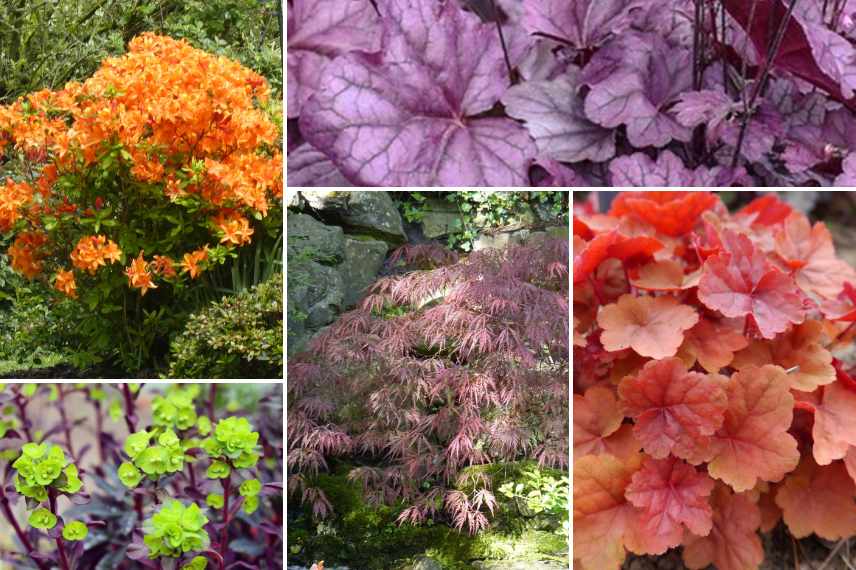
Orange rhododendron, Heuchera ‘Pink Panther’, Euphorbia amygdaloides ‘Purpurea’, Acer dissectum ‘Garnet’, and Heuchera ‘Caribbean Sea’
Tie in with rest of garden
An orange-and-purple border is often difficult to reproduce throughout the garden. Better use it sparingly and blend it subtly into other beds and garden features.
To do this, use the “neutral” shades of foliage, but also green flowers at the bed edge: all greens, from anise to grey‑green, are useful, as are straw or rust tones of ornamental grasses such as Chionochloa rubra, for example. Broad leaves are also useful to ensure transition — those of a Gunnera, large hostas or lush ferns — or, conversely, diaphanous foliage such as bronze fennel.
Another option is to tie the bed to the rest of the garden with white and cream, chosen from the blooms or by relying on a striking variegated foliage.
Remember that orange and purple flank red on the colour wheel, and that lighter purple becomes mauve. Red and mauve, in their gradations, will therefore be the bridging colours to use to link everything together. To connect with the rest of the garden, treat the bed edges starting from claret, move towards deep violet and violet to lilac, or use burgundy blooms gradually flushed with red. Bring in a few redder plants where the rest of the garden contains them (for example Gladioli ‘Black Surprise’), or caramel tones such as Ipomoea ‘Sweet Caroline Bronze’ to move towards orange and yellow, the variegation of a shrub such as Pseudowintera colorata ‘Red Leopard’, etc. Options are really numerous!
Saffron‑yellow will also be an interesting colour to slip in sporadically at the end of the bed to link to an area dominated by mauves and violets, as well as to all Indian pinks and tea roses with orange tones.
Another option is to plant a few bicolour plants at the border, which will act as a link, or flowers with purple or black centres: a mass of Asiatic lily ‘Netty’s Pride’ purple and white to join an area dominated by white, Iris germanica ‘Bruno’ purple and mauve to merge with a mauve and pink zone, Iris germanica ‘Hissy Fit’ to move towards a yellow‑based palette, etc. And don’t forget flowers with purple or black hearts to create a subtle link (for example Euphorbia characias ‘Black Pearl’).
Finally, take into account the often pinkish or white colouring of purple‑leaved shrubs: to integrate them well, choose some surrounding plants with pink‑orange flowers that will not jar.
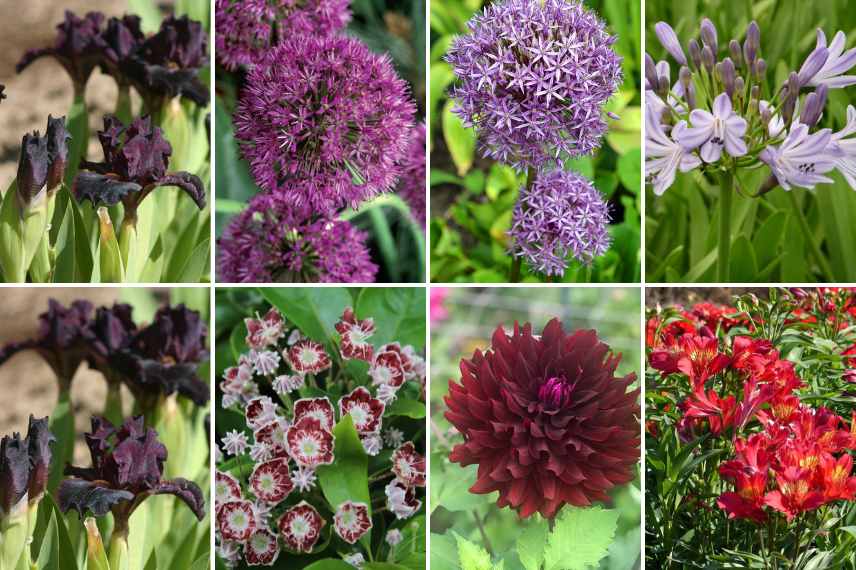
Two examples: top shows transition from purple to mauve; bottom shows transition towards a redder area
Working with the seasons
Fancy a vibrant orange-and-purple tableau that changes things up for a season… or want to be persuaded to repeat the scheme elsewhere in the garden? Try an orange–purple pairing in spring or autumn.
Create a sophisticated spring scene where Ranunculus, wallflowers, Euphorbia characias for a fresh, acid green note, Tulip ‘Cairo’, early and late tulips for good continuity (for example ‘Sarah Raven’ and ‘Black Parrot’), almost-black Persian fritillaries or imperial fritillaries, and an apricot-flowered Chaenomeles will blend their hues. Once blooms have faded, you can move on to other tones (yellows and violets, for example) or maintain continuity.
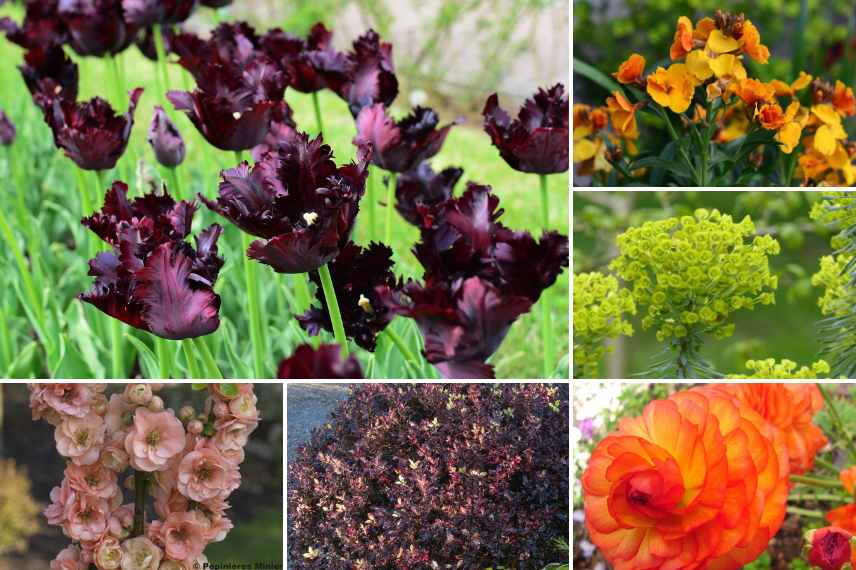
Tulips ‘Black Parrot’, Erysimum (wallflower), Euphorbia characias, Chaenomeles superba ‘Cameo’, Pittosporum tenuifolium ‘Tom Thumb’ and Ranunculus ‘Double Orange’
For an autumnal version, focus mainly on fiery foliage, although some perennials such as chrysanthemums will provide brilliant colour. Ornamental grasses are always effective for tying the whole together until first frosts. Combine the foliage of a Cotinus, shifting between purple and orange, with the flowering of violet Penstemon (Penstemon ‘Raven’ or ‘Sour Grapes’), Chrysanthemum indicum ‘Cedie Mason’ and ‘Herbstbrokat’, Heucheras and orange or purple Dahlias.
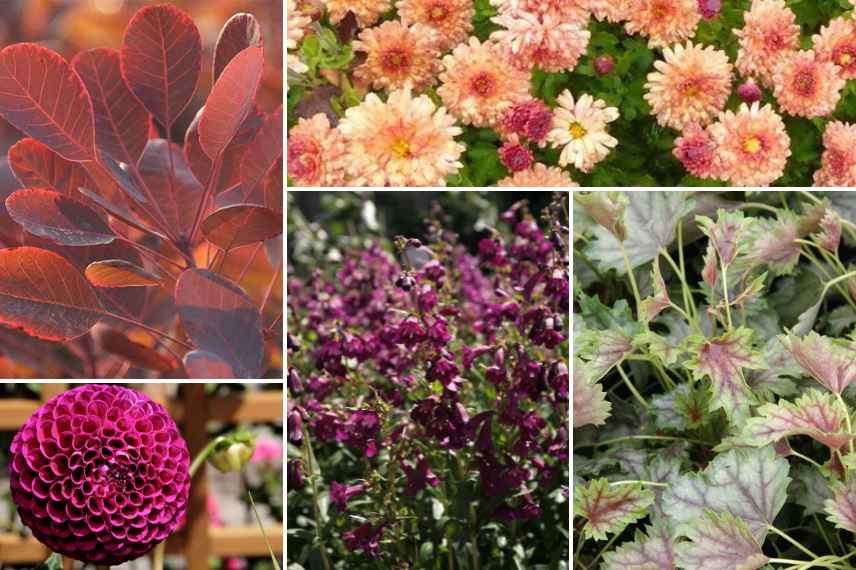
Cotinus, Chrysanthemum indicum, Dahlia ‘Downham Royal’, Penstemon ‘Raven’, Heuchera americana ‘Birkin’
- Subscribe!
- Contents
This form is protected by reCAPTCHA - the Google Privacy Policy and Terms of Service apply.

































Comments