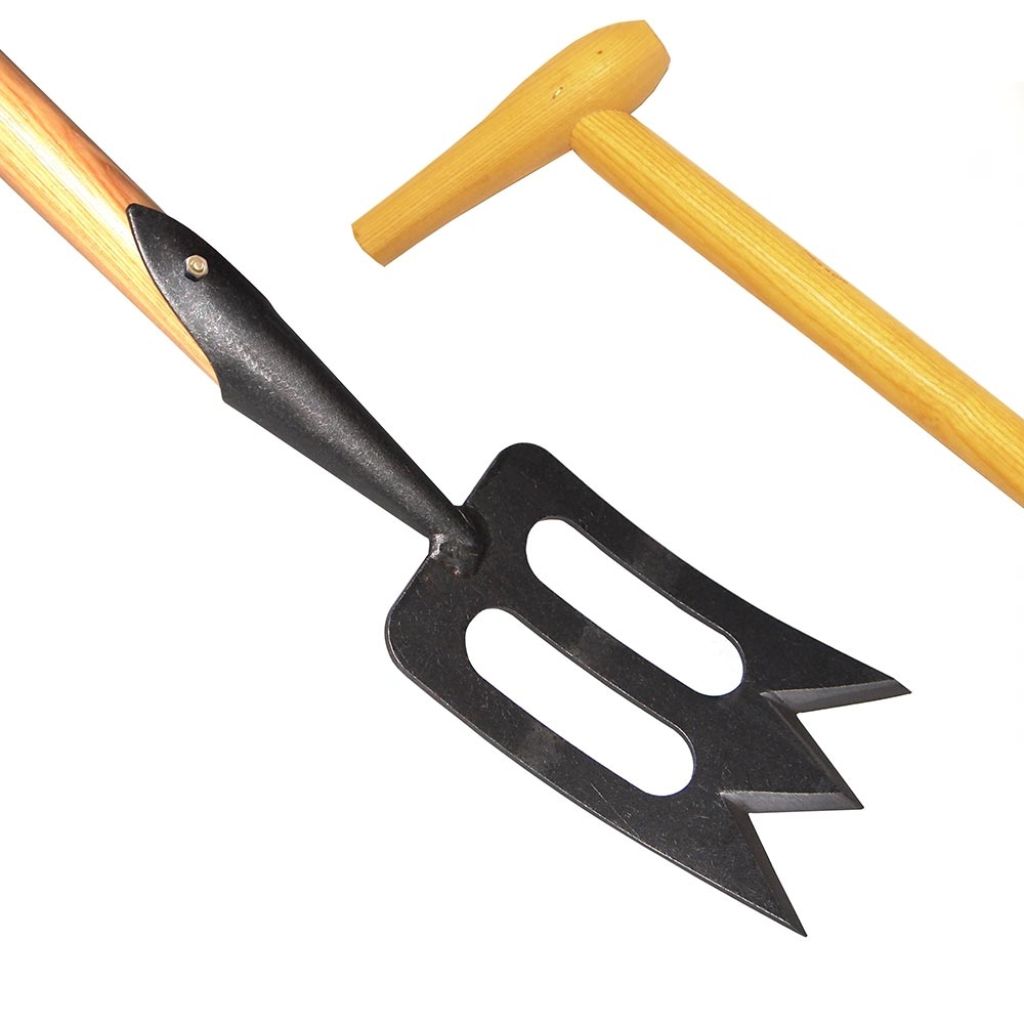
Large traditional spork-shaped hoe by De Pypere
Large traditional spork-shaped hoe by De Pypere
High-quality tool for easy hoeing and weeding! Very sturdy and comfortable.
Charlyne, 24/04/2022
Back-to-school special offer!
Get €10 off for every €50 you spend! And get up to €40 off on a single order.
How does it work?
1. Shop your favourites
Add your favourite plants to your basket. For every €50 you spend (excluding delivery charges, store credit and the plastic-free option), you’ll receive a €10 voucher.
€50 spent = €10 voucher
€100 spent = €20 voucher
€150 spent = €30 voucher
€200 spent = €40 voucher
2. Place your order
Once your basket reaches one of the spending thresholds, place your order. You can even choose your delivery date!
3. Receive your voucher
As soon as your order has been shipped, you’ll receive an email containing your personal voucher code and its value.
4. Use it on your next order
Your voucher is valid for 90 days from the date you receive it. It can be used once only, on a new order worth at least the value of the voucher, excluding delivery charges.
Please note: Vouchers can be combined with other offers, but cannot be split or refunded.
Home or relay delivery (depending on size and destination)
Important: You may be charged customs duties by your country’s customs authorities upon delivery.
Schedule delivery date,
and select date in basket
We guarantee the quality of our plants for a full growing cycle, and will replace at our expense any plant that fails to recover under normal climatic and planting conditions.
This large traditional spork-shaped hoe from De Pypere is equipped with a long ash T-shaped handle and has a "spoon-fork" shaped head with 3 slightly curved and connected tines that allow for ergonomic use. It is a powerful garden tool that combines the benefits of the spade and fork and is very well suited for working on most soil. It is effective for removing weeds that grow between plants and is used for aeration and surface loosening. Its blade is hand forged in steel, with a boron steel finish. It is a durable, robust, well-made tool that will last for many years.
Dimensions: spork-shaped head: 17 x 10cm (4in) - Length of the handle: 1.70m (6ft) (well suited for tall people)
The hoe is an indispensable tool, designed for weeding the vegetable or ornamental garden without resorting to the use of chemicals and for working the soil surface. This spork-shaped model is suitable for loose and light soils as well as heavy soils. Hoeing has been part of the gardener's vocabulary since the Middle Ages, with the act of hoeing meaning "to do twice". After using the hoe to uproot weeds, the gardener can use the hoe for a second time to loosen and break up the surface layer of the soil. The soil is thus aerated around plants in the vegetable or ornamental garden. According to the old saying, "One hoeing is worth two waterings": after watering or rain, clayey or loamy soil tends to harden when drying, forming a compacted crust that is very difficult to rehydrate and suffocating for plants, which also promotes water evaporation. Breaking up this crust after watering limits the evaporation of water. The fork-shaped hoe consists of a long natural ash handle, known for its hardness, with a socket where the forged head made of tempered steel, resistant to shocks, torsion, and corrosion is fixed. The T-shaped handle allows for leverage to drive the head into the soil while rotating it. It is compostable, and the metal head is recyclable. The word 'spork' is an applied Anglicism, which refers to a utensil shaped like a spoon with the pointed ends of a fork.
The traditional De Pypere range includes high-quality applied tools, all made of applied forged steel and equipped with ash handles.
This tool is under warranty. The warranty does not apply to handles or grips, only to the metal parts, except for consumables (screws, springs, other) and within the scope of normal use.
Technical features
Tips
-
, onOrder confirmed
Reply from on Promesse de fleurs
Recently viewed products
Haven't found what you were looking for?
Hardiness is the lowest winter temperature a plant can endure without suffering serious damage or even dying. However, hardiness is affected by location (a sheltered area, such as a patio), protection (winter cover) and soil type (hardiness is improved by well-drained soil).

The flowering period indicated on our website applies to countries and regions located in USDA zone 8 (France, the United Kingdom, Ireland, the Netherlands, etc.)
It will vary according to where you live:- In zones 9 to 10 (Italy, Spain, Greece, etc.), flowering will occur about 2 to 4 weeks earlier.
- In zones 6 to 7 (Germany, Poland, Slovenia, and lower mountainous regions), flowering will be delayed by 2 to 3 weeks.
- In zone 5 (Central Europe, Scandinavia), blooming will be delayed by 3 to 5 weeks.
In temperate climates, pruning of spring-flowering shrubs (forsythia, spireas, etc.) should be done just after flowering.
Pruning of summer-flowering shrubs (Indian Lilac, Perovskia, etc.) can be done in winter or spring.
In cold regions as well as with frost-sensitive plants, avoid pruning too early when severe frosts may still occur.
The planting period indicated on our website applies to countries and regions located in USDA zone 8 (France, United Kingdom, Ireland, Netherlands).
It will vary according to where you live:
- In Mediterranean zones (Marseille, Madrid, Milan, etc.), autumn and winter are the best planting periods.
- In continental zones (Strasbourg, Munich, Vienna, etc.), delay planting by 2 to 3 weeks in spring and bring it forward by 2 to 4 weeks in autumn.
- In mountainous regions (the Alps, Pyrenees, Carpathians, etc.), it is best to plant in late spring (May-June) or late summer (August-September).
The harvesting period indicated on our website applies to countries and regions in USDA zone 8 (France, England, Ireland, the Netherlands).
In colder areas (Scandinavia, Poland, Austria...) fruit and vegetable harvests are likely to be delayed by 3-4 weeks.
In warmer areas (Italy, Spain, Greece, etc.), harvesting will probably take place earlier, depending on weather conditions.
The sowing periods indicated on our website apply to countries and regions within USDA Zone 8 (France, UK, Ireland, Netherlands).
In colder areas (Scandinavia, Poland, Austria...), delay any outdoor sowing by 3-4 weeks, or sow under glass.
In warmer climes (Italy, Spain, Greece, etc.), bring outdoor sowing forward by a few weeks.
Shipping country and language
Your country of residence may be:
Your country of residence is:
For a better user experience on our website, you can select:
Your shipping country:
-
 Austria
-
 Belgium
-
 Bosnia & Herzegovina
-
 Bulgaria
-
 Croatia
-
 Cyprus
-
 Czechia
-
 Denmark
-
 Estonia
-
 Finland
-
 France
-
 Germany
-
 Greece
-
 Hungary
-
 Iceland
-
 Ireland
-
 Italy
Italy
-
 Latvia
-
 Liechtenstein
-
 Lithuania
-
 Luxembourg
-
 Malta
Malta
-
 Netherlands
-
 Poland
-
 Portugal
-
 Romania
-
 Serbia
-
 Slovakia
-
 Slovenia
-
 Spain
Spain
-
 Sweden
-
 Switzerland
Language:
-
French
-
 English
-
Spanish
-
Italian
-
German
-
Portuguese
-
Dutch
-
Finnish
My Account
Hello
My wish lists
My cart
Log in / Register
Existing customer?
This form is protected by reCAPTCHA - the Google Privacy Policy and Terms of Service apply.
New customer?
Create an account to track your orders, access our customer service and, if you wish, make the most of our upcoming offers.