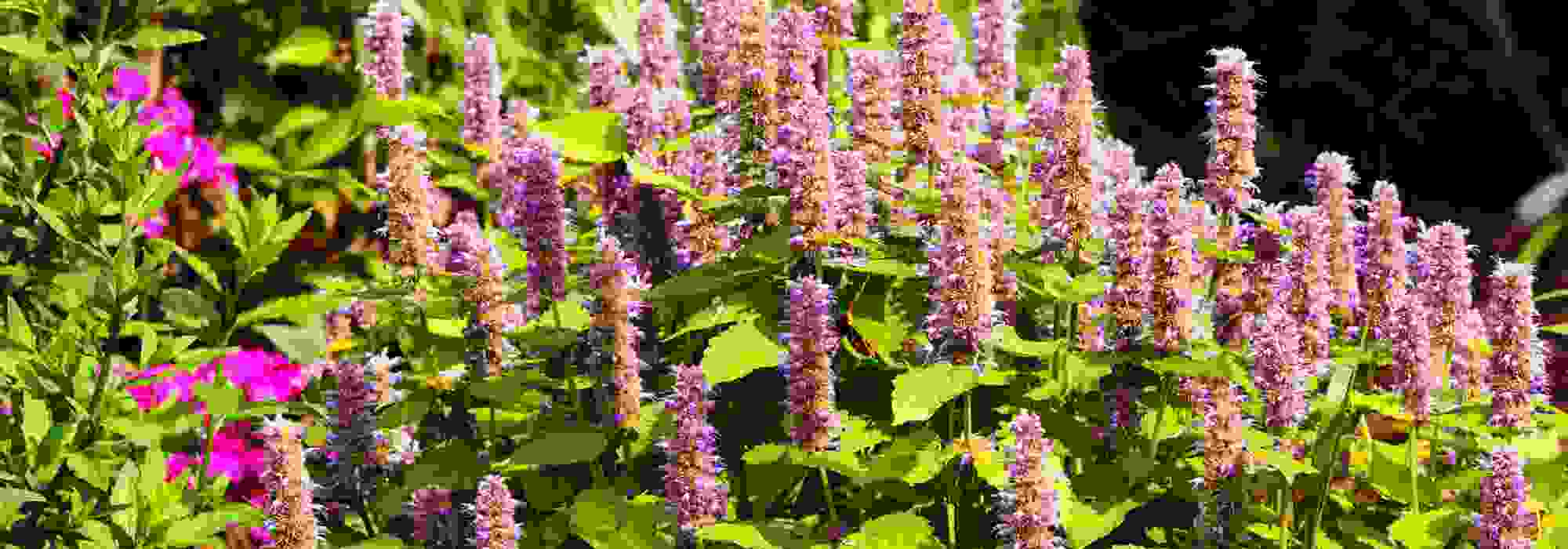
Aromatic and ornamental plants
Most beautiful perennials and aromatic shrubs for your borders
Contents
While herbs mainly flavour our dishes throughout the year, many of them are also very attractive in the garden as ornamental plants. It would be a shame not to use them more in the garden, within flowerbeds and borders!
This edible garden, both pleasing to the eye and good to eat, is one of the true trends of recent years. Let’s look at which of these plants are prized for their flowering or for their colourful or variegated foliage, sometimes spectacular, and should not be underestimated in our arrangements and displays.

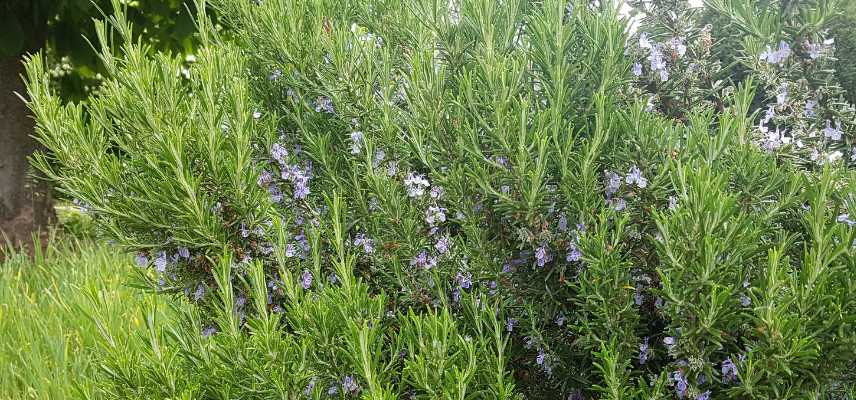
Rosemary plants
Flowering several times a year and covered in a myriad of small blue tubular flowers, rosemary is a small shrub taking various habits, indispensable in gardens of southern France. It can also be grown almost anywhere, so robust and very cold-hardy it is, provided it is planted in very well-draining soil (like lavender). Creeping forms do not exceed 50 cm in height, but some spread to over 1 m, while bushy forms develop into attractive evergreen masses at maturity, valuable for our gardens.
Shade of blue varies among the many varieties, and a few have white or pink flowers. Discover them in our article How to choose a rosemary plant?
Where to plant? It is the perfect companion for dry, no-watering gardens, garrigue or Mediterranean gardens, sunny rockeries suited to spreading forms, no-maintenance gardens, and of course herb gardens.
Sages
This very large botanical genus offers delightful ornamental surprises, both in vivid or pale blooms and in downy or colourful foliage. Many sage varieties are culinary; both leaves and flowers are used in cooking.
Salvia officinalis is very attractive when planted in borders, at the base of or among perennials and shrubs. It would be a shame to confine it to the herb bed: it includes several original variegated-leaf cultivars such as the Salvia officinalis ‘Tricolor’ or ‘Purpurascens’. The herbaceous sages are common in our flowerbeds, and we are less likely to think of their edible qualities — something not to forget when strolling the garden with a small basket in hand! Discover gems such as the pineapple sage ‘Golden Delicious’, boasting golden, bushy foliage and late red blooms.
Where to plant them? Always in very well-drained soil and in full sun. Sages can really establish themselves in many borders across all garden types.
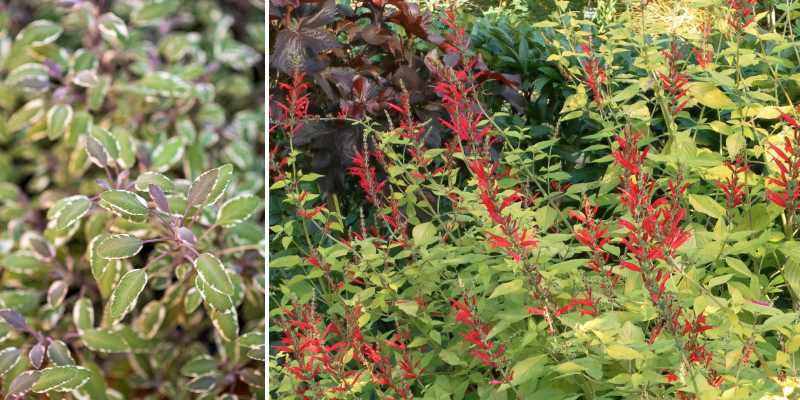
Salvia officinalis ‘Tricolor’ and Salvia elegans ‘Goden Delicious’
Common fennel
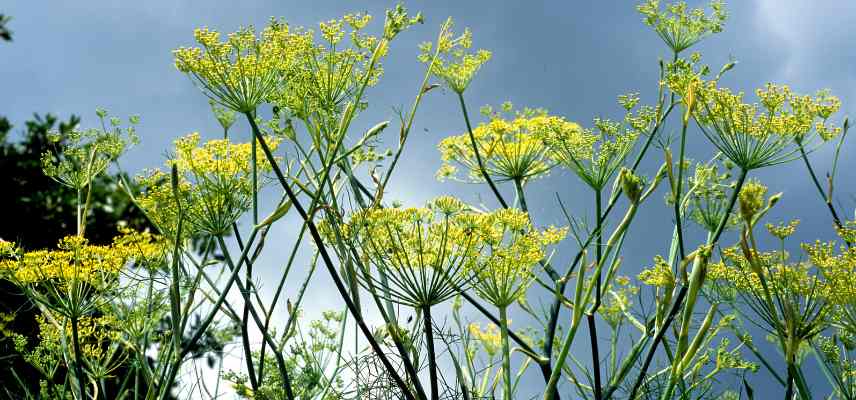
Here is another attractive culinary herb to admire in the garden: with its bright yellow flowers in umbels, common fennel (Foeniculum vulgare) is one of the very tall perennial plants, adding volume to a border. But beyond its natural beauty and melliferous qualities, its finely divided, very airy foliage with an aniseed flavour is obviously appreciated and is used to flavour many dishes, effectively replacing dill. It does not form a bulb, unlike fennel in the vegetable garden, but grows up to 2 m tall.
Very hardy, common fennel can be planted in any garden, on two conditions: it requires plenty of sun and free-draining soil, which remains cool in summer. Beware of self-seeding, which can make it invasive (this can be controlled by cutting the flowers once they have faded, before they set seed). The purple variety is also very ornamental.
Sweet cicely
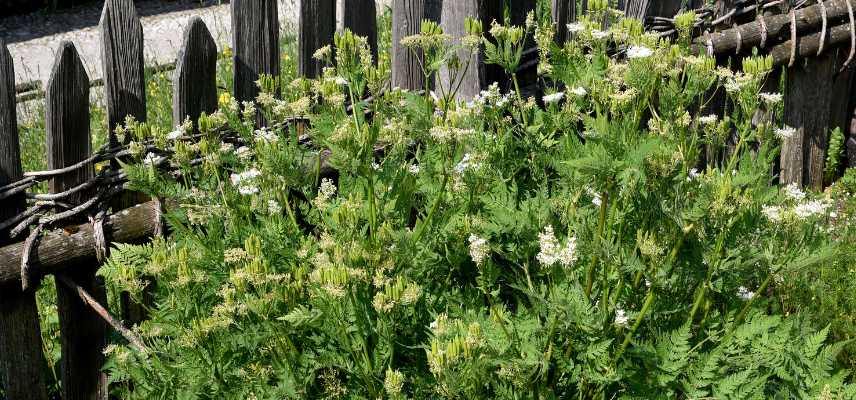
Under Latin name Myrrhis odorata, plant’s aromatic richness is immediately apparent. Musk chervil is another very decorative plant in the garden. It is also called aniseed chervil, so fragrant is its fern-like divided foliage. In flower, Myrrhis odorata bears small white umbels in spring which, like those of common fennel, provide pollen for pollinators. It grows to about 1 m tall.
It is a handsome partial-shade perennial that prefers fresh, humus-bearing soils.
Where to plant it? Musk chervil is very much at home in a vicar’s garden, a country garden, or an English-style perennial garden.
Basils
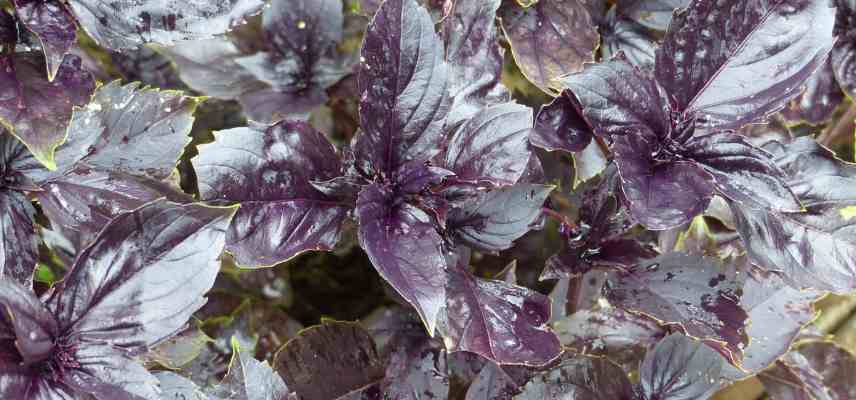
Basils aren’t just for the vegetable garden or herb beds. Starting with purple basil (Ocimum basilicum), which brings dark tones and glossy leaves when planted alongside other perennials or shrubs.
Among other attractive basils to consider: ‘Dark Opal‘, an annual basil with violet‑tinged leaves and mauve flowers, or a very handsome perennial basil, Kenyan basil or basil ‘Magic Mountain Bio’ producing attractive, very ornamental flowering spikes. Its small purple leaves and stems are also highly decorative. As for ‘Pesto Perpetuo’, it is a pretty variegated variety, upright somewhat like ‘Lesbos’.
Where to plant? In the garden as a colourful border, as they rarely exceed 60 cm; planting in pots also works well on a terrace or balcony, basil needing moist soil and full sun. It is therefore less affected by slugs and snails.
Helichrysum italicum or curry plant
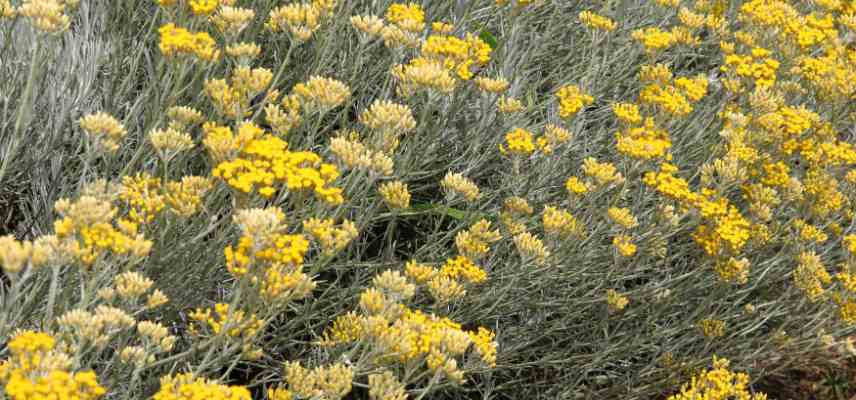
curry plant or curry herb is a real delight in sun-drenched borders. We love its distinctive leafy appearance, described as acuminate in botanical terms, grey in colour, from which, from May onwards, bright sunny yellow flowers emerge in flattened corymbs that persist for much of the summer. Slightly crushed foliage of Italian immortelle releases a very strong curry scent, and can be used fresh or dried in cooking. Helichrysum italicum forms a pretty cushion-shaped bush about 50 cm high, spreading a little wider.
Where to plant it? In a Mediterranean garden, without watering or in garrigue, in a yellow garden, in a border of grey foliage, in a scented garden, in a summer rockery, or a seaside garden as it tolerates sea spray well. Plant in full sun, in well-drained soil that does not retain moisture in winter.
Thymes
Here’s another culinary herb that should quickly be added to our borders! Why? Because thyme is one of those very effective groundcover plants and proves to be a plant for the future thanks to its great drought resistance. This small shrub, creeping or bushy, has a different flavour depending on whether one means common thyme, wild thyme or lemon thyme. As with many Lamiaceae, their flowers can be eaten; they appear in spring as a colourful cloud.
Some, like Thymus citriodorus ‘Aureus’ reward us with yellow-margined foliage, or like ‘Silver Queen‘, cream-variegated leaves.
Where to plant them? In well-draining soil and in full sun, otherwise they will languish: rockeries are very suitable, as are gardens that don’t need watering or maintenance-free gardens.
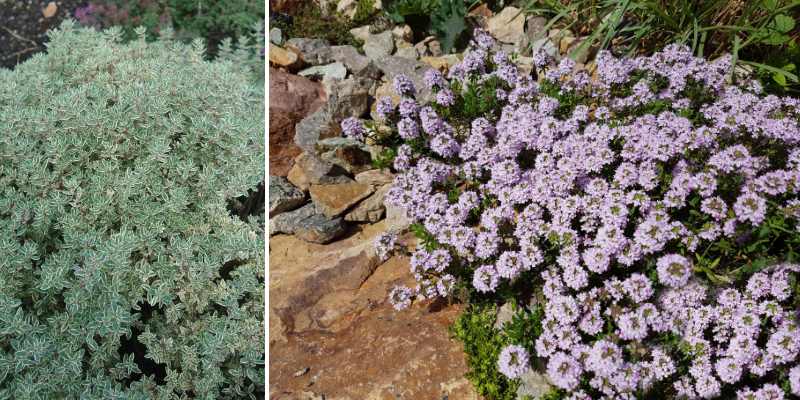
To the left, Thymus citriodorus ‘Silver Queen’, and to the right a common thyme in a rockery
Agastaches and hyssop
Other Lamiaceae of interest in sunny midsummer flowerbeds, agastaches and hyssops are now available in many enticing varieties, such as ‘Kudos Mandarin‘, a striking orange agastache, the classic ‘Black Adder‘ entirely blue, or the original pink hyssop! They are also loved for being nectariferous and melliferous for garden wildlife.
Although widely used in borders, and particularly valued for their upright habit with tall spikes like some herbaceous sages, their role on our plates is often less well known. In cooking, it is their fresh aroma, both aniseed and minty, that gives them strong aromatic power.
Where to plant? In dry gardens, mixed borders, country gardens, even in pots on the terrace! Plant them always in full sun, in well-drained soil.
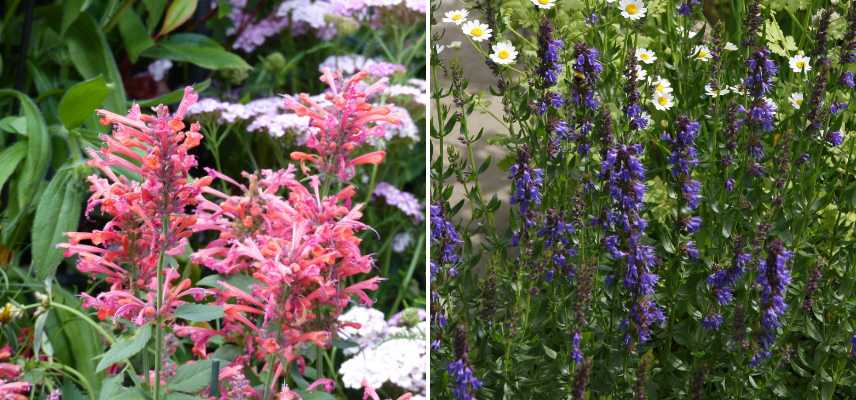
Agastache ‘Kudos Coral’, and Hyssopus officinalis
Chives
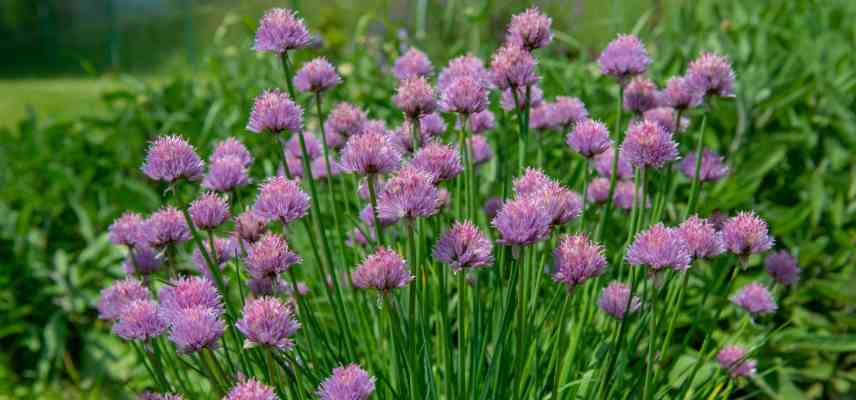
Chives are much better known and used in cooking than agastache. They are, like thyme or mint, staples, perfect with their garlicky flavour to enhance fresh cheeses, omelettes or salads. The Allium schoenoprasum, its Latin name, blooms between April and May.
Frankly, all chives are beautiful in flower, delightful little balls like miniature alliums on stalks. You can have fun planting varieties with white flowers, such as ‘Cliffs of Dover‘ or pink ones such as ‘Forescate‘, for a change, but the mauve ones really make a striking display in any border. Once the flowers have faded, the clump remains compact and, it must be admitted, tends to pop up just about everywhere.
Where to plant it? On borders in an English-style garden, in a pink or white garden depending on the variety, in a cottage garden, in full sun or partial shade.
- Subscribe!
- Contents
This form is protected by reCAPTCHA - the Google Privacy Policy and Terms of Service apply.

































Comments