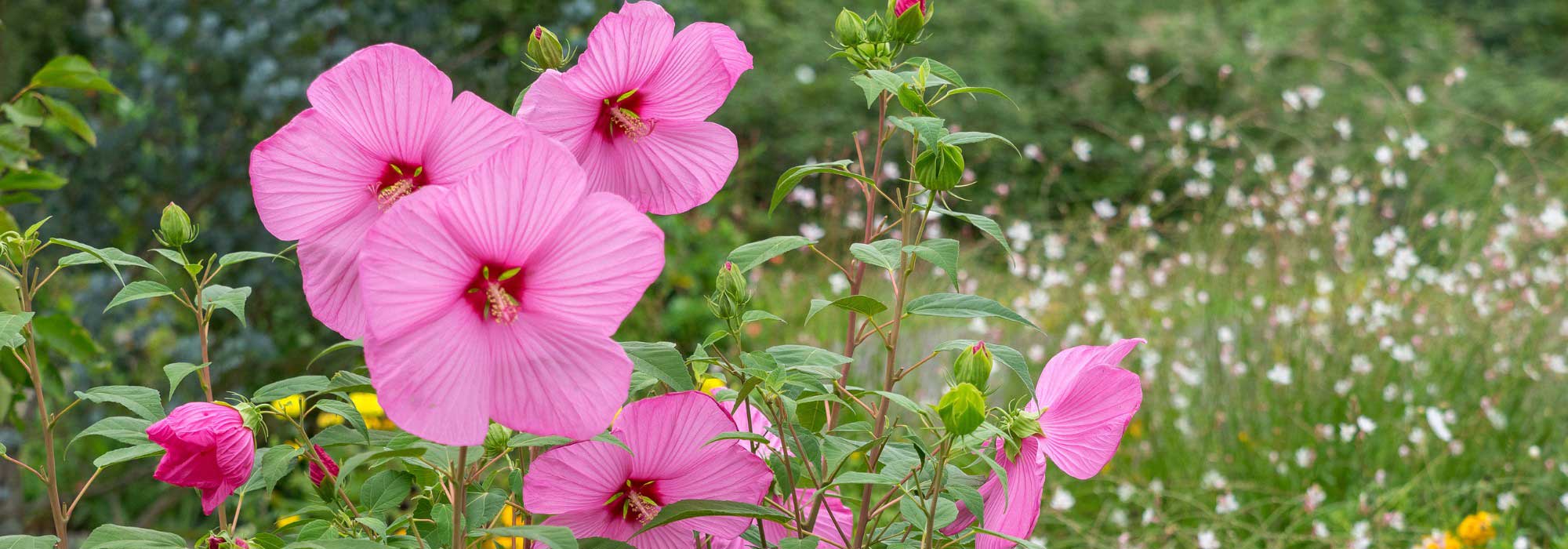
Companion plants for common Rose mallow: 5 ideas for a lush border
5 garden moods
Contents
Common Rose mallows seduce with their large, spectacular flowers, often 20 cm across, in vivid colours. Vigorous and hardy, these bushy perennials often reach 1.20 to 1.80 m in height and favour rich, moist to waterlogged soils, in sunny positions. They thrive particularly well at the water’s edge or in damp borders, where they bring exuberance and very exotic charm.
Although their appearance can sometimes surprise in a naturalistic garden, these hibiscus naturally find their place in lush displays, on pond edges, as a focal point in cool summer borders or in more romantic scenes.
Which companion plants to pair with them? Here are five inspiring settings to showcase these spectacular perennials in the garden!

On the banks of a pond
On pond banks, at the edge of a pond or around a water feature, common Rose mallows reveal their full potential, bringing a touch of refined exoticism. Fond of rich, consistently moist soils, these exuberant perennials find a perfectly suited environment here.
To create a dense, luxuriant scene around a water feature, plant, for example, Hibiscus moscheutos ‘Planet® Griotte Tangri’, with cherry-coloured blooms that last particularly long, from July to September.
Plant imposing foliage such as Gunnera, Rodgersia pinnata ‘Chocolate Wings’ or a Colocasia esculenta whose generous proportions enhance the luxuriant effect. You can also include Ethiopian arums or some papyrus for graphic interest. Cannas such as the water canna, Canna glauca ‘Endeavour’, will bring exotic-looking blooms in warm colours.
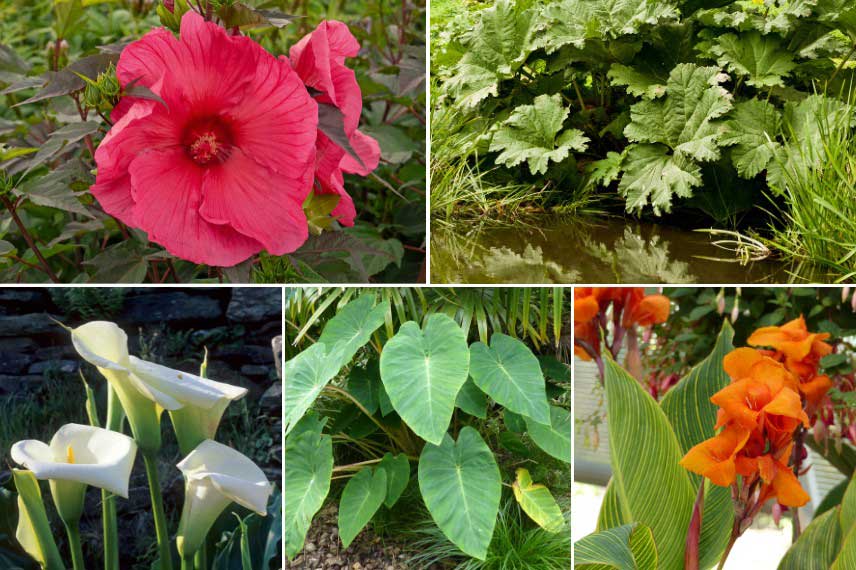
Hibiscus moscheutos ‘Planet Griotte’, Gunnera, Zantedeschia aethiopica, Colocasia esculenta and Canna striata
In a lush exotic border
With lush foliage, highly ornamental throughout the growing season, and exuberant flowering, common Rose mallow make a striking presence in a lush, tropical-inspired border. They help compose an abundant, exotic scene when paired with plants that share their preference for moist to wet soils.
They can be paired with hardy banana plants such as the Sikkim banana, the flamboyant-flowering cannas, or the large-leaved Tetrapanax to emphasise the sense of luxuriance. Beschorneria yuccoides, upright and architectural, provides striking vertical lines, provided soil is not waterlogged.
In regions with mild winters, Cordylines, Agaves, hardy Yuccas or a Chamaerops humilis will provide evergreen structure. An Abutilon, extremely decorative with its bright red bell-shaped flowers, will also perfectly embody exoticism and cheerfulness!
Intensify the tropical effect with bright blooms such as those of Hedychium, with spicy, fragrant notes, or Tigridia pavonia, a bulbous plant with a strongly exotic appearance. Arum ‘Himalaya’, elegant, also pairs perfectly with this type of planting. These perennials reinforce the exotic atmosphere while offering a good succession of summer blooms.
If space allows, introduce a tree fern Dicksonia antarctica, bringing freshness and lightness to the understorey, or other moisture-loving ferns (such as the large Osmunda regalis).
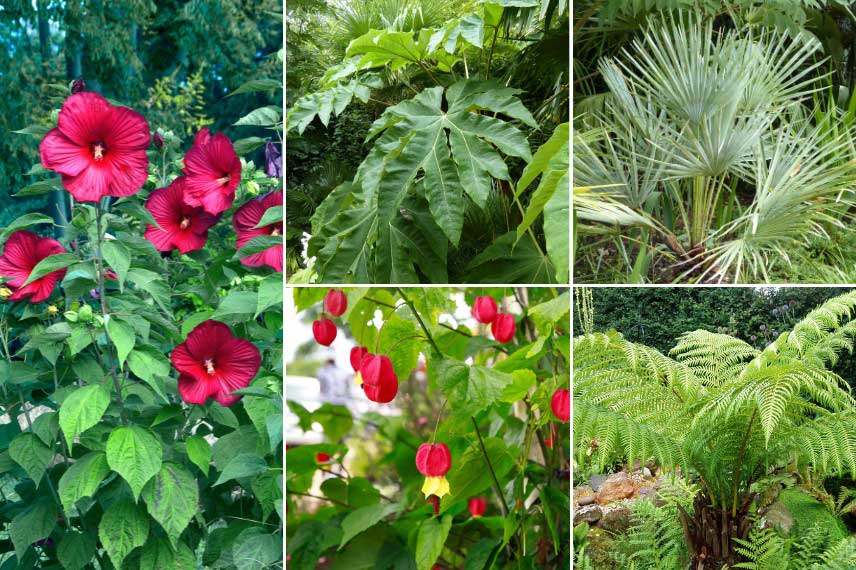
Hibiscus moscheutos, Tetrapanax papyrifera ‘Rex’, Chamaerops humilis ‘Cerifera’, Abutilon megapotamicum, Dicksonia antarctica (photo: Amanda Slater)
In a romantic scene
Far from flamboyant exoticism, some common Rose mallow, with the delicacy of their hues and the elegance of their purple foliage, fit perfectly into a romantically inspired border.
At the centre of a cool, tonal scene, Hibiscus moscheutos ‘Carousel® Ghost®’ stands out with large pure-white flowers of rare luminosity, carried on deeply cut foliage flushed with purple. Not far away, Hibiscus moscheutos ‘Planet® Solène Tansol’ unfurls soft-pink corollas veined with red around a cherry centre, adding a touch of softness tinged with intensity.
Around these spectacular saucer-shaped flowers, Phlox paniculata in white, pink or lilac tones form scented clouds throughout summer. Single dahlias with candy-pink collars, such as Dahlia ‘Happy Single Juliet’, extend the floral brilliance in a more natural style, while hardy geranium ‘Rozanne’ weaves a soft blue carpet at their feet. Foxgloves, with light, vertical spikes, introduce a play of airy heights, softened by the ethereal flowering of Crambe cordifolia, like a white breath suspended above the border. To complete the composition, Hydrangea paniculata ‘Little Lime’ reinforces the floriferous note, within a soft, refined palette.
You can also slip in a few repeat-flowering roses, whose scented blooms will prolong the border’s charm into autumn and enhance its romantic character. To extend interest into autumn, consider adding a Rostrinucula dependens, with its late, delicate flowering.
At the edge of the border, accompany this little world with Eupatorium in moist, cool soil.
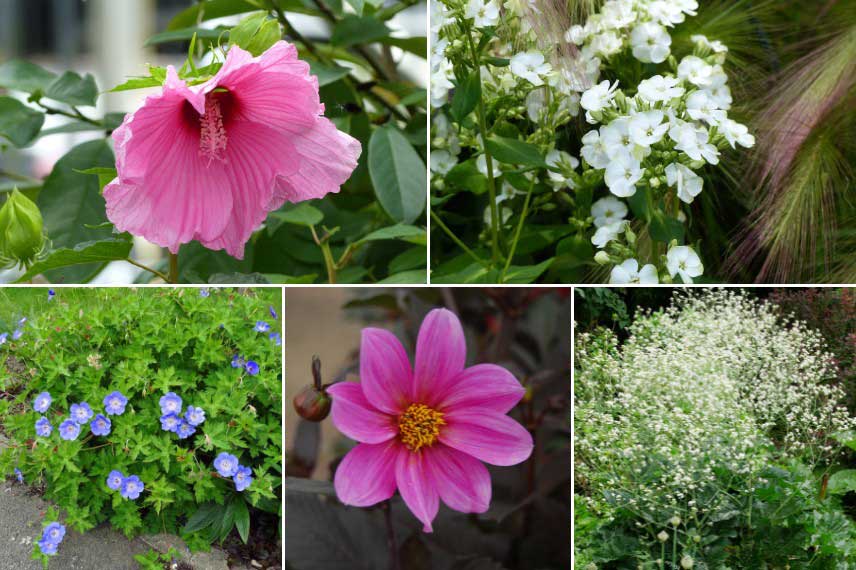
Hibiscus moscheutos ‘Planet Solene’, Phlox paniculata ‘Jade’, hardy geranium ‘Rozanne’, Dahlia ‘Happy Single Juliet’ (photo: Andy Mabbett) and Crambe cordifolia
Read also
How to dry hibiscus flowers?In a wild, natural setting
Common Rose mallow, with their large ephemeral flowers and imposing stature, naturally find their place in loose, almost spontaneous-looking plantings that evoke lush, flourishing wet prairies.
Around, for example, a Hibiscus moscheutos ‘Cherry Cheesecake’ with huge white flowers heavily flushed with pink, the Panicum virgatum ‘Rehbraun’, with foliage green turning reddish-brown by late summer, adds movement and emphasises the natural character of the setting. One can pair it with purple loosestrife, whose purple spikes enliven the banks, as well as Buenos Aires verbenas, whose slender, airy stems attract butterflies and bees. Wet-prairie asters (Aster novi-belgii) extend the season into autumn, while the Eupatorium maculatum ‘Atropurpureum’, with large purple umbels, stands in the background.
A few Filipendula ulmaria, with frothy panicles, or Carex pendula, graceful and pendulous, further enrich the palette by adding texture and lightness.
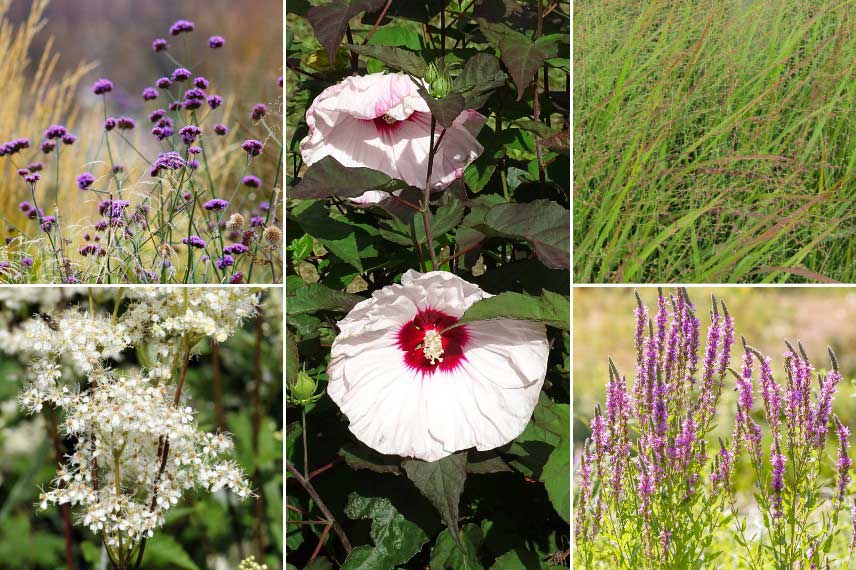
Verbena bonariensis, Hibiscus moscheutos ‘Cherry Cheesecake’, Panicum virgatum ‘Rehbraun’ (photo: L. Enking), Filipendula ulmaria and Lythrum salicaria
In a damp border
In the wettest areas of the garden, often the hardest to plant, common Rose mallows reveal their full potential. They bring luxuriance and colour where few plants will thrive. They sit elegantly within naturalistic compositions, rewarding with abundant flowering. Their generosity complements the lightness of summer blooms and the freshness of lush foliage.
You could, for example, imagine a border organised around a few soft‑toned hibiscus, such as Hibiscus moscheutos ‘Carousel® Pink Candy’, whose large pale corollas contrast with purple foliage. Around them, plant perennials for moist to wet soils such as Iris sibirica, with fine, elegant stems, Ligularias with tall yellow spikes, or Hosta sieboldiana, which form drifts of blue‑grey foliage. Pair them happily with other shade plants, such as ferns or Epimediums.
A few Astilbes, with their feathery panicles, add a delicate, airy touch, while Rodgersias, such as ‘Irish Bronze’, with their large, palmate, leathery bronze‑coloured leaves, form solid clumps. Their pink panicles extend interest into early summer.
To lighten the whole, moisture‑loving grasses such as Molinia caerulea ‘Transparent’ introduce a natural, delicate movement into this border.
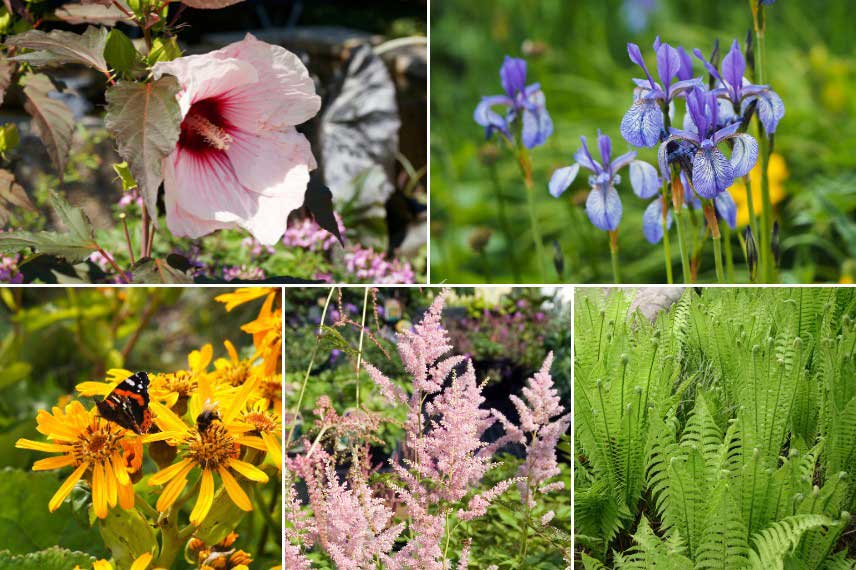
Hibiscus moscheutos ‘Carousel Joli Coeur’, Iris sibirica, Ligularia dentata ‘Desdemona’, Astilbe japonica ‘Peach Blossom’ (photo: David J. Stang) and Matteuccia struthiopteris
- Subscribe!
- Contents
This form is protected by reCAPTCHA - the Google Privacy Policy and Terms of Service apply.

































Comments