Diseased or spotted dead leaves: which ones to keep? Which ones to remove?
Compost them, keep them for mulching or throw them away?
Contents
As winter approaches, there is one garden task that seems unavoidable: clearing up fallen leaves. A chore for some and a promise of abundance for others, this tidying-up does raise questions. What should you do with leaves that are spotted, holed, discoloured or visibly diseased? The answer depends entirely on the source of the problem, which can have several causes: fungal, bacterial or viral diseases, a simple nutrient deficiency, or stress linked to growing conditions or the climate… Let’s discover which fallen leaves affected by disease or pests can be composted, kept as mulch, or must be disposed of.

How to use fallen leaves in the garden?
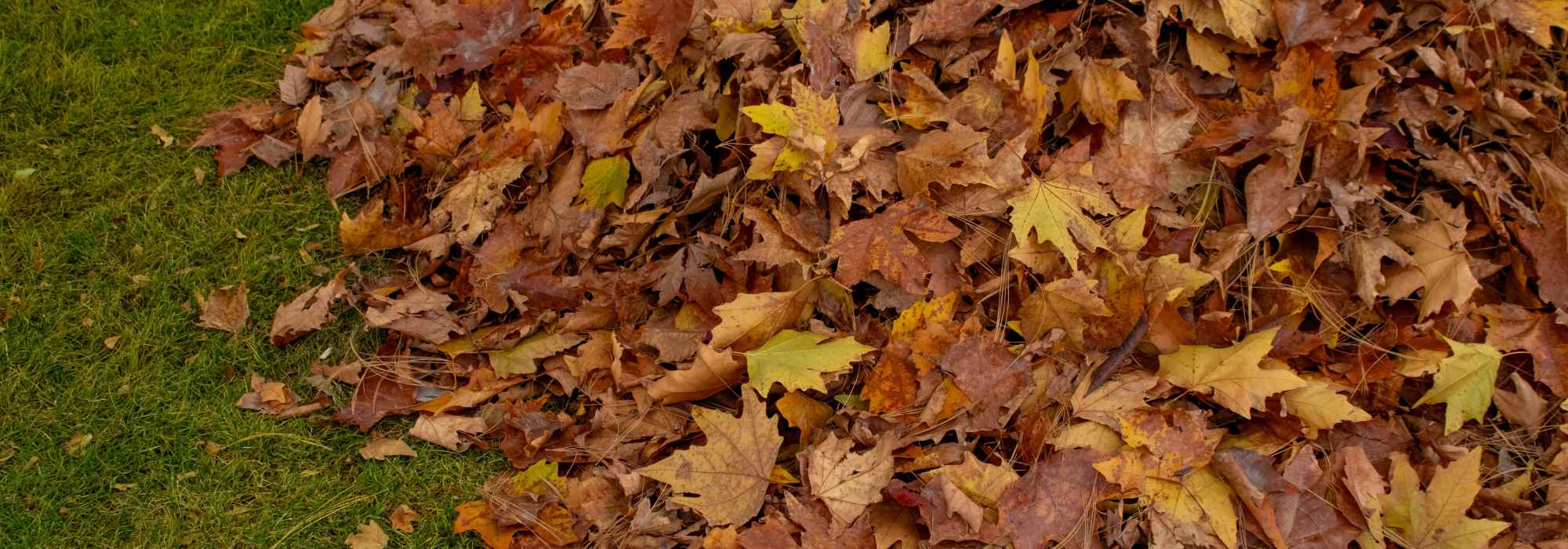
Admittedly, collecting fallen leaves is never the most enjoyable task in the garden. However, if you see them not as bulky waste that is a chore to collect, but rather as a free and versatile resource for the garden, the task seems less tedious. In fact, fallen leaves are a highly valuable resource in the garden.
- Used as mulch around beds and vegetable crops, they protect the soil from frost, limit the leaching of nutrients by winter rain and slow the growth of weeds, while recreating the humus of woodland.
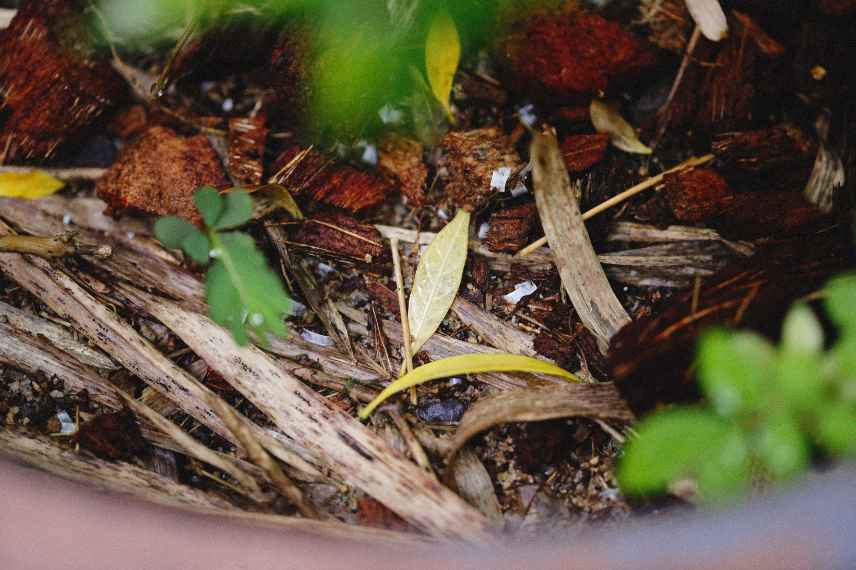
- Shredded or added to the compost in successive layers, they provide the carbon needed to balance the nitrogen-rich materials supplied by lawn clippings and kitchen waste, while encouraging earthworm activity.
- Collecting them also makes it possible to make leaf mould: stored on their own in a large black sack or wire-mesh enclosure for one or two years, they slowly break down into a fine, light texture that is ideal for sowing or repotting acid-loving plants.
- Left in a pile in a quiet corner of the garden, they provide an essential winter refuge for beneficial wildlife, from hedgehogs to beneficial insects.
Fallen leaves provide carbon for compost
However, collecting fallen leaves sometimes raises questions for the meticulous gardener. Some are spotted, nibbled or visibly diseased… What should you do with them?
Leaves affected by pathogens or insects should be discarded or burnt
To take stock of diseased dead leaves that should not be kept, it may be worth pointing out that burning green waste (dead leaves, lawn clippings, pruning branches) is strictly regulated in France. Under the 2011 circular and the French Environmental Code, as a general rule, burning private individuals’ green waste in the open air is strictly prohibited all year round. However, certain departments or rural areas may authorise the burning of this waste, particularly as part of efforts to control harmful organisms. This is why it is essential to check with your local town hall or prefecture, as burning dead leaves at home can result in a €450 fine. So, rather than burning dead leaves, it is preferable to take them to the recycling centre, which works with professional industrial composting facilities operating at high temperatures and able to eradicate pathogenic agents.
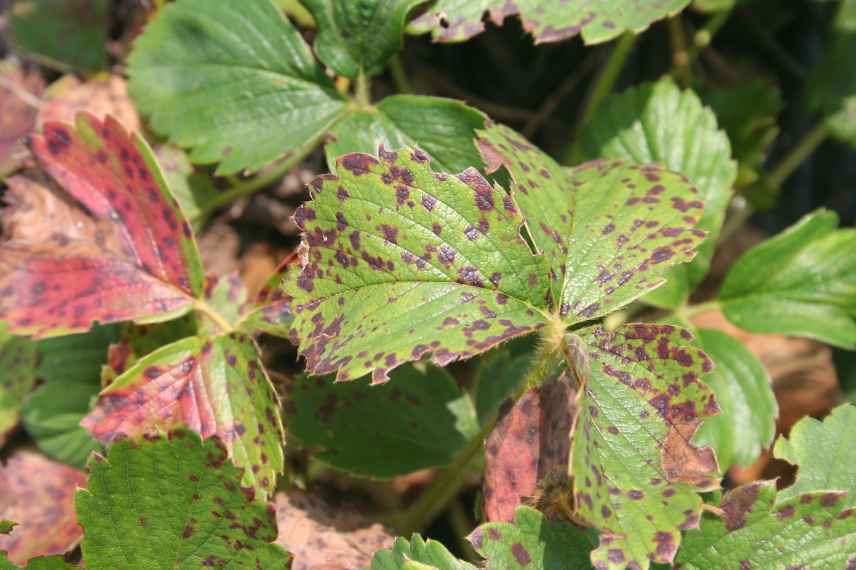
But let us get back to our dead leaves! Diseased ones, what’s more! Some must be collected carefully and taken straight to the recycling centre you use. This is especially true of leaves affected by pathogenic organisms responsible for fungal or bacterial diseases. Why throw them away? Quite simply because these pathogenic agents survive in dead leaves as spores or mycelium, or withstand the cold in plant debris throughout the winter. And in spring, they may potentially reinfect new crops or young shoots if the dead leaves are left in place or composted in the household compost bin, which is often not hot enough to destroy them. The key is therefore to identify the disease. If you cannot do so, err on the side of caution and safety by taking your dead leaves to the recycling centre.
Some spotted dead leaves must be collected carefully and taken straight to the recycling centre you use.
Diseases that persist on dead leaves
- Powdery mildew, recognisable by its white coating visible on the foliage of squashes and courgettes, roses, apple trees… The fungi responsible overwinter as resistant spores on dead leaves and buds.
- Scab, which affects apple trees, pear trees and quinces, is recognisable by the presence of velvety olive-green to black spots on the leaves, and then on the fruit. The fungus (Venturia inaequalis or pyrina) spends the winter in dead leaves that have fallen to the ground. In spring, rain propels the spores onto young leaves.
- Black spot or Marsonia on roses is recognisable by circular black spots on the foliage, yellowing and premature leaf fall. The spores survive on leaves left on the ground.
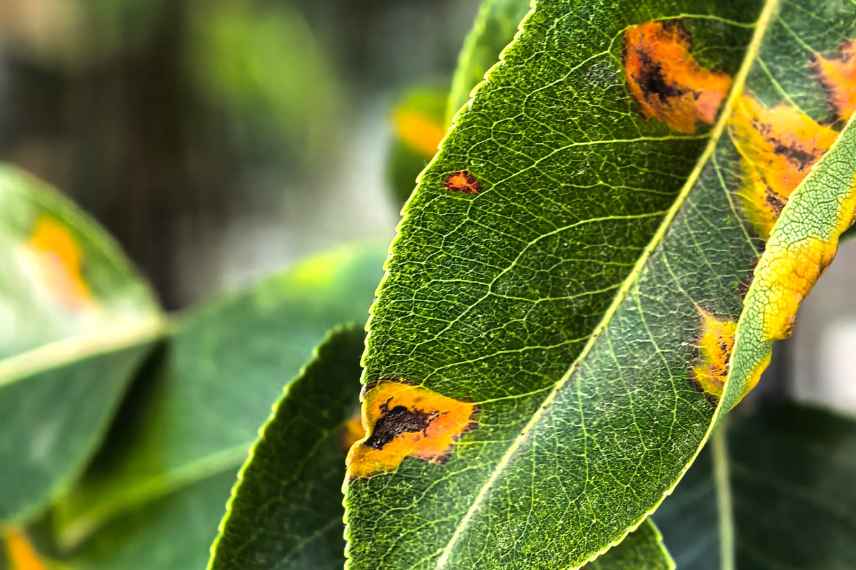
- Rust on roses, mallows, leeks, garlic… can be identified by the orange, yellow or brown pustules on the undersides of the leaves. The spores overwinter on stems and nearby weeds.
Leaves affected by rust must be taken to the recycling centre.
- Downy mildew appears as grey to brown, necrotic spots on the leaves and stems of tomatoes, potatoes and grapevines. Do not forget the white coating on the undersides of the leaves. The spores can survive in the soil or on crop debris, including forgotten potatoes.
- Peach leaf curl is recognisable by the red swellings on foliage that becomes crinkled in spring. Although the spores tend to take refuge under the bud scales and bark, it is preferable to throw them away.
- Fire blight is caused by a bacterium (Erwinia amylovora) that suddenly dries out the leaves of trees and shrubs in the rose family. It turns them brown or black but remains on the branches. This is a very serious, highly contagious and tightly regulated disease. As there is no treatment, it is essential to cut off the affected twigs and leaves and notify your local town hall or the regional plant protection service to find out what to do.
Insect pests that survive in dead leaves
Dead leaves provide ideal shelter for many garden insects and pests that spend the winter there, in the form of eggs, larvae, pupae or adults in diapause:
- Leaf-mining flies or leaf-mining moths: their larvae tunnel through the lamina of the leaves themselves. Some leaf-miner species leave the leaf at the end of the season to pupate in the soil just below the surface. Others, such as the horse chestnut leaf miner, overwinter directly inside fallen dead leaves as extremely hardy pupae. This is why collecting and disposing of spotted horse chestnut leaves is essential to limit attacks the following year.
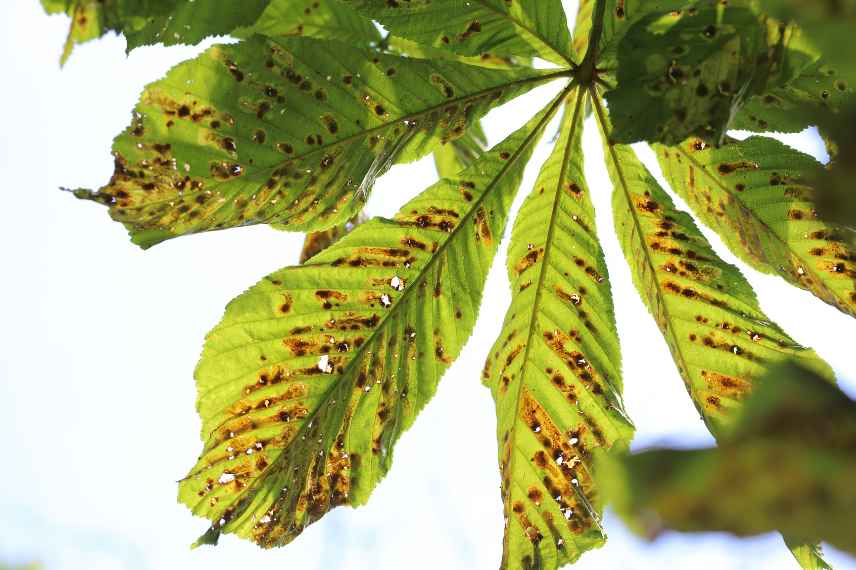
As the horse chestnut leaf miner overwinters in the leaves, they must be thrown away.
- Flea beetles are tiny jumping beetles that perforate the leaves of cabbages, radishes, turnips… The adults leave the plants in late autumn to hide, among other places, under dead leaves. As soon as the first mild spells of spring return, they emerge from this shelter to attack young seedlings.
- The adult vine weevil often hides beneath thick layers of dead leaves in winter at the base of rhododendrons and laurels.
Damaged fallen leaves to compost or use as mulch
Some spots visible on dead leaves have no effect on the soil or plants to come, as these spots are caused by temporary deficiencies, particular stress or even fungi that do not attack healthy plants. Similarly, dead leaves with holes or nibbled edges can be kept for composting or even left in place as mulch, as the insects responsible for this damage do not overwinter on the foliage.
Our list of spotted or insect-damaged dead leaves that can be kept or added to the compost:
- Leaves riddled with holes, with nibbled edges, pierced or discoloured by the feeding damage of sap-sucking insects such as aphids, scale insects and red spider mites… Other insects such as leafhoppers, sawflies and certain caterpillars also attack foliage. Most of the insects that fed on these leaves left them long ago, either to overwinter as eggs, pupae or adults in the soil or under the bark. In short, as these insects no longer live on the dead leaves, they can be composted or used as mulch.
- Leaves affected by nutrient deficiency, such as chlorosis, generally recognisable by their premature yellowing, should be composted.
- Leaves scorched by high temperatures, made necrotic by water stress or riddled with hail damage can be composted or even left in place without any risk.
- Leaves marked by sooty mould, a black deposit resembling soot caused by a fungus that feeds on the honeydew produced by aphids or scale insects, can be composted.
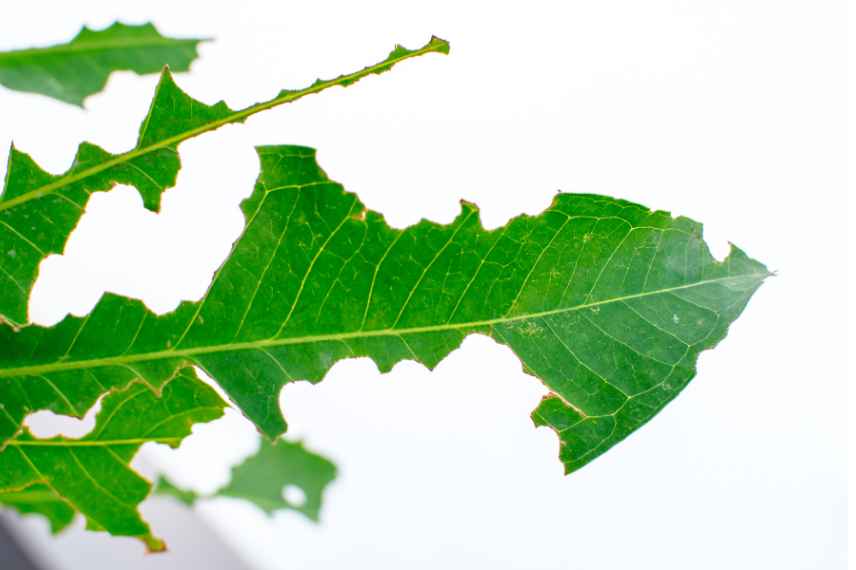
Once dead, this leaf can be composted or left in place.
Read also
How to collect fallen leaves?A special case: leaves affected by a virus
Cucumber or tomato mosaic is a viral disease. It can be identified by the mottled patterns on leaves, which turn yellow and become distorted prematurely. A virus needs a living host organism to multiply. It cannot survive on its own on a dead leaf that is drying out and decomposing. However, it can persist in the roots of perennial plants or be transmitted by vectors. Isolated leaves pose no major risk in a decomposing compost heap, but as a precaution, avoid putting in whole uprooted plants carrying serious systemic viral diseases.
- Subscribe!
- Contents
This form is protected by reCAPTCHA - the Google Privacy Policy and Terms of Service apply.

































Comments