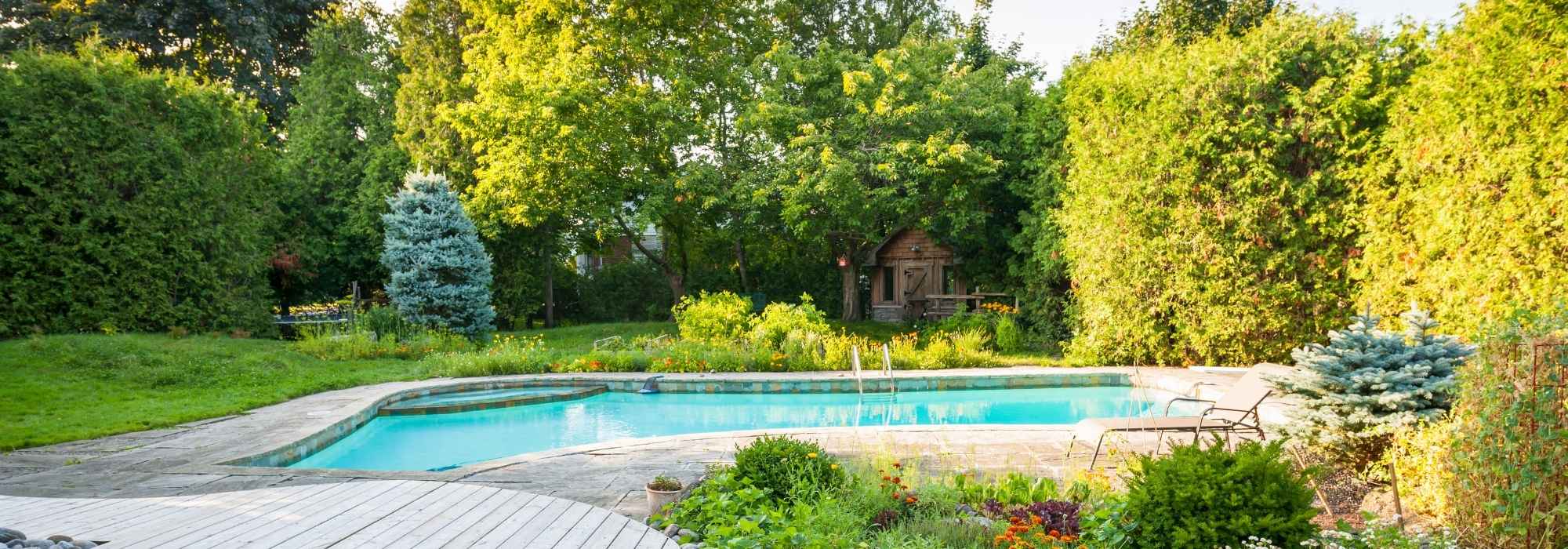
Which plants to choose around a pool?
Our selection and planting advice
Contents
Plants located along or very near a swimming pool must have many qualities, being able to withstand both sun and splashes of salt or chlorine depending on the type of water treatment, while also having a non-invasive root system that must not threaten the liner. They are also chosen for their evergreen appearance, to avoid tedious raking of debris from the water, and for being low-shedding.
So which all-purpose plants are best for our pools? We present the best plants to plant around a swimming pool.
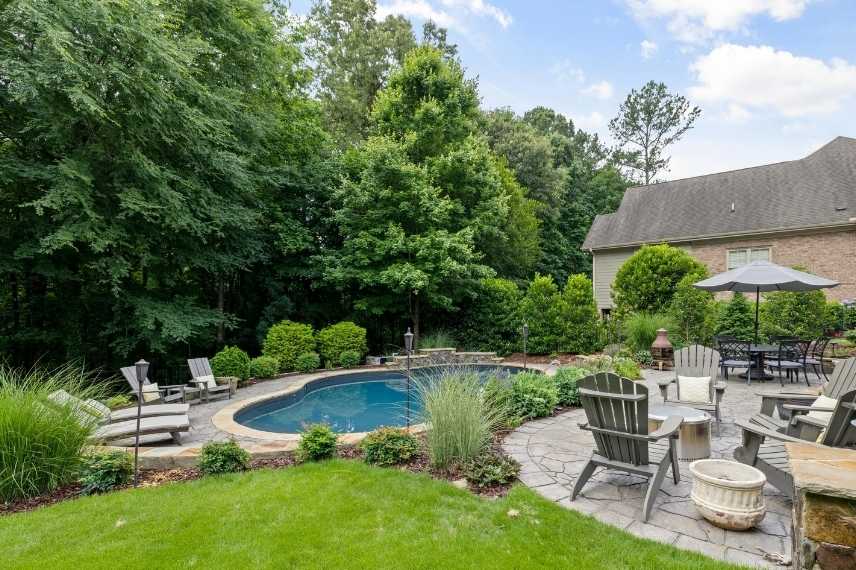
Poolside classics
All these plants are prized for their holiday feel and the sense of escape they provide, perfectly in tune with pool ambience, used mainly outdoors during the warmer months.
Agapanthus
They dress pools beautifully, whatever the style. Often seen, you might prefer blooms of very intense blue such as ‘Ever Sapphire’ or large white agapanthus for a deliberately classic look.
In warm climates, favour evergreen agapanthus, which will retain their foliage late into the season.
Ideal in contemporary schemes.
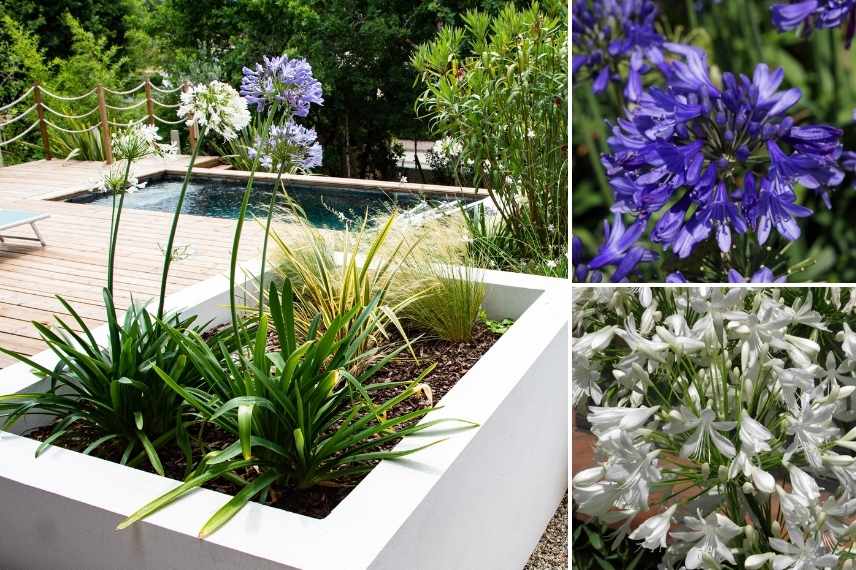
Agapanthus ‘Ever Sapphire’ and Agapanthus umbellatus ‘White Umbrella’
Banana trees
These plants are perfect around a pool when aiming for a thoroughly tropical, exotic vibe. Banana trees produce little waste, reach substantial size at maturity, and even provide shade once well developed. Count on the number one banana tree in our northern hemisphere, Musa ‘Basjoo’, or for warm-climate gardens the divine Abyssinian red banana.
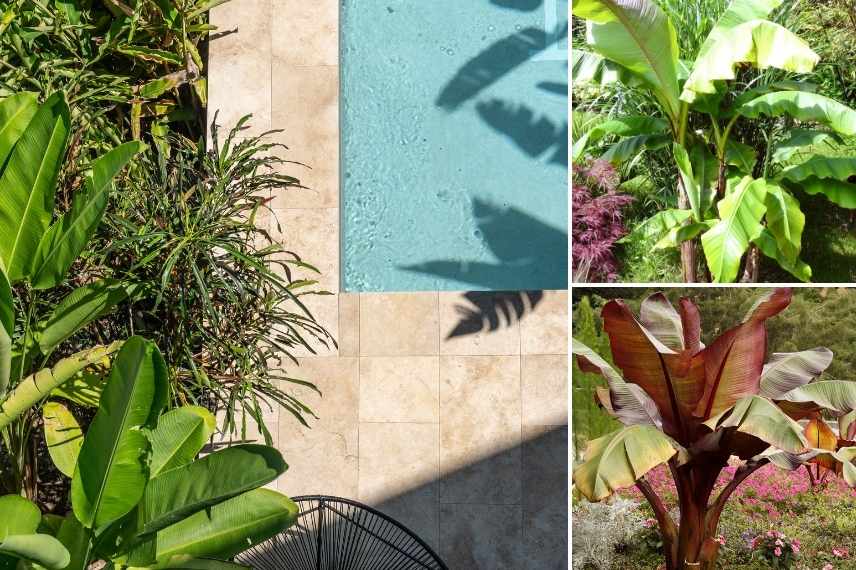
Musa ‘Basjoo’ and Ensete ventricosum ”
Palms
Irreplaceable for conjuring a sense of being at the ends of the earth, palms have long been favoured by pool landscapers for planting close to the pool.
The Trachycharpus fortunei, or hemp palm, is certainly the one that will suit pools across France. It is the hardiest of all palms. It has the advantage of a tall trunk that does not interfere with placing sunloungers at its base. Some lower palms are equally interesting, such as Chamaerops humilis and all dwarf palms. Also consider Cycas, which resemble them while remaining low and very present (plant further away than single-stem palms because of their spines).
It is entirely possible to imagine a pool surrounded solely by palms of different sizes and shapes!
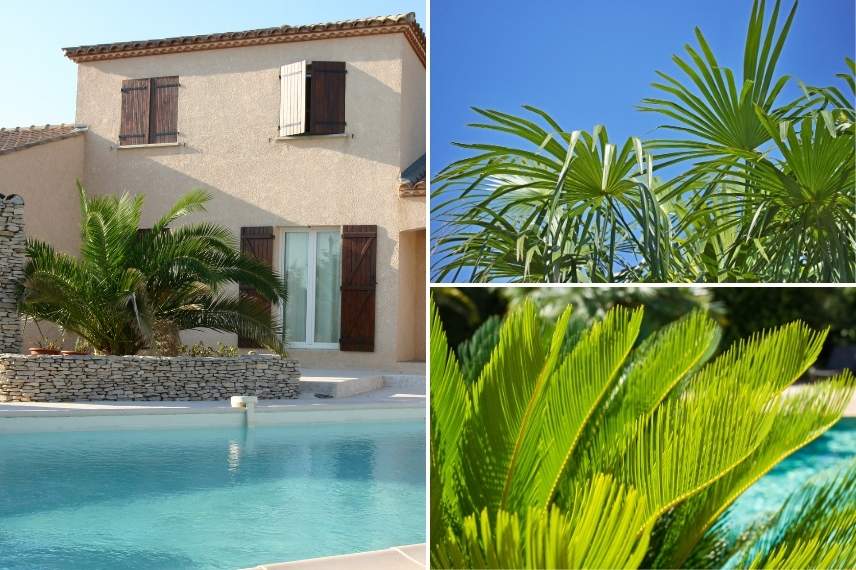
On the right, Trachycarpus fortunei and below Cycas revoluta
Agaves
If pool is not frequented by children, because agaves have very sharp leaf tips, this striking plant evoking hot, distant lands can be considered. Agaves can also be planted in a tall planter to avoid this drawback. Same applies to young Cordylines.
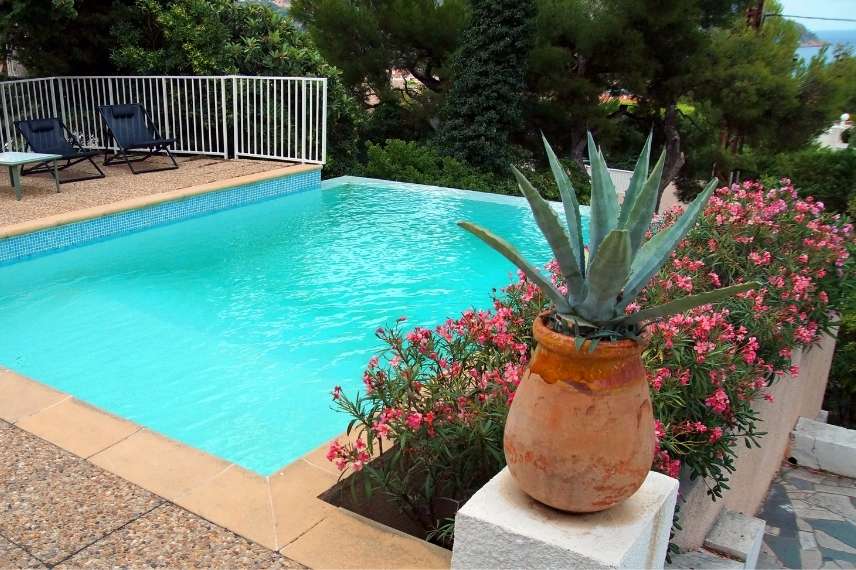
When raised in pots, agaves pose no danger if children use the pool
Trees
Provided they are placed well away from the pool, some evergreen or deciduous trees offer both appreciable volume in an otherwise rather flat setting and shade increasingly sought after as summers face heatwaves. But they must be planted at least 3 metres away, and you must choose species whose root system is compatible with the pool. An Albizia proves a very ornamental, exotic choice, but as its flowers and leaves can fall all summer it should be reserved for sheltered, wind-free areas; otherwise it becomes a real maintenance headache.
Entirely Mediterranean in feel, the olive tree fits perfectly into gardens of southern France. It is the ideal tree for Provençal mas and villas around the Mediterranean, thanks to its evergreen foliage and beauty. Ripe fruits in October are not a nuisance here.
Read also: Which privacy screens should you choose to shield your pool from prying eyes?
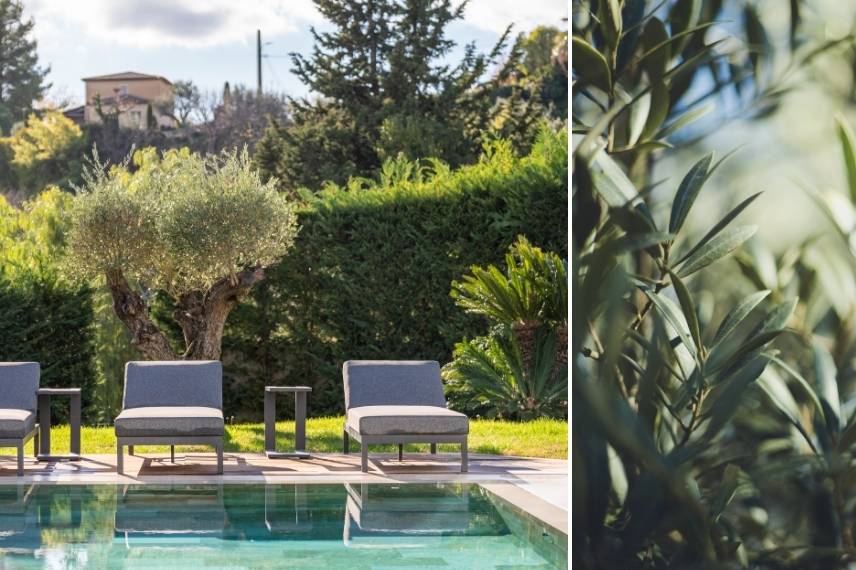
→ More details and advice in our article Shading a pool: which plants to choose?
Read also
Designing poolside areas in 5 stylesUnexpected choices to enhance a pool
Other plants, equally ornamental and often graphic, are excellent choices around a pool. Some shrubs in particular are perfect when planted at a reasonable distance.
Grasses
They really create a dreamlike setting once well established, after about three years’ growth.
Choice is wide, with a preference for evergreen grasses if the pool is visible from a room of the house, for prolonged visual interest during winter months (fescues, Helictotrichon, Carex testacea and Buchanan’s sedge, etc.).
Grasses repeated in patterns around the pool, or planted in groups, are particularly sought after in contemporary layouts. Taller ones such as Miscanthus are striking in large spaces.
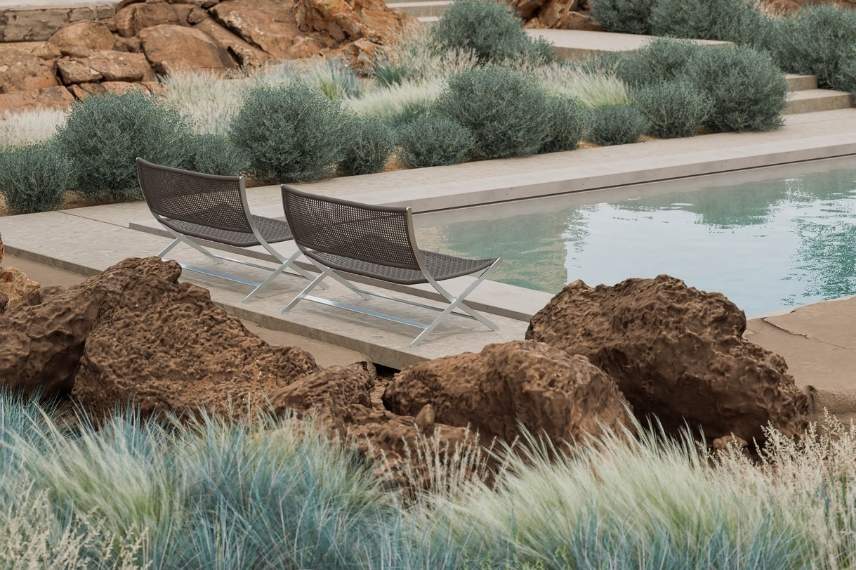
A very attractive planting with fescues
Rosemary and aromatic or grey-foliaged shrubs
It is not often considered, but rosemary remains a superb idea for dressing pool surrounds. Likewise Teucrium, santolinas and Afghan sages, which form either rounded masses or more opulent clumps, are suited to pools in dry gardens, rockeries, garrigue and, of course, Mediterranean-style gardens.
Feijoa
Hardy enough to establish in many regions (it may lose its leaves from −15°C), the Brazilian guava is an original option for poolside. Evergreen, with attractive habit, grey foliage and exotic flowers, it provides shade once mature (but it is slow-growing, somewhat like olive, so choose an established shrub at planting).
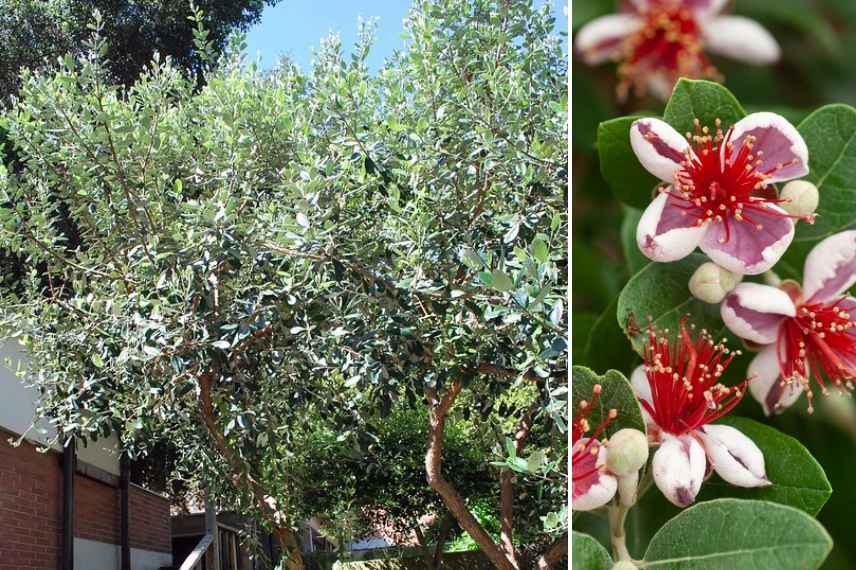
Foliage and flowers at their best!
Arbutus (strawberry tree)
Another very ornamental shrub is the arbutus; the smaller Arbutus unedo ‘Compacta’ is a possible candidate, particularly suited to calcareous and siliceous soils and exhibiting a taproot, ideal in a pool context.
Arctostaphylos uva-ursi
Finally, a handy groundcover undershrub, also called bearberry, forming low, spreading cushions and flowering with pale pink bell-shaped flowers, should not be underestimated for filling gaps between different plantings.
Specific case No. 1: saltwater pools
Salt-treated swimming pools, increasingly popular for their eco-friendly appeal, require very tolerant plants, which rank among plants that resist sea spray well. So opt for salt-loving plants, especially when living in a warm climate and the pool is used daily. Repeated splashes throughout summer really put to the test foliage closest to the pool.
Rely here on tough or greyish foliage such as:
- the Phormium, chosen according to species and variety depending on the pool’s footprint in its surroundings (Phormium tenax reserved for large pools)
- rosemary
- Grasses: Pennisetum, Calamagrostis, Stipa tenuissima, Eragrostis,
- Agaves, including Agave americana
- Oleander (keep away if children are present, as all parts are toxic)
- Evergreen euonymus (Euonymus fortunei)
- Perovskia,
- Feijoa
- Westringia, etc.
These options are of course suitable for any conventional pool.
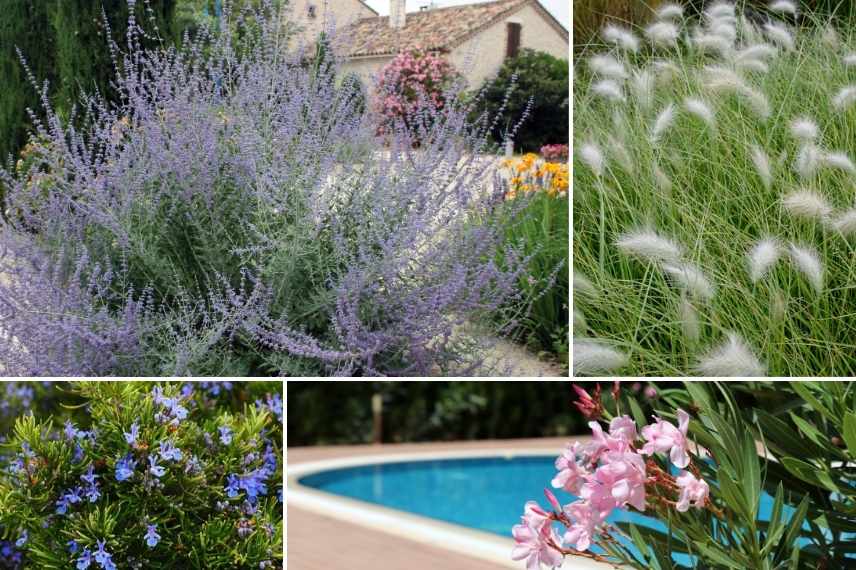
Perovskia atricipifolia ‘Blue Spire’, Pennisetum vilosum, Rosmarinus prostratus and Nerium oleander
Specific case No. 2: above-ground pools
Many opt for an above-ground pool, very practical. Affordable for most people, it is much loved by children. These pools sit well above ground, and planting around them is a real asset, helping to integrate them into often small gardens or housing developments. Some privacy from neighbours is usually sought here too, who might, so to speak, plunge into the pool!
Here, therefore, deciduous shrubs are preferred, especially medium to tall in size, such as Elaeagnus, privets or a variegated white dogwood (which grows quickly and loses its leaves late) to surround the pool with a screen of greenery and make the often nearby fence disappear. Tall Miscanthus or upright Panicum are also perfect for surrounding the pool.
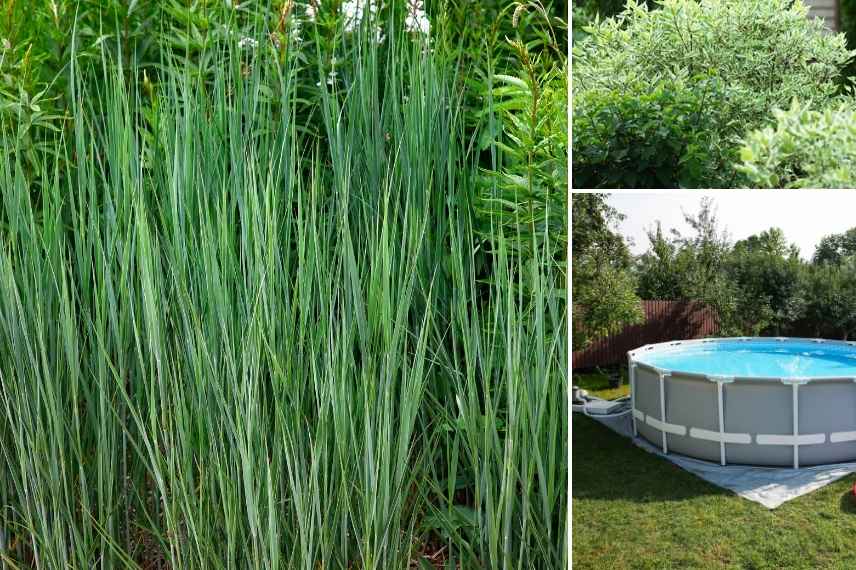
Panicum virgatum ‘Heavy Metal’ and Cornus alba ‘Elegantissima’
Specific case No. 3: secured swimming pools
Around a secure pool, tiling/decking usually occupies the interior of the perimeter, which limits planting to the outside of the fence. To disguise a fence that is often unattractive, opt for plants suited to a narrow strip in open ground or in containers along the fence.
Les grimpantes comme la clématite, palissées sur un treillis fixé à la clôture, montent vite pour un effet cache optimal. Les arbustes persistants (Eleagnus, Photinia, laurustinus, il en existe de beaux panachés) formeront un écran dense et résistant à la taille, idéal pour une haie basse ou moyenne. Pour apporter du volume sans entretien, les grandes graminées comme les miscanthus ou les lavandes et romarins en massif suffisent généralement à créer un rideau léger et parfumé. Un Juniperus rampant est un complément très ornemental à l’extérieur de la barrière.
Above all, avoid plants with a trailing habit or those that are too wide, as they could encroach on pool space. A continuous planting strip along the fence, with staggered heights, will reinforce the screening effect while maintaining secure access.
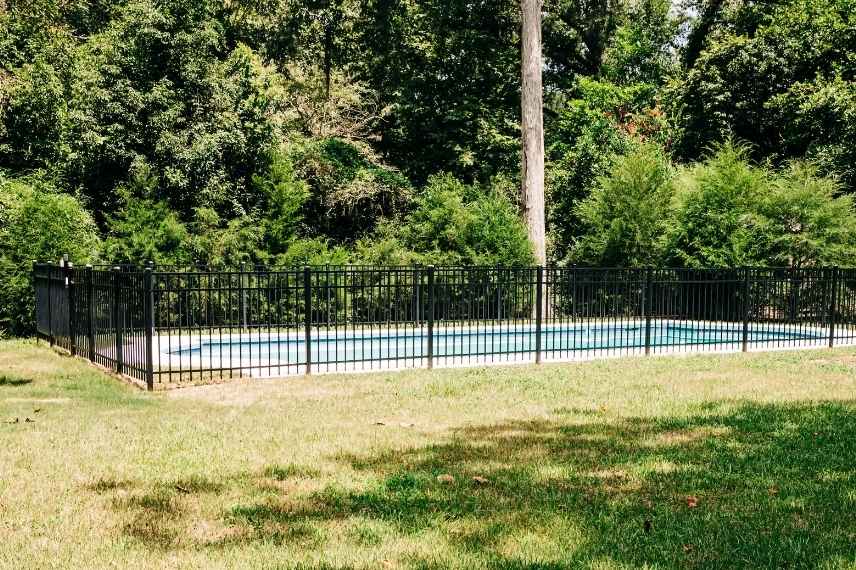
Hide that pool from me — I couldn’t bear to see it!
Our planting advice around a swimming pool
- As most options consist of slow-growing evergreen plants, plant them at the start of the project, always taking into account their mature size.
- Unless aiming for a jungle effect, limit plant palette to 3 or 4 species, repeating them.
- Avoid planting too close to pool coping: allow at least 1 metre between coping and a shrub, 1.2-2 m for planting a palm, and 80 cm for a perennial.
- Plantings can be placed in inserts or large planters provided during the construction of a pool: they take up less ground space and are perfect for contemporary layouts.
- Wasps flying over your sun lounger during a nap… not ideal, as you will agree: therefore abandon the idea of lavender which, although ornamental, will inevitably attract them.
- Opt for container plantings if you do not appreciate these typical plants, which are, admittedly, often seen around pools. Pots provide a different rhythm to the space, especially if chosen for their aesthetic qualities (Anduze pottery, terracotta or designer pots). For example, consider adorning the pool with two or three potted bougainvilleas, to be put away for winter, or pots of perennials, annuals or bulbous plants such as Cannas or castor oil plant.
- If space is limited, or the pool is small and installed near a wall, choose plants that do not grow too tall.
- Lap pools are enhanced by restrained planting, using a repeating motif from a single plant: grasses are ideal.
- If possible, install drip irrigation on pools with wooden decking.
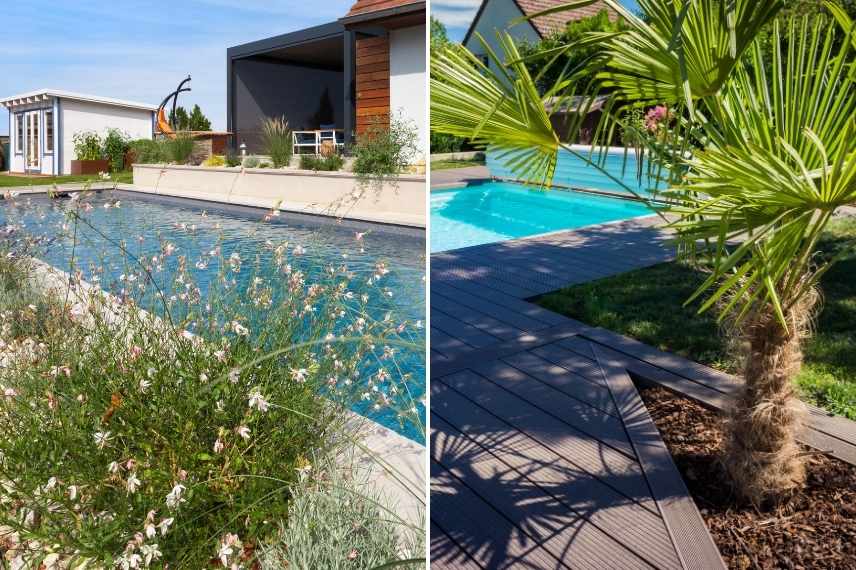
Planting set back slightly protects plants or allows installation of some more sensitive plants
- Subscribe!
- Contents
This form is protected by reCAPTCHA - the Google Privacy Policy and Terms of Service apply.
































Comments