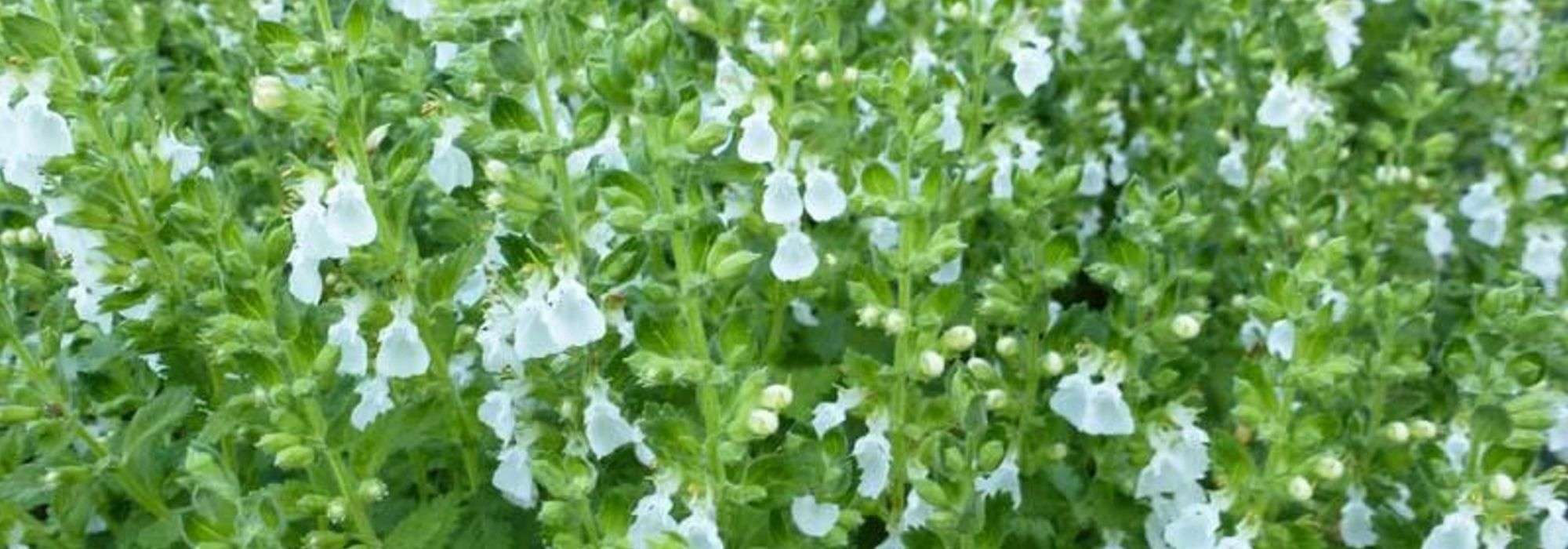
Teucrium (germander): planting and care
Contents
Germander in a nutshell
- Teucrium, or germander, is a perennial or undershrub prized for arid, mineral areas of the garden
- Size ranges from a few centimetres (Germandrée petit-chêne) to over 1.50 m for Teucrium fruticans or shrubby germander
- Flowering, in white, pink or blue and more rarely yellow, occurs in winter, spring or summer
- Hardy and undemanding, well adapted to drought, it grows in full sun in very free-draining, poor, stony soil
- Easy to shape by pruning, ideal for hedges, rockeries and arid borders in dry and coastal gardens
A word from our expert
Genus Teucrium includes various subshrubby Mediterranean perennials among which shrub germander (Teucrium fruticans) and its magnificent variety ‘Azureum’ with blue flowers nearly 2 m tall, and pretty bushes such as Teucrium chamaedrys or wall germander not exceeding 30 cm in height. Alongside these species most often seen in gardens, one also sometimes finds Teucrium polium or felty germander with small, grey-silver evergreen leaves, as well as Teucrium x lucydris, which make excellent groundcover plants for rockeries and borders.
Teucrium are appreciated for their foliage often aromatic, topped by early or summer flowering in white, pink, purple, blue, and more rarely pale yellow.
Rather hardy for a Mediterranean plant, germander is unfazed by drought, sea spray or arid, poor, calcareous soils. It tolerates pruning very well and can be easily trained into topiary.
Give it a sunny spot — it is a boon in a dry garden!

Description and botany
Botanical data
- Latin name Teucrium
- Family Lamiaceae
- Common name Germander
- Flowering March to September depending on species
- Height 0.15 to 2 m
- Exposure Sun
- Soil type Stony (poor and free-draining)
- Hardiness -5°C to -15°C depending on species
Teucrium or Germander belongs to family Lamiaceae, like its close relatives sages, mints, lavenders and thymes. The genus comprises around a hundred species native to hillsides and rocky zones of the Mediterranean regions of southern Spain, southern Portugal and Morocco, and even the arid hills of Iran and the Caucasus. Germanders are divided into creeping species such as Teucrium chamaedrys (dwarf germander) and shrubby types such as Teucrium fruticans, also called “tree germander”, the latter being the species most commonly found in gardens. This species grows naturally on Mediterranean coastal cliffs where it is protected. ‘Azureum’, a teucrium with blue flowers, is one of the loveliest varieties of this shrubby germander.
Among Teucrium species are Teucrium hircanicum, the Iranian germander, and Teucrium x lucidrys, or Germander Lucidrys, a low subshrub that forms a very dense carpet, to name a few of the species most often planted in gardens.
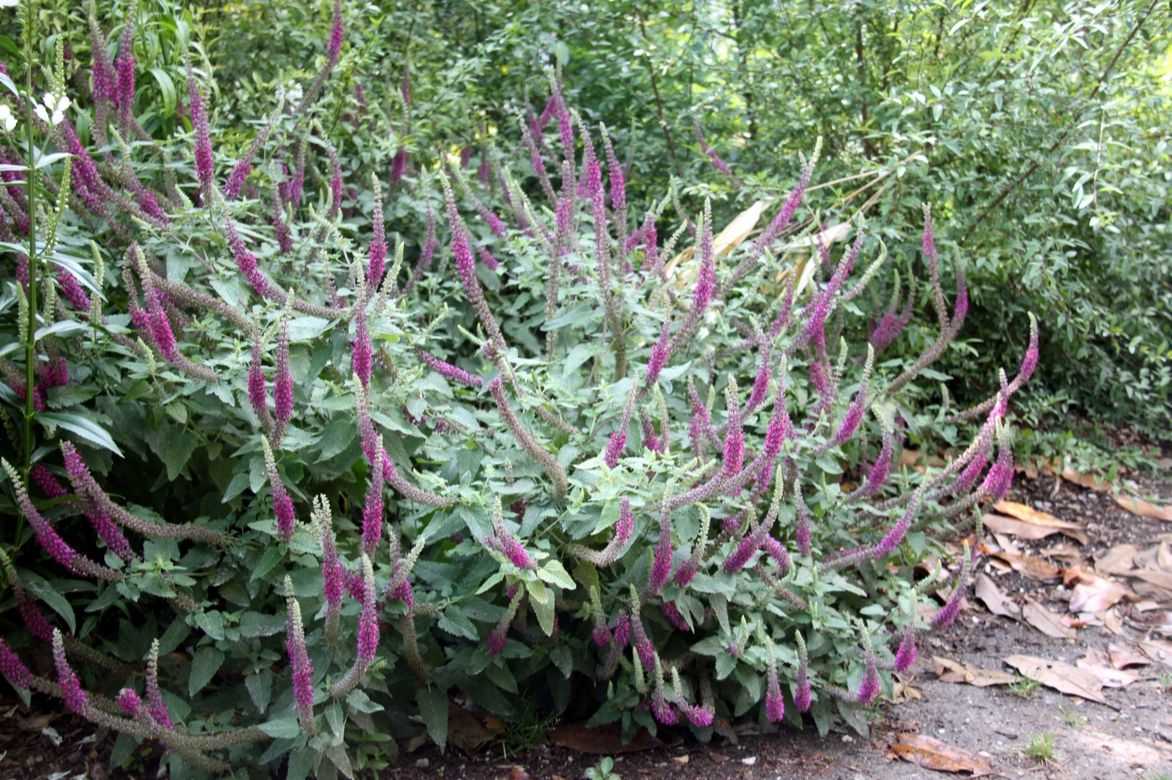
Habit and size vary by species: shrubby and somewhat untidy, reaching up to 1.4 m, even 2 m across in Teucrium fruticans, forming upright clumps about 60 cm high in Teucrium hircanicum, and very creeping and mat-forming in Teucrium chamaedrys and Teucrium x lucidrys, both 15–40 cm tall. Teucrium aroanium, one of the smallest species (8–10 cm high), makes an excellent groundcover.
Foliage is often evergreen, sometimes semi-evergreen or even deciduous, depending on climate, and grows on stems with a quadrangular cross-section that are often woody, sometimes woolly. Some germanders produce upright, heavily branched stems (Teucrium fruticans), while others (Teucrium chamaedrys) spread slowly via stoloniferous stems that root where they touch the soil.
Leaf shape, texture and colour also vary by species. Leaves are arranged in opposite, decussate pairs along the stem. They measure 3–5 cm long and are linear, oval to oblong or lanceolate, with prominent veins, entire or so strongly crenate that they resemble tiny oak leaves in dwarf germander, hence that subspecies’ vernacular name.
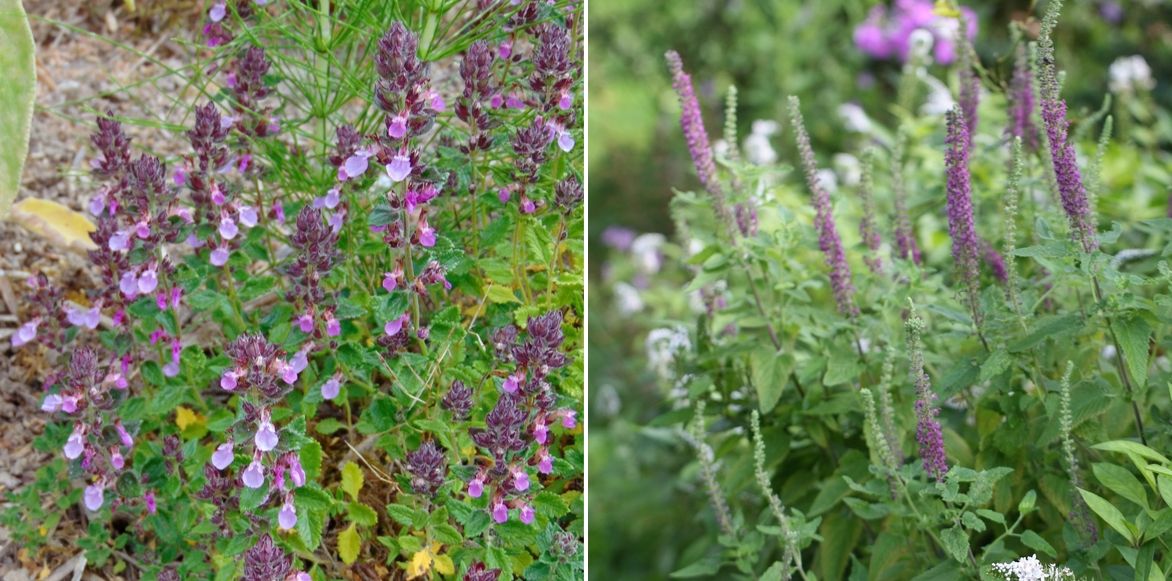
Teucrium chamaedrys / Teucrium hircanicum
Tough, glossy green above on most species, leaves are often covered with a fine down giving a bright grey‑green, silvery appearance in Teucrium fruticans. The underside is frequently covered with a thick white felt or tomentum. On some plants, leaves are slightly aromatic when crushed, emitting a scent reminiscent of hay or a slightly acrid odour.
From this mostly glabrous or pubescent, compact yet airy foliage emerge in spring (February to June, sometimes as early as December in Mediterranean areas) or in summer (June to September north of the Loire), depending on species and climate, small inflorescences typical of Lamiaceae. Grouped in 2 to 6, in racemes or spikes on the upper parts of the hairy stems, the round, downy flower buds open into bilabiate corollas about 1 cm across. These small but numerous flowers, set within a campanulate calyx, have five pointed petals fused together to form a single lower lip. The median lobe is more elongated. Each flower contains a cluster of four prominent stamens, two more exserted than the others.
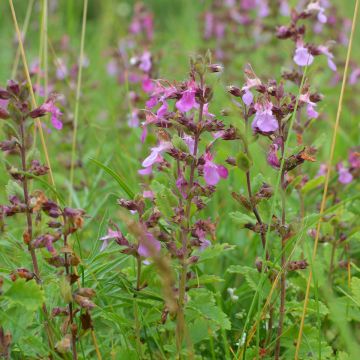
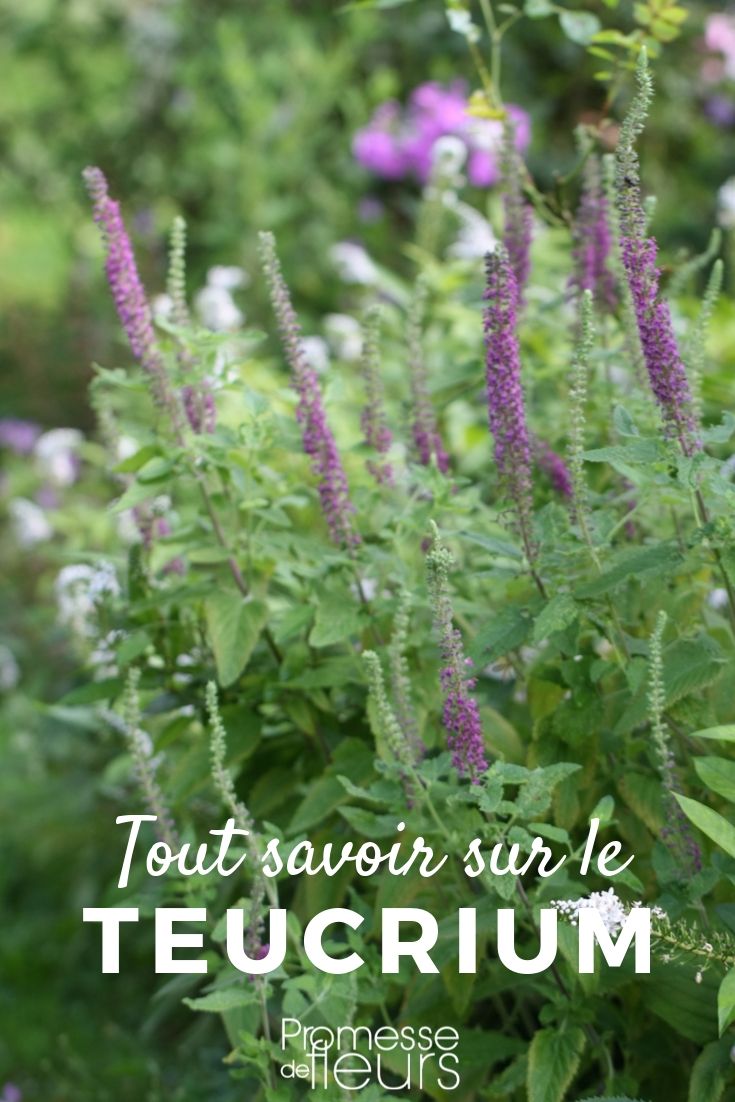
Teucrium hircanicum is notable for its long violet spikes, which can measure up to 20 cm in length.
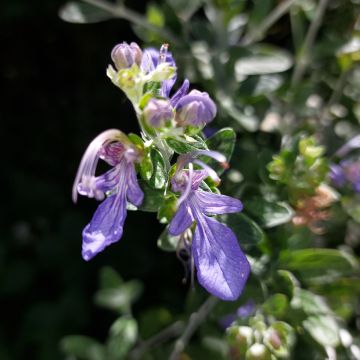
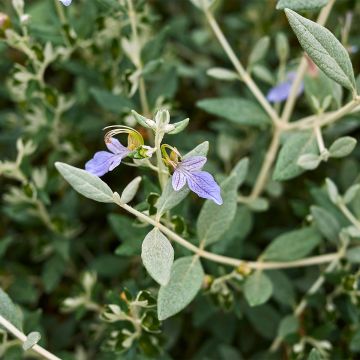
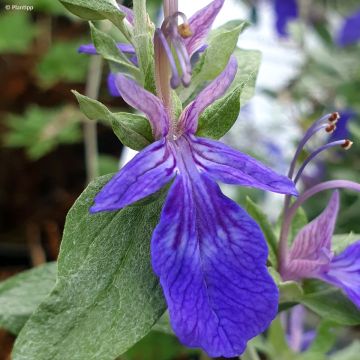
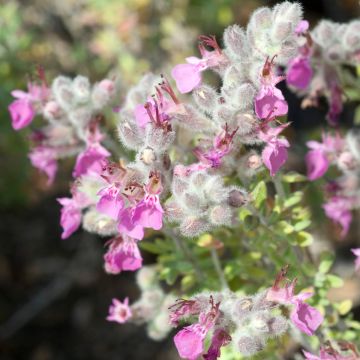
Each of these delicate little flowers opens in colours ranging from pure white in Teucrium chamaedrys ‘Alba’ to lilac‑pink, through the purple‑red of the Iranian germander, and more rarely yellow (Teucrium polium, Teucrium flavum), while the cultivar ‘Azureum’ stands out with vivid blue flowers tinged with lavender.
This delicate, highly nectariferous and melliferous flowering appears over many months and attracts pollinating insects.
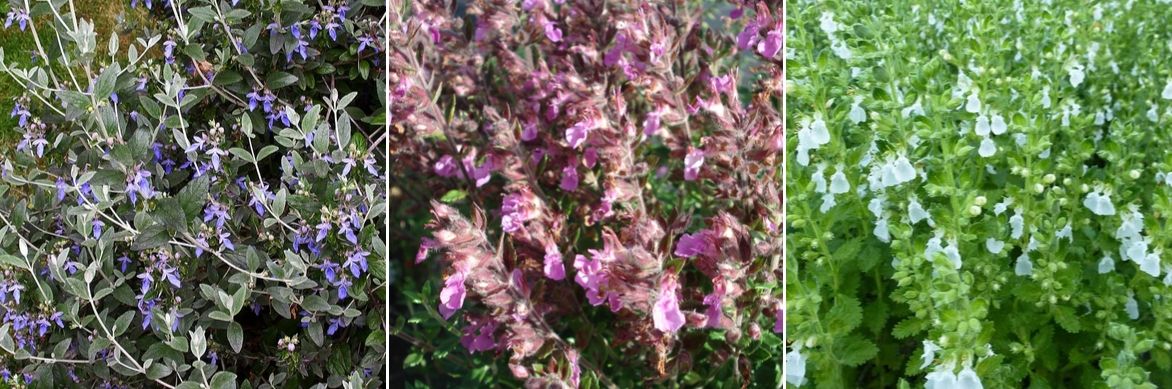
Teucrium fruticans (photo Peganum) / Teucrium lucidrys / Teucrium chamaedrys ‘Alba’
Fruits consist of four achenes containing the seeds, which can naturalise by self-seeding.
A Mediterranean plant that thrives in full sun and tolerates poor soils, Teucrium is essential in dry gardens and can withstand short frosts down to about -12°C.
Teucrium, notably the well-known dwarf germander, has antiseptic and digestive medicinal properties, and is also used to treat rheumatism and headaches. Young leaves can flavour salads, and the plant is used to impart its slightly bitter taste to liqueurs such as chartreuse and vermouth. Its dried flowering tops are used to make infusions.
Main species and varieties
In the family of Germanders, you can choose from pretty small groundcovers, robust perennials forming handsome vigorous clumps 60 to 80 cm high and shrubby species capable of reaching 2 m in height! Hardiness varies by species, as does the shape and colour of the foliage. Cultivars have expanded the palette of flower colours in Germanders, which were originally pink to purple.
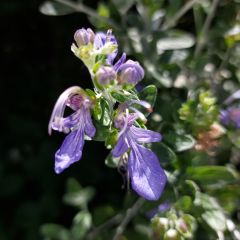
Teucrium fruticans Azureum - Tree Germander
- Flowering time March to September
- Height at maturity 1,20 m
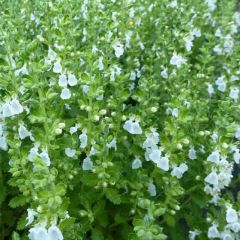
Teucrium chamaedrys Alba - Germander
- Flowering time July to September
- Height at maturity 30 cm
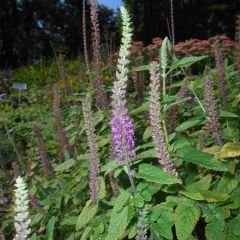
Teucrium hircanicum - Germander
- Flowering time July to September
- Height at maturity 60 cm
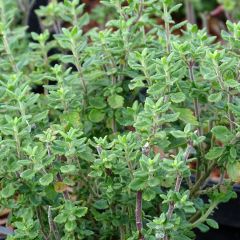
Teucrium x lucidrys - Germander
- Flowering time July to October
- Height at maturity 30 cm
Discover other Teucrium
View all →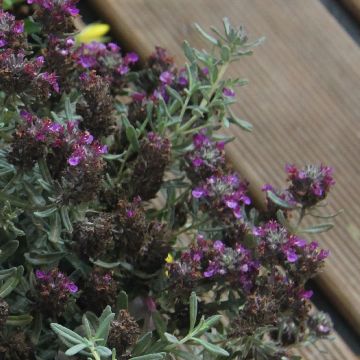
Available in 2 sizes
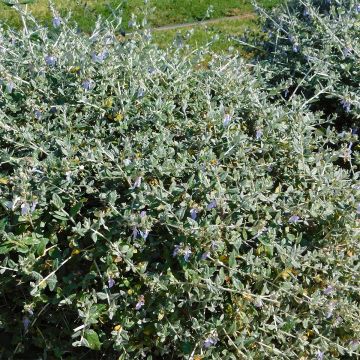
Available in 2 sizes
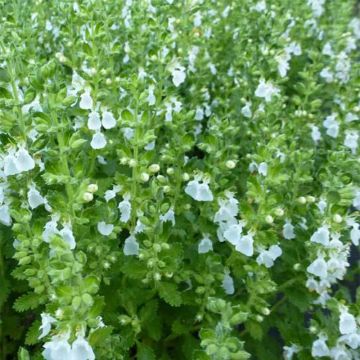
Available in 1 sizes
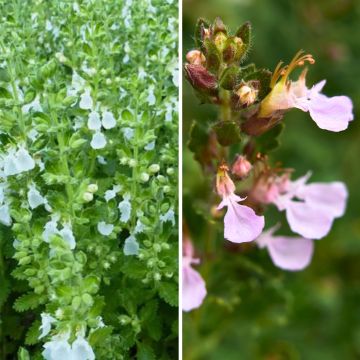
Available in 0 sizes
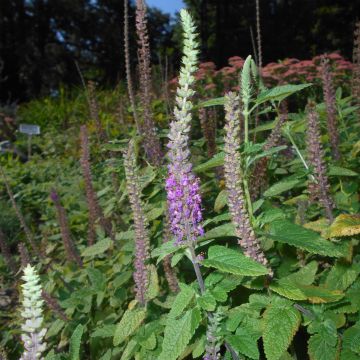
Available in 1 sizes
Available in 2 sizes
Available in 2 sizes
Available in 1 sizes
Available in 1 sizes
Available in 1 sizes
Planting
Where to plant Teucrium?
Germander is a Mediterranean plant accustomed to dry, poor and calcareous soils. It is well equipped against drought and long hot, dry summers. Most Teucrium species nonetheless tolerate cold fairly well and withstand short frosts (down to -10°C to -12°C) once established. Teucrium fruticans, slightly more tender (suffers frost from about -5°C), will do better in regions with mild winters; in our coldest, wettest areas, grow it in a pot and overwinter frost-free.
It likes full sun, which will enhance the silvery colour of some foliage and intensify its fragrance.
Native to arid regions, it prefers stony, poor, dry and calcareous soils in which it grows best, but will also accept any good garden soil provided it is very well drained: it dislikes waterlogged soils in winter, where wintering will be difficult. In heavy soils, grow on a bank or in a raised bed.
This undershrub or small perennial is an excellent plant for dry soils, forming neat glossy green or silvery clumps. It has a place in all natural gardens or as a windbreak in coastal gardens, since it is not bothered by sea spray.
Smaller species will grow on dry banks, on rockery slopes, in the crevices of an old stone wall in the most inhospitable parts of the garden and even in a pot.
Shrubby germanders are ideal for informal or clipped hedges and for shrub borders. They are perfectly suited to being pruned as topiary.
When to plant Teucrium?
Plant Teucrium in spring from February to May depending on region when temperatures rise, or in autumn from September to November in warm climates.
How to plant Teucrium?
In open ground
For creeping species allow 5 plants per m². For shrub germander, 1 plant per m² is sufficient.
- Dig a hole 2 to 4 times wider than the rootball
- Loosen the soil well
- Lighten with coarse sand
- Spread a 10 cm layer of gravel at the bottom of the planting hole
- Place plant and backfill
- Firm down lightly
- Water generously then moderately, avoiding waterlogging the roots
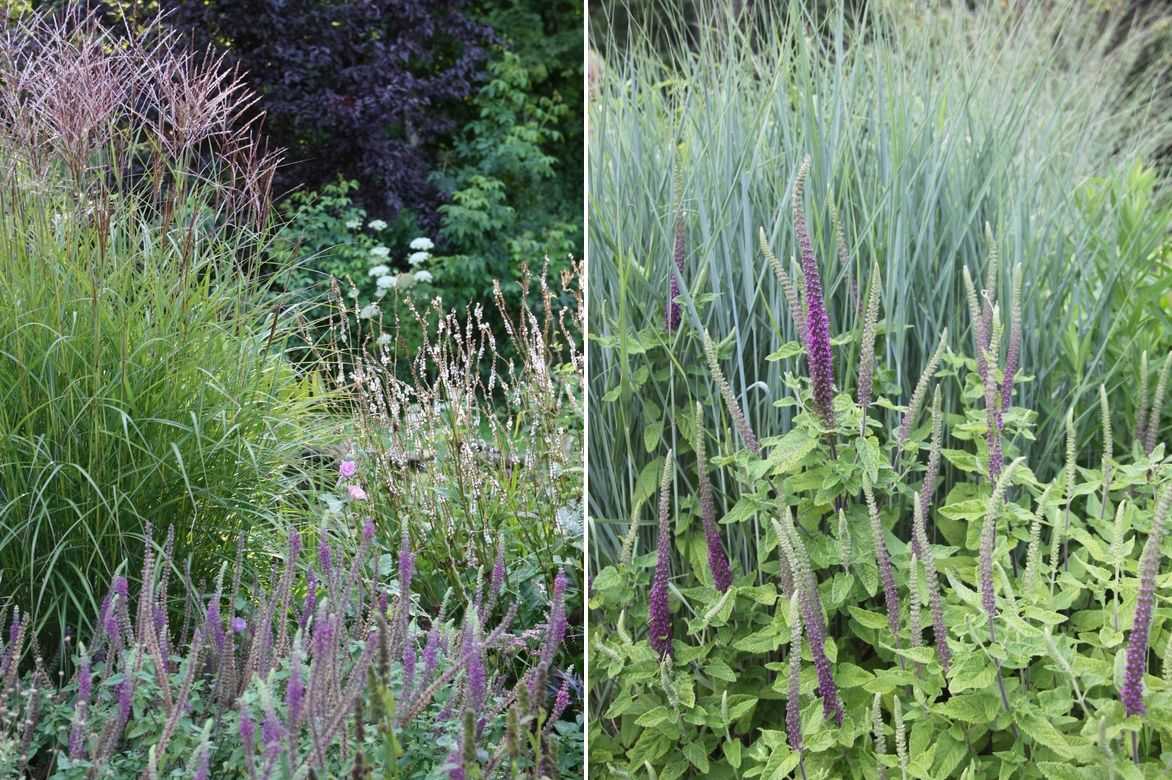
Teucrium hircanicum with grasses
In a pot
Teucrium can also be grown in a pot on a terrace or balcony, overwintered frost-free in the wettest regions. Potting mix must be very free-draining to avoid stagnant moisture around the roots: do not leave water in saucers.
- Lay a good drainage layer (gravel or clay pellets) at the bottom of the pot
- Plant in a mix of equal parts sand and compost for Mediterranean plants
- Water at planting, then sparingly
- In cold regions, move the pot indoors for winter and put it back out in spring
Maintenance, pruning and care
Teucrium is an undemanding plant that requires very little attention and is ideal for a low-maintenance weekend garden. Water for the first two months after planting to encourage rooting, then only during prolonged drought and always sparingly, as it is accustomed to the long dry summers typical of the Mediterranean climate. Once well established, let nature take its course!
Deadhead regularly to encourage new blooms and extend the flowering period. Allow a few flower tops to go to seed so you can sow them the following year.
For potted teucrium, water more regularly, always allowing the compost to dry out between waterings.
For this undemanding plant, no fertiliser is necessary.
Watch for self-sown seedlings, which are often numerous; remove them or replant them wherever you wish.
In regions with harsh, wet winters, bring the more tender teucrium such as Teucrium fruticans in from frost and rain, and put them back out as soon as temperatures rise in spring. Repot every two or three years or top-dress each spring with compost.
Resistant to disease, teucrium have virtually no pests.
Find more advice on how to care for perennial plants and how to protect your plants from cold and frost in winter.
When and how to prune?
Pruning teucrium is the only real maintenance. It is recommended each year to keep a neat, bushy habit. Annual cuts in late winter and summer prevent the formation of old wood. If left unpruned, teucrium tends to form a rather untidy silhouette. It responds well to clipping into a ball like box or as topiary. We therefore recommend two prunings:
- In spring, shear back the largest young shoots with shears to even the clump; cut fairly short and remove all dead wood
- Just after flowering, remove spent flowers by making a cleaning cut just below the flower head
Every 4 years, rejuvenate the oldest plants by cutting them back hard to three buds at the stump; they will regrow vigorously!
Propagation
Germander propagates easily in June by herbaceous cuttings or by semi‑ripe cuttings in July–August, by sowing in spring with mature seeds harvested in autumn in the garden or by layering for shrubby species, a more tedious operation.
Taking cuttings of Teucrium
- Take cuttings with a heel 5–10 cm long
- Remove leaves from lower half of stem
- Insert cuttings two‑thirds of their length into a seed tray or into pots in a free‑draining mix of equal parts potting compost and sand
- Keep in partial shade and water regularly until rooting, which is fairly quick
- In winter, protect cuttings from frost under a cold frame
- Plant out permanently the following spring
- Pinch out young shoots to encourage bushier growth
- Water well during first year after planting
Sowing
- Under cover in February–March, sow seeds in a tray containing a good seed compost and sand
- Cover seeds lightly with compost
- Firm down and keep moist until germination
- Keep seedlings in light
- Prick out seedlings into individual pots when strong enough to handle
- Plant out into ground once temperatures have risen
- Pinch out young shoots to encourage branching
By layering
- In spring, bend down a low branch
- Remove leaves from that section of stem
- Lay it in a mixture of garden soil, turf and sand
- Bury it so it can root
- In September, cut off rooted layers with pruning shear
- Pot up each shoot into a pot in a mix of potting compost and sand
- Keep over winter under a cold frame
- The following spring, plant out in garden into well‑drained soil
Pairing germander with other plants in the garden
Germander is a plant accustomed to long hot periods and naturally finds its place in dry gardens and natural gardens where the sun reigns supreme, in a scree or rockery garden alongside dry-soil plants and other Mediterranean perennials.
Teucrium fruticans, with its slightly untidy habit, will be happy as an informal or clipped hedge alongside summer-flowering shrubs as undemanding as it is: Escallonia, Vitex, Australian rosemary, Cistus, Althaea. In a natural border, you can create a lush summer display by combining it with shrubby lavateras, Caryopteris, hollyhocks, dry-soil euphorbias, Achillea millefolium, Nepeta, and a few clumps of Stipa tenuifolia and Stipa pennata. The silvery foliage of Teucrium fruticans ‘Azureum’ will be echoed by the handsome grey foliage of Artemisia, santolinas or Helichrysum italicum.
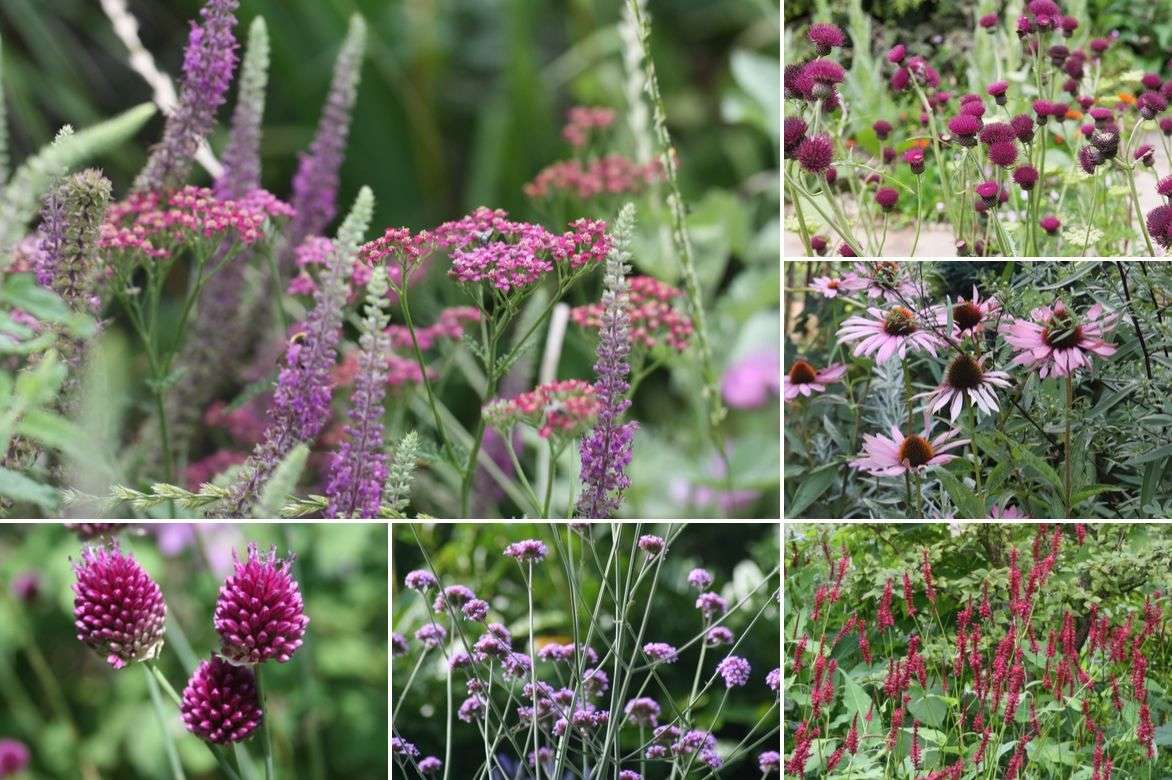
An example of a natural combination: Teucrium hircanicum and Achillea ‘Cerise Queen’, Cirsium rivale ‘Atropurpurea’, Echinacea purpurea, Persicaria amplexicaulis ‘Blackfield’, Verbena bonariensis and Allium sphaerocephalon
In a rockery evoking the garrigue, small germanders will keep company with other undemanding, drought-tolerant plants such as prostrate rosemary, Helichrysum petiolare, Perovskia, woody thymes, salvias, small potentillas, and sedums.
They also make pretty aromatic borders, paired with lavenders. The blue or violet flowers of germanders pair well with hardy geraniums or with Echinops ritro and provide a lovely contrast with the complementary yellow of coreopsis and Helianthemum.
The mat-forming species can also cover the base of ceanothus or buddleias and of Mediterranean shrubs such as prostrate broom, olive, mimosa, Cistus and lantanas, as well as small dry-soil shrubs such as Hertia cheirifolia and Hypericum olympicum.
→ Discover other ideas for combining Teucrium in our advice sheet!
Useful resources
- Discover our different varieties of Teucrium as well as a small selection of drought-resistant perennials, ideal for gardens without watering!
- What to plant in stony soil?
- All our plants for a dry garden
- Which plants for a sunny naturalistic garden?
- Subscribe!
- Contents
This form is protected by reCAPTCHA - the Google Privacy Policy and Terms of Service apply.

































Comments