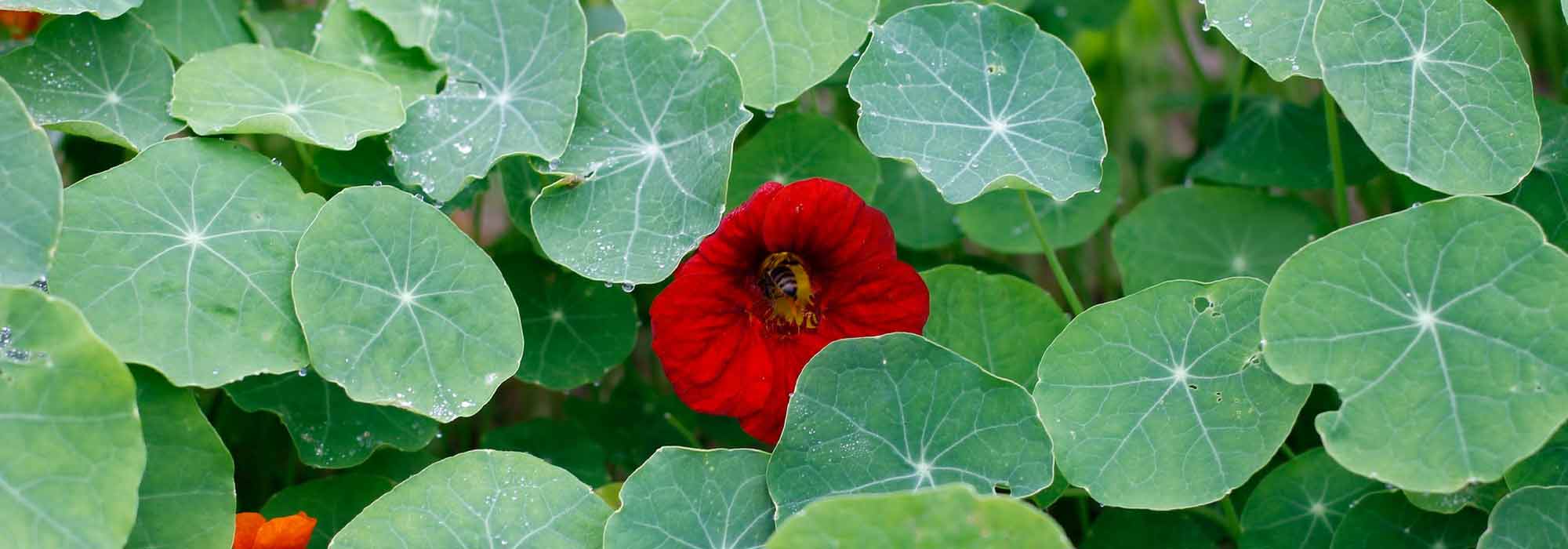
Nasturtium: planting, sowing and care
Contents
Nasturtium in a nutshell
- Climbing, trailing or dwarf, annual or perennial, nasturtium is an easy-to-grow, versatile flower that blooms abundantly all summer, even in pots from which it will spill over exuberantly
- This frost-tender plant only fears frosts and is most often grown as an annual in our regions; however, there are a few little-known perennial species!
- Its trumpet-shaped flowers and pretty round leaves lend an exotic touch to borders or any support they’re given
- Impossible to miss, it grows easily everywhere: it’s the ideal plant for beginner gardeners and children!
- Leaves, flower buds and flowers are edible and can liven up summer salads!
A word from our expert
Nasturtium has it all! It is very easy to sow or plant, grows quickly, flowers from June until first frosts, spreads freely to cover the soil, dress a border or scramble up any available support. In short, nasturtium is versatile!
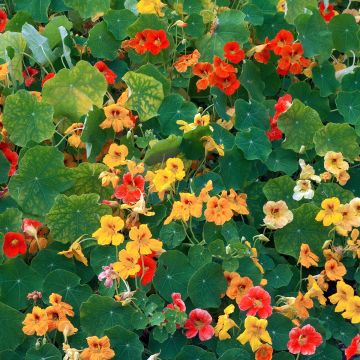
With its beautiful round leaves above which proud flowers in bold reds, oranges and yellows emerge, it always brings freshness and cheer.
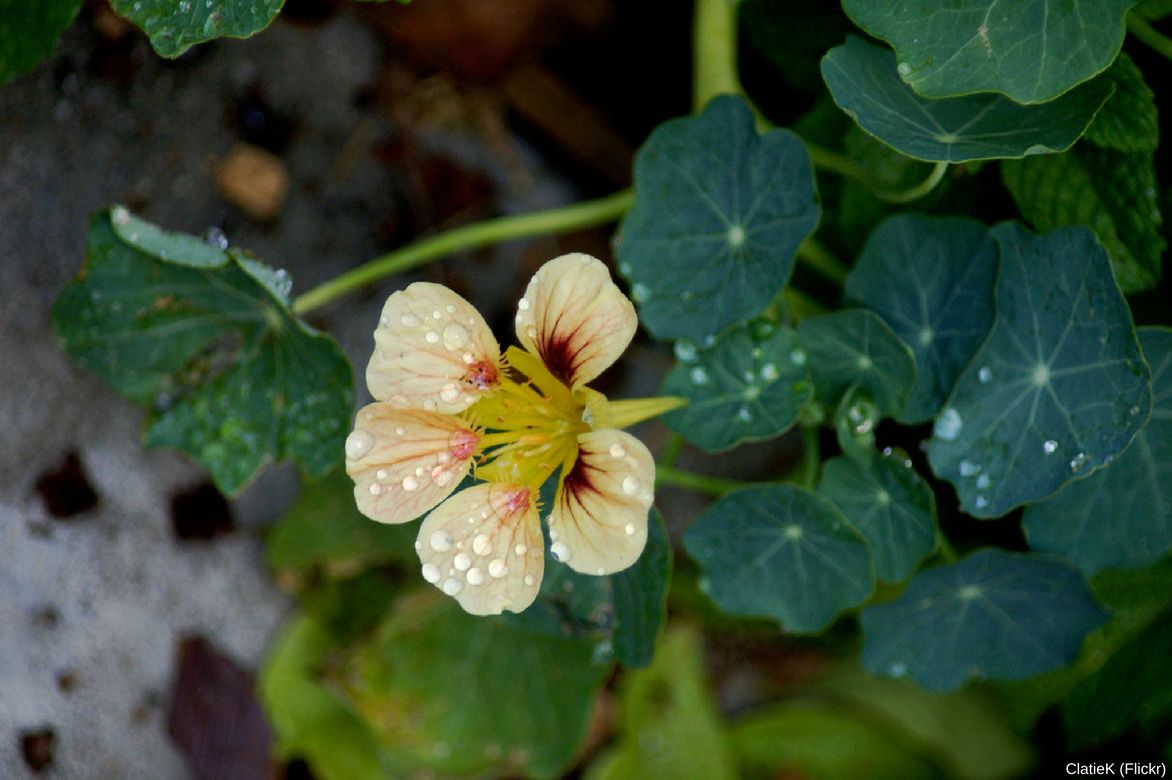
Nasturtium flower in an irresistible colour.
To top it all, its edible flowers and leaves are delicious in salads and its flower buds can be pickled in vinegar like capers!
Alongside annual climbing nasturtiums such as the Garden Nasturtium (Tropaeolum majus), which can reseed year after year, there are perennial nasturtiums unfairly little known such as the tuberous nasturtium grown like a potato, Tropaeolum ciliatum, a frost-tender nasturtium, and Tropaeolum speciosum, the Elegant Nasturtium, best grown in milder regions.
All are easy to sow or plant and grow in full sun, content with any soil, even poor ones.
What’s more, nasturtium is one of the must-have plants in the vegetable garden: it’s a genuine aphid trap, attracting aphids like a magnet!
Don’t deprive yourself of this lovely accessible to all plant and treat yourself to our unique collection of annual nasturtium seeds and nasturtiums in plug plants!

Description and botany
Botanical data
- Latin name Tropaeolum
- Family Tropaeolaceae
- Common name Nasturtium
- Flowering June to autumn
- Height 0.1 to 4 m
- Exposure Sun, partial shade
- Soil type Any, well-drained
- Hardiness -5°C to -15°C depending on species
Nasturtium or Tropaeolum is an annual or perennial plant native to Central and South America, belonging to family Tropaeolaceae. There are 80 to 90 species growing wild in cool mountainous areas. Two groups of nasturtiums are distinguished: dwarf and climbing types.
The large nasturtium (Tropaeolum majus), introduced to Europe as an edible plant under the name “Peruvian cress”, is the best known and most widely grown in gardens. It has produced many cultivars, as have Tropaeolum minus and Tropaeolum majus nanum (a semi-dwarf form), the dwarf nasturtiums.
Among nasturtiums grown as annuals in our climates, the Canary nasturtium (Tropaeolum peregrinum) is sometimes seen; an unusual variety with foliage and flowers very different from its relatives.
However, genus includes some perennial species little known in France, such as the tuberous nasturtium (Tropaeolum tuberosum), a botanical species and ancient vegetable cultivated in the Andes for its edible tubercle. The Tropaeolum ciliatum is a bulbous, non-hardy nasturtium. Tropaeolum speciosum, the flame nasturtium, is a climbing perennial from Chile far less common because more difficult to grow. Tropaeolum tricolorum is another climbing perennial with an early spring flowering.
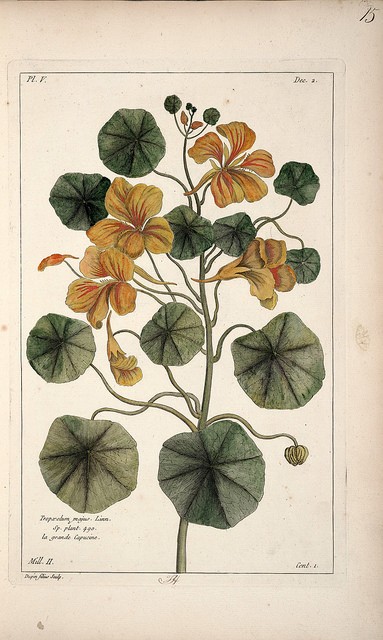
Tropaeolum majus – botanical illustration
Size varies by species; plants are dwarf or climbing and twining. Large nasturtium (Tropaeolum majus) or “garden nasturtium”, the tuberous nasturtium and Tropaeolum peregrinum are climbers reaching easily 2.5 m and more within a few months. Tropaeolum ciliatum can climb at least 3 to 4 m, while dwarf varieties such as Tropaeolum minus have a compact habit and will not exceed 40 cm in height but form low clumps up to 1.5 m across.
Whether annual or perennial, they all show rapid growth.
Leaf petioles coil so plants readily climb any supports provided (wire mesh, fences, arbors, branches…), and without gardener intervention nasturtiums will spread as an all-terrain groundcover. In a pot, they make an elegant trailing plant.
The perennial nasturtium (like the tuberous nasturtium appreciated in cooking) is rhizomatous, developing from large fleshy tubercles sometimes knobbly in pearly white or yellow tinged with purple. Like potato, it forms strings of tubercles that multiply quickly and are eaten cooked, as crudités, or preserved like gherkins.
In annual species, root system is shallow and not long-lived: small tubercles the size of peppercorns die quickly when winter arrives. However, in mild regions nasturtiums self-seed from year to year very easily.
Nasturtium sends out slender brittle stems that climb by twining around any support, thanks to long leaf petioles, somewhat like Clematis. Most nasturtiums have typical foliage: attractive leaves, deciduous or semi-evergreen in mild climates, 2 to 7 cm across, rounded (peltate) with wavy margins, borne on a central petiole and divided into 5 to 7 rounded lobes.
In Tropaeolum speciosum and Tropaeolum ciliatum leaves are palmate and cut into uneven, pointed rounded lobes.
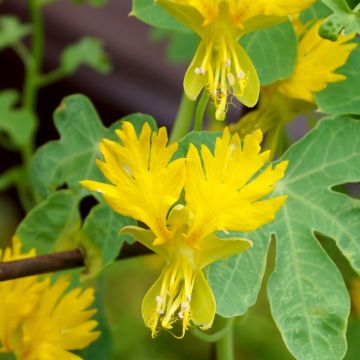
Canary nasturtium stands out with distinctive mid-green foliage composed of palmatisect leaves, like fig leaves.
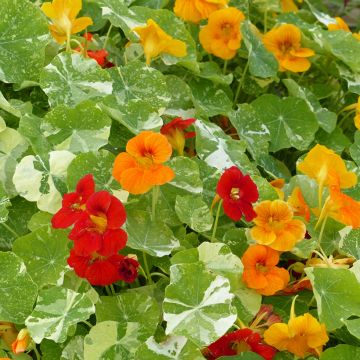
Leaves may be dull, acid green, very dark bronze-green to blue-grey green often crossed by finer, paler veins. Some cultivars such as ‘Alaska’ show variegated foliage, marbled with cream.
Young tender leaves of nasturtiums are edible and can be eaten raw: they have a
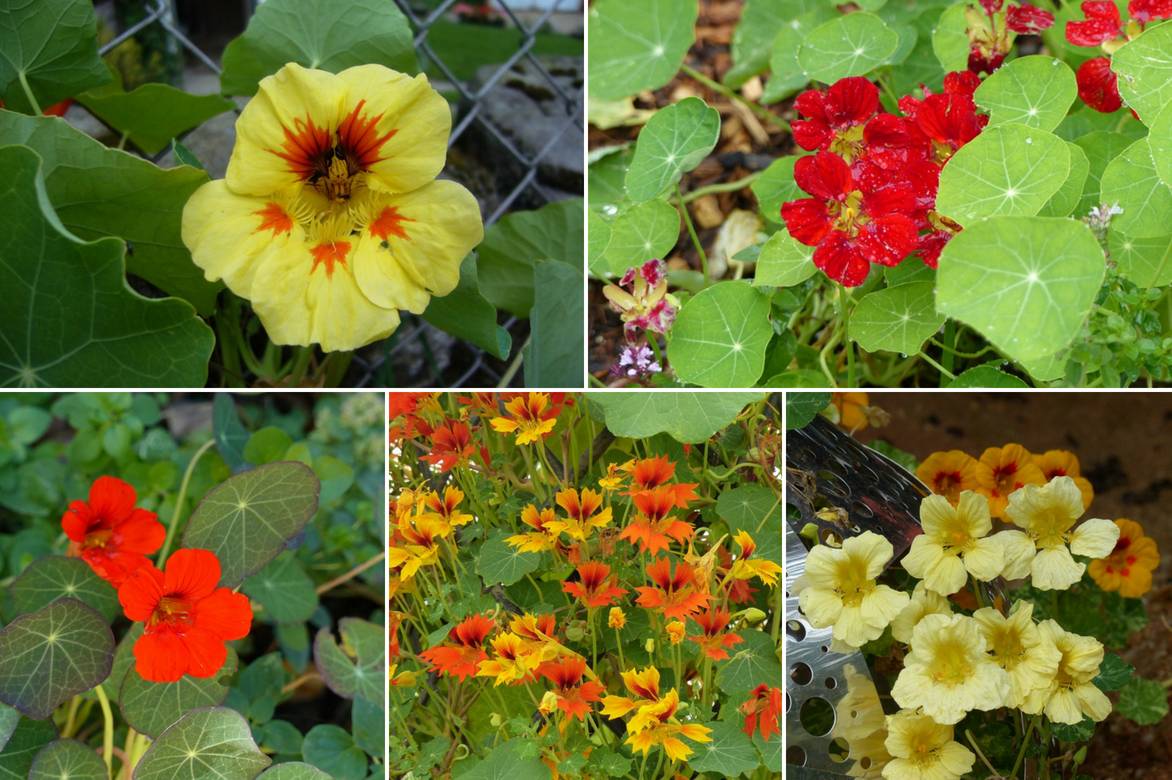
Nasturtium flowers offer a wide palette of colours and petal shapes that are out of the ordinary: Tropaeolum ‘Banana Split’, Tropaeolum ‘Scarlet Emperor’, Tropaeolum ‘Impératrice des Indes’, Tropaeolum ‘Phoenix’, Tropaeolum ‘Milkmaid’.
Highly graphic, these ever-fresh leaves add luxuriance and showcase the exotic colours and shapes of the flowers. Nasturtium is valued for original, long flowering that continues from May to September, sometimes until first frosts.
Flowers sit proudly above generous foliage and, depending on species, can be hidden by a mass of leaves.
Pretty funnel-shaped flowers 1 to 7 cm in diameter open singly in leaf axils. In most nasturtiums they consist of 5 rounded petals with fine attachments, irregular and often
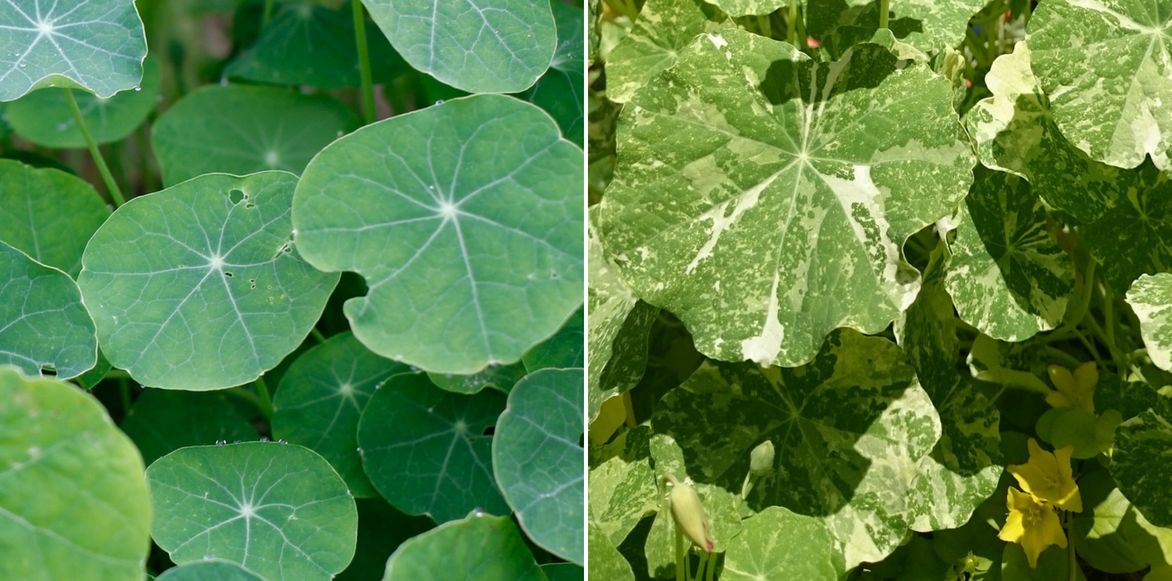
Nasturtium foliage: green or variegated
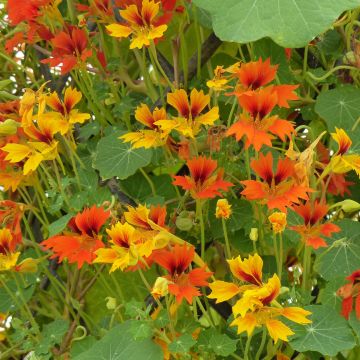
In some cultivars petal shapes differ. Tropaeolum minus ‘Phoenix bears deeply cut, ciliated petals resembling flames. Canary nasturtium displays feathery flowers with prominent stamens like golden butterflies, while tuberous nasturtium has tubular flowers on a long curved peduncle. Tropaeolum tricolor bears small blood-red flowers with a yellow centre surrounded by a purple ring.
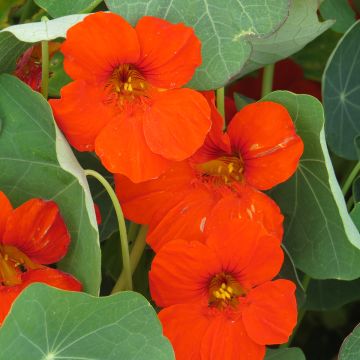
Most flowers show bright fire-like hues, from classic vivid vermilion to deep red and peachy orange, to cream-white recalling fresh butter and canary yellow. Many cultivars differ by corolla pattern: solid, speckled or delicately veined.
Some nasturtium flowers are remarkable; ‘Black Velvet’ is an almost black mahogany, ‘Chameleon’ produces numerous blooms shifting from cream splashed with red, reminiscent of some orchids.
They give off a light daffodil-like scent, stronger in mornings and evenings. Spurs filled with nectar attract pollinating insects throughout season.
Edible, these vitamin C-rich flowers add colourful, peppery flavour to salads and can even be eaten in savoury fritters!
After flowering, flowers turn into globular 3-chambered fruits (triachenes) with ridges containing a large seed the size of a chickpea that can be pickled as a vinegar condiment like capers, as can the flower buds.
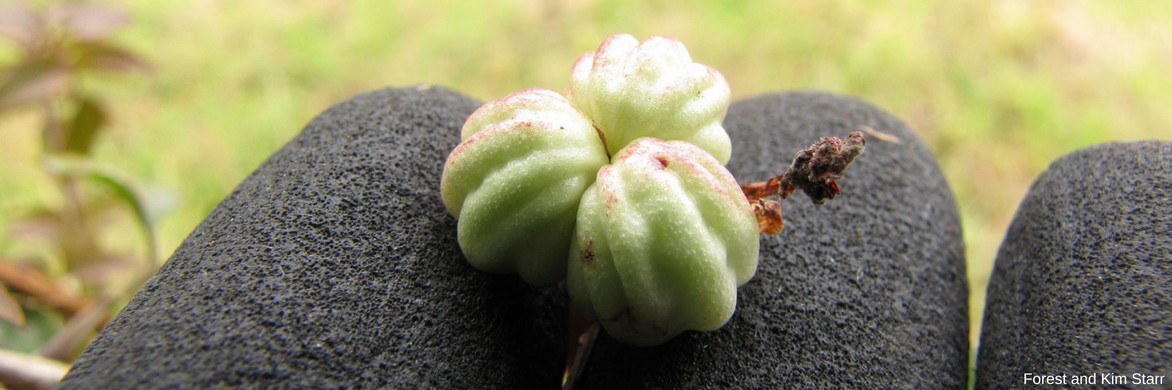
Fruit of nasturtium.
Hardy annual nasturtium thrives in all soils, even poor ones. It prefers sun but tolerates light shade. Extremely easy to grow, it is ideal for gardening for beginners and children!
Non-hardy perennials (Tropaeolum speciosum, tuberous nasturtium) are usually grown as annuals in our country, to be lifted and stored in a greenhouse at first frosts or reserved for regions with mild winters, due to low frost tolerance (down to about -10°C).
Nasturtium develops very quickly to cover a trellis, pergola or framework in a few weeks. Left free without support, climbing nasturtium will form an original groundcover in borders or the centre of an annual bed. It can also be grown in pots or hanging baskets, where it makes a blazing trailing display on terraces and balconies.
Large nasturtium used in cosmetics for toning properties is included in haircare products.
Main species and varieties
When talking about nasturtiums, one immediately thinks of tender annual nasturtiums such as our common large nasturtium (Tropaeolum majus), known for hooded red, yellow or orange flowers and for their characteristic round leaves in bright green or bluish green. It has given rise to Lobb’s Hybrid, very vigorous and floriferous, to numerous varieties—some dwarf, others trailing—and to the ‘Alaska’ series, indispensable compact dwarf annuals.
Less commonly grown, the Canary nasturtium (Tropaeolum peregrinum) is also an attractive, vigorous annual climber and very easy to grow.
Perennial species such as the tuberous nasturtium (grown for its edible tuber), tropaeolum speciosum, tropaeolum tricolorum and tropaeolum ciliatum (the hardiest) are unjustly little known. Less common in our gardens, they are nonetheless as floriferous but more delicate to grow, being semi-hardy and surviving in open ground only in mild climates.
Whether climbing and twining, sometimes up to 4 m high, or an adorable dwarf nasturtium, queen of borders and summer pots, choice of a nasturtium depends on intended use and on your climate.
Alongside famous Tropaeolum majus ‘Impératrice des Indes’ with scarlet flowers, annual nasturtiums come in numerous varieties differing in flower colour, plain or streaked, ranging from mahogany to cream-white. Some, such as Tropaeolum majus ‘Alaska’, are even distinguished by very bright cream-variegated foliage.
Tropaeolum Tom Thumb - Dwarf Nasturtium seeds in a mix
- Flowering time July to November
- Height at maturity 35 cm
Tropaeolum tricolor
- Flowering time May to August
- Height at maturity 2 m
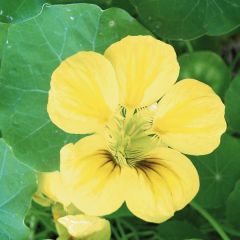
Tropaeolum ciliatum - Yellow Flame Flower
- Flowering time August, September
- Height at maturity 4 m
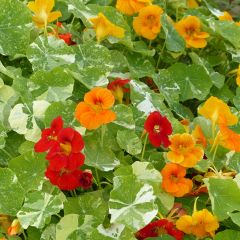
Tropaeolum majus - Nasturtium Alaska Mix Seeds
- Flowering time July to November
- Height at maturity 30 cm
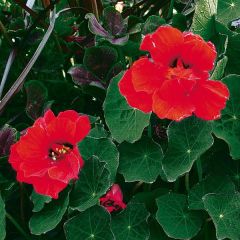
Tropaeolum majus 'Red Wonder'
- Flowering time June to November
- Height at maturity 2 m
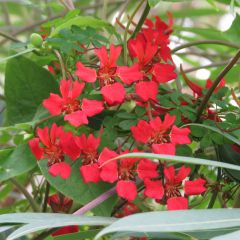
Tropaeolum speciosum
- Flowering time August to November
- Height at maturity 3 m
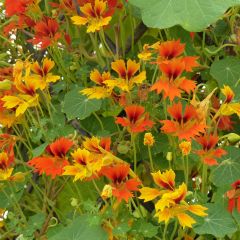
Dwarf Nasturtium Phoenix Seeds - Tropaeolum minus
- Flowering time July to November
- Height at maturity 30 cm
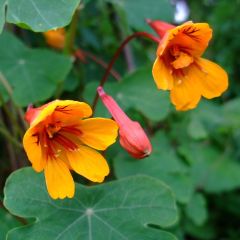
Tropaeolum tuberosum Ken Aslet
- Flowering time August to October
- Height at maturity 2 m
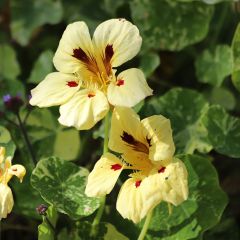
Tropaeolum majus Cream Troika - Nasturtium Seeds
- Flowering time July to October
- Height at maturity 20 cm
Graines de Capucine naine Milkmaid - Tropaeolum majus
- Flowering time July to November
- Height at maturity 30 cm
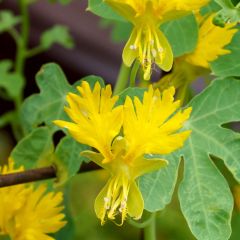
Tropaeolum peregrinum - Canary Naked Seeds
- Flowering time July to November
- Height at maturity 30 cm
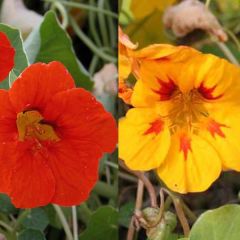
Collection of 5 Nasturtiums (Tropaeolum majus)
- Flowering time June to November
- Height at maturity 2 m
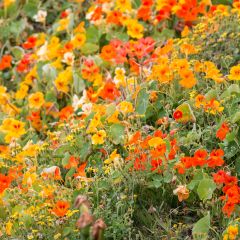
Tropaeolum majus Single-Flowered Mix - Trailing Nasturtium Organic Seeds
- Flowering time July to November
- Height at maturity 2,50 m
Discover other Nasturtium
View all →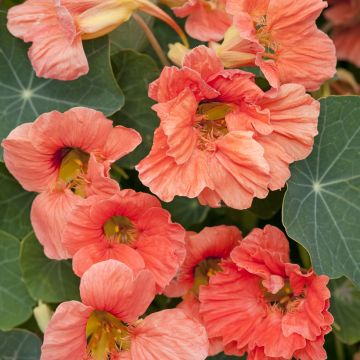
Available in 1 sizes
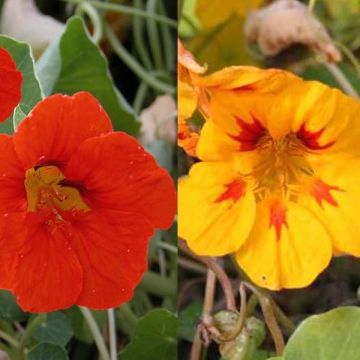
Available in 0 sizes
Available in 1 sizes
Available in 1 sizes
Available in 1 sizes
Available in 1 sizes
Available in 1 sizes
Available in 1 sizes
Available in 1 sizes
Available in 1 sizes
Planting
Where to plant and sow nasturtiums
Most nasturtiums do not tolerate frost, which is why, in our climates, they are grown as annuals in open ground. In cold regions you will need to re-sow or replant them the following spring. In mild-winter regions, nasturtiums will self-seed naturally from year to year very easily.
Some non-hardy perennial species such as the elegant nasturtium (Tropaeolum speciosum) can be grown in open ground wherever frost is not severe (down to -5°C) or in a heated greenhouse elsewhere, where you can grow it all year round.
Tropaeolum ciliatum is one of the few frost-resistant nasturtiums, hardy down to -15°C, and can remain in place all winter: it will regrow from the crown if aerial parts have been damaged by winter. This species also undergoes a summer dormancy, losing its foliage but looking splendid again from autumn.
The tuberous nasturtium is not very hardy and must be lifted and stored at first frosts, like a dahlia.
Undemanding, nasturtiums grow quickly and well in sun but will tolerate light shade, provided they are sheltered from strong winds (stems are brittle), and they will grow in any soil type. They prefer ordinary soil; soil that is too rich will encourage foliage at expense of flowers.
Canary nasturtium and elegant nasturtium will bloom profusely if their roots are kept cool and their young shoots are placed in full sun.
Very floriferous and fast-growing, they can reach 2 m in a single summer; nasturtiums are an excellent choice as climbers as well as for groundcover. In open ground, when not trained on a support, they form a handsome bushy mass at front of a border, on an edging or spilling over a low wall.
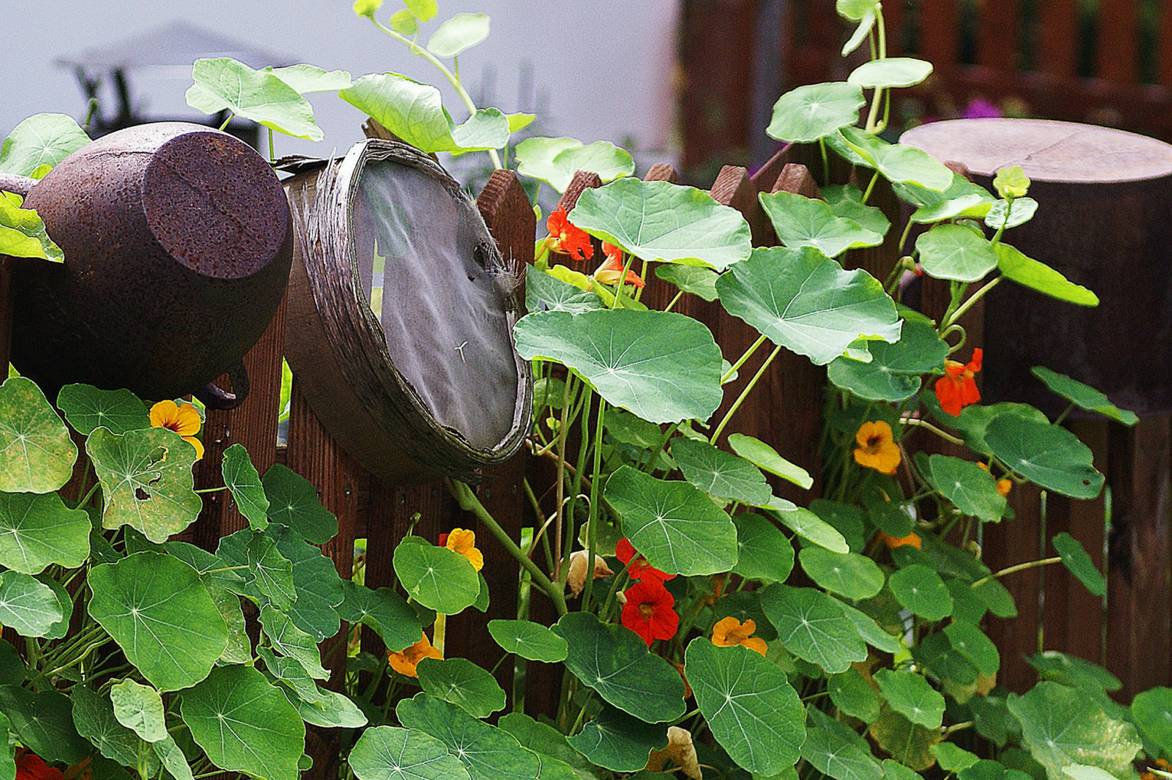
Nasturtiums make a pretty addition to a wooden fence.
Annual climbing nasturtiums are perfect for dressing a wire fence quickly and creatively, flowering a hedge, or adding elegant cover to an arbour or pergola.
Dwarf varieties will rapidly form a wide carpet, create flowered borders and can also be grown in pots, window boxes or hanging baskets, from which they will cascade with leaves and flowers.
Edible, nasturtium also has a place in vegetable gardens, where it has the added benefit of attracting aphids away from your vegetables!
When to plant nasturtiums?
Plant our young nasturtiums in mini-plugs and our tubers in open ground only once frost risk has passed and soil is well warmed, from late April to May.
How to plant nasturtiums
Planting in open ground with our nasturtiums in mini-plugs
Our green plants supplied in trays of 5 mini-plugs are sturdy enough to be planted in open ground as soon as frost risk is definitely over. Until then, pre-cultivate them in pots in a warm bright place to speed growth. Space plants about 50 cm to 1 m apart for climbing types and 30 cm for dwarf nasturtiums.
Offer a support to climbing nasturtiums at planting around which they can climb, but you can also let them cover the soil if you have enough space.
- Dig a hole 2 to 3 times wider than the plug
- Spread a handful of grit to improve drainage
- Place the mini-plug in centre of hole, collar at soil level
- Backfill with excavated soil mixed with a little potting compost
- Firm down with your foot
- Water regularly until established, then water only in prolonged dry spells
Planting tubers of tuberous nasturtium
Tuberous nasturtium is a very old vegetable with surprising flavour, as well as an attractive plant! It suits vegetable plots. Tubers are harvested 6 to 7 months after planting, in autumn. Supplied as bulbs, tuberous nasturtium and Tropaeolum ciliatum can be planted in pots or in open ground as soon as frosts are no longer expected, from April to May depending on climate. Tropaeolum ciliatum should be left in place. They will flower after one year of cultivation. Slightly more demanding than annual nasturtiums, they prefer cool, light, friable, well-drained soil.
- Plant bulbs 10 cm deep in well-worked soil enriched with potting compost
- Water generously at planting
- Lift tuberous nasturtium tubers before frosts and store frost-free in soil or potting compost
Growing nasturtiums in pots
All annual nasturtiums and some tender perennial species are suitable for growing in pots or hanging baskets. Growing nasturtiums in pots is as easy as growing them in open ground. Dwarf or semi-dwarf forms are ideal. Tender perennials should be put into storage at first chills or kept in a heated conservatory throughout the year.
- Plant in a rich, well-draining mix made of one third geranium potting compost, one third fine grit and one third garden soil
- Train stems of climbers if necessary
- Water generously, keeping substrate slightly moist
- Feed regularly every 8 days
- Place in sun
- Reduce watering in autumn
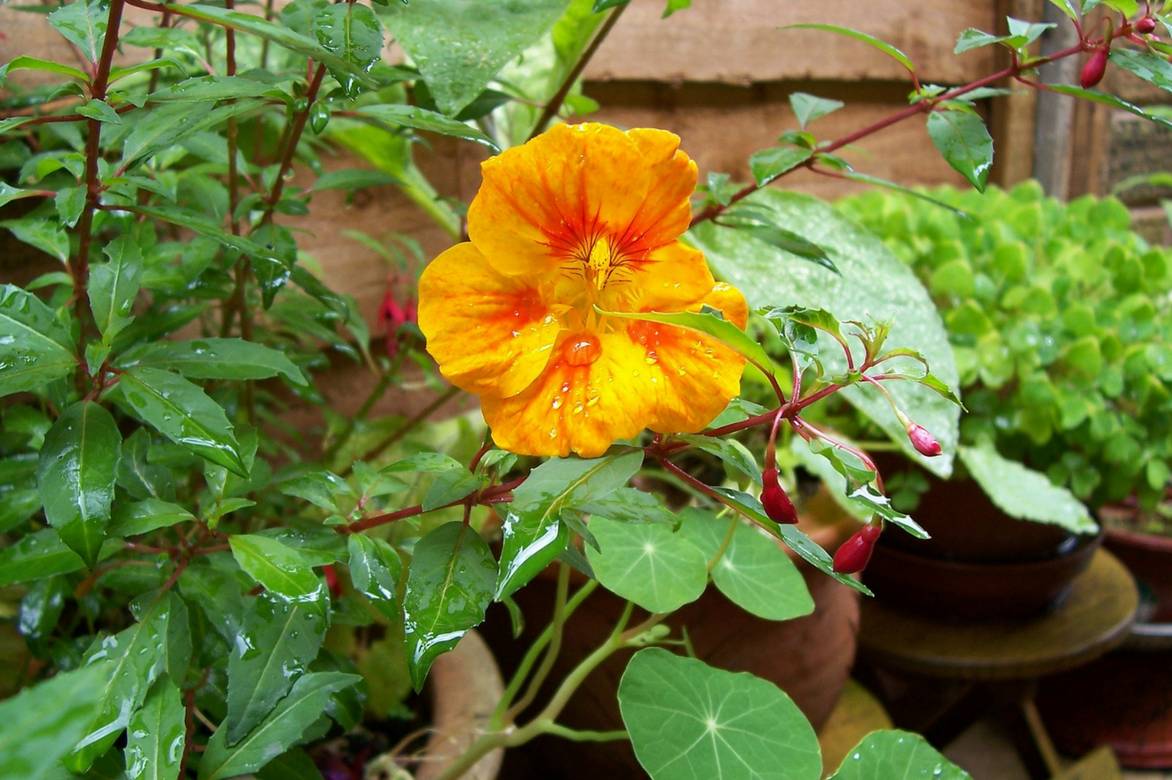
Nasturtium grown in a pot, with a fuchsia.
→ Discover our advice sheet on 6 climbers to grow in pots on a west-facing balcony
When and how to sow and germinate nasturtium seeds
When to sow nasturtium seeds?
Nasturtium seeds can be sown under cover at between 13 and 16 °C, from February (or in September) in pots or seed trays, or directly outdoors at their final position, from March to May.
Under cover
Early sowings produce very fine plants for the growing season. Choose from our unique collection of nasturtium seeds!
- In March–April, under cover at a temperature of 15–20 °C, sow 3 to 5 seeds per pot into a moist, free-draining seed compost
- Cover seeds to a depth of 2 cm and top with a thin layer of compost
- Place trays under a mini greenhouse or enclose in a plastic bag
- Firm down lightly and keep in light until germination
- After 3 weeks, prick out young plants into seed trays or 8 cm pots
- In May, when soil has warmed and risk of frost has passed, plant out in garden, in pots or planters using good potting compost
- Provide support if you want them to twine around it
Sow nasturtium seeds directly in open ground
From late April to May, after frosts and when soil is well warmed, sowing nasturtium seeds is child’s play! Sow in full sun on well-drained, well-prepared soil.
- Sow in clusters of 4 or 5 seeds at 6 mm depth in the same hole, spaced 30 cm apart, or in rows spaced 30 cm apart
- Cover seeds with a layer of soil about ten centimetres thick without firming too much
- Water soil regularly and lightly to aid germination (between 7 and 12 days)
- Thin out to leave one vigorous plant every 30 cm
→ Also see our tutorial: How to sow nasturtiums?
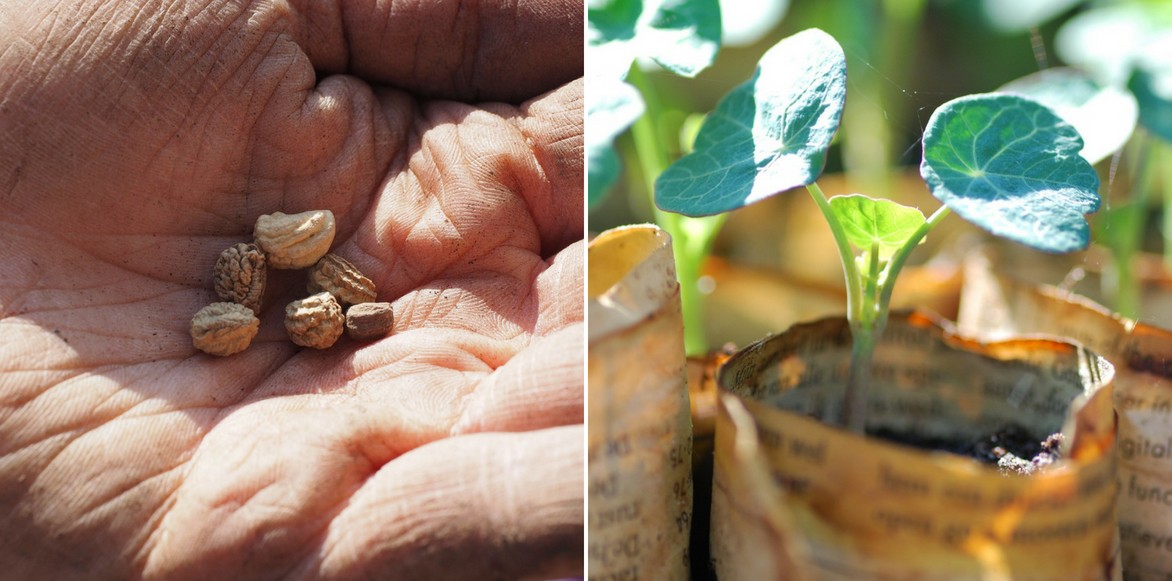
Nasturtium seeds and seedlings.
Care and maintenance
annual nasturtium is really low maintenance, only vulnerable to severe frosts. It dies at the first hard frost. Its minimal requirements make it a truly easy plant for amateur gardeners and children.
From early autumn, pull up dried, yellowed clumps after flowering. Take the opportunity to collect the seeds, which you can re-sow the following spring.
Plant out young nasturtium plants each year unless you get frequent self-seeding, common with these easy-to-grow annuals. You only need to remove overcrowded plants.
For climbing varieties, stake your plants as soon as they are planted in ground or in pots: their growth is very rapid, they can gain 30 cm per week.
Water regularly to help the plant establish; thereafter only water during periods of severe drought.
Remove faded flowers regularly to encourage repeat flowering.
Do keep an eye on the development of perennial nasturtiums left in the ground in mild climates, as they can become invasive and spread everywhere: after flowering, simply cut back the stems when they start to get out of hand.
Water nasturtiums grown in pots more frequently.
As winter approaches, move potted perennial nasturtiums into a greenhouse or conservatory where temperature will not fall below 10°C.
For the tuberous nasturtium, increase the harvest of tubers by earthing up the stems, a little like for a potato plant. Lift the bulbs at the first frosts, as they cannot tolerate temperatures below -5°C, and store them frost-free, in a cellar in sand or fresh compost so they do not dry out.
Potential pests and diseases
nasturtium is very often prey to black aphids that it irresistibly attracts; they then desert all neighbouring plants. It’s a biological aphid trap. It is used as a “trap plant” in the vegetable patch near vegetable plants or in the garden around roses to divert them naturally. Spray with diluted black soap to eliminate aphids if you find their presence unsightly and follow our advice to tackle them naturally.
Tuberous nasturtium, as well as nasturtium ciliatum, are not affected by aphids.
Slugs love young tender leaves; discover our slug control solutions!
It also attracts caterpillars of the cabbage white, which tunnel through the leaves. Make tansy decoctions to eliminate them.
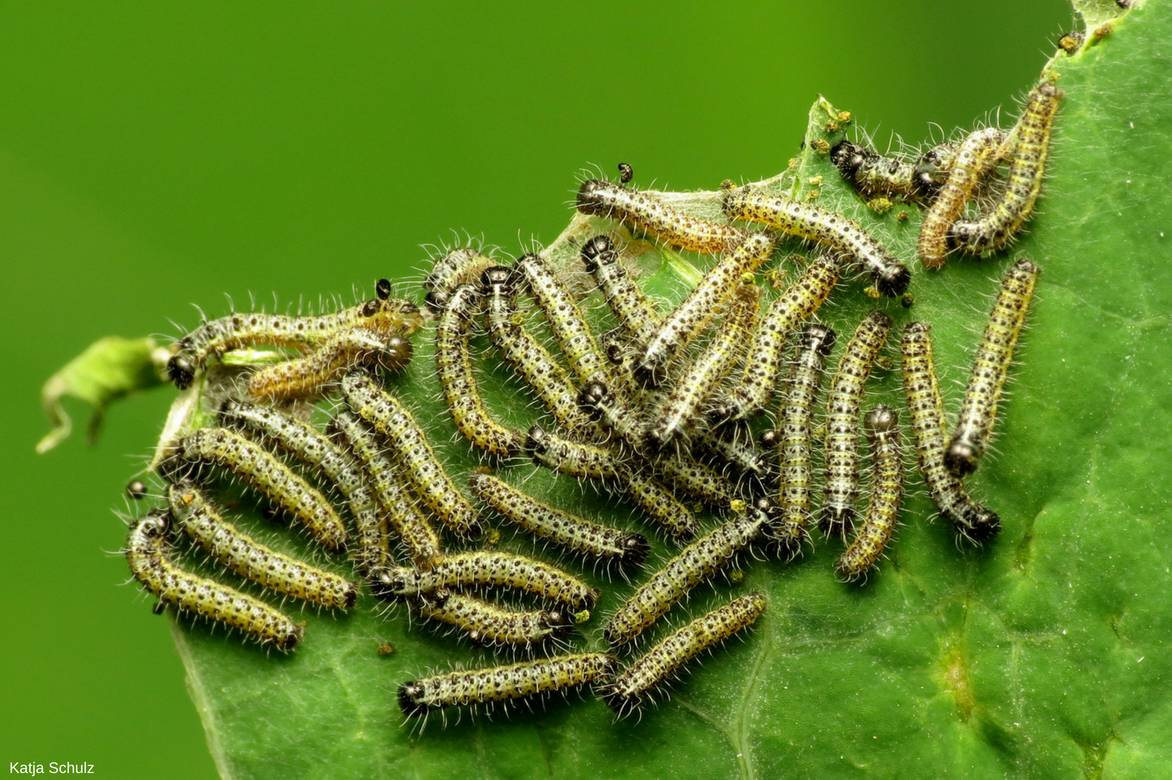
Pierid caterpillars feast on nasturtium leaves.
Propagation
Les annual nasturtiums self-seed here and there in regions where it doesn’t freeze severely. You can also collect the seeds in autumn, leave them to dry until they are shrivelled to re-sow them the following spring. It is also possible in August or September to try taking a few nasturtium cuttings.
Taking a nasturtium cutting
- Choose healthy stems about 10 cm long
- Plant them in a tray of compost
- Cover with plastic
- Keep cuttings frost-free in a greenhouse or conservatory
- Pot on the following spring
Companion plants for nasturtiums
Voluble or creeping, nasturtium is a beautiful plant with warm, vibrant colours that adapts to every desire, in-ground or in a pot. In a few weeks it adds a touch of the exotic to even the most formal displays. Enjoyed in all gardens for its exuberance, striking graphic foliage and long flowering of fiery colours that blends with foliage and flowers of neighbouring plants.
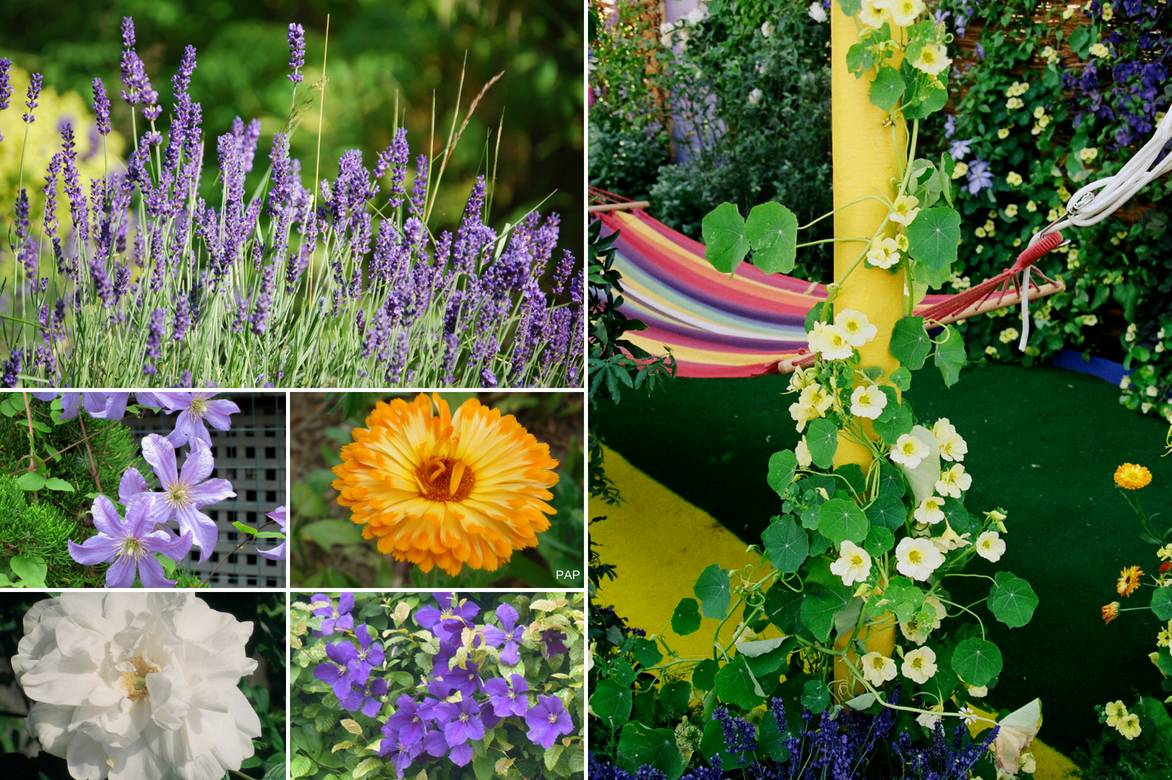
An example of a pairing: pale-yellow nasturtium such as Tropaeolum majus ‘Milkmaid’, Lavandula angustifolia ‘Hidcote’, Clematis ‘Prince Charles’, Calendula officinalis, rose ‘Blanc Double de Coubert’ and Clematis jackmanii.
Its always-vibrant colours are essential in summer in all beds, in colourful mixed borders, in containers and even in the vegetable garden, where it pairs well with other companions in warm tones such as red, salmon, peach, apricot…
Left to trail, to dress a path, it will form a luxuriant, original flowering carpet alongside a black-eyed Susan or a hardy geranium, at foot of shrubs such as barberries, a rose, a mock orange.
In beds of summer-flowering perennials or annuals, it will be teamed with flamboyant Echinacea, Helenium, cosmos, achilleas, vigorous cannas, cordylines or gladioli around which it will twine delicately.
It pairs with other original climbers such as Eccremocarpus scaber, Cobaea scandens, Bignonia or Sollya heterophylla, creating an exotic-looking jumble.
With climbing asarines, ipomoeas and perennial and annual sweet peas, they will climb in no time up a small trellis or arch.
For an effective combination, mix nasturtiums together: dwarf varieties will cover base of a Canary nasturtium all summer long.
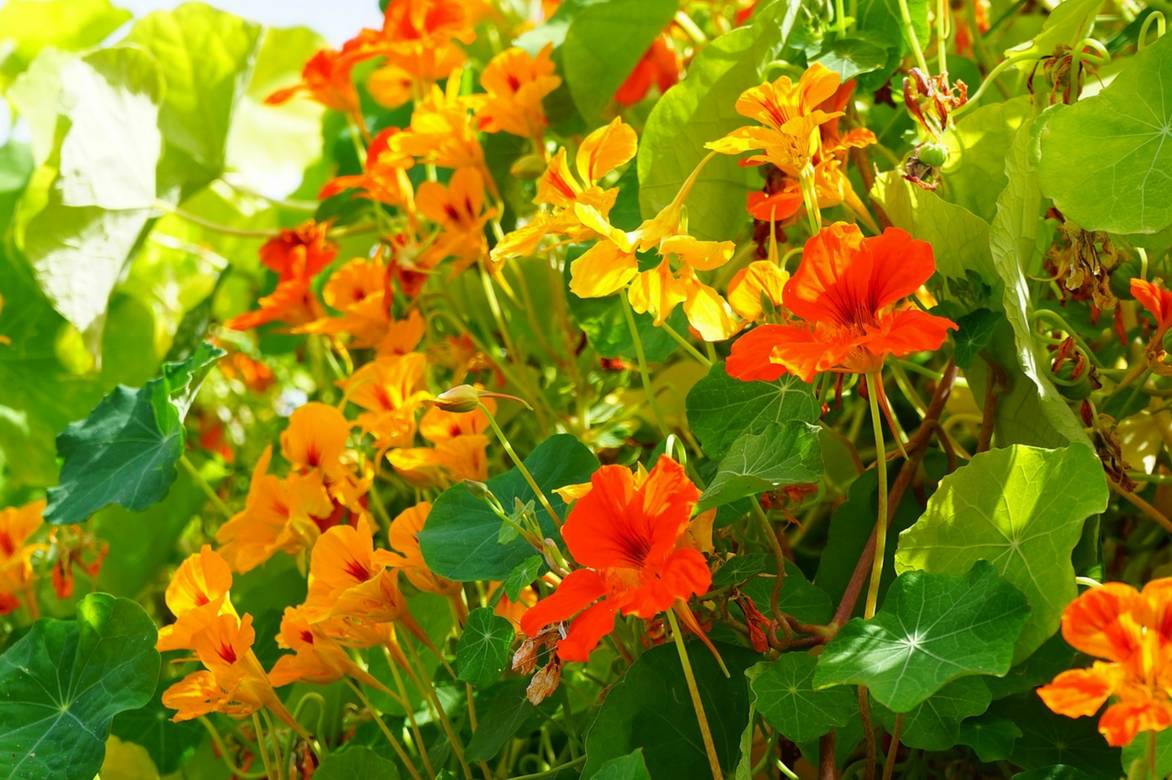
Pair nasturtiums together for a pretty mix of colours
Creamy-white variegated foliage of nasturtium Tropaeolum majus series ‘Alaska’ will go well with a cultivar of Helichrysum petiolare, a coleus, Nicotiana, and French marigolds.
Spectacular garlands of Tropaeolum speciosum will adorn a hedge of dark foliage such as yew and other conifers.
For a summer of colourful, fragrant salads within easy reach, near kitchen along a path, on edge of a terrace or in an organic vegetable garden, pair peppery dwarf nasturtiums with borage and plant them at foot of a fennel vulgare or officinalis.
Nasturtium also makes a strong impact in a hanging basket or a pot alongside petunias, ivy geraniums, alyssum or Mandevilla.
Useful resources
- Discover our ideas for pairing nasturtiums
- Eating flowers has become a real culinary trend! What are the best edible flowers?
- All our tips to tackle aphids effectively and naturally
- Discover Mickaël’s video tips to master climbing nasturtium
- An original recipe: How to make nasturtium capers with Ingrid!
- Discover Olivier’s favourite: nasturtium, an essential garden flower
- Grow nasturtiums in pots for plenty of flowers!
- Our article: Invasive plant — should we be afraid of Chilean nasturtium?
- Subscribe!
- Contents
This form is protected by reCAPTCHA - the Google Privacy Policy and Terms of Service apply.

































Comments