Rediscover our grandparents' plants!
Timeless gems
Contents
Some old-fashioned plants are gradually coming back into fashion. These are the plants our grandparents used to grow, once considered dated or not spectacular enough, and rediscovered a few decades later. They have the retro charm of gardens from times gone by, and often prove to be both as useful to wildlife as they are resilient to drought. In short, they were ahead of their time and it is time to give them the recognition they deserve!
Discover these forgotten gems of the ornamental garden and vegetable garden.

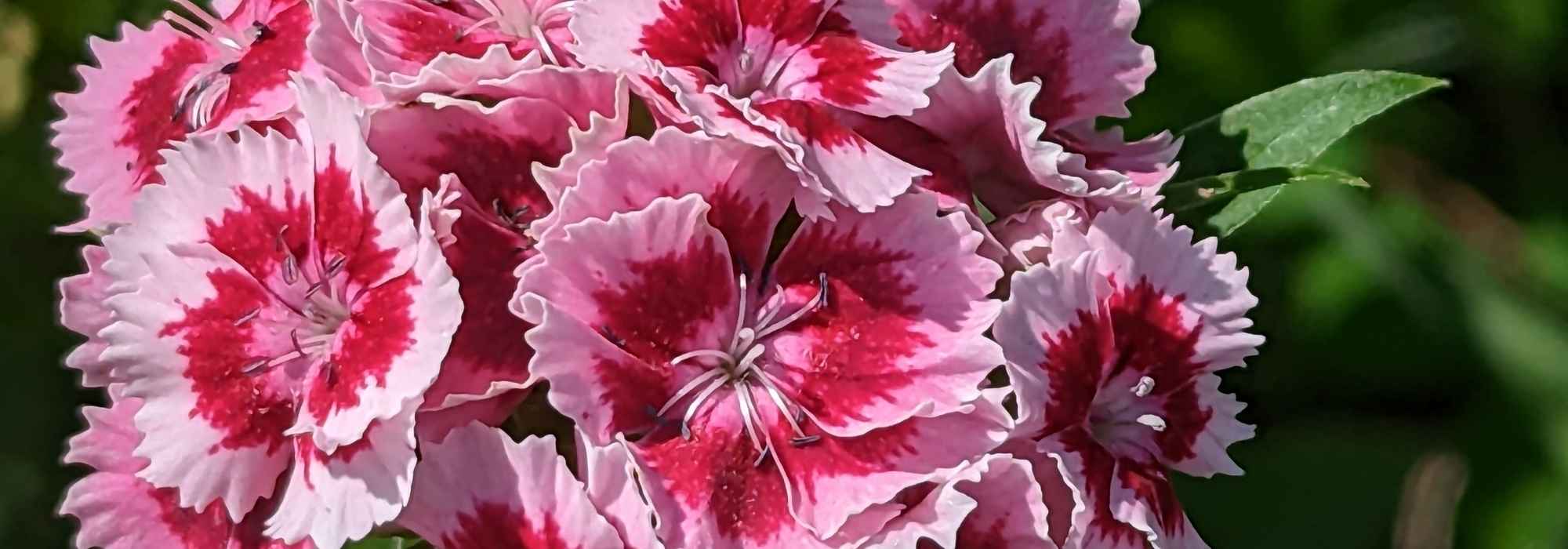
Sweet Williams
It may be the first one that comes to mind, as sweet William has long been planted in flower beds alongside geraniums (well… pelargoniums) in cottage gardens: sweet William (Dianthus barbatus to those in the know).
Carnations remain perennial plants often grown in our gardens, but this species, Dianthus barbatus, had somewhat disappeared from the scene. It is hard to see why, as it is the very essence of the country garden and old-fashioned flowers that nostalgic gardeners love. Very hardy in both cold and heat, it needs little care and little watering, apart from at the start of growing.
We love its small, very dense, fringed flowers, single or double depending on the variety, grouped at the tops of the stems and furnished with fine green bracts. Their colours range from white to almost-black deep violet, including bicoloured flowers. Its fragrance resembles that of cloves. Plant it in full sun or light partial shade, in any good, not overly chalky garden soil, to enjoy its fairly long flowering period, from spring until the end of summer. It is also perfectly suited to containers on the balcony and is one of the star flowers of a cutting garden, thanks to its excellent vase life.
Admittedly, sweet William lives for only three to four years, behaving more like an annual that needs to be resown (or not, as it self-seeds fairly easily, so leave a few flower heads in place when you cut the flowers to encourage further flowering). Do not underestimate it, though, and give it pride of place in the garden… or the vegetable garden!
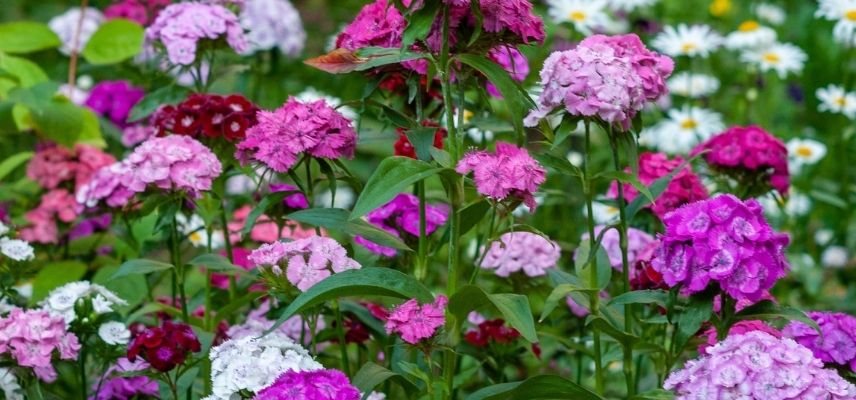
Dianthus barbatus: a charming range of colours
→ Find out more in our complete guide to Dianthus barbatus.
Read also
Designing a country gardenCommon lilac
The lilacs (Syringa) are linked, for an entire generation, to childhood memories of grandparents who lived in the countryside. That is certainly the case for me, and memories of preparing bouquets of fragrant flowers undoubtedly play a part. There are more than thirty species of lilac and hundreds of varieties, developed in France mainly by the Nancy-based horticulturist Victor Lemoine, who produced the first double-flowered varieties, including the beautiful white form ‘Madame Lemoine‘.
Once well established, common lilacs (Syringa vulgaris) do not flinch in the face of a few spells of drought (they originate from Eastern Europe). They are particularly robust, easy to grow and nectar-rich, attracting plenty of pollinators, including butterflies and bees. Their flowering in thyrsi is naturally short-lived, but this is true of many spring-flowering shrubs, and they are no less charming for it.
Persian lilac (Syringa persica), like Afghan lilac, is even more tolerant of drought and will adapt to longer periods of dry weather.
Plant them in rich, well-drained soil, in full sun, where they will flower much more abundantly. Choose lilacs grafted onto Ligustrum ovalifolium, as they produce fewer suckers.
→ Read also: Lilac – Syringa: the most fragrant varieties.
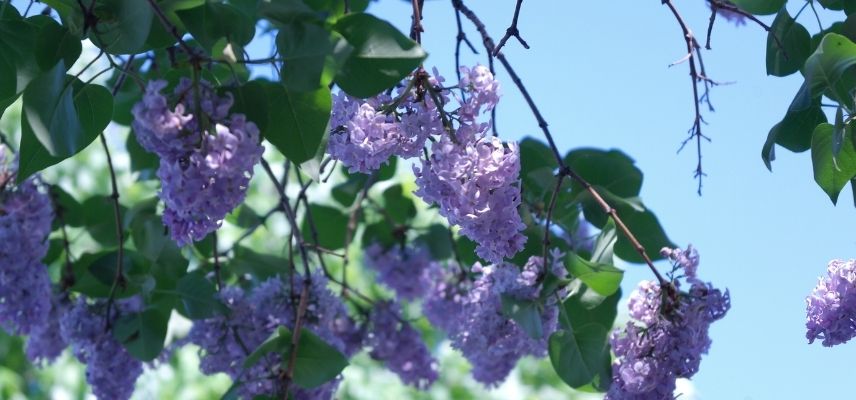
Lilac, a timeless shrub and a sign that fine weather is returning
The wallflower
The wallflower
The common wallflower, also known as the wallflower, is the most widespread of the wallflowers and was once a firm favourite in our grandmothers’ gardens. Erysimum cheiri, its Latin name, is a charming perennial plant that is still well worth growing today. Its sunny brilliance is rediscovered, with its burnt-sugar and orange-coloured flowering. A little wonder that thrives in the sun and remains low-growing, making it suitable for growing in borders or in a pot on a terrace.
Wallflowers can become woody undershrubs over the years. As its name suggests, it readily grows on walls, which gives us a good indication of its need for very well-drained, even dry soil that is never wet. It is a champion during very dry summers, suffering no ill effects from prolonged lack of water. It is therefore ideal for rock gardens and particularly sunny areas.
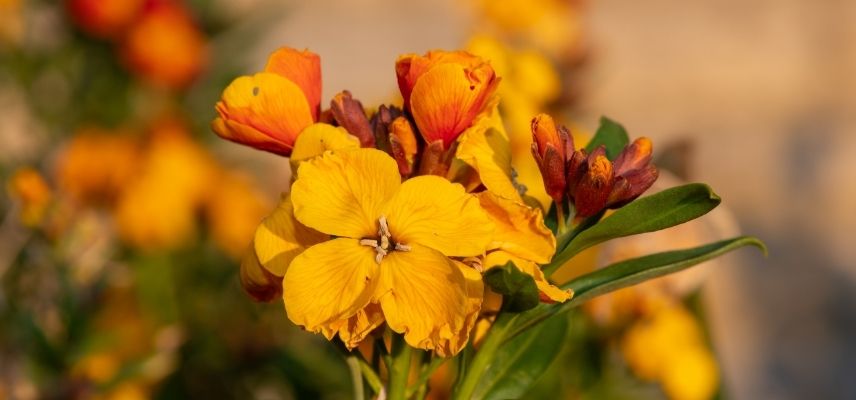
Erysimum cheiri
→ Find out more in our complete guide to wallflowers.
Read also
Bohemian garden ideasThe issue
Pot marigold
Let us call it by its Latin name, Calendula officinalis, which everyone will recognise for its cosmetic properties. This ancient plant has indeed been one of the best-known medicinal plants since the Middle Ages, when it was used to treat scabies. It is still used today in pharmacology and for its benefits for the skin.
Long-lasting flowering, like wallflowers, recognised qualities for keeping pests away from the vegetable garden, a very simple plant that is both a dye plant and edible, and one that self-seeds, without any care, pot marigold really does have everything going for it, and our grandparents understood this very well! As an anecdote, it was notably used on farms to improve the colour of butter in winter, when cows deprived of fresh grass produced pale butter, thanks to its natural pigments. This earned it the name saffron of the poor.
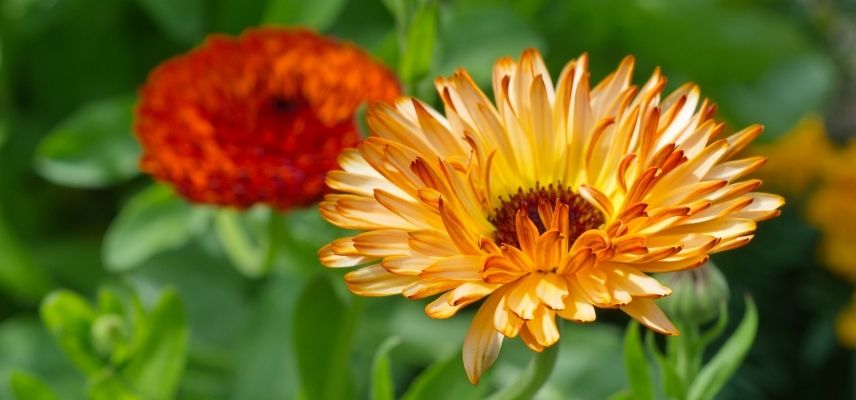
Calendula officinalis
→ Find out more in our complete guide to pot marigold, and in Why plant pot marigolds in the vegetable garden?
Chrysanthemums
Another plant that has long suffered from a negative image, the chrysanthemum was nevertheless one of the favourite plants in gardens of the past. Considered an ill-omened flower because of its strong associations with November, cemeteries and commemorative ceremonies for the First World War, this beautiful perennial has the good sense to flower very late in our Western gardens. For some varieties, they are even the last plants to bloom in autumn, when leaves are already falling in abundance in the garden.
Do not be misled by the forced potted plants sold by florists as All Saints’ Day approaches, nor by the melancholy, artificial appearance of their large flowers. Garden chrysanthemums (Chrysanthemum indicum), native to Asia, resemble asters, with which they share the same botanical family, and come in wonderfully rich, often warm colours. Their flowers are either pompon-shaped or simpler and star-shaped, typical of the Asteraceae family.
Chrysanthemum x rubellum, with its more relaxed habit, Chrysanthemum coronarium, once often seen in vegetable gardens, and Chrysanthemum carinatum, annuals reclassified by botanists under Glebionis, which was used as a cut flower, are all beautiful plants to bring back into the garden without delay.
They all need sunshine and well-drained soil to flower well, with taller varieties sometimes needing staking, and above all, pinching to encourage branching from spring onwards.
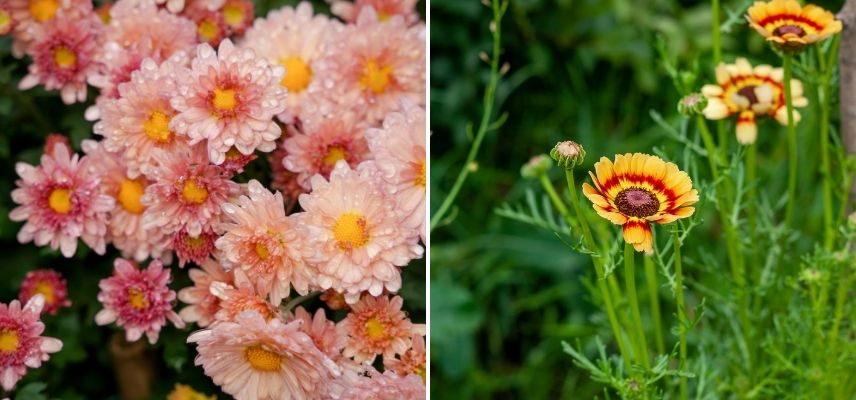
Chrysanthemum indicum and Chrysanthemum carinatum
→ Find out more in our complete guide to the chrysanthemum; also discover our chrysanthemum seeds.
Cast-iron plants
This is a plant I enjoy talking about whenever I get the chance. In my view, it deserves to be given a proper second chance. And when we talk about vintage plants, cast-iron plants certainly fit the bill! Confined to being grown in pots indoors, often becoming dusty in our memories, Aspidistra brought happiness to our grandmothers. Could their poor reputation be due to their rather unflattering nickname, if ever there was one: snake plant?
In any case, they are among those unkillable plants that can withstand hurried or careless gardeners, leaving their plant with little or no watering. Often seen in pots in the narrow, shady Mediterranean streets where they unfurl their long, strap-like foliage, Aspidistra are not bothered in the slightest by dense shade. They also survive very well in areas of dry shade in the garden. What more could you ask for? Adopt these superb green plants and let them see a bit of the world… simply in the garden!
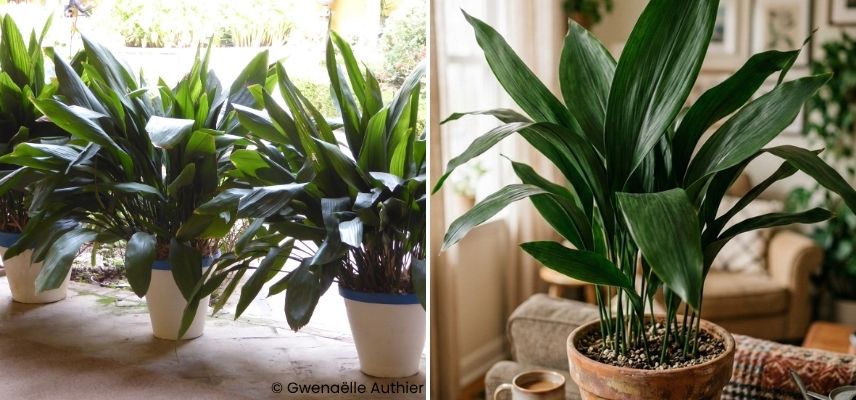
Outdoors, in a lovely container or indoors, don’t forget Aspidistra
→ Find out more in our comprehensive guide to Aspidistra, and in our articles How to grow Aspidistra indoors and in the garden? and Gardening in dry shade.
But also…
To name just a few: the rowan (Sorbus aucuparia), a true bird magnet with flamboyant autumn colours, the hawthorn (Crataegus monogyna), perfect for a defensive hedge, the snowberry and its white berries in winter, elder and Physocarpus, and among perennials and annuals, the columbine (now more commonly called Aquilegia), the sweet pea, Mirabilis (marvel of Peru), the China aster or China aster (Callistephus), the snow-in-summer with its silvery-grey foliage, the extravagant amaranth, gladioli, irises and hyacinths, as well as all the plants that self-seed, requiring virtually no care. In short, once again, these are easy plants, often reliable garden favourites.
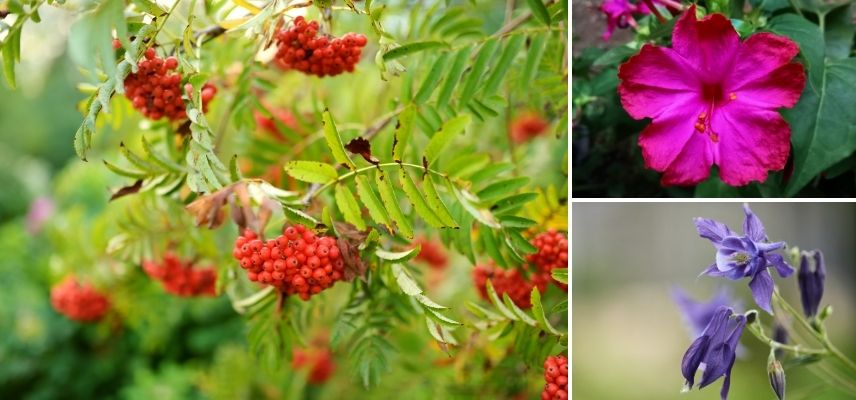
Sorbus aucuparia, Mirabilis jalapa and Aquilegia vulgaris
From the vegetable garden…
Our grandparents planted and sowed extensively, particularly in the vegetable garden, which was a major source of food for the family when they were lucky enough to have a sufficiently large plot of land. When we look at the plants that were staples of the larder at the time, we unsurprisingly find tasty vegetables and plants, some of them heirlooms, which were both beautiful and useful.
But the vegetable garden has undergone many changes over the decades. Some vegetables, now described as old-fashioned, are gradually returning to our growing habits. They had been neglected mainly because of their associations with wartime shortages or because they took a long time to prepare. We are returning to them for their less standardised flavour, their originality and how easy they are to grow in the vegetable garden, as well as for a less and less meat-based diet. They are often root vegetables or so-called perpetual vegetables, meaning perennials that return year after year.
We also remember them from the past: marsh mallow, rhubarb, blackcurrants and gooseberries, globe artichokes, purslane and salsify, rows of French beans, sorrel, lovage, orache, amaranth and Jerusalem artichokes, garlic and Welsh onions…
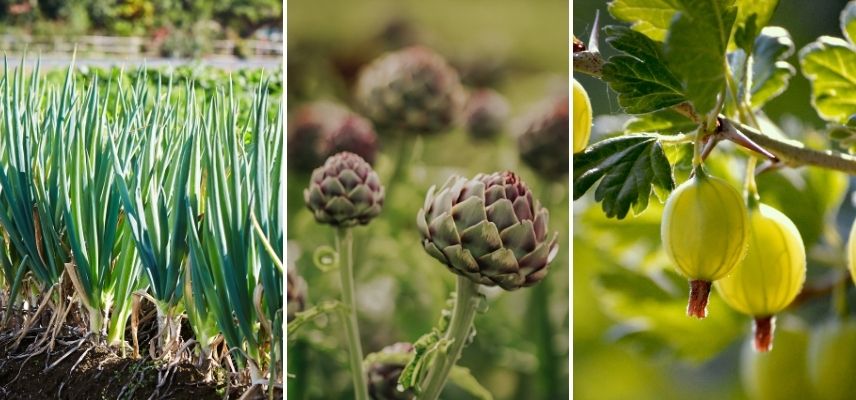
Welsh onion, globe artichoke and gooseberry
→ Read also: How to create an edible garden, How to create a perpetual vegetable garden, 10 perpetual or perennial vegetables for a sustainable, self-sufficient vegetable garden; Little-known or forgotten squashes: treasures for the kitchen garden; Skirret, a forgotten perennial vegetable that is easy to grow, and How to harvest and use amaranth in cooking.
- Subscribe!
- Contents
This form is protected by reCAPTCHA - the Google Privacy Policy and Terms of Service apply.

































Comments