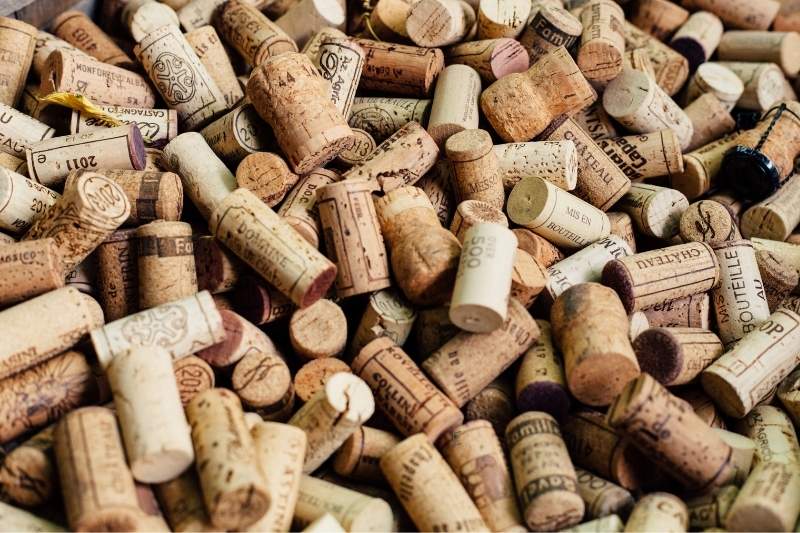
There are materials that do us good. Cork, from the tree that bears its name, is one of them, and it has been making a notable comeback in our lives for several years now. A renewable, 100% natural, ecological material, cork is not used only to seal our best vintages.
The possibilities offered by this natural material are many and its recycling concerns us all.
Cork: a bio-based, ancestral and innovative material
Cork comes from the bark of the cork oak (Quercus suber), a tree growing around the Mediterranean, mainly in Portugal, and also in Spain, Italy, France, Algeria and Morocco. It has been exploited primarily in Europe since the 17th century, but its qualities were known to the Romans and Greeks, who began making cork stoppers to better preserve wine or oil in amphorae (clay or resin stoppers having proved limited). It was Dom Pierre Pérignon, a Benedictine monk well known in the Champagne world, who is said to have popularised the use of cork.
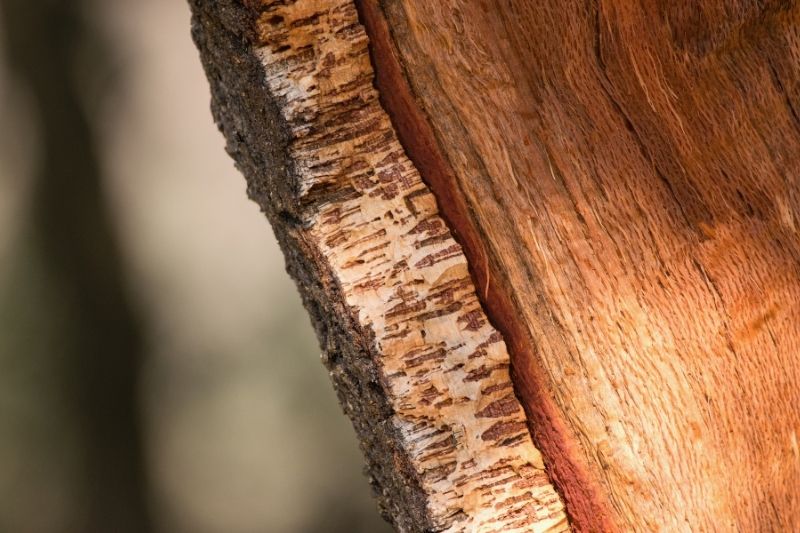
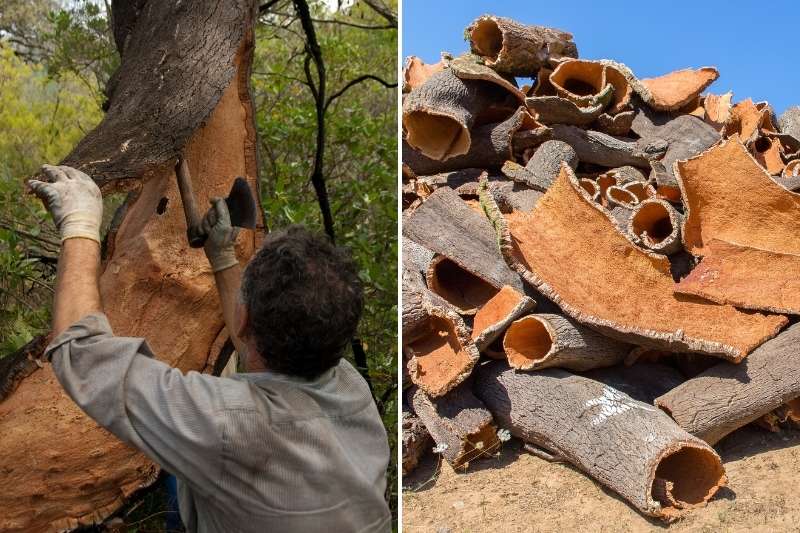
Only the bark – referred to as suberified bark – is harvested. The tree is not cut down; only its very thick cork bark, up to 25 cm thick, is removed using a special axe, without damaging the cambium (living tissue beneath the cork).
The tree therefore remains alive. The cork oak is able to regenerate its bark after each harvest, allowing sustainable exploitation over decades. It is also fire-resistant: after each fire, frequent in these Mediterranean regions, it reconstitutes its bark… like a vegetal phoenix or a Terminator of the forests!
Properties and uses of cork
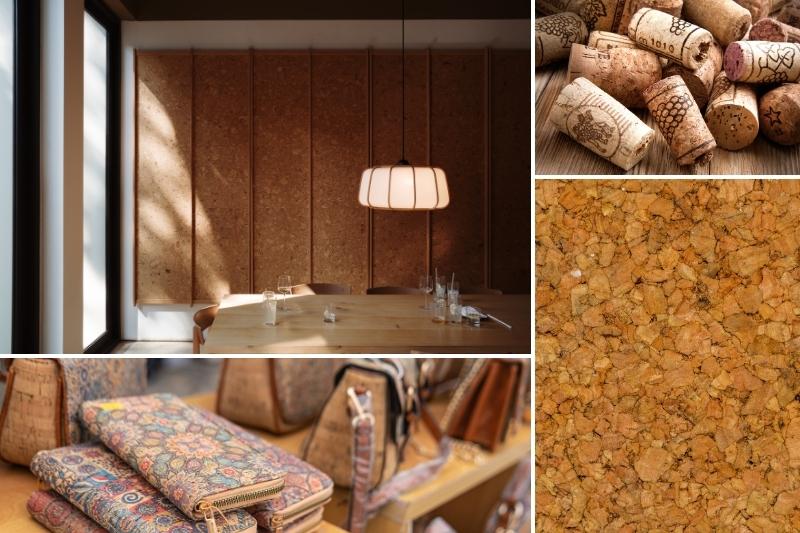
Given all its qualities, cork has many uses beyond making stoppers. It is a technical material widely used in the marine sector for boat decks because of its rot-resistant properties, in leather goods to make soles, shoes and small items, and as an accessory for numerous decorative items, jewellery and furniture. Light yet flexible, impermeable and insulating, attractive and watertight, it has also become a material of choice for thermal and acoustic insulation. The construction industry also uses it as an effective moisture barrier, accounting for 14% of its use. The wine industry remains its main outlet, representing 69% of consumption. It uses the protective and breathable qualities of cork as well as its density to produce high-quality stoppers.
Production and extraction
Portugal, the world’s leading cork exporter, is the undisputed leader in production (50% of the total). Suberaies, the name given to cork oak forests, account for nearly a quarter of the country’s woodlands, with a strong concentration in the Alentejo region. Portuguese cork represents 50% of world production. Portugal and Spain alone cover more than half of the exploited areas.
France produces a smaller but high-quality quantity, in specific areas (Corsica, Pyrénées-Orientales, Var and Landes). The cork sector in France produces 3 billion cork stoppers per year, out of 14 billion worldwide.
It must be understood that cork forests and plantations in Portugal and other Mediterranean countries are ecosystems in their own right. Cork cultivation relies on patient, extensive management of natural areas.
Furthermore, knowing that one tonne of cork absorbs 2 tonnes of CO2, and that global production is 300,000 tonnes per year, there is no need to do the maths to grasp the ecological value of this resource.
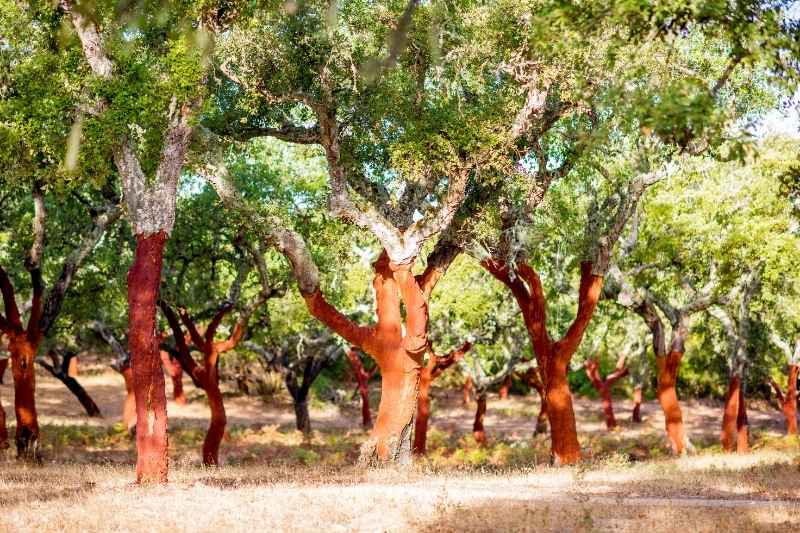
Extraction is done manually on the trunk when the tree is mature, at least 25 years old, by cutting or "lifting" the bark in large slabs. This is known as the debarking or lifting operation, carried out during the sap-rise period, from May to August. The first harvest produces so-called "male" cork, of lower quality, very thick and too hard, which will be sent for grinding. The bark renews naturally every 12 years approximately, on trees living on average 200 years. Each cork oak can thus be "scalped" around fifteen times in its life, producing so-called "female" cork, a noble, excellent-quality material. The cork slabs are air-dried for six months. Harvested cork has a very long shelf life, close to 100 years!
Cork recycling: an eco-friendly civic act within everyone's reach
France, as the world’s second-largest wine consumer, has a role to play.
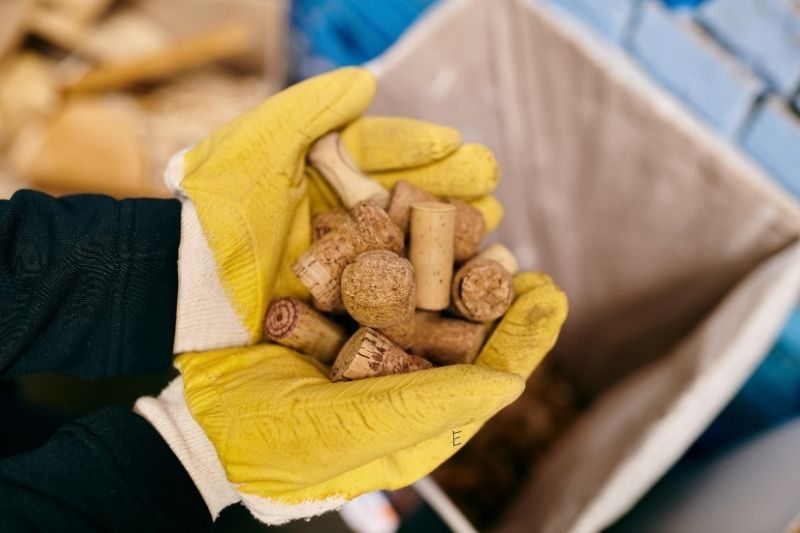
A 100% plant-based product, cork stoppers can be recycled, but they are not classed as packaging. They therefore cannot be put in the yellow recycling bin. They must be dropped off at a local collection point. Household waste centres, town halls, supermarkets, organic shops, wine merchants and sometimes schools are all places where precious stoppers can be returned.
Fewer people know that many local, regional and national associations take part in collections to support charitable causes.
Options in France include Recycliege France, Planetliege (site of the French Cork Federation), and regional waste management organisations such as Smitcom.
Once collected, stoppers are sent to specialised recycling plants where they receive specific treatment. Ground, they become granules, which are then turned into boards or blocks to make other objects, including new stoppers, or used for energy recovery.
Avoid putting cork stoppers in the compost. Although biodegradable, they decompose rather slowly and, in that case, should not be bonded with glue or plastic, as some new commercial stoppers are. These must be thrown in the household refuse bin.
Sorting cork: a well-established process
Each year more than 60 million cork stoppers are recycled in France out of a consumption of 3 billion cork-sealed bottles.
In this area, prevention and information are major issues for this circular economy in order to promote a reflex in our daily habits: collect cork stoppers together at home rather than throwing them one by one in the bin.
At European level, there is a recycling code for cork, FOR51. It identifies products made from natural cork without any agglomerate or synthetic substitute.
Be careful not to confuse 100% cork stoppers with cork-look stoppers, which are agglomerates of synthetic materials and glue: these must not go in the yellow recycling bin!
Cork in the garden: why not consider it?
An insulating material in summer and winter, therefore thermoregulating… Now, doesn't that sound good for our plants? Cork stoppers are indeed one of the original but proven recycling options for our potted plants. For drainage or insulation against the cold, once cut into small pieces (yes, you have to get your hands a little dirty), 100% cork stoppers prove to be precious and economical allies, replacing clay pebbles. Placed under pots, they protect those left on terraces and balconies in winter.
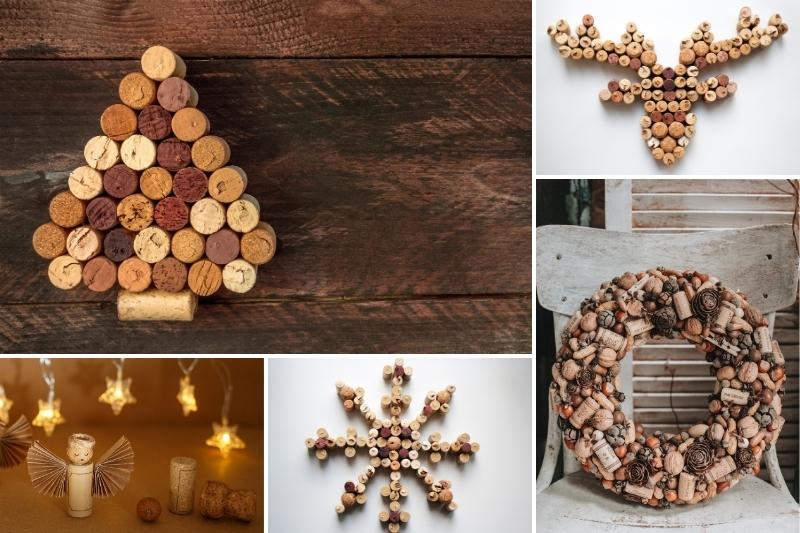
Our cork stoppers can also find a second life and be upcycled very prettily and easily for Christmas. The natural material and colour of cork pair perfectly with pine cones and wood to decorate the home for the festive season. Keep it in mind!
Further reading…
Cork is venturing into the space industry! Discover this surprising article on the aeronautical potential of cork from a small French company.
Two websites to consult: Planète Liège and the Mediterranean Cork Institute (IML), which provide much more information on their comprehensive sites.
This video shows the cork stopper manufacturing process in a Portuguese factory.


















Comments