Begonia boliviensis Copacabana Red coated seeds
Begonia boliviensis Copacabana Red coated seeds
Begonia boliviensis Copacabana Red coated seeds
Begonia boliviensis Copacabana Red
Bolivian Begonia, Bonfire Begonia
Back-to-school special offer!
Get €10 off for every €50 you spend! And get up to €40 off on a single order.
How does it work?
1. Shop your favourites
Add your favourite plants to your basket. For every €50 you spend (excluding delivery charges, store credit and the plastic-free option), you’ll receive a €10 voucher.
€50 spent = €10 voucher
€100 spent = €20 voucher
€150 spent = €30 voucher
€200 spent = €40 voucher
2. Place your order
Once your basket reaches one of the spending thresholds, place your order. You can even choose your delivery date!
3. Receive your voucher
As soon as your order has been shipped, you’ll receive an email containing your personal voucher code and its value.
4. Use it on your next order
Your voucher is valid for 90 days from the date you receive it. It can be used once only, on a new order worth at least the value of the voucher, excluding delivery charges.
Please note: Vouchers can be combined with other offers, but cannot be split or refunded.
Home or relay delivery (depending on size and destination)
Important: You may be charged customs duties by your country’s customs authorities upon delivery.
Schedule delivery date
and select date in basket
This plant carries a 6 months recovery warranty
More information
We guarantee the quality of our plants for a full growing cycle, and will replace at our expense any plant that fails to recover under normal climatic and planting conditions.
Would this plant suit my garden?
Set up your Plantfit profile →
Description
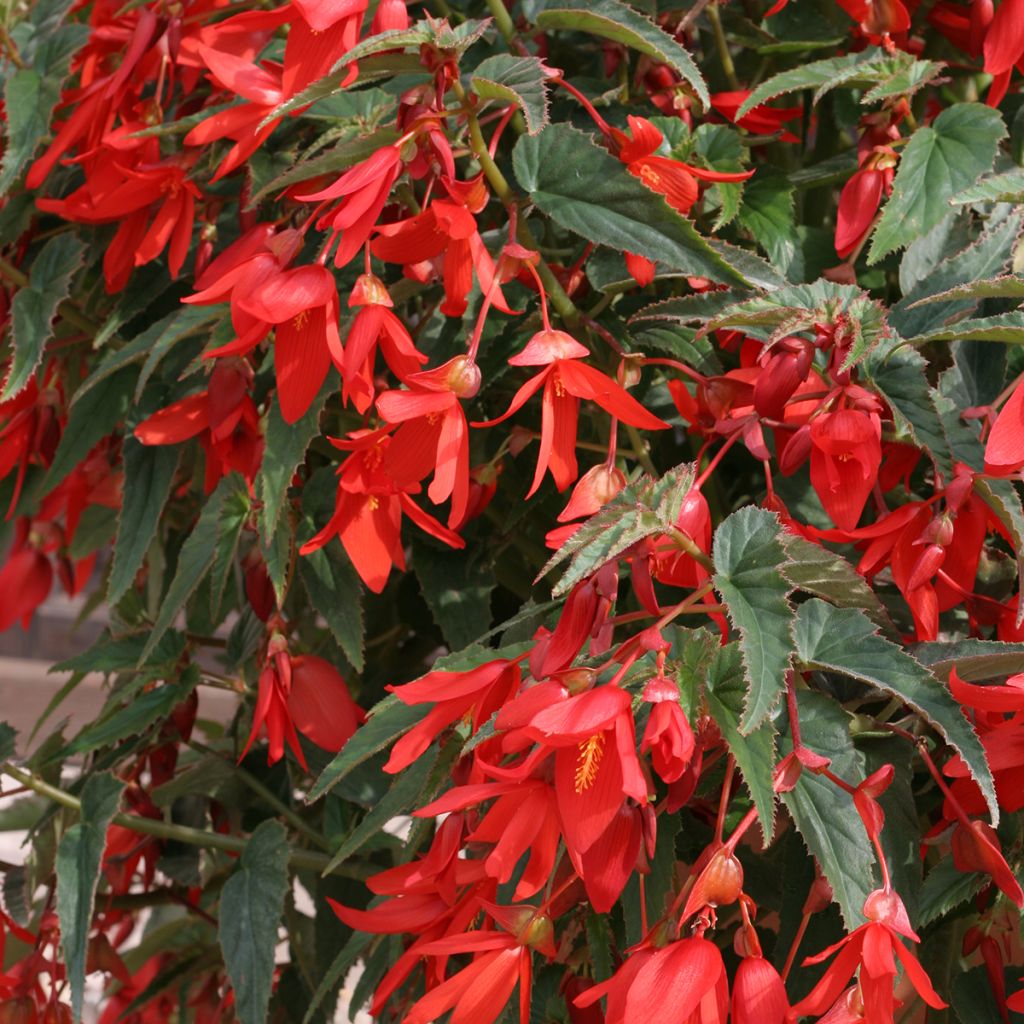
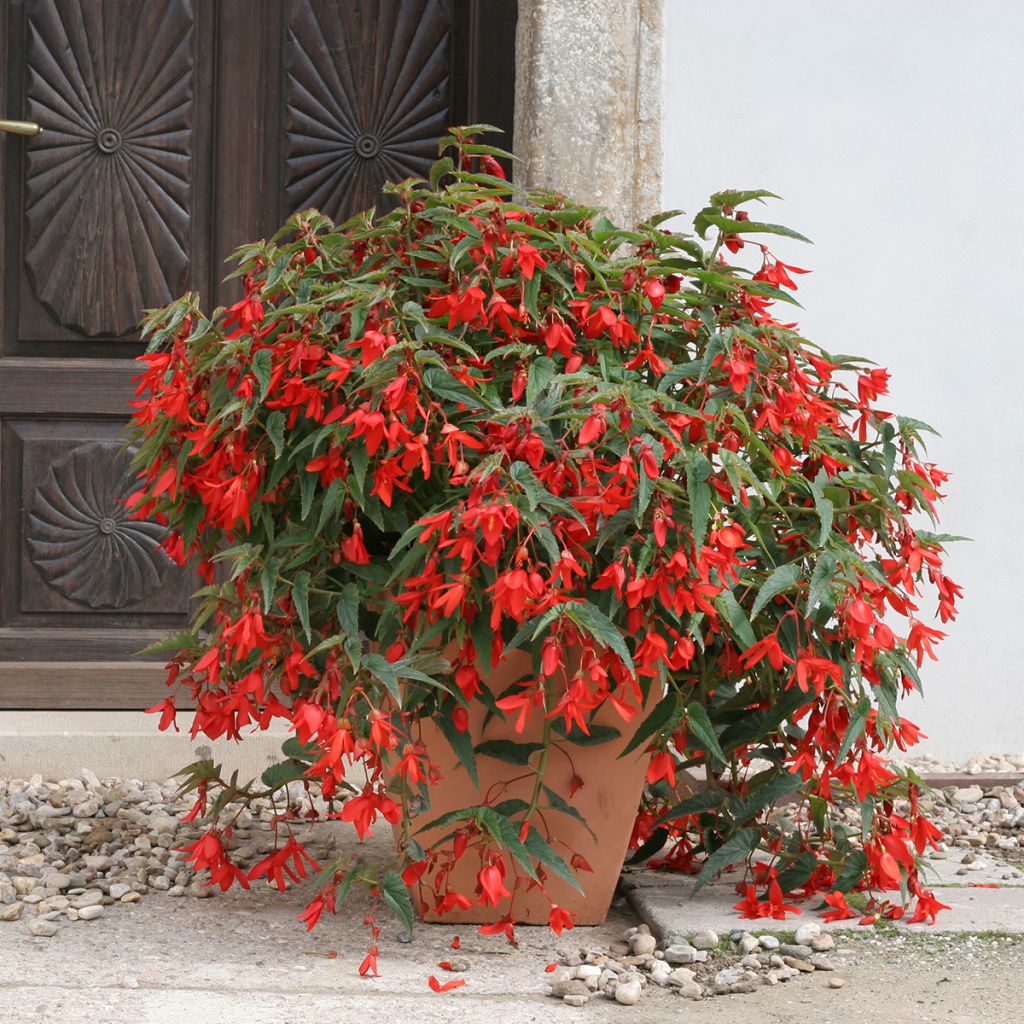
The Bolivian Begonia Copacabana F1 Red is a trailing tuberous begonia adorned with a profusion of long red bell-shaped flowers, from early summer until the first cold spells. Derived from the species Begonia boliviensis, this hybrid cultivar is characterised by vigorous growth, almost uninterrupted flowering and better tolerance to sun, rain and irregular watering. In hanging baskets, window boxes or large pots, it forms a light and colourful mass in a single season.
Sow the coated seeds under cover; they are much easier to handle than traditional fine seeds. This method of propagation makes it possible to produce a large number of uniform young plants at a reasonable cost.
Botanically speaking, the Bolivian begonia belongs to the Begoniaceae family. The type species, Begonia boliviensis, also known as the Bolivian tuberous begonia or Andean begonia, is native to the mountains of Bolivia and north-western Argentina. It is a tuberous perennial. In our climates, this plant is grown as a frost-tender perennial or, more simply, as a summer annual: its tubers cannot withstand frost in open ground.
The Copacabana F1 series, created by the Czech seed house Cerny Seed, was developed as an alternative to trailing begonias propagated by cuttings. Introduced in the early 2010s, it includes several shades (orange, salmon, red, white, yellow and tricolour), all marked by a compact habit, abundant flowering and good adaptability to a variety of growing conditions, in pots as well as in borders.
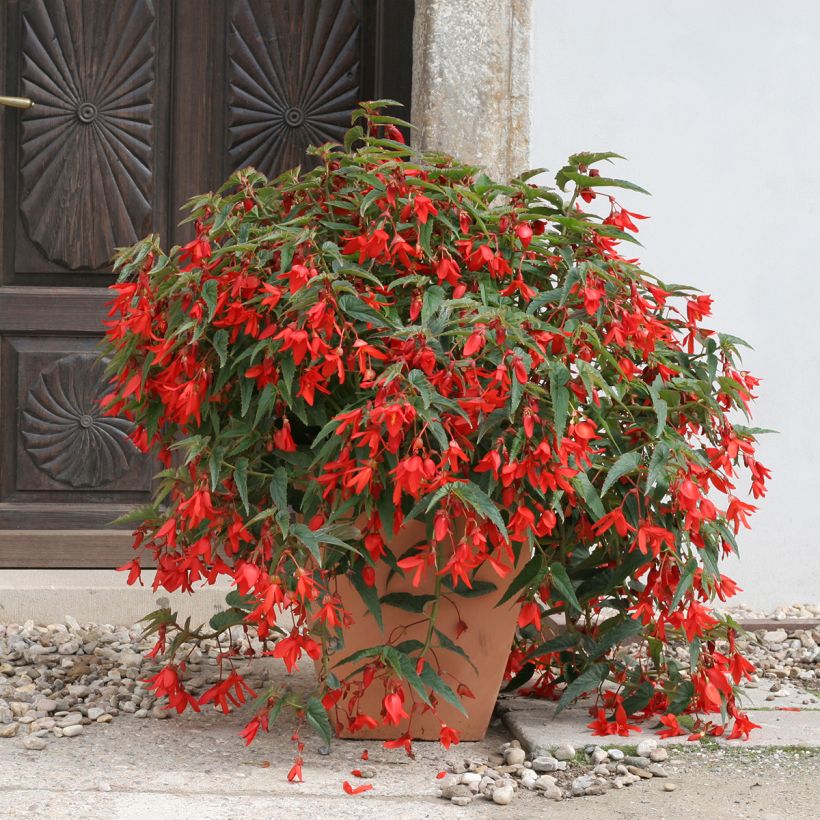
Copacabana F1 Red plants form a dense clump within a few weeks, at first slightly upright, then highly branched and softly trailing. Each reaches 35 to 40cm in height and 40 to 50cm in width; in hanging baskets, the arching stems easily cascade down 50 to 60cm. The bright green foliage consists of narrow, asymmetrical, finely toothed, 8 to 12 cm long leaves. Flowering extends from June to October, provided sown early enough: allow 14 to 17 weeks between sowing and the first flowers. The pendulous inflorescences arise from the leaf axils. Each flower, shaped like an elongated bell, measures 6 to 7cm in length. The narrow tepals display a deep red, slightly lighter towards the throat, and curl backwards. As with all begonias, male and female flowers coexist on the same plant: the more imposing male bears a cluster of stamens, the female a winged ovary which then produces small capsules containing seeds.
Begonia boliviensis Copacabana F1 Red is suitable for hanging baskets, deep window boxes and large pots. Grow it in a rich, light potting compost that remains moist without being waterlogged, preferably in a sheltered position away from wind. It pairs well with the blue-grey foliage of Dichondra 'Silver Falls', which highlights its red flowers, and with Begonia pendula White. To add a floral note, you can add a few plants of Calibrachoa Lia® 'Spark Pink'.
Historically, Begonia boliviensis played an important role in the creation of modern tuberous begonias. Introduced to Europe in 1864 by the British collector Richard Pearce, it was presented to the public in 1867 in Paris. It served as a parent to several of the first horticultural hybrids that established the reputation of large-flowered begonias. In our latitudes, the Bolivian begonia and its hybrids, such as the Copacabana series, are grown exclusively for their ornamental value.
Report an error about the product description
Begonia boliviensis Copacabana Red coated seeds in pictures
Flowering
Foliage
Plant habit
Botanical data
Begonia
boliviensis
Copacabana Red
Begoniaceae
Bolivian Begonia, Bonfire Begonia
Begonia argentinensis, Begonia boliviensis var. latitepala, Begonia boliviensis var. volcanensis
Cultivar or hybrid
Planting and care
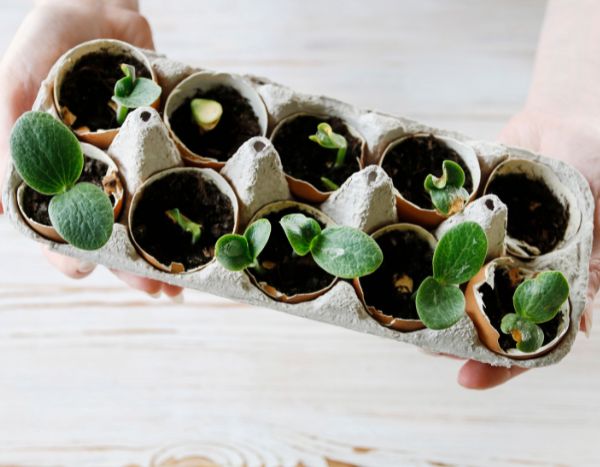
Sow your Bolivian begonia Copacabana F1 Red seeds from January to March in a seed tray.
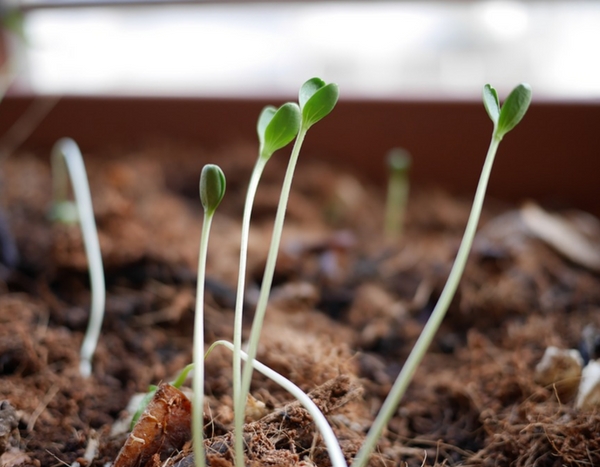
Use a good quality potting compost and sieve the surface to ensure good contact between the seed and its substrate. Before sowing, firm the compost lightly with a presser board and moisten it slightly. Sow your seeds carefully. Do not cover the seeds. Water with a very fine spray or use a small hand mister. Place your seed tray in the light, out of direct sunlight, at a temperature of 24°C to 27°C.
Germination will take 15 to 30 days. As soon as the young plants can be handled, transplant them into 7cm pots. Keep the compost moist but not waterlogged during growth. Then, 15 days before planting out in their final position, begin to acclimatise them gradually to a temperature of 15°C.
At the end of May or beginning of June, the temperature in the garden will be warm enough to plant out your young plants. Choose a slightly shaded spot. Add a good trowelful of compost to each planting hole. Space your plants 40cm apart.
Regularly remove faded flowers to maintain their beauty and encourage new blooms.
In autumn, bring the pots indoors under cover and allow the foliage to dry off, then lift the tubers from the soil, brush them clean and store them in a dry place until the following spring, when they can be replanted in pots.
Sowing period
Intended location
Planting & care advice
-

-
-

-

-

-

-

-
This item has not been reviewed yet - be the first to leave a review about it.
Recently viewed products
Haven't found what you were looking for?
Hardiness is the lowest winter temperature a plant can endure without suffering serious damage or even dying. However, hardiness is affected by location (a sheltered area, such as a patio), protection (winter cover) and soil type (hardiness is improved by well-drained soil).

The flowering period indicated on our website applies to countries and regions located in USDA zone 8 (France, the United Kingdom, Ireland, the Netherlands, etc.)
It will vary according to where you live:- In zones 9 to 10 (Italy, Spain, Greece, etc.), flowering will occur about 2 to 4 weeks earlier.
- In zones 6 to 7 (Germany, Poland, Slovenia, and lower mountainous regions), flowering will be delayed by 2 to 3 weeks.
- In zone 5 (Central Europe, Scandinavia), blooming will be delayed by 3 to 5 weeks.
In temperate climates, pruning of spring-flowering shrubs (forsythia, spireas, etc.) should be done just after flowering.
Pruning of summer-flowering shrubs (Indian Lilac, Perovskia, etc.) can be done in winter or spring.
In cold regions as well as with frost-sensitive plants, avoid pruning too early when severe frosts may still occur.
The planting period indicated on our website applies to countries and regions located in USDA zone 8 (France, United Kingdom, Ireland, Netherlands).
It will vary according to where you live:
- In Mediterranean zones (Marseille, Madrid, Milan, etc.), autumn and winter are the best planting periods.
- In continental zones (Strasbourg, Munich, Vienna, etc.), delay planting by 2 to 3 weeks in spring and bring it forward by 2 to 4 weeks in autumn.
- In mountainous regions (the Alps, Pyrenees, Carpathians, etc.), it is best to plant in late spring (May-June) or late summer (August-September).
The harvesting period indicated on our website applies to countries and regions in USDA zone 8 (France, England, Ireland, the Netherlands).
In colder areas (Scandinavia, Poland, Austria...) fruit and vegetable harvests are likely to be delayed by 3-4 weeks.
In warmer areas (Italy, Spain, Greece, etc.), harvesting will probably take place earlier, depending on weather conditions.
The sowing periods indicated on our website apply to countries and regions within USDA Zone 8 (France, UK, Ireland, Netherlands).
In colder areas (Scandinavia, Poland, Austria...), delay any outdoor sowing by 3-4 weeks, or sow under glass.
In warmer climes (Italy, Spain, Greece, etc.), bring outdoor sowing forward by a few weeks.
Shipping country and language
Your country of residence may be:
Your country of residence is:
For a better user experience on our website, you can select:
Your shipping country:
-
 Austria
-
 Belgium
-
 Bosnia & Herzegovina
-
 Bulgaria
-
 Croatia
-
 Cyprus
-
 Czechia
-
 Denmark
-
 Estonia
-
 Finland
-
 France
-
 Germany
-
 Greece
-
 Hungary
-
 Iceland
-
 Ireland
-
 Italy
Italy
-
 Latvia
-
 Liechtenstein
-
 Lithuania
-
 Luxembourg
-
 Malta
Malta
-
 Netherlands
-
 Poland
-
 Portugal
-
 Romania
-
 Serbia
-
 Slovakia
-
 Slovenia
-
 Spain
Spain
-
 Sweden
-
 Switzerland
Language:
-
French
-
 English
-
Spanish
-
Italian
-
German
-
Portuguese
-
Dutch
-
Finnish
My Account
Hello
My wish lists
My cart
Log in / Register
Existing customer?
This form is protected by reCAPTCHA - the Google Privacy Policy and Terms of Service apply.
New customer?
Create an account to track your orders, access our customer service and, if you wish, make the most of our upcoming offers.