Groundcover shrubs that flower in autumn: our favourites
Our selection for late flowering
Contents
In autumn, some shrubs still bring colour and texture, thus extending the flowering season until the first frosts. Among them, groundcover shrubs are a wise choice for those who want to carpet their garden. Their low height makes them ideal plants for dressing the base of beds, borders, rockeries or embankments, while reducing maintenance, as they limit weed proliferation. Furthermore, these late flowerings give a good boost to foraging insects and bees before winter. Here is a selection of groundcover shrubs that will brighten your garden in autumn.
→ Also find our podcast on the most beautiful autumn flowering displays :

Heathers (Calluna and Erica)
Heathers are small shrubs well known for bringing colour in summer, autumn and winter, depending on variety. Hardy, groundcover plants, they prefer acidic, well-drained soils, making them ideal candidates for rockeries, borders or woodland understoreys.
Summer heathers (Calluna vulgaris)
As its name suggests, the summer heather (Calluna vulgaris) flowers in late summer, but this long flowering continues into autumn, usually until first frosts, around November. They produce clusters of flowers that can be, for example, purple in Calluna vulgaris ‘Garden Girls® Angie’, soft pink in ‘Radnor’ or white in ‘Garden Girls® Madonna’. Its compact size most often ranges between 20 and 40 cm in height, forming a pretty colourful carpet.
In addition, its evergreen foliage remains decorative all year round. Summer heather favours poor, slightly acidic soils and adapts well to sunny or partly shaded positions. It pairs perfectly with ferns or ornamental grasses such as carex for a contrast of textures.
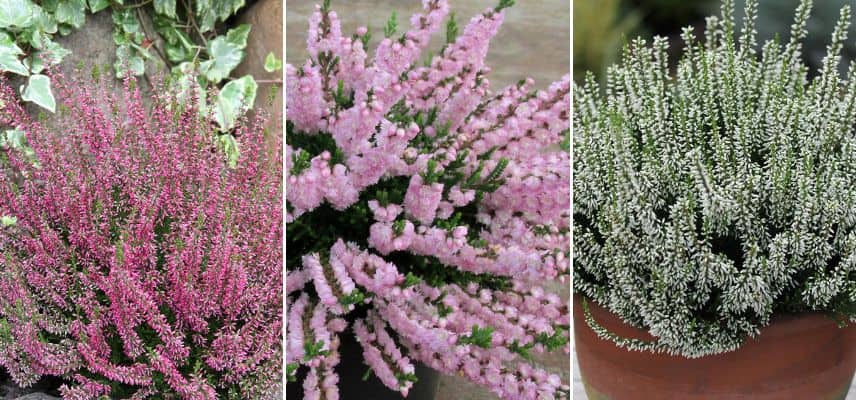
From left to right: Calluna vulgaris ‘Garden Girls® Angie’ ; Calluna vulgaris ‘Radnor’ ; Calluna vulgaris ‘Garden Girls® Madonna’.
Winter heathers (Erica carnea)
Winter heathers take over with a flowering that extends from autumn (around November) to the start of spring (often March). They produce small bell-shaped pink flowers, as in variety ‘Kramer’s Rote’, or white ones, as in ‘Silberschmelze’, on evergreen foliage year-round. This heather is more tolerant than Calluna regarding soil type, even accepting slightly calcareous, moist soil. Winter heather pairs wonderfully with cyclamen coum or hellebores to extend the garden’s visual interest throughout winter.
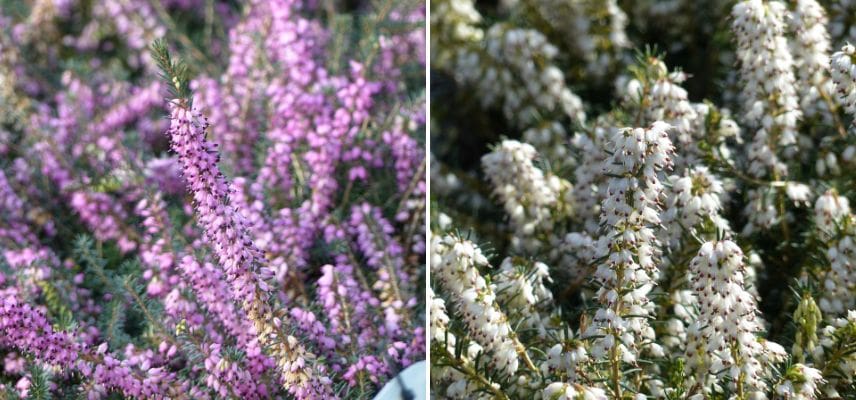
Erica carnea ‘Kramer’s Rote’ and Erica carnea ‘Silberschmelze’
Autumn camellias
Autumn camellias (Camellia sasanqua) are particularly appreciated for their late flowering, often from October to November. Among the varieties, some stand out for their compact, wide habit, making them excellent groundcover. At the Camellia sasanqua ‘Waterfall White‘, one can admire semi-double, white flowers lightly scented, with a golden-yellow centre. Meanwhile the ‘Waterfall Pink‘ variety offers pale pink, double flowers, of unparalleled charm. In addition, their evergreen foliage, dark glossy green, remains decorative all year round.
The autumn camellia prefers acidic, well-drained, slightly moist soil. A lightly shaded to partially sunny position, sheltered from cold winds, is ideal. Compact, Camellia sasanqua reaches about 1 metre in height and 1.5 to 2 metres in width at maturity. It is hardy down to -12 °C once established. Plant it alongside rhododendrons, Japanese azaleas or Pieris for successive flowering throughout the year.
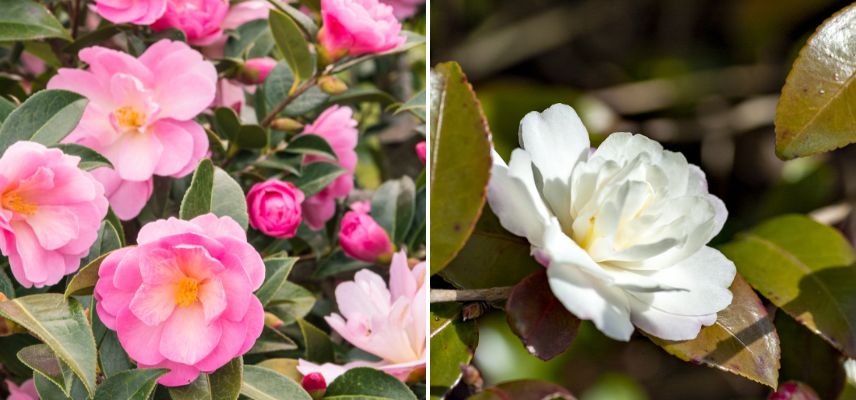
Camellia sasanqua ‘Waterfall Pink’ and Camellia sasanqua ‘Waterfall White’
Groundcover roses
Groundcover roses stand out for their ability to spread their supple stems across the soil, creating an attractive floral cushion. Some of them (the so-called “repeat flowering” varieties) extend their summer flowering into autumn, bringing a romantic, colourful touch to the garden. Note that these roses tend to pause flowering during drought, especially in summer, but flowering usually resumes in autumn, to the great delight of gardeners and pollinators.
Rose ‘The Fairy’
This miniature rose produces clusters of small pale-pink flowers, lightly scented, and blooms from July through to October, even November in absence of frosts. It reaches about 80 cm both in height and spread and is particularly hardy, tolerating cold down to -20 °C. It prefers fertile, well-drained soils but tolerates some drought. Almost fail-safe, it will look splendid alongside lavender or nepeta to attract pollinators.
Rose ‘Rigo Innocencia’
This groundcover rose produces semi-double white flowers that are very disease-resistant, which bloom until October. It is ideal for sunny, well-drained soils, reaching about 50 cm in height and width. Hardy and easy to grow, it brings brightness to the garden. Heucheras or hardy geraniums will provide an interesting colour contrast at the foot of this rose.
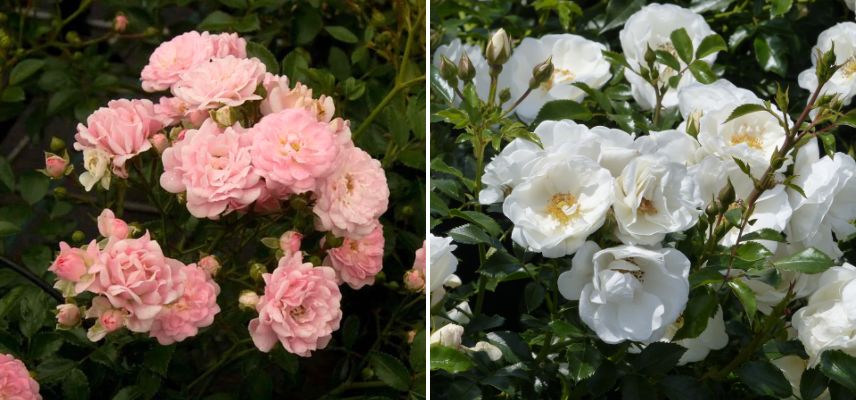
Left: Rose ‘The Fairy’ ; Right: Rose ‘Rigo Innocencia’
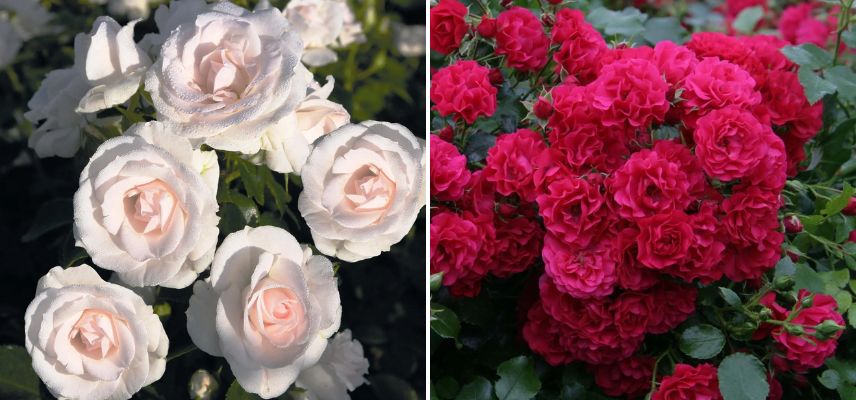
Rose ‘Aspirin Rose’
If you prefer white, slightly pink-tinged double flowers, the groundcover rose ‘Aspirin Rose’ will enchant you. This delicate flowering appears from June and continues until first frosts. At 80 cm tall and 1 m wide, this rose is perfect for adorning a rockery, bank or border. Hardy, it appreciates rich soils and a semi-shaded to sunny position. If you prefer a single-flowered rose, choose variety ‘Tapis Volant’.
Rose ‘Sans contraintes’ ® Toscana® ‘Korstesgli”
This groundcover rose, with raspberry-red blooms, is vigorous and easy to grow. It begins flowering in June and continues until first frosts. Hardy down to -20 °C, it is also very disease-resistant. At maturity it reaches 30 cm in height and 50 cm in width. It prefers rich, well-drained soils and a sunny position. For a striking contrast, pair it with silver-foliaged plants such as artemisia or santolinas.
And many more
There are many groundcover roses that you can find on this page: Our groundcover roses. Among them, rose ‘Golden Border’ with golden flowers that blooms until frosts, or variety ‘Pomponella’ for its many small, very round double roses.
Read also
10 pink flowering groundcover rosesWillmott's Plumbago
For warm, oceanic climates, Willmott’s plumbagos (Ceratostigma) are particularly drought-tolerant and undemanding as to soil type. These small, groundcover shrubs are covered in blue flowers from late summer until first frosts. In addition, their foliage takes on reddish hues as temperatures drop, adding further interest to the garden. These attractive groundcovers tolerate short frosts down to -14 °C and adapt well to dry, well-drained soils, with a preference for full sun.
Ceratostigma willmottianum
This plumbago is notable for its sky-blue flowers, appearing from August to November, on bronze to golden green foliage in summer, then reddening in autumn before falling. It reaches up to 1 metre in height, with a spread of 1.5 metres. It looks striking alongside an ornamental grass such as Stipa tenuissima ‘Pony tails’ to play on textures.
Ceratostigma willmottianum ‘Forest Blue’
This variety produces cobalt-blue flowers, very intense, almost electric, on mid-green foliage in the growing season, which gradually takes on red tones in autumn. More compact than the previous variety, ‘Forest Blue’ reaches 40 to 60 cm in height, with a spread of 80 cm. Undemanding, it grows comfortably in poor, stony soils. To prolong autumn colour in the garden, plant with sedum or euphorbia.
Ceratostigma willmottianum ‘Sapphire Ring‘
This cultivar is one of the most floriferous, with an abundant display of intense blue flowers from July to November. Its foliage is deciduous, mid-green in summer, then shaded with bronze and purple in autumn. Equally hardy to its relatives, it thrives in dry, sunny soils. Plant alongside caryopteris or perovskia for prolonged blue flowering and a drought-tolerant garden.
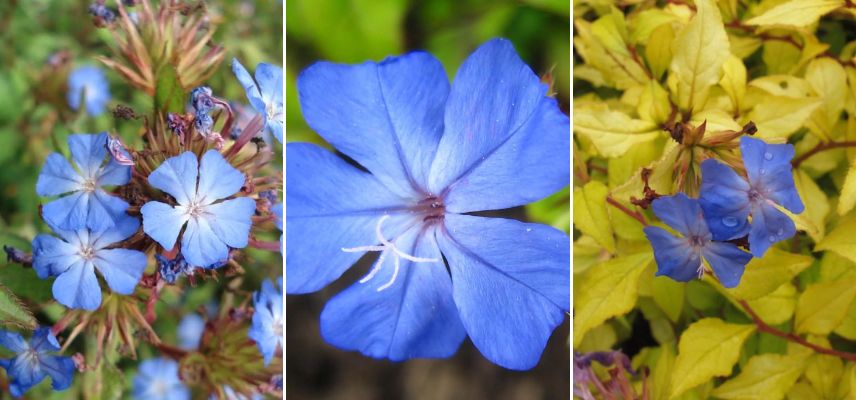
From left to right: Ceratostigma willmottianum , Ceratostigma willmottianum ‘Forest Blue’ et Ceratostigma willmottianum ‘Sapphire Ring‘
Summer flowering that lingers
Some varieties of groundcover shrubs flower in summer and extend their bloom into autumn, usually until the first frosts, bringing a colourful transition to the garden.
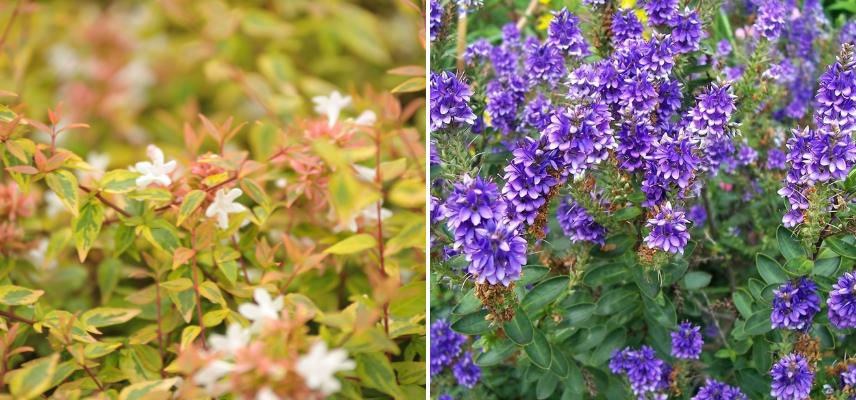
Abelia grandiflora ‘Kaleidoscope’
A pretty compact abelia variety that produces small white and pink, lightly scented flowers in summer which persist until October. It is also appreciated for its green foliage variegated with yellow, semi-evergreen, which turns golden and red in autumn, adding colour to the garden. This groundcover shrub will reach 80 cm in height and 1 metre in spread. Easy to grow and undemanding, it is hardy down to -15 °C in winter and prefers full sun or partial shade, in any well-drained soil. Pair it with Hydrangeas paniculata for a bed with staggered flowering.
Shrubby veronica ‘Autumn Glory‘
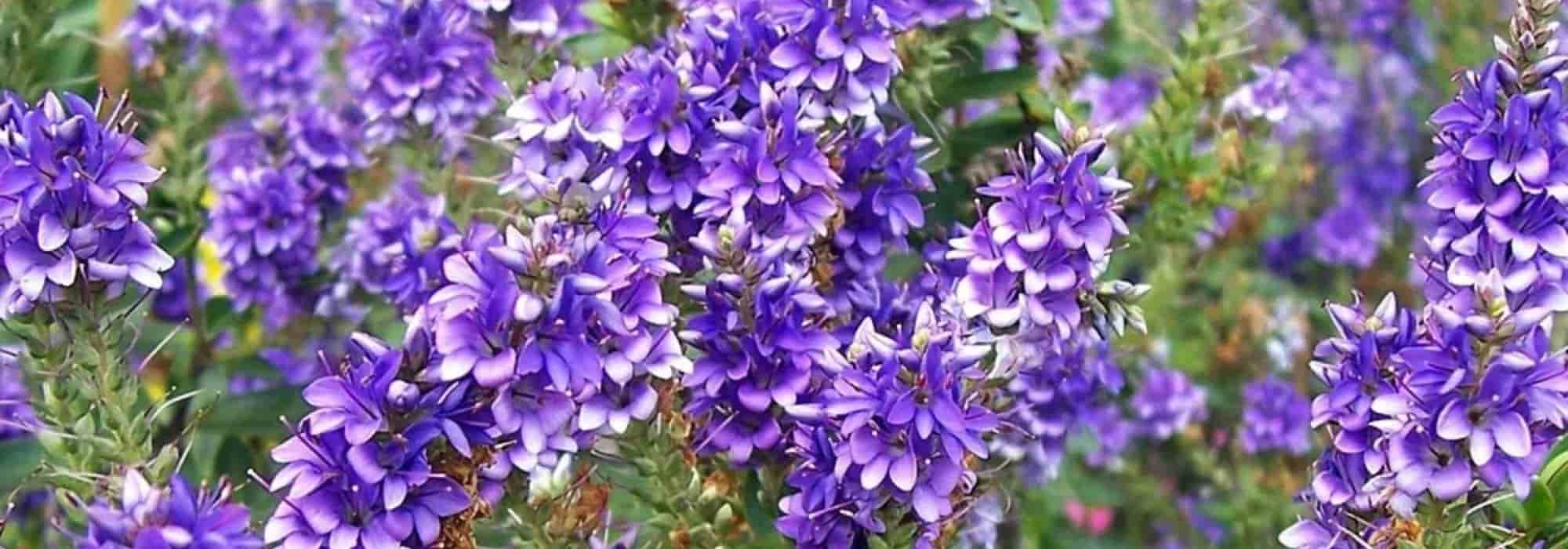
With its small mauve-blue and white flowers at the tips, the shrubby veronica ‘Autumn Glory’ brightens the garden from July to November. Its evergreen, glossy dark green foliage provides interest all year round. Easy to grow and disease-resistant, this Hebe is only moderately hardy (to -7 °C). It therefore performs well outdoors in warm or maritime regions, but can also be grown in a pot to protect it from winter cold in other regions. This compact plant (60–80 cm all round) prefers full sun or partial shade, in rich, well-drained soil. Pair it with heucheras for a contrast of colours and forms.
- Subscribe!
- Contents
This form is protected by reCAPTCHA - the Google Privacy Policy and Terms of Service apply.


































Comments