
How to overwinter a cuphea in a pot?
Our tips for protecting your cuphea from the cold over winter
Contents
Renowned for its colourful, abundant and exceptionally long-lasting flowering, cuphea is easy to grow in pots on balconies, terraces, windowsills and in courtyards. However, its tropical or subtropical origins make it a tender plant. As soon as autumn arrives, you need to think about overwintering it, as most cupheas cannot tolerate freezing temperatures. Discover all our advice for successfully overwintering your potted cuphea.

Why is potted cuphea so sensitive to the cold?
Cuphea is an undershrub in the Lythraceae family, native to tropical and subtropical regions of the Americas. This is why it is most often grown as an annual in our latitudes. Yet it is indeed a perennial. However, it is very tender and its hardiness is very limited. Most species of the genus Cuphea cannot tolerate temperatures below 0 °C. As soon as the thermometer dips towards 5 °C, it already begins to show signs of suffering: growth stops and the plant enters a kind of dormancy. Above all, its survival is at risk. The foliage turns yellow, the leaves fall and the stems become soft.
This is even more true if your Cuphea is grown in a pot. Its root system, confined to a limited volume of soil, is particularly vulnerable because the growing medium freezes much more quickly in a container than in the ground. In addition, the pot offers no protection. Consequently, the only way to keep your Cuphea from one year to the next is to overwinter it.
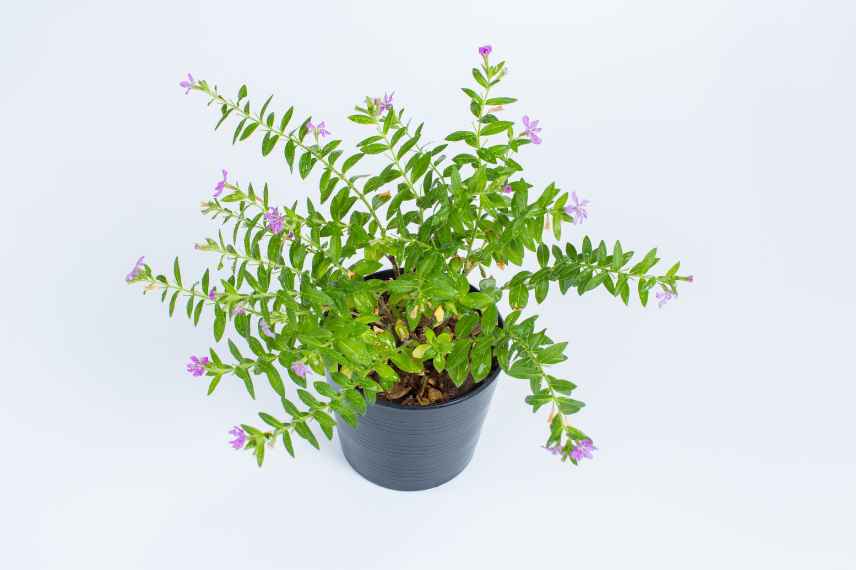
Due to its limited hardiness, Cuphea is ideally grown in a pot.
Where should you overwinter your cuphea?
Finding the right place to overwinter your Cuphea is the first key to success. It needs a light, frost-free space where the temperature generally remains between 8 °C and 15 °C. Unheated verandas, cold greenhouses, conservatories or even very bright rooms, such as a utility room with a large window, are ideal. On the other hand, you should avoid heated rooms such as a living room, lounge or kitchen, as well as dark places such as a windowless garage. In these conditions, your Cuphea would quickly show signs of weakness: sparse or rotting foliage.
Good light is essential during this overwintering period. Even when its evergreen or semi-evergreen foliage is resting, it needs light to maintain its vital functions through photosynthesis. This is why it is advisable to place the pot as close as possible to a south- or west-facing window or glazed door, while keeping it sheltered from direct sunlight, which can scorch the foliage even in winter.
Also make sure that the chosen spot is well ventilated to prevent cryptogamy, while avoiding direct cold draughts that could stress the plant. Good air circulation also helps maintain a balanced humidity level around the foliage, reducing the risk of fungi developing in stuffy, stagnant conditions.
How do you prepare cuphea for overwintering?
It is in autumn that you should start preparing your potted cuphea for overwintering.
The first step is to clean the plant. Remove all faded flowers and dead or yellowing leaves, as they can encourage the potential development of fungal diseases and the proliferation of pests such as whiteflies and thrips. Take advantage of this thorough clean-up to inspect your plant and look for any unwanted insects or hidden eggs. These could take advantage of the move to settle comfortably in your home, multiply and infest your other plants.

Before bringing the cuphea indoors, clean the foliage and prune it.
Next comes pruning, which is important for reducing the plant’s size and stimulating its vigour. Using clean secateurs disinfected with alcohol to prevent the transmission of pathogenic organisms from one plant to another, cut the stems back by about one third, or even by half for very vigorous plants, cutting just above a node or a bud. This clean-up pruning allows the plant to concentrate its remaining energy in its main trunk and roots, and encourages much denser, more vigorous branching as soon as spring returns.
How should you water cuphea in winter?
During the winter period, Cuphea’s water requirements decrease considerably. As the plant is no longer producing new leaves or flowers, its transpiration is minimal and its metabolism slows down. The most common mistake gardeners make is to water according to the usual summer schedule. Excess water combined with cooler temperatures suffocates the roots, inevitably causing root collar rot and the rapid death of the plant.
During these overwintering months, the rule is to wait until the potting compost is completely dry several centimetres below the surface before watering. Depending on the exact temperature of your overwintering room, watering every fortnight or even every three weeks may be more than enough to meet the plant’s minimal needs.
Always use water at room temperature, preferably lime-free, such as collected rainwater, and make sure you systematically empty any stagnant water from the saucer or cachepot a few minutes after watering to prevent any risk of rotting.
Should you fertilise a cuphea during overwintering?
The question of supplying nutrients does not even arise during winter: it must be stopped completely and rigorously. A Cuphea in dormancy or vegetative rest is unable to assimilate the fertilisers offered to it. Applying nitrogen, phosphorus or potassium at this time would seriously disrupt its natural cycle and encourage it to produce weak, thread-like and extremely fragile shoots. Above all, it could chemically scorch its roots, already weakened by the overall reduction in light and temperature.

When overwintering cuphea, stop applying fertiliser.
Stop applying fertiliser generally from the end of August or the beginning of September, well before overwintering, to give the plant time to use up the last nutrients present in the pot. Patiently wait until spring brings milder weather, precisely when active growth resumes and the first spring buds appear, before considering applying diluted organic fertiliser again to support its magnificent flowering.
Remember to watch out for pests.
An overwintered potted plant is always vulnerable to attacks from pests such as red spider mites and scale insects. This is especially true if the atmosphere is stuffy and ventilation is inadequate. These tiny insects suck the plant’s sap and considerably weaken it, potentially compromising its survival until spring if you do not take the time to check the overall condition of the foliage regularly.
A thorough weekly inspection of the undersides of the leaves and the axils of the stems is therefore strongly recommended throughout the cold season. If you notice the fine webbing characteristic of mites or small whitish, cottony clusters typical of scale insects, act immediately without delay. Meticulous manual cleaning with a cotton bud soaked in soapy water and a little methylated spirit is often enough to stop an infestation in its early stages.
- Subscribe!
- Contents
This form is protected by reCAPTCHA - the Google Privacy Policy and Terms of Service apply.

































Comments