
Mini Cyclamen Djix Red - F1 hybrid Cyclamen
Mini Cyclamen Djix Red - F1 hybrid Cyclamen
Cyclamen x persicum Djix Red®
Back-to-school special offer!
Get €10 off for every €50 you spend! And get up to €40 off on a single order.
How does it work?
1. Shop your favourites
Add your favourite plants to your basket. For every €50 you spend (excluding delivery charges, store credit and the plastic-free option), you’ll receive a €10 voucher.
€50 spent = €10 voucher
€100 spent = €20 voucher
€150 spent = €30 voucher
€200 spent = €40 voucher
2. Place your order
Once your basket reaches one of the spending thresholds, place your order. You can even choose your delivery date!
3. Receive your voucher
As soon as your order has been shipped, you’ll receive an email containing your personal voucher code and its value.
4. Use it on your next order
Your voucher is valid for 90 days from the date you receive it. It can be used once only, on a new order worth at least the value of the voucher, excluding delivery charges.
Please note: Vouchers can be combined with other offers, but cannot be split or refunded.
Why not try an alternative variety in stock?
View all →
Available in 4 sizes

Available in 1 sizes

Available in 2 sizes
This plant carries a 12 months recovery warranty
More information
We guarantee the quality of our plants for a full growing cycle, and will replace at our expense any plant that fails to recover under normal climatic and planting conditions.
Would this plant suit my garden?
Set up your Plantfit profile →
Description
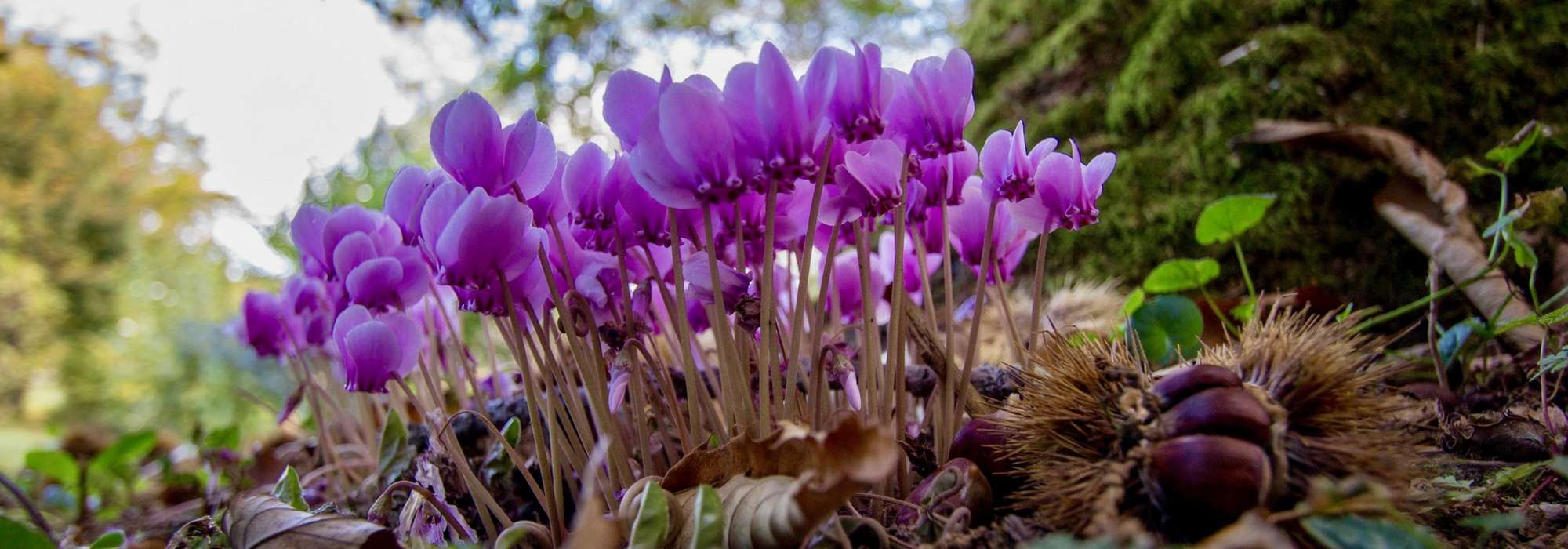
The mini-Cyclamen 'Dijx Red' is unique due to the shape of its flowers, completely inverted. Their fuchsia red and white contrasting colour is also remarkable. Together, they form a bouquet with great vivacity. It is a tender plant, but its long flowering period, from autumn to the heart of winter, is an undeniable asset for indoor decoration during this generally unfavourable period for flowering. The plant's habit is beautifully rounded, with beautiful dark green foliage veined and marbled with grey-green. The mini-cyclamen is often grown as an annual, in partial shade or shade under trees, along pathways, and in shaded rockeries where it looks sensational.
The Cyclamen Super Series 'Djix Red belongs to the Primulaceae family. It comes from the Persian Cyclamen, renowned for its beautiful winter flowering. It is a small perennial plant with tuberous roots, but not very hardy and cannot withstand frost. The tubers of the Cyclamen Dijx Red are round and compressed, covered with smooth and velvety 'skin' and roots originating from their centre and base. The plant's growth cycle depends on genetics and cultivation conditions. In this Djix Red variety, the dormant period corresponds to summer; the plant starts growing at the end of summer and blooms from October to January. It is possible to leave the tubers in the ground in areas spared from frost.
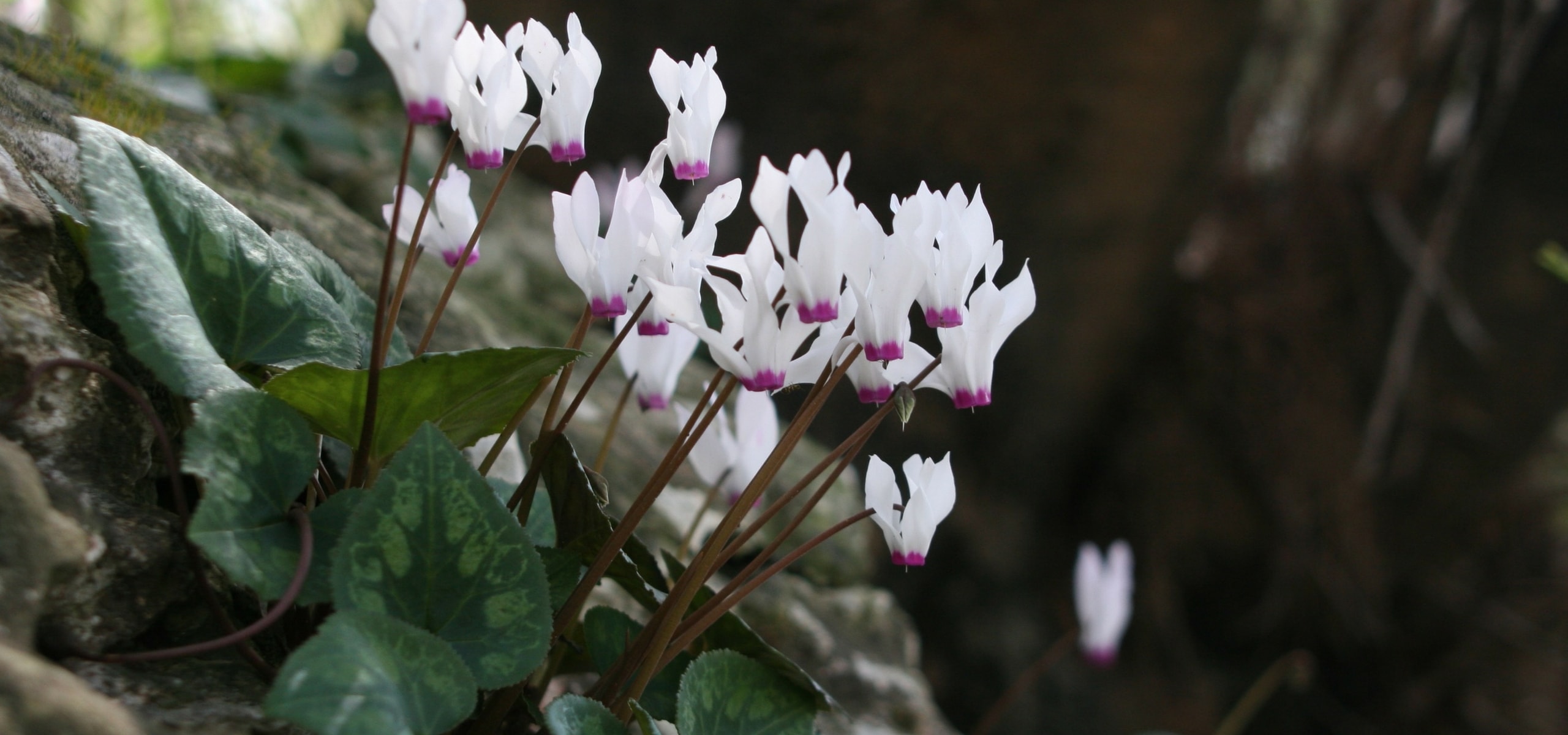
The leaves, round and cordate in shape, measure about 4 cm (2in) in diameter. The colour of the leaves is dark green with veins and maculations of grey-green. Together, they form a small cushion with a diameter of 25 cm (10in). The flowering emerges from the cushion at a height of 25 cm (10in). Initially lying on the ground, the pointed flower buds straighten up on brown peduncles. Each flower consists of 5 large, slightly twisted red petals completely curved backwards. They are enclosed in a small collar of 3 to 5 small white sepals, very appealing to the eye. As soon as the flowering is finished, the foliage turns yellow in January, disappears, and the plant goes into dormancy. During this time of year, watering should be reduced, and the plant should be stored in a cool place.
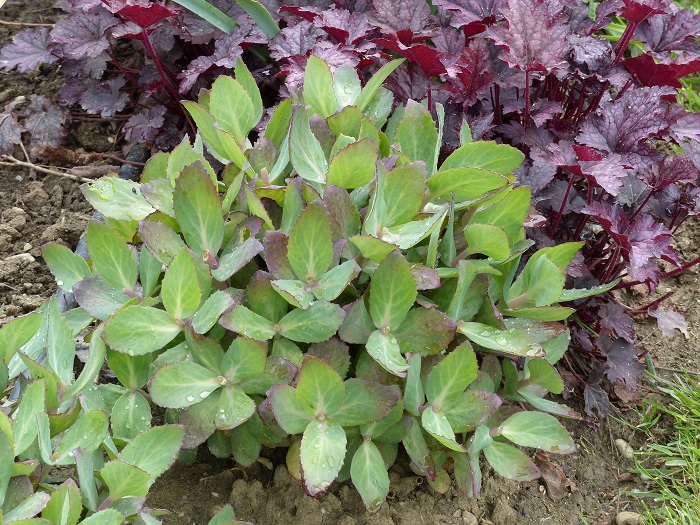
Plant the Cyclamen Super Series Djix in a pot or container with a variegated miniature ivy Kolibri, heucheras, euphorbias that tolerate partial shade, or dwarf euonymus. When planted en masse, in a mix of colours, mini-cyclamens create ephemeral but unforgettable carpets in shaded garden areas, along with begonias and impatiens. They are also ideal for a partially shaded rockery, not too dry, paired with blanda anemones and liverworts. Their red and white flowering is perfect for decorating tables during the end-of-year festivities.
Flowering
Foliage
Plant habit
Botanical data
Cyclamen
x persicum
Djix Red®
Primulaceae
Cultivar or hybrid
Planting and care
How to plant the mini cyclamen Super Series 'Djix Red':
- Place clay pellets in the bottom of your planter to add drainage and aeration.
- Fill the planter 3/4 full with high-quality draining soil.
- Water around the root ball, not in the centre of the plant, to avoid rotting the bulb.
You can also grow this variety in open ground as an annual, in a shaded bed protected from cold winds. It can withstand the first frosts to about -2°C (28.4°F). It tolerates summer heat and drought well, as the tubers are dormant at this time of year.
Maintenance:
Indoors, avoid excessive heat, watering, dry air, and direct sunlight.
Place your cyclamen in a room maintained at around 15°C (59°F), away from direct sunlight.
Place a saucer under your planter, as this will aid watering.
During the growth and flowering period, water regularly, always waiting for the substrate to be almost dry between waterings. Empty the saucer 2 hours after watering if necessary. Remove faded flowers as they appear. Optionally, use a fertiliser for flowering plants.
After flowering, reduce and stop watering, and do not provide any more fertiliser. Cut off dry leaves. Repot your mini cyclamen in a larger container. Once the foliage is completely dry, store your planter frost-free in a shaded area with little or no heat. Begin gradually watering again at the end of summer.
Planting period
Intended location
Care
Planting & care advice
-

-
-
-
-
-
-

-

This item has not been reviewed yet - be the first to leave a review about it.
Recently viewed products
Haven't found what you were looking for?
Hardiness is the lowest winter temperature a plant can endure without suffering serious damage or even dying. However, hardiness is affected by location (a sheltered area, such as a patio), protection (winter cover) and soil type (hardiness is improved by well-drained soil).

The flowering period indicated on our website applies to countries and regions located in USDA zone 8 (France, the United Kingdom, Ireland, the Netherlands, etc.)
It will vary according to where you live:- In zones 9 to 10 (Italy, Spain, Greece, etc.), flowering will occur about 2 to 4 weeks earlier.
- In zones 6 to 7 (Germany, Poland, Slovenia, and lower mountainous regions), flowering will be delayed by 2 to 3 weeks.
- In zone 5 (Central Europe, Scandinavia), blooming will be delayed by 3 to 5 weeks.
In temperate climates, pruning of spring-flowering shrubs (forsythia, spireas, etc.) should be done just after flowering.
Pruning of summer-flowering shrubs (Indian Lilac, Perovskia, etc.) can be done in winter or spring.
In cold regions as well as with frost-sensitive plants, avoid pruning too early when severe frosts may still occur.
The planting period indicated on our website applies to countries and regions located in USDA zone 8 (France, United Kingdom, Ireland, Netherlands).
It will vary according to where you live:
- In Mediterranean zones (Marseille, Madrid, Milan, etc.), autumn and winter are the best planting periods.
- In continental zones (Strasbourg, Munich, Vienna, etc.), delay planting by 2 to 3 weeks in spring and bring it forward by 2 to 4 weeks in autumn.
- In mountainous regions (the Alps, Pyrenees, Carpathians, etc.), it is best to plant in late spring (May-June) or late summer (August-September).
The harvesting period indicated on our website applies to countries and regions in USDA zone 8 (France, England, Ireland, the Netherlands).
In colder areas (Scandinavia, Poland, Austria...) fruit and vegetable harvests are likely to be delayed by 3-4 weeks.
In warmer areas (Italy, Spain, Greece, etc.), harvesting will probably take place earlier, depending on weather conditions.
The sowing periods indicated on our website apply to countries and regions within USDA Zone 8 (France, UK, Ireland, Netherlands).
In colder areas (Scandinavia, Poland, Austria...), delay any outdoor sowing by 3-4 weeks, or sow under glass.
In warmer climes (Italy, Spain, Greece, etc.), bring outdoor sowing forward by a few weeks.
Shipping country and language
Your country of residence may be:
Your country of residence is:
For a better user experience on our website, you can select:
Your shipping country:
-
 Austria
-
 Belgium
-
 Bosnia & Herzegovina
-
 Bulgaria
-
 Croatia
-
 Cyprus
-
 Czechia
-
 Denmark
-
 Estonia
-
 Finland
-
 France
-
 Germany
-
 Greece
-
 Hungary
-
 Iceland
-
 Ireland
-
 Italy
Italy
-
 Latvia
-
 Liechtenstein
-
 Lithuania
-
 Luxembourg
-
 Malta
Malta
-
 Netherlands
-
 Poland
-
 Portugal
-
 Romania
-
 Serbia
-
 Slovakia
-
 Slovenia
-
 Spain
Spain
-
 Sweden
-
 Switzerland
Language:
-
French
-
 English
-
Spanish
-
Italian
-
German
-
Portuguese
-
Dutch
-
Finnish
My Account
Hello
My wish lists
My cart
Log in / Register
Existing customer?
This form is protected by reCAPTCHA - the Google Privacy Policy and Terms of Service apply.
New customer?
Create an account to track your orders, access our customer service and, if you wish, make the most of our upcoming offers.