
Delphinium ruysii Pink Sensation - Larkspur

Delphinium ruysii Pink Sensation - Larkspur

Delphinium ruysii Pink Sensation - Larkspur

Delphinium ruysii Pink Sensation - Larkspur

Delphinium ruysii Pink Sensation - Larkspur

Delphinium ruysii Pink Sensation - Larkspur

Delphinium ruysii Pink Sensation - Larkspur

Delphinium ruysii Pink Sensation - Larkspur
Delphinium ruysii Pink Sensation - Larkspur
Delphinium × ruysii Pink Sensation
Larkspur
Plant received quickly, produced a very beautiful flowering and flourished well. Very pleased.
Liliane, 30/09/2024
Back-to-school special offer!
Get €10 off for every €50 you spend! And get up to €40 off on a single order.
How does it work?
1. Shop your favourites
Add your favourite plants to your basket. For every €50 you spend (excluding delivery charges, store credit and the plastic-free option), you’ll receive a €10 voucher.
€50 spent = €10 voucher
€100 spent = €20 voucher
€150 spent = €30 voucher
€200 spent = €40 voucher
2. Place your order
Once your basket reaches one of the spending thresholds, place your order. You can even choose your delivery date!
3. Receive your voucher
As soon as your order has been shipped, you’ll receive an email containing your personal voucher code and its value.
4. Use it on your next order
Your voucher is valid for 90 days from the date you receive it. It can be used once only, on a new order worth at least the value of the voucher, excluding delivery charges.
Please note: Vouchers can be combined with other offers, but cannot be split or refunded.
Home or relay delivery (depending on size and destination)
Important: You may be charged customs duties by your country’s customs authorities upon delivery.
Schedule delivery date
and select date in basket
This plant carries a 12 months recovery warranty
More information
We guarantee the quality of our plants for a full growing cycle, and will replace at our expense any plant that fails to recover under normal climatic and planting conditions.
Would this plant suit my garden?
Set up your Plantfit profile →
Description
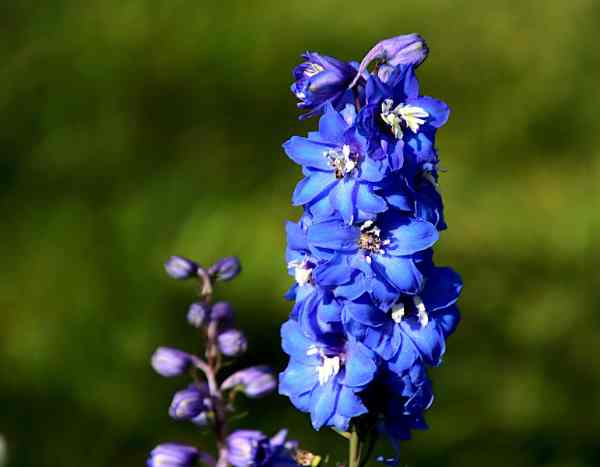
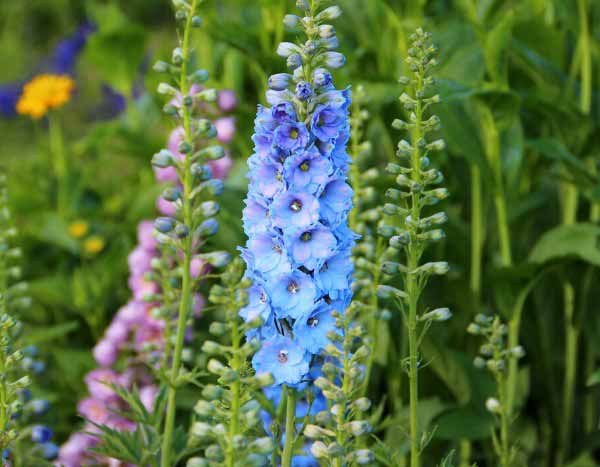
Le Delphinium × ruysii ‘Pink Sensation’, ou pied-d’alouette vivace, est un hybride remarquable par ses fleurs d'un rose saumoné, une couleur peu courante et pleine de charme. Elles éclosent sur des épis minces et ramifiés, plus gracieux que les longues chandelles des grands hybrides classiques. Si l'on prend soin de couper les premières hampes fanées, la plante peut refleurir à la fin de l’été. Elle est parfaite avec des roses anglaises, dans un massif romantique ou de cottage, et ses tiges fleuries peuvent également être cueillies pour les bouquets.
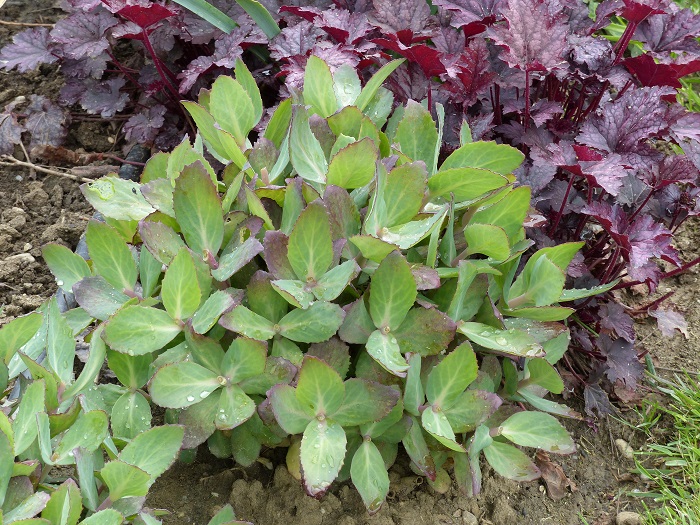
Ce delphinium appartient à la famille des Renonculacées. C’est une vivace herbacée de courte vie : toute sa végétation aérienne sèche en automne, puis de nouvelles pousses paraissent au printemps à partir de la souche. Il s'agit d'un hybride horticole et non d'une espèce sauvage. D’origine néerlandaise, apparu fortuitement, ‘Pink Sensation’ serait issu d’un croisement entre un Delphinium elatum et un D. nudicaule. Le premier est originaire d’Eurasie. Le second pousse dans l’ouest de l’Amérique du Nord, de la Californie à l’Oregon, et porte des fleurs rouges ou orangées. Ce parent californien a transmis à l’hybride ses tons chauds, très éloignés du bleu qui domine chez les pieds-d’alouette. La plante forme une touffe étroite de feuilles concentrées dans sa partie basse. Dans une terre riche et fraîche, ses tiges florales dressées et ramifiées atteignent 1 m à 1,40 m de hauteur pour une envergure de 40 à 50 cm. Ses feuilles vert foncé sont arrondies dans leur contour, mais profondément découpées en lobes étroits. À partir de juin, les tiges portent plusieurs grappes allongées de fleurs ouvertes, de 3,5 à 4 cm de diamètre, munies à l’arrière de l’éperon caractéristique du genre. Leur coloris rose saumoné, plus ou moins grisé selon la lumière et la température, peut se rapprocher du blanc ou du mauve près du centre. La floraison principale se poursuit en juillet et en août. Si les épis défleuris sont coupés assez tôt, de nouvelles fleurs apparaissent sur les ramifications secondaires jusqu’en septembre, voire en octobre sous un climat doux. Cet hybride résiste jusqu'à environ −15 °C.
Dans un grand massif romantique, ce delphinium se glisse entre des rosiers anglais, des campanules, des digitales et des népétas. Ses épis rose saumoné accompagnent les roses abricotées de ‘The Lark Ascending’ et le rose tendre de ‘Gentle Hermione’. Autour d’eux, la Campanula lactiflora ‘Prichard’s Variety’, la digitale ‘Sutton’s Apricot’ et le Nepeta ‘Walker’s Low’ composent un mélange de bleu mauve, de rose et d’abricot. Les fleurs se mêlent à différentes hauteurs, comme dans les grandes plates-bandes des jardins anglais.
Note : de mars à septembre, les tiges de nos delphiniums sont taillées court afin de permettre une meilleure ramification de la souche et d'obtenir un enracinement optimal. Cette taille permet par ailleurs aux tiges de ne pas se casser durant le transport.
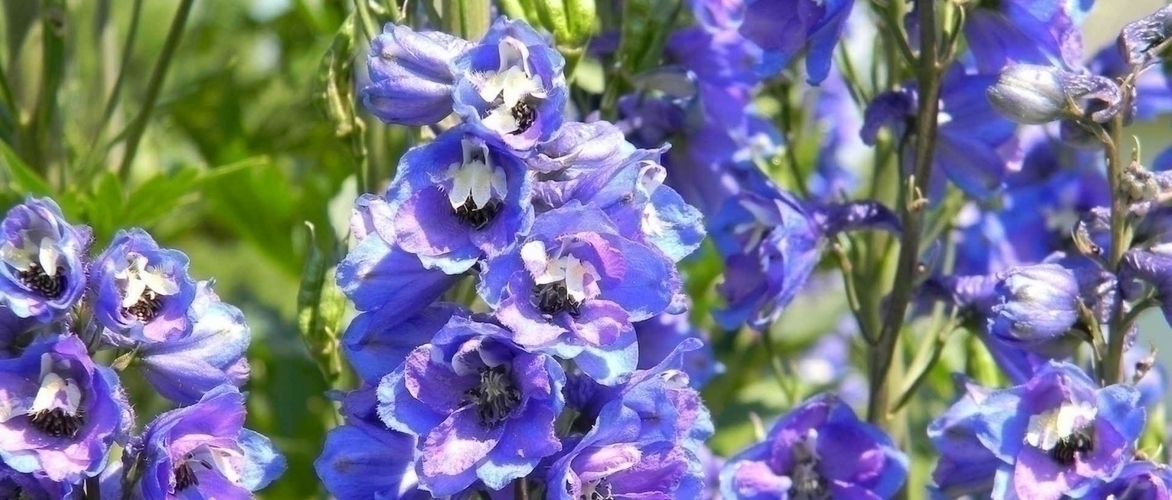
Delphinium ruysii Pink Sensation - Larkspur in pictures


Flowering
Foliage
Plant habit
Safety measures
Botanical data
Delphinium
× ruysii
Pink Sensation
Ranunculaceae
Larkspur
Delphinium × ruysii ‘Pink Sensation’
Cultivar or hybrid
ingestion
Cette plante est toxique si elle est ingérée volontairement ou involontairement.
Ne la plantez pas là où de jeunes enfants peuvent évoluer, et lavez-vous les mains après l'avoir manipulée.
Pensez à conserver l'étiquette de la plante, à la photographier ou à noter son nom, afin de faciliter le travail des professionnels de santé.
Davantage d'informations sur https://plantes-risque.info
Planting and care
Delphinium × ruysii ‘Pink Sensation’ is planted from February to April or from September to November, when no frost is forecast and in soil that is not waterlogged. Choose a sunny position, sheltered from strong winds. Loosen the soil deeply and incorporate well-rotted compost; in clay soil, place the stump on a slight mound so that water drains away in winter. Chalk is tolerated. Place the collar at soil level and space the young plants 45 to 50 cm apart. Water during the first growth season, then whenever the soil is dry in summer. A spring application of compost and a thin mulch maintain a cool, moist environment, without covering the stump. Install a stake when the stems reach 40 to 50 cm and watch out for slugs as growth begins. Basal cuttings taken in spring allow this short-lived cultivar to be maintained.
Planting period
Intended location
Care
Planting & care advice
-
-
-
-
-
-
-
-
-
, onOrder confirmed
Reply from on Promesse de fleurs
Recently viewed products
Haven't found what you were looking for?
Hardiness is the lowest winter temperature a plant can endure without suffering serious damage or even dying. However, hardiness is affected by location (a sheltered area, such as a patio), protection (winter cover) and soil type (hardiness is improved by well-drained soil).

The flowering period indicated on our website applies to countries and regions located in USDA zone 8 (France, the United Kingdom, Ireland, the Netherlands, etc.)
It will vary according to where you live:- In zones 9 to 10 (Italy, Spain, Greece, etc.), flowering will occur about 2 to 4 weeks earlier.
- In zones 6 to 7 (Germany, Poland, Slovenia, and lower mountainous regions), flowering will be delayed by 2 to 3 weeks.
- In zone 5 (Central Europe, Scandinavia), blooming will be delayed by 3 to 5 weeks.
In temperate climates, pruning of spring-flowering shrubs (forsythia, spireas, etc.) should be done just after flowering.
Pruning of summer-flowering shrubs (Indian Lilac, Perovskia, etc.) can be done in winter or spring.
In cold regions as well as with frost-sensitive plants, avoid pruning too early when severe frosts may still occur.
The planting period indicated on our website applies to countries and regions located in USDA zone 8 (France, United Kingdom, Ireland, Netherlands).
It will vary according to where you live:
- In Mediterranean zones (Marseille, Madrid, Milan, etc.), autumn and winter are the best planting periods.
- In continental zones (Strasbourg, Munich, Vienna, etc.), delay planting by 2 to 3 weeks in spring and bring it forward by 2 to 4 weeks in autumn.
- In mountainous regions (the Alps, Pyrenees, Carpathians, etc.), it is best to plant in late spring (May-June) or late summer (August-September).
The harvesting period indicated on our website applies to countries and regions in USDA zone 8 (France, England, Ireland, the Netherlands).
In colder areas (Scandinavia, Poland, Austria...) fruit and vegetable harvests are likely to be delayed by 3-4 weeks.
In warmer areas (Italy, Spain, Greece, etc.), harvesting will probably take place earlier, depending on weather conditions.
The sowing periods indicated on our website apply to countries and regions within USDA Zone 8 (France, UK, Ireland, Netherlands).
In colder areas (Scandinavia, Poland, Austria...), delay any outdoor sowing by 3-4 weeks, or sow under glass.
In warmer climes (Italy, Spain, Greece, etc.), bring outdoor sowing forward by a few weeks.
Shipping country and language
Your country of residence may be:
Your country of residence is:
For a better user experience on our website, you can select:
Your shipping country:
-
 Austria
-
 Belgium
-
 Bosnia & Herzegovina
-
 Bulgaria
-
 Croatia
-
 Cyprus
-
 Czechia
-
 Denmark
-
 Estonia
-
 Finland
-
 France
-
 Germany
-
 Greece
-
 Hungary
-
 Iceland
-
 Ireland
-
 Italy
-
 Latvia
-
 Liechtenstein
-
 Lithuania
-
 Luxembourg
-
 Malta
-
 Netherlands
-
 Poland
-
 Portugal
-
 Romania
-
 Serbia
-
 Slovakia
-
 Slovenia
-
 Spain
-
 Sweden
-
 Switzerland
Language:
-
French
-
 English
-
Spanish
-
Italian
-
German
-
Portuguese
-
Dutch
-
Finnish
My Account
Hello
My wish lists
My cart
Log in / Register
Existing customer?
This form is protected by reCAPTCHA - the Google Privacy Policy and Terms of Service apply.
New customer?
Create an account to track your orders, access our customer service and, if you wish, make the most of our upcoming offers.