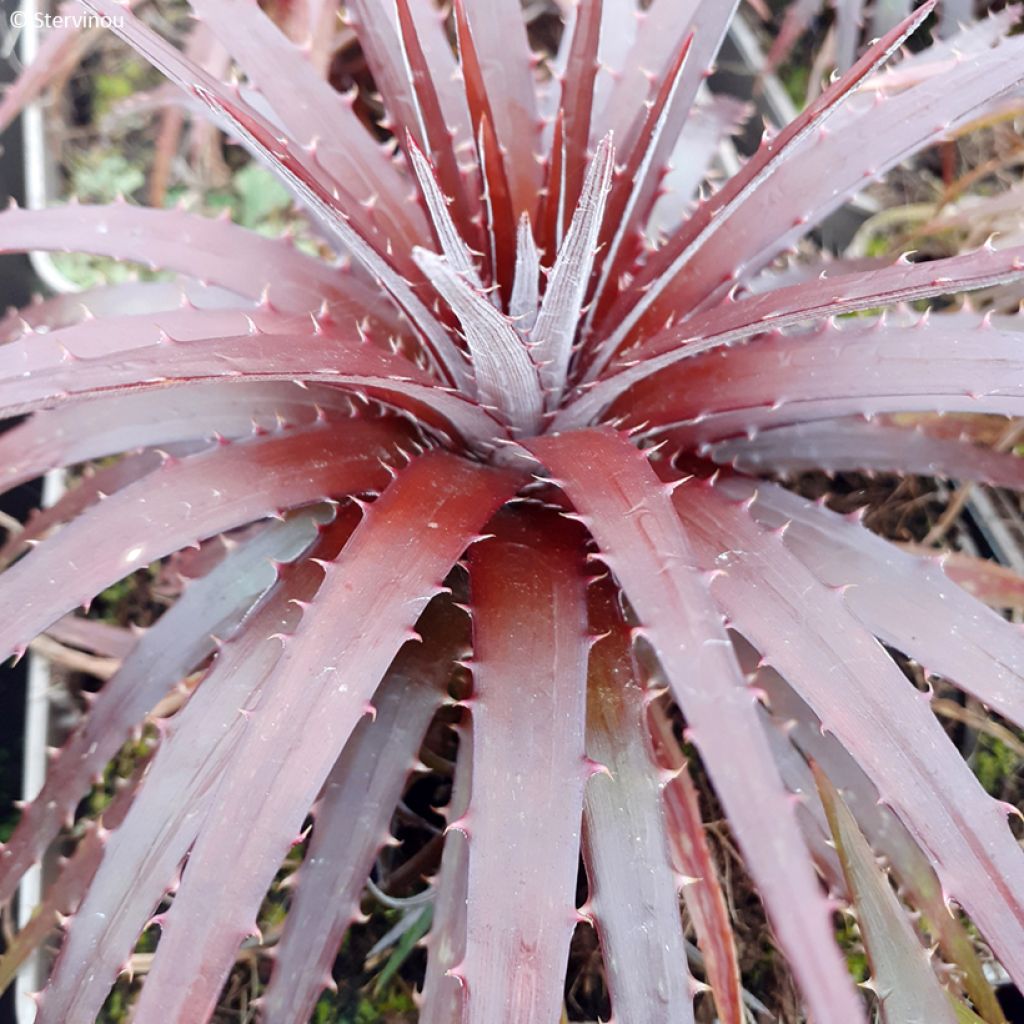
Dyckia Burgundy Ice
Dyckia Burgundy Ice
Dyckia Burgundy Ice
Saw-blade
Matches the photo shown on the website. Can't wait to see it grow!
SHINRA TENSEI, 28/10/2025
Back-to-school special offer!
Get €10 off for every €50 you spend! And get up to €40 off on a single order.
How does it work?
1. Shop your favourites
Add your favourite plants to your basket. For every €50 you spend (excluding delivery charges, store credit and the plastic-free option), you’ll receive a €10 voucher.
€50 spent = €10 voucher
€100 spent = €20 voucher
€150 spent = €30 voucher
€200 spent = €40 voucher
2. Place your order
Once your basket reaches one of the spending thresholds, place your order. You can even choose your delivery date!
3. Receive your voucher
As soon as your order has been shipped, you’ll receive an email containing your personal voucher code and its value.
4. Use it on your next order
Your voucher is valid for 90 days from the date you receive it. It can be used once only, on a new order worth at least the value of the voucher, excluding delivery charges.
Please note: Vouchers can be combined with other offers, but cannot be split or refunded.
Home or relay delivery (depending on size and destination)
Important: You may be charged customs duties by your country’s customs authorities upon delivery.
Schedule delivery date
and select date in basket
This plant carries a 12 months recovery warranty
More information
We guarantee the quality of our plants for a full growing cycle, and will replace at our expense any plant that fails to recover under normal climatic and planting conditions.

Would this plant suit my garden?
Set up your Plantfit profile →
Description
The Dyckia 'Burgundy Ice' is a perennial whose silhouette is as intriguing as it is appealing. This plant with an exotic appearance forms a rosette of long, very slender leaves, punctuated with small curved teeth that are best avoided. Evergreen, its distinctive graphic design and shiny dark purple colour make it particularly attractive. The plant gradually widens by producing offsets at the base and eventually forms a low cushion, wider than it is tall. In summer, flower spikes rise from mature rosettes, displaying small flowers in a bright orange hue at their tips. With low to medium hardiness, this Dyckia can be grown in the ground in mild climates, or in a pot to be brought indoors in winter in harsher climates.
The Dyckia belongs to the Bromeliaceae family, which includes around fifty genera mainly found in tropical areas of South America. Many species are epiphytic, meaning they grow on a support like a tree, and some are terrestrial, the most famous being the Pineapple. In this second category, there are many ornamental plants, like the Guzmania or the Billbergia, grown indoors, but some can also be planted outdoors in mild climates, such as the Puya or the Dyckia, whose rosettes bear a clear family resemblance. Botanical classifications estimate the number of Dyckia species to be close to 200, originating from South America and predominantly Brazil. The plant is also known by its former genus names Garrelia and Prionophyllum.
'Burgundy Ice' is a horticultural variety particularly decorative in all seasons with its colourful evergreen foliage. It appears to be a hybrid of Dyckia platyphylla, a botanical species that grows naturally in the state of Bahia (central-east Brazil), capable of withstanding -8°C despite its tropical origin. The wild plant has green leaves, but they tend to turn purple in the sun, enhanced by whitish teeth around their edges, and produces an orange-yellow flowering. 'Burgundy Ice' would thus be a more ornamental improvement compared to the species. This slow-growing perennial forms an initial rosette consisting of very slender leaves, whose width gradually and regularly decreases from the base to the pointed end. These leaves are adorned with short needles, nevertheless formidable to touch, curved downwards, and with a white-yellow colour that contrasts beautifully with the dark colour of the leaf blade. In full sun, the leaves take on a dark burgundy hue, hence the plant's baptismal name, while in lower light, they tend to be a dark green with a slightly metallic sheen. Over time, the Dyckia widens by producing offsets at the base, which in turn form rosettes that tend to overlap and intertwine slightly, giving the clump a very decorative tousled appearance. After 10 years of cultivation, the developed low cushion will reach approximately 30 cm in height by 40 cm in width. Mature rosettes produce a lovely summer flowering in the form of flower spikes that rise up to 70-80 cm in height. Their tips consist of a spike of small sessile flowers (lacking floral stalks and therefore directly attached to the flower axis), somewhat tubular, with a flared end. Measuring approximately 2 to 3 cm in length and numbering around fifteen, they are mainly eye-catching due to their bright orange colour, punctuated in the centre by the yellow of the stamens.
With its compact habit, Dyckia 'Burgundy Ice' can easily be grown in a pot to be sheltered in winter in regions too cold to plant it in the ground, although its hardiness (down to -10°C in well-drained conditions) is quite commendable for a Bromeliad. In Atlantic coastal areas, and in the south (where summer watering will be necessary), you can place it in a rockery to create an exotic scene. Pair it with other plants with distinctive silhouettes like Mangaves with their highly decorative leaves. In cooler zones, opt instead for Aloe striatula, with its exotic appearance resembling its cousins from warm countries and its generous yellow-orange candelabra-like flowering. To move away from rosette forms and vary silhouettes, adopt the surprising Cylindropuntia kleiniae, much hardier than its desert cactus appearance suggests. Its cylindrical stems and ephemeral but stunning flowers are unmatched in creating an atmosphere with distant accents.
Dyckia Burgundy Ice in pictures
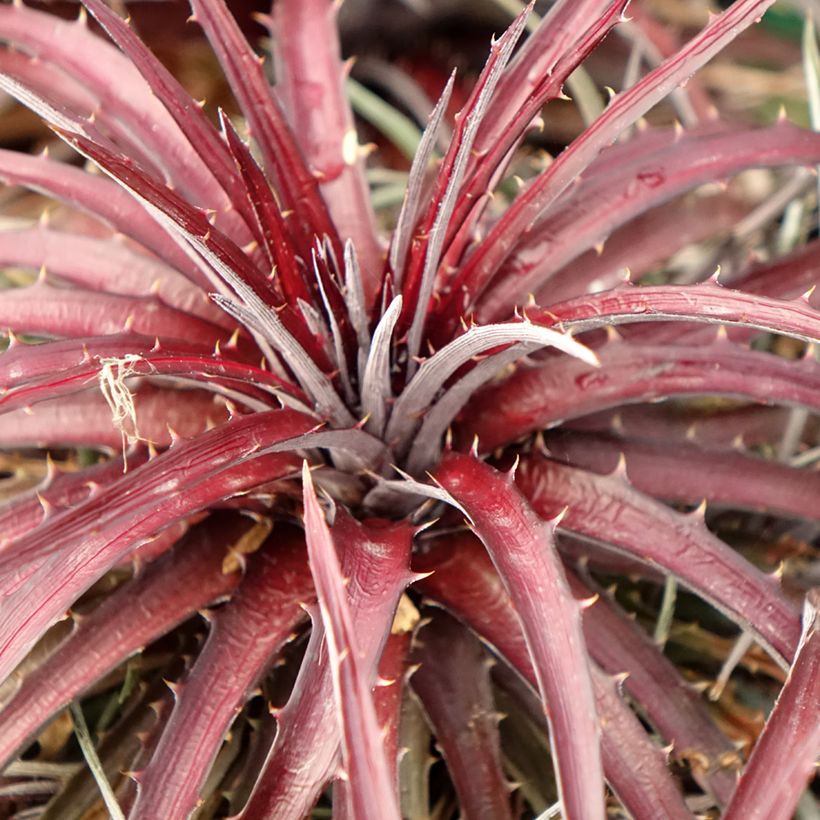
Flowering
Foliage
Plant habit
Botanical data
Dyckia
Burgundy Ice
Bromeliaceae
Saw-blade
South America
Planting and care
The Dyckia 'Burgundy Ice' is a plant with moderate hardiness that can be grown in open ground mainly in regions where frosts only occasionally drop to -8°C/-10°C, in dry conditions. Indeed, humidity accentuates the effects of frost, so it will need a well-draining soil for the winter (while in summer, it will appreciate regular watering). In climates that are too cold, or cool and humid at the same time, pot cultivation is more suitable, allowing for overwintering sheltered from frost in a cool and bright room, greatly reducing watering.
Plant your Dyckia in a wider than high pot with the bottom filled with gravel, potsherds, or clay pellets. The mix it is placed in should be fertile and well-draining (1/3 leaf compost, 1/3 regular garden soil, 1/3 sand enriched with a handful of crushed horn). A special cactus potting mix will work very well.
Position the plant in full sun. Water regularly during the growth period so that the soil never completely dries out. Feed the plant with diluted "special green plant" fertiliser once a month in the watering water. In winter, reduce watering and feeding, and let the soil almost dry out between waterings.
In regions with mild climates and light frosts, plant it in open ground, in the sun, in a very well-drained, even sandy or rocky soil mixed with leaf compost. In summer, make sure the plant does not lack water too much: watering once a week or every 15 days will suffice, depending on your climate. In winter, it can do without rain or watering.
If heavy frost is forecast, lay down a thick mulch at the base of the plant and cover it with a thick winter veil. The drier the soil, the more the plant will resist frosts.
Planting period
Intended location
Care
Planting & care advice
-
-
-
-
-

-
-
-
-
, onOrder confirmed
Reply from on Promesse de fleurs
Recently viewed products
Haven't found what you were looking for?
Hardiness is the lowest winter temperature a plant can endure without suffering serious damage or even dying. However, hardiness is affected by location (a sheltered area, such as a patio), protection (winter cover) and soil type (hardiness is improved by well-drained soil).

The flowering period indicated on our website applies to countries and regions located in USDA zone 8 (France, the United Kingdom, Ireland, the Netherlands, etc.)
It will vary according to where you live:- In zones 9 to 10 (Italy, Spain, Greece, etc.), flowering will occur about 2 to 4 weeks earlier.
- In zones 6 to 7 (Germany, Poland, Slovenia, and lower mountainous regions), flowering will be delayed by 2 to 3 weeks.
- In zone 5 (Central Europe, Scandinavia), blooming will be delayed by 3 to 5 weeks.
In temperate climates, pruning of spring-flowering shrubs (forsythia, spireas, etc.) should be done just after flowering.
Pruning of summer-flowering shrubs (Indian Lilac, Perovskia, etc.) can be done in winter or spring.
In cold regions as well as with frost-sensitive plants, avoid pruning too early when severe frosts may still occur.
The planting period indicated on our website applies to countries and regions located in USDA zone 8 (France, United Kingdom, Ireland, Netherlands).
It will vary according to where you live:
- In Mediterranean zones (Marseille, Madrid, Milan, etc.), autumn and winter are the best planting periods.
- In continental zones (Strasbourg, Munich, Vienna, etc.), delay planting by 2 to 3 weeks in spring and bring it forward by 2 to 4 weeks in autumn.
- In mountainous regions (the Alps, Pyrenees, Carpathians, etc.), it is best to plant in late spring (May-June) or late summer (August-September).
The harvesting period indicated on our website applies to countries and regions in USDA zone 8 (France, England, Ireland, the Netherlands).
In colder areas (Scandinavia, Poland, Austria...) fruit and vegetable harvests are likely to be delayed by 3-4 weeks.
In warmer areas (Italy, Spain, Greece, etc.), harvesting will probably take place earlier, depending on weather conditions.
The sowing periods indicated on our website apply to countries and regions within USDA Zone 8 (France, UK, Ireland, Netherlands).
In colder areas (Scandinavia, Poland, Austria...), delay any outdoor sowing by 3-4 weeks, or sow under glass.
In warmer climes (Italy, Spain, Greece, etc.), bring outdoor sowing forward by a few weeks.
Shipping country and language
Your country of residence may be:
Your country of residence is:
For a better user experience on our website, you can select:
Your shipping country:
-
 Austria
-
 Belgium
-
 Bosnia & Herzegovina
-
 Bulgaria
-
 Croatia
-
 Cyprus
-
 Czechia
-
 Denmark
-
 Estonia
-
 Finland
-
 France
-
 Germany
-
 Greece
-
 Hungary
-
 Iceland
-
 Ireland
-
 Italy
Italy
-
 Latvia
-
 Liechtenstein
-
 Lithuania
-
 Luxembourg
-
 Malta
Malta
-
 Netherlands
-
 Poland
-
 Portugal
-
 Romania
-
 Serbia
-
 Slovakia
-
 Slovenia
-
 Spain
Spain
-
 Sweden
-
 Switzerland
Language:
-
French
-
 English
-
Spanish
-
Italian
-
German
-
Portuguese
-
Dutch
-
Finnish
My Account
Hello
My wish lists
My cart
Log in / Register
Existing customer?
This form is protected by reCAPTCHA - the Google Privacy Policy and Terms of Service apply.
New customer?
Create an account to track your orders, access our customer service and, if you wish, make the most of our upcoming offers.