Adansonia digitata - Baobab seeds
Adansonia digitata - Baobab seeds
Adansonia digitata - Baobab seeds
Adansonia digitata
Baobab
Back-to-school special offer!
Get €10 off for every €50 you spend! And get up to €40 off on a single order.
How does it work?
1. Shop your favourites
Add your favourite plants to your basket. For every €50 you spend (excluding delivery charges, store credit and the plastic-free option), you’ll receive a €10 voucher.
€50 spent = €10 voucher
€100 spent = €20 voucher
€150 spent = €30 voucher
€200 spent = €40 voucher
2. Place your order
Once your basket reaches one of the spending thresholds, place your order. You can even choose your delivery date!
3. Receive your voucher
As soon as your order has been shipped, you’ll receive an email containing your personal voucher code and its value.
4. Use it on your next order
Your voucher is valid for 90 days from the date you receive it. It can be used once only, on a new order worth at least the value of the voucher, excluding delivery charges.
Please note: Vouchers can be combined with other offers, but cannot be split or refunded.
This plant carries a 6 months recovery warranty
More information
We guarantee the quality of our plants for a full growing cycle, and will replace at our expense any plant that fails to recover under normal climatic and planting conditions.
Would this plant suit my garden?
Set up your Plantfit profile →
Description
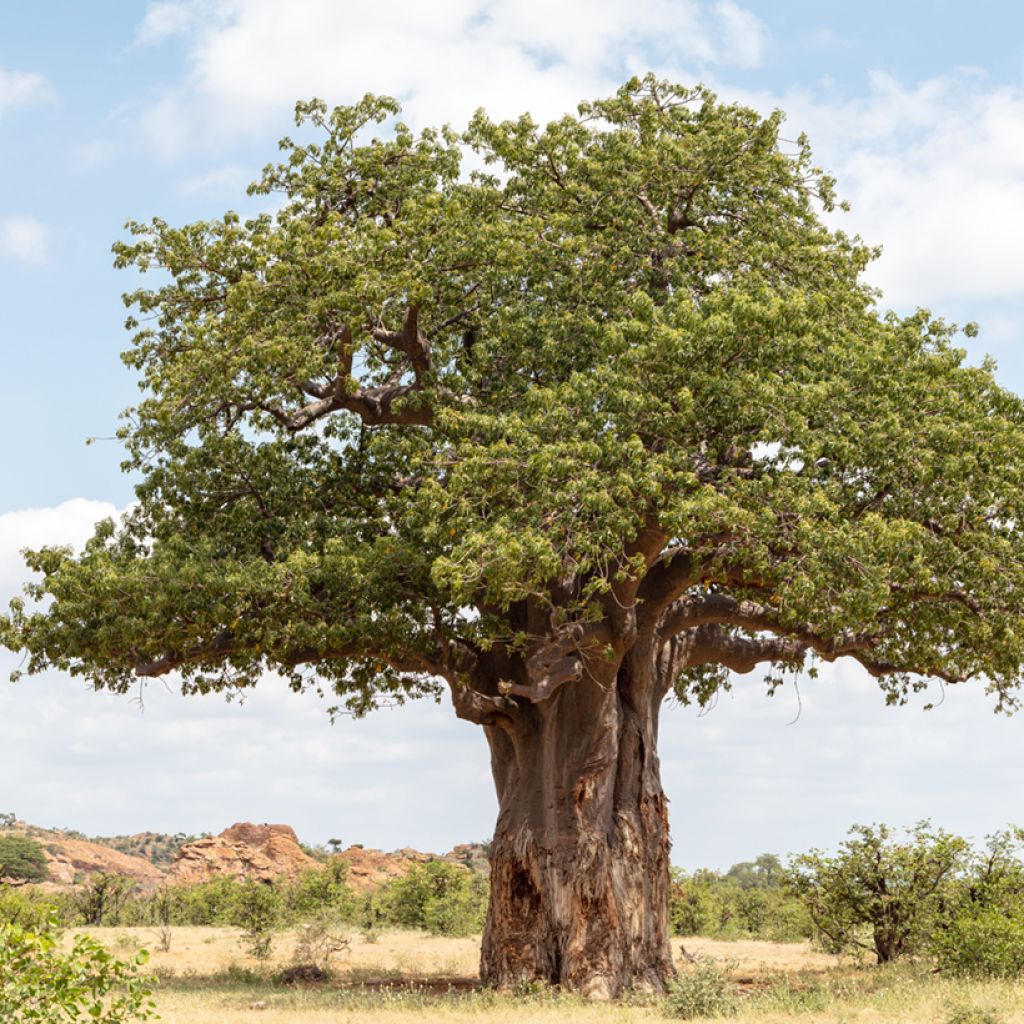
Adansonia digitata, better known as the African baobab, is a majestic tree from the arid regions of Africa. Nicknamed the "Tree of Tales" due to its central role in local traditions, it is also called the "Bottle Tree" for its swollen trunk capable of storing water. Although it does not flower or fruit in our climates, it can be grown in pots, where it retains its unique appearance. It is easy to care for and adapts well to indoor cultivation, like a cactus. In fine weather, it will enjoy being placed outdoors on a balcony or terrace, as long as nighttime temperatures remain mild. However, by September, it should be brought indoors to a heated room to protect it from the cold.
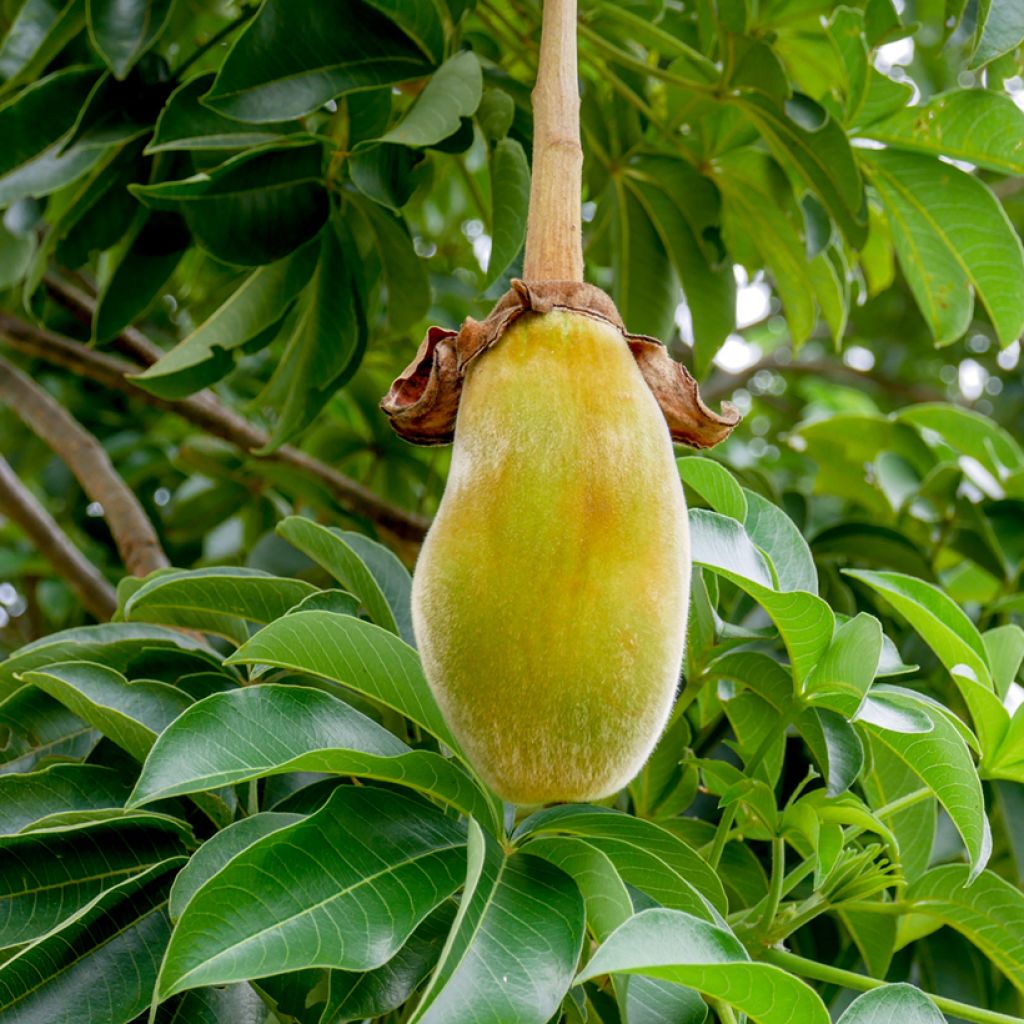
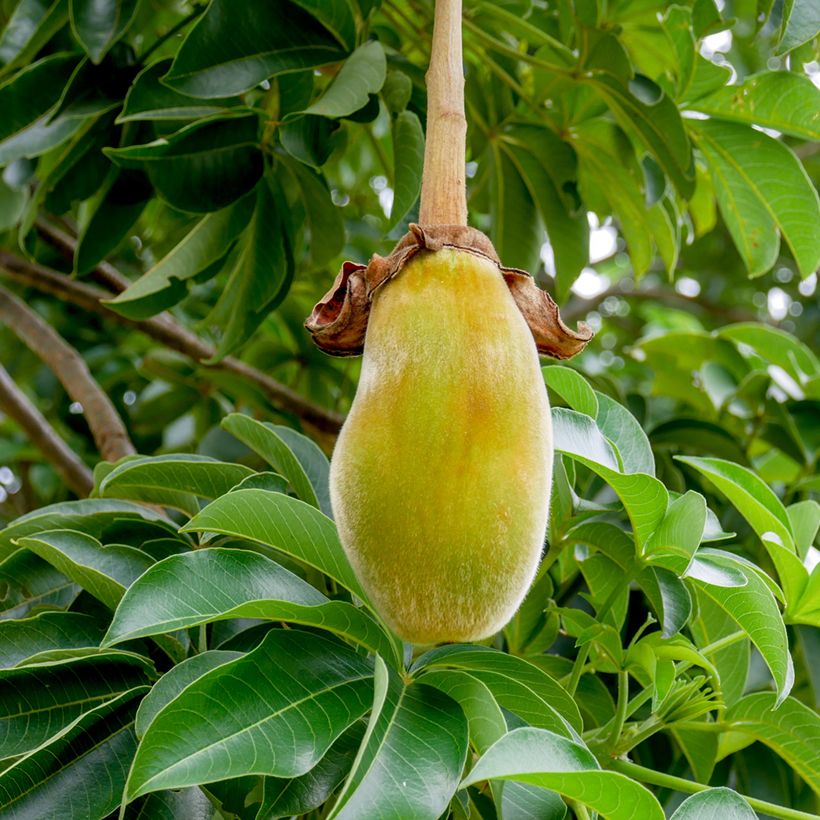
According to botanical classifications, Adansonia digitata belongs to the Bombacaceae or Malvaceae family. It grows mainly in dry savannas, stretching from the Sahel in West Africa to the Transvaal in South Africa. This tree plays a key role in its ecosystem: it provides water and food for many animal species and serves as a valuable shelter. Local populations also use its leaves, fruits, and seeds for food. Its wood, however, is too spongy to be used. Some baobabs reach impressive ages, sometimes exceeding 2,000 years. In our latitudes, pot cultivation is preferred, particularly as an indoor bonsai. In its natural habitat, the baobab can grow between 3 and 20 metres tall, depending on climatic and soil conditions. When grown in pots and regularly pruned, it remains much more compact, usually not exceeding 2.50 metres in height with a spread of 1.50 metres. Its massive trunk, with spongy tissues, allows it to store the water needed for survival during droughts. The bark, initially brown and slightly shiny, becomes greyer with age. From this trunk emerge thick branches that form a broad, spreading crown, resembling an inverted root system. The baobab loses its foliage during the dry season, a natural cycle that should be respected in our climates to avoid rotting of the fleshy roots. Its deep green leaves are single on young plants, later developing into compound leaves with 5 to 7 leaflets in maturity. In the wild, flowering only occurs after about ten years. Just before the rainy season, it produces large white flowers suspended on long peduncles. Their centre consists of a dense pom-pom-like cluster of stamens, from which the pistil protrudes. These flowers, which only open at night, attract fruit bats, which ensure their pollination as the bats love the abundant nectar and are sensitive to the flower's distinctive scent. After pollination, the baobab develops oblong fruits with thick skin, containing a nutritious pulp rich in vitamins and calcium, as well as edible oil-rich seeds. It is possible to sow these to grow multiple baobabs at a lower cost, making for a rather fun activity.
With its sculptural trunk and singular appearance, the African baobab is a superb indoor plant, perfect for creating an exotic or contemporary atmosphere. It pairs wonderfully with other architectural plants such as agaves, the jade tree Crassula ovata 'Minor', or the bird of paradise (Strelitzia reginae) on a terrace or in a conservatory.
Report an error about the product description
Adansonia digitata - Baobab seeds in pictures
Flowering
Foliage
Plant habit
Botanical data
Adansonia
digitata
Malvaceae
Baobab
West Africa
Planting and care
Before sowing baobab seeds (Adansonia digitata), it is important to prepare them properly to optimise germination. Their shell is particularly hard, so scarification is necessary. This involves lightly scoring the outer layer with a file or sandpaper until the lighter endosperm is visible, without damaging the inside. Once this step is completed, the seeds should be soaked in lukewarm water (around 30°C) for 24 to 48 hours. A thermos flask can be useful to maintain the temperature. If after this time the seeds have not swollen, the process can be repeated.
The substrate should be light and well-draining. A mix of 50% sowing compost and 50% vermiculite or perlite is ideal. Before sowing, it is advisable to lightly moisten the substrate without saturating it. The seeds should be planted about 3 cm deep in plastic pots, as peat pots retain too much moisture. If several seeds are sown in the same tray, a spacing of at least 5 cm is recommended. Once in place, simply lightly firm the substrate and mist with a little water to ensure good humidity.
The seeds usually germinate within 7 to 14 days if placed in a warm and bright environment, with temperatures between 25 and 30°C. A propagator can help maintain a consistent atmosphere and encourage germination. The substrate's moisture should be monitored, ensuring the soil is never waterlogged. When the young shoots have developed their first true leaves after the cotyledons, they should be transplanted into individual pots about 5 cm wide. During this process, handle the taproot carefully to avoid damage.
Sowing period
Intended location
Planting & care advice
-

-
-
-
-
-
-

-
This item has not been reviewed yet - be the first to leave a review about it.
Recently viewed products
Haven't found what you were looking for?
Hardiness is the lowest winter temperature a plant can endure without suffering serious damage or even dying. However, hardiness is affected by location (a sheltered area, such as a patio), protection (winter cover) and soil type (hardiness is improved by well-drained soil).

The flowering period indicated on our website applies to countries and regions located in USDA zone 8 (France, the United Kingdom, Ireland, the Netherlands, etc.)
It will vary according to where you live:- In zones 9 to 10 (Italy, Spain, Greece, etc.), flowering will occur about 2 to 4 weeks earlier.
- In zones 6 to 7 (Germany, Poland, Slovenia, and lower mountainous regions), flowering will be delayed by 2 to 3 weeks.
- In zone 5 (Central Europe, Scandinavia), blooming will be delayed by 3 to 5 weeks.
In temperate climates, pruning of spring-flowering shrubs (forsythia, spireas, etc.) should be done just after flowering.
Pruning of summer-flowering shrubs (Indian Lilac, Perovskia, etc.) can be done in winter or spring.
In cold regions as well as with frost-sensitive plants, avoid pruning too early when severe frosts may still occur.
The planting period indicated on our website applies to countries and regions located in USDA zone 8 (France, United Kingdom, Ireland, Netherlands).
It will vary according to where you live:
- In Mediterranean zones (Marseille, Madrid, Milan, etc.), autumn and winter are the best planting periods.
- In continental zones (Strasbourg, Munich, Vienna, etc.), delay planting by 2 to 3 weeks in spring and bring it forward by 2 to 4 weeks in autumn.
- In mountainous regions (the Alps, Pyrenees, Carpathians, etc.), it is best to plant in late spring (May-June) or late summer (August-September).
The harvesting period indicated on our website applies to countries and regions in USDA zone 8 (France, England, Ireland, the Netherlands).
In colder areas (Scandinavia, Poland, Austria...) fruit and vegetable harvests are likely to be delayed by 3-4 weeks.
In warmer areas (Italy, Spain, Greece, etc.), harvesting will probably take place earlier, depending on weather conditions.
The sowing periods indicated on our website apply to countries and regions within USDA Zone 8 (France, UK, Ireland, Netherlands).
In colder areas (Scandinavia, Poland, Austria...), delay any outdoor sowing by 3-4 weeks, or sow under glass.
In warmer climes (Italy, Spain, Greece, etc.), bring outdoor sowing forward by a few weeks.
Shipping country and language
Your country of residence may be:
Your country of residence is:
For a better user experience on our website, you can select:
Your shipping country:
-
 Austria
-
 Belgium
-
 Bosnia & Herzegovina
-
 Bulgaria
-
 Croatia
-
 Cyprus
-
 Czechia
-
 Denmark
-
 Estonia
-
 Finland
-
 France
-
 Germany
-
 Greece
-
 Hungary
-
 Iceland
-
 Ireland
-
 Italy
Italy
-
 Latvia
-
 Liechtenstein
-
 Lithuania
-
 Luxembourg
-
 Malta
Malta
-
 Netherlands
-
 Poland
-
 Portugal
-
 Romania
-
 Serbia
-
 Slovakia
-
 Slovenia
-
 Spain
Spain
-
 Sweden
-
 Switzerland
Language:
-
French
-
 English
-
Spanish
-
Italian
-
German
-
Portuguese
-
Dutch
-
Finnish
My Account
Hello
My wish lists
My cart
Log in / Register
Existing customer?
This form is protected by reCAPTCHA - the Google Privacy Policy and Terms of Service apply.
New customer?
Create an account to track your orders, access our customer service and, if you wish, make the most of our upcoming offers.