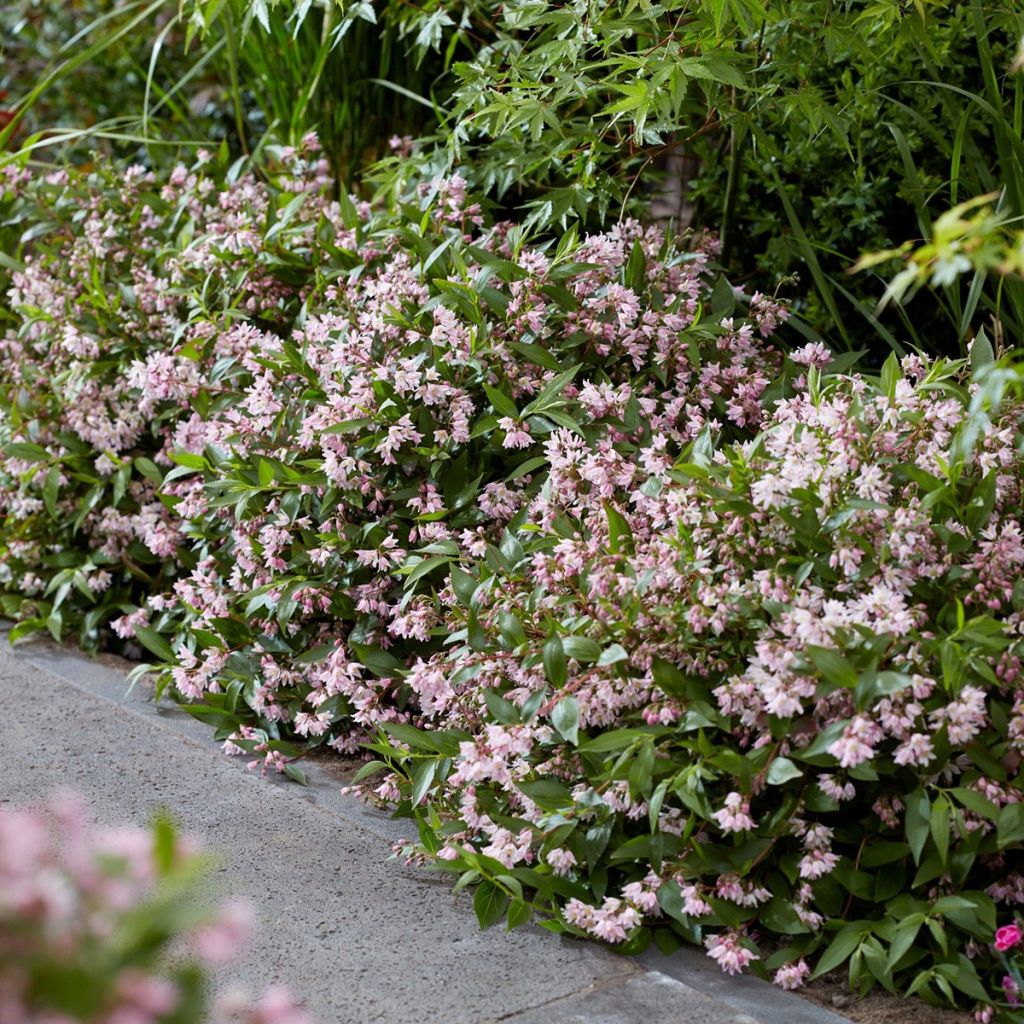
Deutzia Pink Carpet
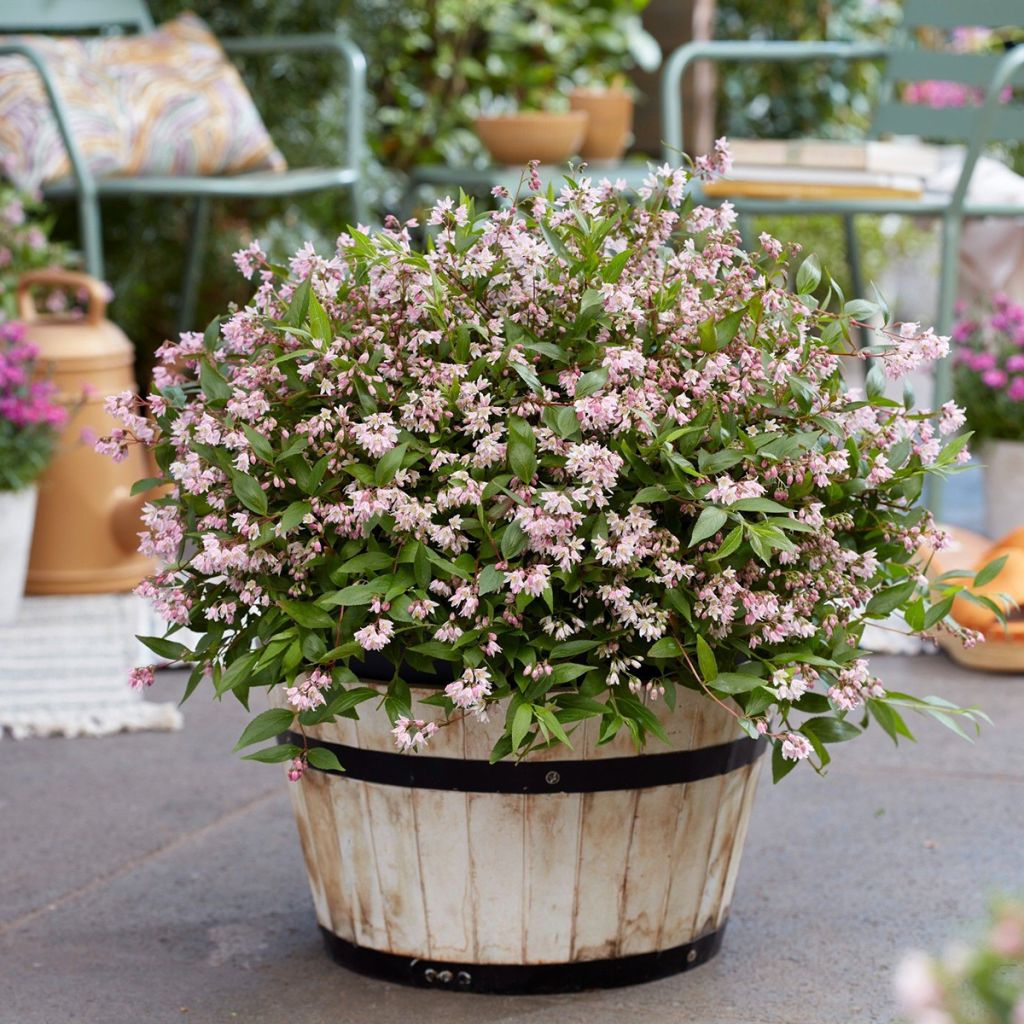
Deutzia Pink Carpet
Deutzia Pink Carpet
Deutzia x gracilis 'Pink Carpet '
Japanese Snow Flower
Back-to-school special offer!
Get €10 off for every €50 you spend! And get up to €40 off on a single order.
How does it work?
1. Shop your favourites
Add your favourite plants to your basket. For every €50 you spend (excluding delivery charges, store credit and the plastic-free option), you’ll receive a €10 voucher.
€50 spent = €10 voucher
€100 spent = €20 voucher
€150 spent = €30 voucher
€200 spent = €40 voucher
2. Place your order
Once your basket reaches one of the spending thresholds, place your order. You can even choose your delivery date!
3. Receive your voucher
As soon as your order has been shipped, you’ll receive an email containing your personal voucher code and its value.
4. Use it on your next order
Your voucher is valid for 90 days from the date you receive it. It can be used once only, on a new order worth at least the value of the voucher, excluding delivery charges.
Please note: Vouchers can be combined with other offers, but cannot be split or refunded.
Why not try an alternative variety in stock?
View all →
Available in 3 sizes

Available in 2 sizes

Available in 4 sizes

Available in 1 sizes

Available in 2 sizes

Available in 1 sizes

Available in 2 sizes

Available in 3 sizes

Available in 2 sizes

Available in 3 sizes
This plant carries a 24 months recovery warranty
More information
We guarantee the quality of our plants for a full growing cycle, and will replace at our expense any plant that fails to recover under normal climatic and planting conditions.
Would this plant suit my garden?
Set up your Plantfit profile →
Description
The Deutzia x gracilis 'Million Stars® Pink Carpet' is a miniature shrub that captivates with its compact habit and its exceptionally generous flowering. It develops a dense, rounded clump, as tall as it is wide, composed of bright green foliage. From May onwards, numerous small star-shaped flowers, white and pink, open in tight clusters. These bright cut flower arrangements contrast wonderfully with the foliage they almost completely cover, giving the plant the appearance of a flowering ball. Grown in a pot, it makes a perfect specimen for beautifying a terrace or balcony. Easy to grow, this small shrub prefers moderate sun or partial shade, grows in most soils that are not too dry, and resists cold and diseases without any problem.
Once classified among Saxifragaceae, Deutzia is now placed in the Hydrangeaceae family, alongside hydrangeas, from which the botanical family name is derived. This family also includes the popular Mock Oranges (Philadelphus), or the lesser-known Jamesia americana, a pretty little rockery shrub. The genus Deutzia comprises around fifty species, originating mainly from East Asia, but also from Europe and Central America. Discovered in Japan in 1845, Deutzia gracilis forms a small shrub of about 70 cm, with an upright, bushy habit, bearing lanceolate leaves 3 to 7 cm long. Its pure white flowers, measuring 1.5 to 2 cm, appear in upright clusters 4 to 8 cm long. In the past, this species was forced in greenhouses to obtain early flowering, but today it is mainly cultivated in open ground, and it has given rise to many horticultural hybrids.
Among them, Deutzia gracilis 'Million Stars® Pink Carpet' stands out for its extreme compactness. This dwarf cultivar indeed rarely exceeds 60 cm in both height and width and forms a dense, bushy ball with slightly irregular outlines. It is suitable both in a flower bed, where it can play a groundcover role, and as a decorative pot plant thanks to its moderate growth and tolerance to pruning, which allows it to be shaped into a beautiful ball. Its fine, lanceolate foliage, delicately dentate, emerges in soft green tones before turning to a bright green. Between May and June, it becomes covered with clusters of fifteen to twenty small flowers, which corolla is almost white on the inside, while the reverse of the petals displays a beautiful soft pink. Each about 1.5 cm, their star-shaped form, with five pointed petals, gives the flowering a light and sparkling appearance. Gathered in cut flower arrangements approximately 5 cm in diameter, they conceal a good part of the vegetation.
Hardy and undemanding, the Deutzia 'Million Stars® Pink Cloud' thrives in almost all ordinary soils, provided they are not too dry. It is an ideal shrub for small gardens, patios, or terraces, where its charm works in a limited space. To vary and extend the flowering season in a small flower bed, it can be combined with other compact and equally easy-to-grow shrubs. Very early in the season, the Forsythia 'Mikador', explodes into a golden spray one metre high that illuminates the garden. The Abelia 'Pastel Charm' will take over from your Deutzia from July and throughout the summer with its charming pale yellow and pink bell-shaped flowers. A crape myrtle from the "With Love" series such as the Lagerstroemia indica 'Virgin With Love' with pure white flowers will also enchant your summer.

Deutzia Pink Carpet in pictures

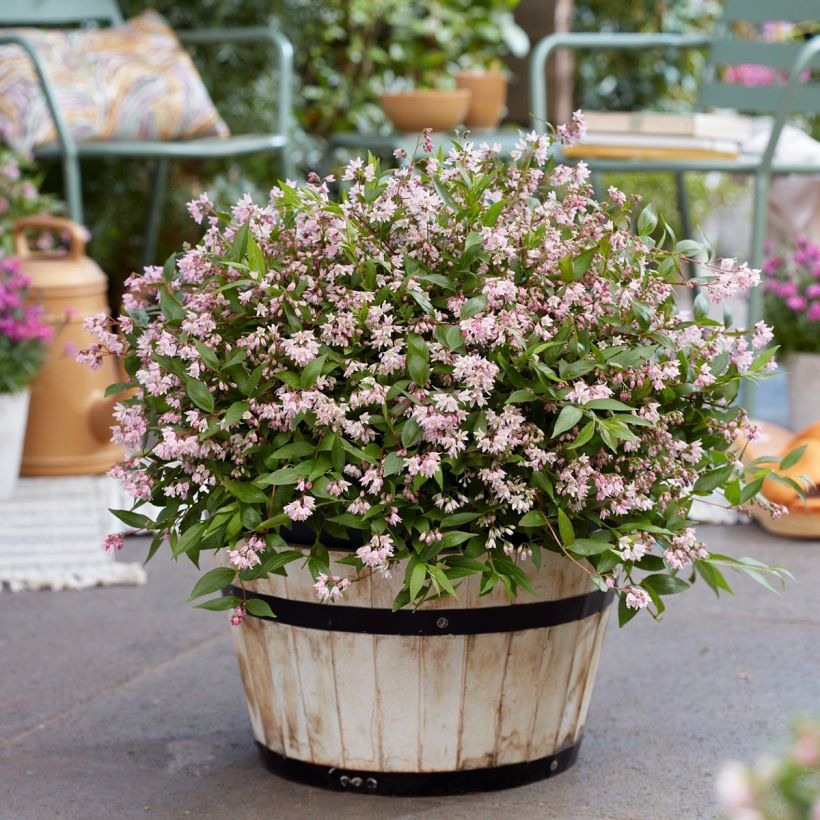
Plant habit
Flowering
Foliage
Botanical data
Deutzia
x gracilis
'Pink Carpet '
Hydrangeaeceae
Japanese Snow Flower
Deutzia x hybrida Million Stars® 'Pink Carpet'
Cultivar or hybrid
Planting and care
Deutzia gracilis 'Million Stars Pink Carpet' is very easy to cultivate, as it is perfectly hardy (-20°C) and grows anywhere where the soil is deep and well-drained. It tolerates all types of ground, except those that are truly too dry; however, it prefers fertile soils rich in humus, capable of retaining some moisture. In a sunny (not scorching, as atmospheric dryness tends to brown the leaf tips) or partially shaded position, it should be planted between October and April, outside of frost periods. It will need to be watered regularly for the first two summers, particularly if it is hot and dry. It becomes fairly drought-resistant with age and is not susceptible to diseases.
Each year after flowering, cut back the spent shoots just above an eye and as close as possible to the stump. Remove 1/3 of the old shoots at their base to allow the plant to continually rejuvenate and thus remain bushy and floriferous.
Planting period
Intended location
Care
Planting & care advice








This item has not been reviewed yet - be the first to leave a review about it.
Recently viewed products
Haven't found what you were looking for?
Hardiness is the lowest winter temperature a plant can endure without suffering serious damage or even dying. However, hardiness is affected by location (a sheltered area, such as a patio), protection (winter cover) and soil type (hardiness is improved by well-drained soil).

The flowering period indicated on our website applies to countries and regions located in USDA zone 8 (France, the United Kingdom, Ireland, the Netherlands, etc.)
It will vary according to where you live:- In zones 9 to 10 (Italy, Spain, Greece, etc.), flowering will occur about 2 to 4 weeks earlier.
- In zones 6 to 7 (Germany, Poland, Slovenia, and lower mountainous regions), flowering will be delayed by 2 to 3 weeks.
- In zone 5 (Central Europe, Scandinavia), blooming will be delayed by 3 to 5 weeks.
In temperate climates, pruning of spring-flowering shrubs (forsythia, spireas, etc.) should be done just after flowering.
Pruning of summer-flowering shrubs (Indian Lilac, Perovskia, etc.) can be done in winter or spring.
In cold regions as well as with frost-sensitive plants, avoid pruning too early when severe frosts may still occur.
The planting period indicated on our website applies to countries and regions located in USDA zone 8 (France, United Kingdom, Ireland, Netherlands).
It will vary according to where you live:
- In Mediterranean zones (Marseille, Madrid, Milan, etc.), autumn and winter are the best planting periods.
- In continental zones (Strasbourg, Munich, Vienna, etc.), delay planting by 2 to 3 weeks in spring and bring it forward by 2 to 4 weeks in autumn.
- In mountainous regions (the Alps, Pyrenees, Carpathians, etc.), it is best to plant in late spring (May-June) or late summer (August-September).
The harvesting period indicated on our website applies to countries and regions in USDA zone 8 (France, England, Ireland, the Netherlands).
In colder areas (Scandinavia, Poland, Austria...) fruit and vegetable harvests are likely to be delayed by 3-4 weeks.
In warmer areas (Italy, Spain, Greece, etc.), harvesting will probably take place earlier, depending on weather conditions.
The sowing periods indicated on our website apply to countries and regions within USDA Zone 8 (France, UK, Ireland, Netherlands).
In colder areas (Scandinavia, Poland, Austria...), delay any outdoor sowing by 3-4 weeks, or sow under glass.
In warmer climes (Italy, Spain, Greece, etc.), bring outdoor sowing forward by a few weeks.
Shipping country and language
Your country of residence may be:
Your country of residence is:
For a better user experience on our website, you can select:
Your shipping country:
-
 Austria
-
 Belgium
-
 Bosnia & Herzegovina
-
 Bulgaria
-
 Croatia
-
 Cyprus
-
 Czechia
-
 Denmark
-
 Estonia
-
 Finland
-
 France
-
 Germany
-
 Greece
-
 Hungary
-
 Iceland
-
 Ireland
-
 Italy
Italy
-
 Latvia
-
 Liechtenstein
-
 Lithuania
-
 Luxembourg
-
 Malta
Malta
-
 Netherlands
-
 Poland
-
 Portugal
-
 Romania
-
 Serbia
-
 Slovakia
-
 Slovenia
-
 Spain
Spain
-
 Sweden
-
 Switzerland
Language:
-
French
-
 English
-
Spanish
-
Italian
-
German
-
Portuguese
-
Dutch
-
Finnish
My Account
Hello
My wish lists
My cart
Log in / Register
Existing customer?
This form is protected by reCAPTCHA - the Google Privacy Policy and Terms of Service apply.
New customer?
Create an account to track your orders, access our customer service and, if you wish, make the most of our upcoming offers.