Kalmia latifolia Zebulon
Kalmia latifolia Zebulon
Kalmia latifolia Zebulon
Mountain Laurel, Calico Bush, Spoonwood, American mountain laurel, Broad-leaved Kalmia
The two pots of Kalmia Zebulon arrived in good shape. One branch was broken on one of the plants, but it didn't affect its beauty. Both plants look vigorous. To be continued...
Mireille , 05/02/2025
Back-to-school special offer!
Get €10 off for every €50 you spend! And get up to €40 off on a single order.
How does it work?
1. Shop your favourites
Add your favourite plants to your basket. For every €50 you spend (excluding delivery charges, store credit and the plastic-free option), you’ll receive a €10 voucher.
€50 spent = €10 voucher
€100 spent = €20 voucher
€150 spent = €30 voucher
€200 spent = €40 voucher
2. Place your order
Once your basket reaches one of the spending thresholds, place your order. You can even choose your delivery date!
3. Receive your voucher
As soon as your order has been shipped, you’ll receive an email containing your personal voucher code and its value.
4. Use it on your next order
Your voucher is valid for 90 days from the date you receive it. It can be used once only, on a new order worth at least the value of the voucher, excluding delivery charges.
Please note: Vouchers can be combined with other offers, but cannot be split or refunded.
Home or relay delivery (depending on size and destination)
Important: You may be charged customs duties by your country’s customs authorities upon delivery.
Schedule delivery date,
and select date in basket
This plant carries a 24 months recovery warranty
More information
We guarantee the quality of our plants for a full growing cycle, and will replace at our expense any plant that fails to recover under normal climatic and planting conditions.

Would this plant suit my garden?
Set up your Plantfit profile →
Description
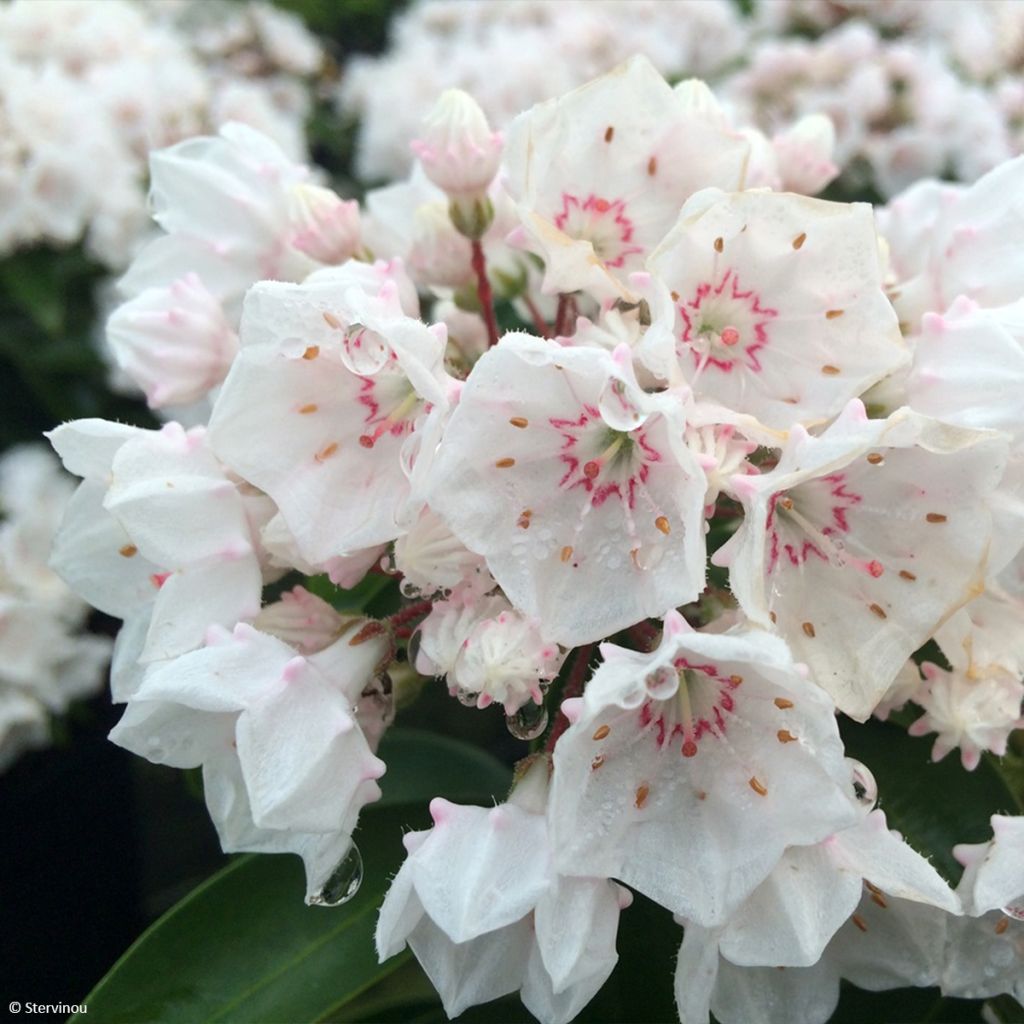
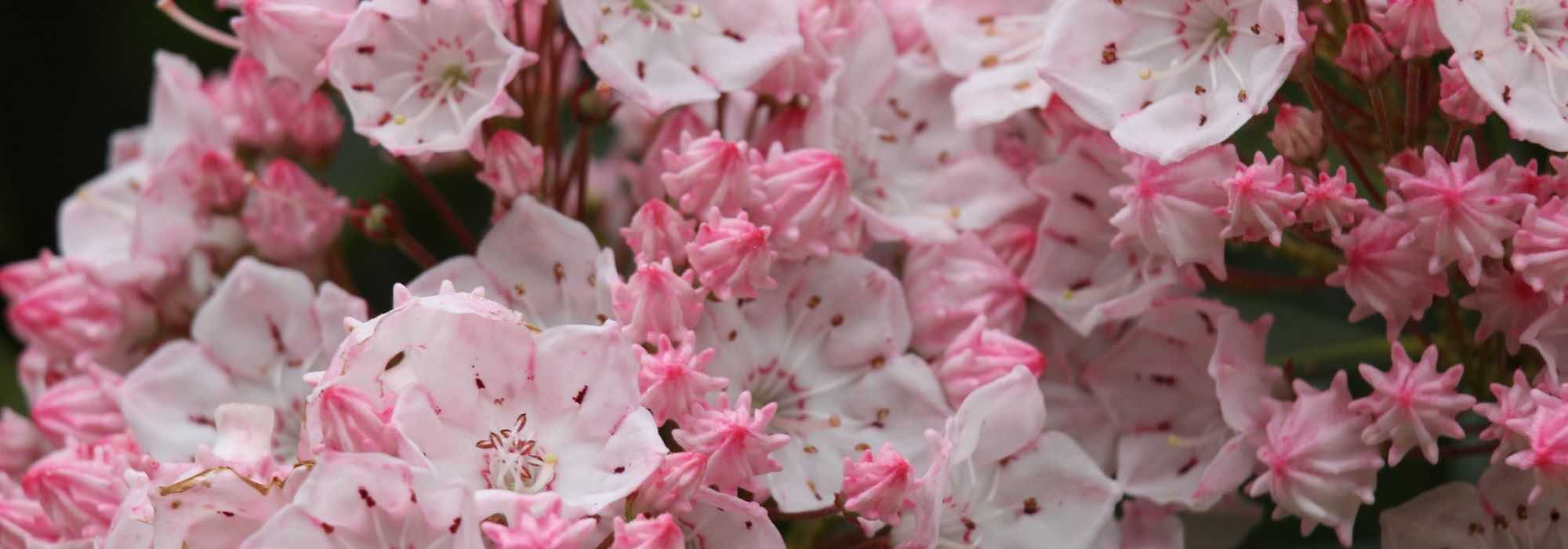
Kalmia latifolia Zebulon also known as mountain laurel, is a hybrid of Kalmia latifolia Ginkona and Kalmia latifolia Peppermint and has retained the best qualities of its parents. This Kalmia has very large corollas arranged in terminal corymbs of white, tinged with pink and red. The red central ring gives it all its elegance. This shrub has an upright and compact habit and does not exceed 1.20 m (4ft) in height at maturity. It is hardy to -30°C (-22°F) and prefers a semi-shaded position.
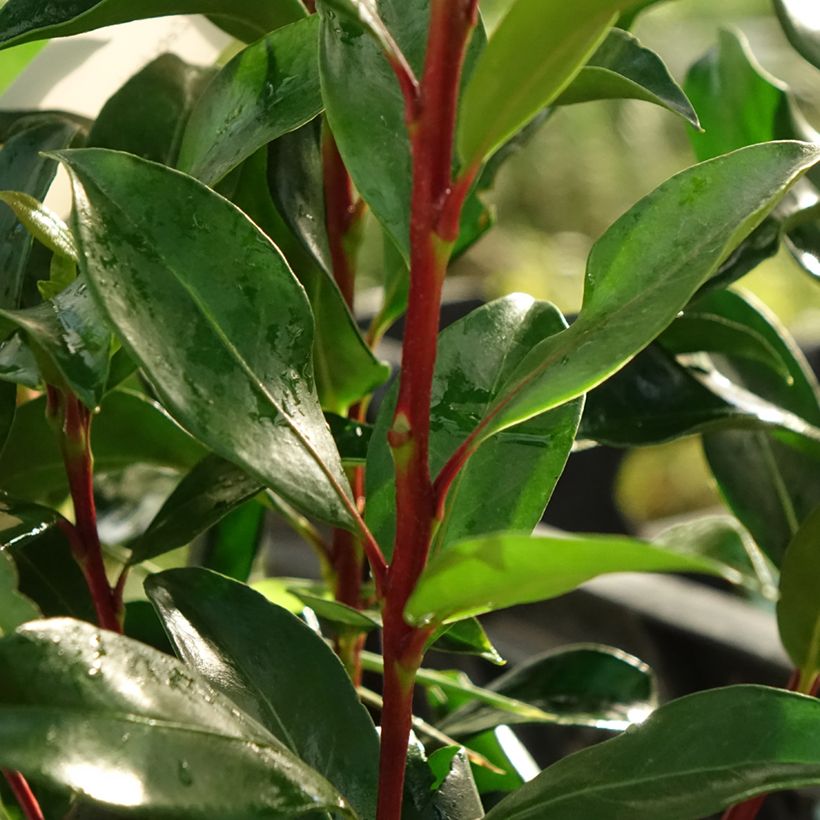
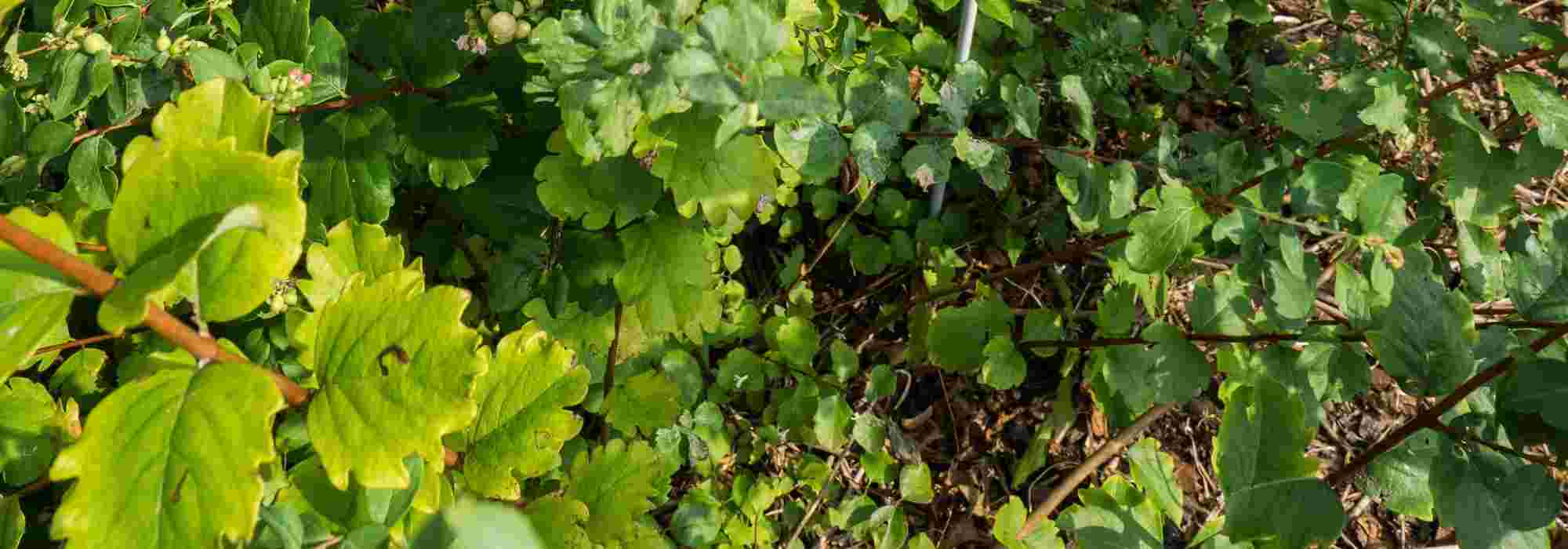
Kalmia latifolia belongs to the Ericaceae family, like Heather and Rhododendron. 'Zebulon' is a variety of modest dimensions, not exceeding 1.20 m (4ft) in height and 80 cm (32in) in width. Its growth is slow. Its well-branched trunk gives it a bushy, compact and somewhat upright habit. Its evergreen foliage, medium green in colour, with a lighter underside, guarantees decorative interest all year round. The leaves are tough and thick with a slightly V-shaped form. The shrub is at its peak in late spring, in May-June, when it is completely covered with its unique flowers. Their waxy texture brings out the unique patterns drawn on the petals. Each branch bears terminal clusters of numerous white flowers adorned with a central pink to red ring and dotted with red spots. They are very open, becoming flat at maturity and measuring up to 5 cm (2in) in diameter. The white stamens are nestled on the petals. The still unopened flower buds, white in colour, unmistakably resemble small delicacies like meringues. After flowering, if they have not fallen, the flowers give way to brown capsule-shaped fruits that persist throughout winter.
Kalmias are unjustly overlooked. Their flowering is enchanting, they are hardy heathland shrubs that should be planted in semi-shaded, damp, moist, humus-rich soil. Undoubtedly unique because it is so rare, Kalmia Zebulon will be perfect for accompanying and enhancing your other heathland plants, Hydrangeas, Japanese maples, Magnolias, for example. It will work wonders in an informal hedge, in a shrub bed, integrated into a perennial bed or around a pond. Due to its small size, it is also suitable for container cultivation on balconies or patios, provided the soil is kept consistently moist.
Properties:
Kalmia latifolia is a shrub where all parts (leaves, flowers, fruits, roots) are toxic, to humans as well as animals (dogs, cats, sheep, horses), if ingested.
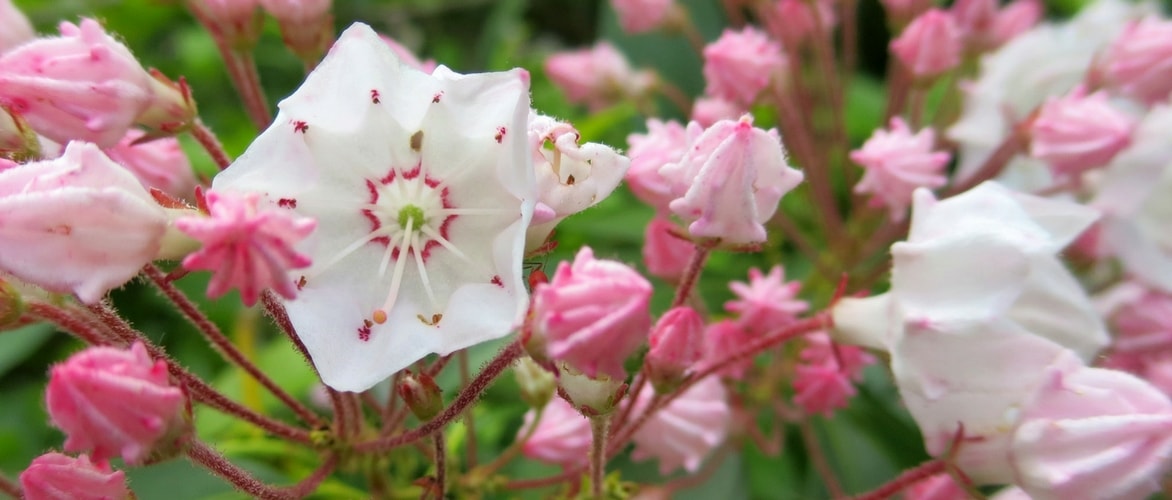
Kalmia latifolia Zebulon in pictures
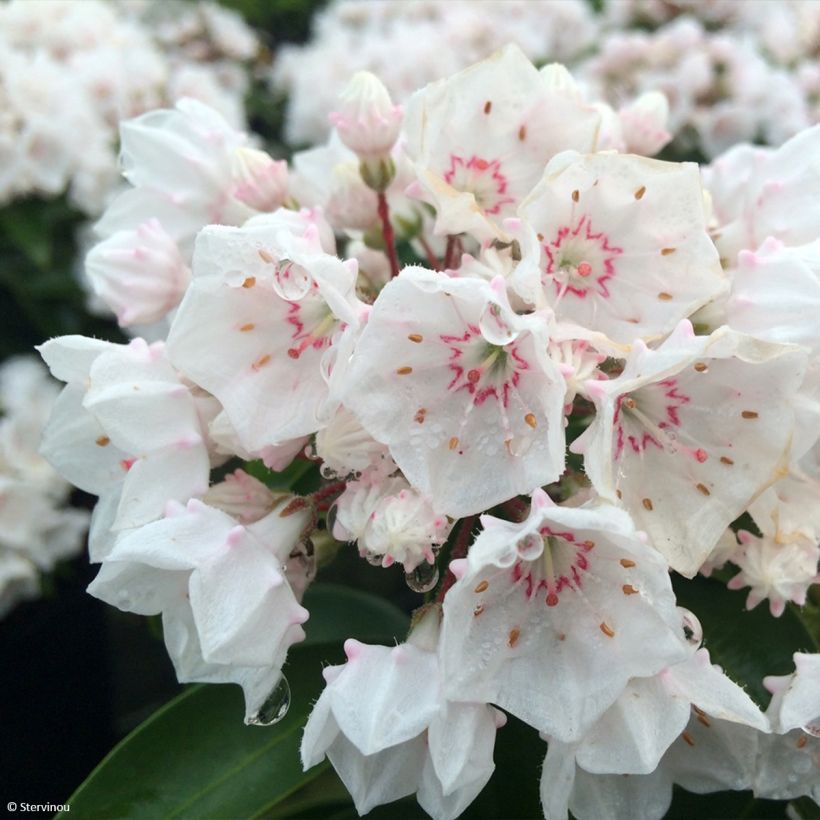
Plant habit
Flowering
Foliage
Botanical data
Kalmia
latifolia
Zebulon
Ericaceae
Mountain Laurel, Calico Bush, Spoonwood, American mountain laurel, Broad-leaved Kalmia
Cultivar or hybrid
Planting and care
Kalmia latifolia 'Zébulon' is extremely hardy and can withstand very low temperatures, even below -20°C (-4°F). Belonging to the Ericaceae family, it should be planted in a partially shaded position, in a humus-rich and fertile, acidic, and moist (even wet) soil. For planting, avoid periods of frost or extreme heat, but plant in spring or autumn to facilitate its establishment. Prepare a hole that is wide and deep enough, 40 cm (16in) by 40 cm (16in) for your Kalmia 'Zébulon' to settle in to permanently. If the soil is calcareous, it should be replaced with a mixture of ericaceous compost and leaf compost in a large planting hole. Regular watering in the first few weeks after planting is necessary to keep the soil moist. Mulching with pine bark at the base can be beneficial to protect the fine and superficial roots. Every spring, loosen the soil around the base and topdress with compost, ericaceous compost and mulch. Mountain laurel dreads scorching situations. It must be placed in such a way that it is shaded during the hottest hours of the day. During the summer period and especially in case of drought, ensure regular watering (preferably with rainwater). This summer watering is particularly important as floral buds form for the following spring. Mountain laurel thrives in damp and humid conditions, making it vigorous in oceanic or rainy climates. With its small size, it is well adapted to container cultivation on a patio or balcony. The risk of soil drying out is higher in pot cultivation, so a large container and increased monitoring of watering will be essential.
Planting period
Intended location
Care
Planting & care advice
-
-

-
-
-

-
-
-

-
, onOrder confirmed
Reply from on Promesse de fleurs
Recently viewed products
Haven't found what you were looking for?
Hardiness is the lowest winter temperature a plant can endure without suffering serious damage or even dying. However, hardiness is affected by location (a sheltered area, such as a patio), protection (winter cover) and soil type (hardiness is improved by well-drained soil).

The flowering period indicated on our website applies to countries and regions located in USDA zone 8 (France, the United Kingdom, Ireland, the Netherlands, etc.)
It will vary according to where you live:- In zones 9 to 10 (Italy, Spain, Greece, etc.), flowering will occur about 2 to 4 weeks earlier.
- In zones 6 to 7 (Germany, Poland, Slovenia, and lower mountainous regions), flowering will be delayed by 2 to 3 weeks.
- In zone 5 (Central Europe, Scandinavia), blooming will be delayed by 3 to 5 weeks.
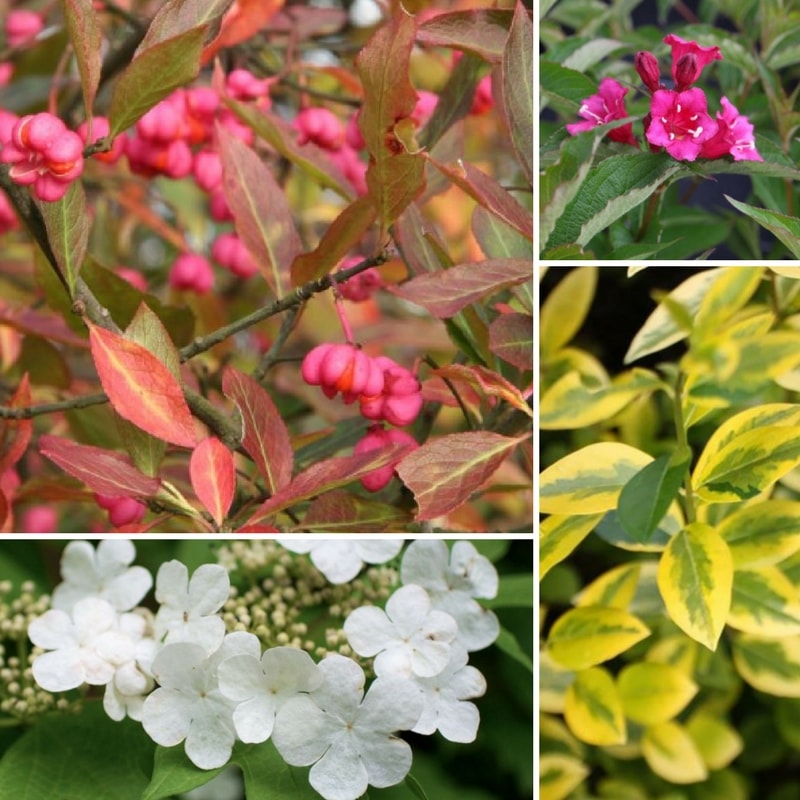
In temperate climates, pruning of spring-flowering shrubs (forsythia, spireas, etc.) should be done just after flowering.
Pruning of summer-flowering shrubs (Indian Lilac, Perovskia, etc.) can be done in winter or spring.
In cold regions as well as with frost-sensitive plants, avoid pruning too early when severe frosts may still occur.
The planting period indicated on our website applies to countries and regions located in USDA zone 8 (France, United Kingdom, Ireland, Netherlands).
It will vary according to where you live:
- In Mediterranean zones (Marseille, Madrid, Milan, etc.), autumn and winter are the best planting periods.
- In continental zones (Strasbourg, Munich, Vienna, etc.), delay planting by 2 to 3 weeks in spring and bring it forward by 2 to 4 weeks in autumn.
- In mountainous regions (the Alps, Pyrenees, Carpathians, etc.), it is best to plant in late spring (May-June) or late summer (August-September).
The harvesting period indicated on our website applies to countries and regions in USDA zone 8 (France, England, Ireland, the Netherlands).
In colder areas (Scandinavia, Poland, Austria...) fruit and vegetable harvests are likely to be delayed by 3-4 weeks.
In warmer areas (Italy, Spain, Greece, etc.), harvesting will probably take place earlier, depending on weather conditions.
The sowing periods indicated on our website apply to countries and regions within USDA Zone 8 (France, UK, Ireland, Netherlands).
In colder areas (Scandinavia, Poland, Austria...), delay any outdoor sowing by 3-4 weeks, or sow under glass.
In warmer climes (Italy, Spain, Greece, etc.), bring outdoor sowing forward by a few weeks.
Shipping country and language
Your country of residence may be:
Your country of residence is:
For a better user experience on our website, you can select:
Your shipping country:
-
 Austria
-
 Belgium
-
 Bosnia & Herzegovina
-
 Bulgaria
-
 Croatia
-
 Cyprus
-
 Czechia
-
 Denmark
-
 Estonia
-
 Finland
-
 France
-
 Germany
-
 Greece
-
 Hungary
-
 Iceland
-
 Ireland
-
 Italy
Italy
-
 Latvia
-
 Liechtenstein
-
 Lithuania
-
 Luxembourg
-
 Malta
Malta
-
 Netherlands
-
 Poland
-
 Portugal
-
 Romania
-
 Serbia
-
 Slovakia
-
 Slovenia
-
 Spain
Spain
-
 Sweden
-
 Switzerland
Language:
-
French
-
 English
-
Spanish
-
Italian
-
German
-
Portuguese
-
Dutch
-
Finnish
My Account
Hello
My wish lists
My cart
Log in / Register
Existing customer?
This form is protected by reCAPTCHA - the Google Privacy Policy and Terms of Service apply.
New customer?
Create an account to track your orders, access our customer service and, if you wish, make the most of our upcoming offers.