Ampelopsis brevipedunculata Elegans - Porcelainberry
Ampelopsis brevipedunculata Elegans - Porcelainberry
Ampelopsis brevipedunculata Elegans
Porcelainberry, Amur peppervine
Ultra-fast delivery, the plant arrived in very good condition. A magnificent plant that just wants to grow and spread out. I am completely satisfied with my purchase.
veronique , 18/07/2024
Back-to-school special offer!
Get €10 off for every €50 you spend! And get up to €40 off on a single order.
How does it work?
1. Shop your favourites
Add your favourite plants to your basket. For every €50 you spend (excluding delivery charges, store credit and the plastic-free option), you’ll receive a €10 voucher.
€50 spent = €10 voucher
€100 spent = €20 voucher
€150 spent = €30 voucher
€200 spent = €40 voucher
2. Place your order
Once your basket reaches one of the spending thresholds, place your order. You can even choose your delivery date!
3. Receive your voucher
As soon as your order has been shipped, you’ll receive an email containing your personal voucher code and its value.
4. Use it on your next order
Your voucher is valid for 90 days from the date you receive it. It can be used once only, on a new order worth at least the value of the voucher, excluding delivery charges.
Please note: Vouchers can be combined with other offers, but cannot be split or refunded.
Home or relay delivery (depending on size and destination)
Important: You may be charged customs duties by your country’s customs authorities upon delivery.
Schedule delivery date,
and select date in basket
This plant carries a 12 months recovery warranty
More information
We guarantee the quality of our plants for a full growing cycle, and will replace at our expense any plant that fails to recover under normal climatic and planting conditions.
Would this plant suit my garden?
Set up your Plantfit profile →
Description
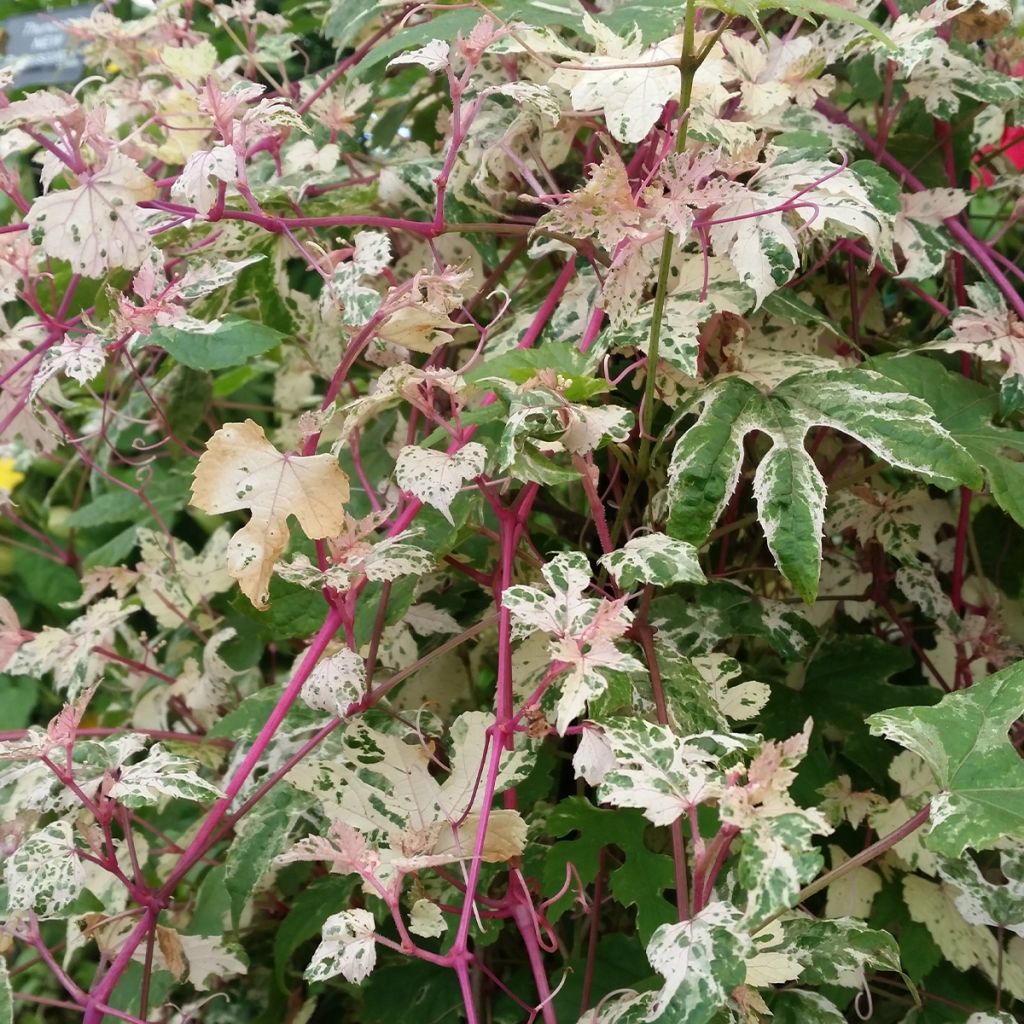
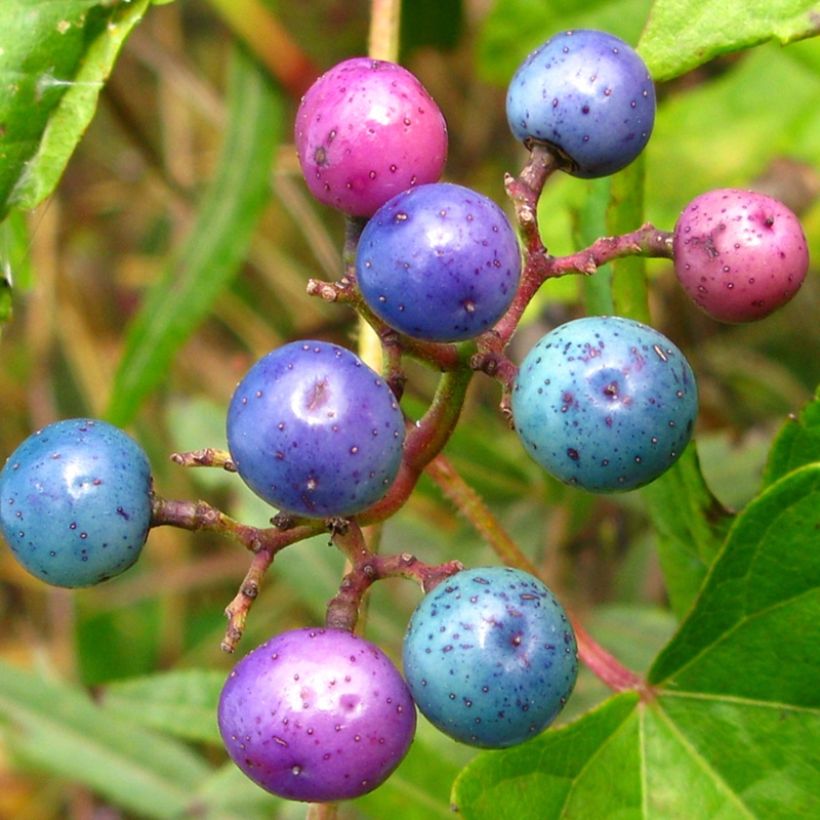
The Ampelopsis brevipedunculata 'Elegans' is a small and slow-growing Virginia creeper. It is ideal for covering a small trellis with its magnificent variegated deciduous foliage. The leaves are adorned with various shades of green, white, and pink, providing a constant spectacle from spring to autumn. In spring, its flowering is quite discreet, but it produces particularly decorative fruits in autumn. Initially grey-violet, these small balls then evolve to a stunning turquoise blue colour. This small climbing plant is moderately hardy and may suffer from extreme cold, so it prefers a semi-shaded location in very sunny regions.
The Ampelopsis brevipedunculata, literally meaning short peduncle, is charmingly named Porcelain Berry by English gardeners, as its turquoise blue fruits indeed resemble the most beautiful porcelain. Ampelopsis belongs to the Vitaceae family, which includes many climbers and vines, the most well-known being Parthenocissus (the common Virginia creeper in our gardens), Cissus used as a houseplant, and Tetrastigma, particularly T. voinierianum, a tropical vine that can grow considerably when cultivated in greenhouses in our climates. But the most famous member of this family is undoubtedly Vitis vinifera, commonly known as the grapevine.
Unlike Parthenocissus, which clings to supports using small suckers, Ampelopsis uses short tendrils. Therefore, it requires an open support, such as a trellis, to climb. The species is very vigorous and can climb up to 7 to 10 metres (23 to 33 feet) in height. The 'Elegans' variety has a slower and more limited growth, reaching a maximum height of 3 or 4 metres (10 or 13 feet), but spreading in width. It is perfect for covering a standard 2 x 2 metre (7 feet) wooden trellis and decorating a terrace, or as a boundary between properties.
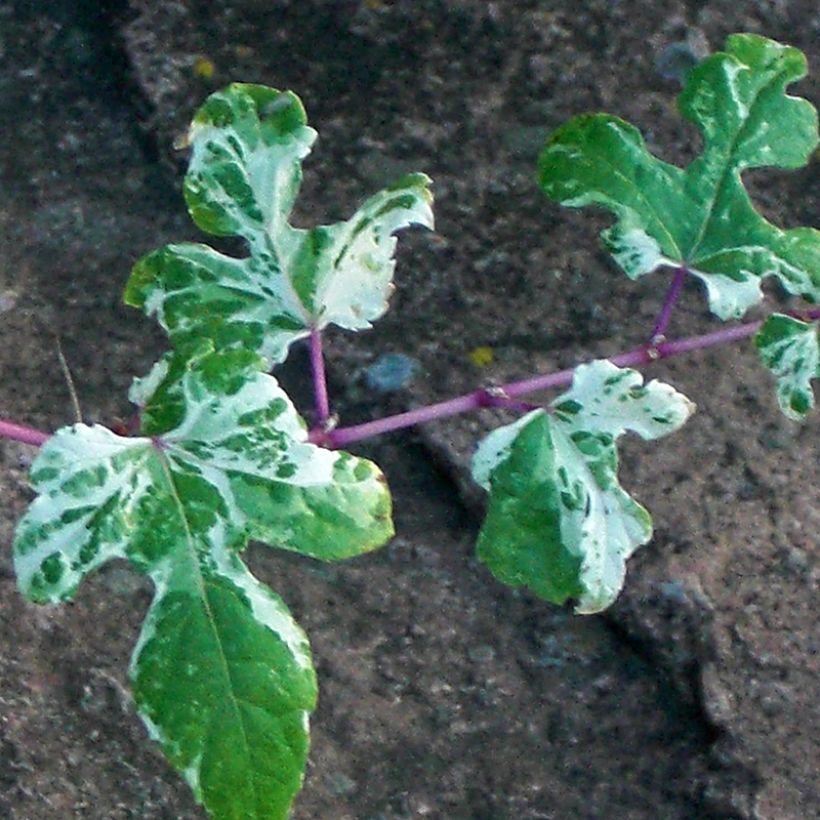
Its beautifully lobed foliage, with 3 or 5 more or less pronounced lobes, is variegated with light green, darker green, white, and pink, bringing color and joy on gray days, with the rain emphasizing these mixed tones even more. It blooms from May to summer, but it is mainly its fruits that stand out. Starting off violet-grey, they gradually turn into a truly sumptuous turquoise blue, which is rare in the plant kingdom. They adorn the plant until the leaves fall and even beyond, although they do not persist in winter as birds consume them.
This variety grows in most soils, except strongly calcareous ones. It prefers fairly rich soils, with a neutral pH and some moisture in summer, while being well-drained for winter. This variety is moderately hardy, down to -10/-12°C (14/10.4°F), but a well-established stump can withstand even lower temperatures. Therefore, it should be protected from cold winter winds. In cooler regions, it will thrive in a sunny location, while in the south, it can be planted in partial shade.
It is not easy to associate this small Virginia creeper with other climbers without risking a clash of colours, due to its patchwork appearance, and its low vigour. To cover a large area, it is best to opt for simplicity by mixing it with the Akebia quinata, which will not overwhelm it. Its compound leaves resembling the Schefflera found in our homes and its cute little violet flowers will go well with the Ampelopsis 'Elegans'. A beautiful Clematis Eximia with charming pale violet flowers will also be a good companion, and to give an exotic touch to your decor, an association with the Passiflora coerulea will create an original scene.

Ampelopsis brevipedunculata Elegans - Porcelainberry in pictures
Plant habit
Flowering
Foliage
Botanical data
Ampelopsis
brevipedunculata
Elegans
Vitaceae
Porcelainberry, Amur peppervine
Cultivar or hybrid
Planting and care
The Ampelopsis brevipedunculata 'Elegans' grows well in any good garden soil, preferably neutral to slightly acidic, but not too chalky. Dig a hole 40 cm (16in) wide and as deep, or larger if the soil is predominantly sandy, to incorporate planting compost and improve water retention. Ampelopsis likes slightly moist soils, but not stagnant moisture in winter, so avoid excessively clayey soils. Soak the root ball in a bucket for 15 minutes to thoroughly moisten it before planting. Water regularly for the first two years, then this climbing plant will tolerate dry conditions relatively well as long as it receives occasional watering in summer. There is no need to prune this climber as its growth is not very fast. Simply remove any frozen branches in spring in case of severe cold.
Planting period
Intended location
Care
Planting & care advice
-

-
-
-
-
-

-
-
-
, onOrder confirmed
Reply from on Promesse de fleurs
Recently viewed products
Haven't found what you were looking for?
Hardiness is the lowest winter temperature a plant can endure without suffering serious damage or even dying. However, hardiness is affected by location (a sheltered area, such as a patio), protection (winter cover) and soil type (hardiness is improved by well-drained soil).

The flowering period indicated on our website applies to countries and regions located in USDA zone 8 (France, the United Kingdom, Ireland, the Netherlands, etc.)
It will vary according to where you live:- In zones 9 to 10 (Italy, Spain, Greece, etc.), flowering will occur about 2 to 4 weeks earlier.
- In zones 6 to 7 (Germany, Poland, Slovenia, and lower mountainous regions), flowering will be delayed by 2 to 3 weeks.
- In zone 5 (Central Europe, Scandinavia), blooming will be delayed by 3 to 5 weeks.
In temperate climates, pruning of spring-flowering shrubs (forsythia, spireas, etc.) should be done just after flowering.
Pruning of summer-flowering shrubs (Indian Lilac, Perovskia, etc.) can be done in winter or spring.
In cold regions as well as with frost-sensitive plants, avoid pruning too early when severe frosts may still occur.
The planting period indicated on our website applies to countries and regions located in USDA zone 8 (France, United Kingdom, Ireland, Netherlands).
It will vary according to where you live:
- In Mediterranean zones (Marseille, Madrid, Milan, etc.), autumn and winter are the best planting periods.
- In continental zones (Strasbourg, Munich, Vienna, etc.), delay planting by 2 to 3 weeks in spring and bring it forward by 2 to 4 weeks in autumn.
- In mountainous regions (the Alps, Pyrenees, Carpathians, etc.), it is best to plant in late spring (May-June) or late summer (August-September).
The harvesting period indicated on our website applies to countries and regions in USDA zone 8 (France, England, Ireland, the Netherlands).
In colder areas (Scandinavia, Poland, Austria...) fruit and vegetable harvests are likely to be delayed by 3-4 weeks.
In warmer areas (Italy, Spain, Greece, etc.), harvesting will probably take place earlier, depending on weather conditions.
The sowing periods indicated on our website apply to countries and regions within USDA Zone 8 (France, UK, Ireland, Netherlands).
In colder areas (Scandinavia, Poland, Austria...), delay any outdoor sowing by 3-4 weeks, or sow under glass.
In warmer climes (Italy, Spain, Greece, etc.), bring outdoor sowing forward by a few weeks.
Shipping country and language
Your country of residence may be:
Your country of residence is:
For a better user experience on our website, you can select:
Your shipping country:
-
 Austria
-
 Belgium
-
 Bosnia & Herzegovina
-
 Bulgaria
-
 Croatia
-
 Cyprus
-
 Czechia
-
 Denmark
-
 Estonia
-
 Finland
-
 France
-
 Germany
-
 Greece
-
 Hungary
-
 Iceland
-
 Ireland
-
 Italy
Italy
-
 Latvia
-
 Liechtenstein
-
 Lithuania
-
 Luxembourg
-
 Malta
Malta
-
 Netherlands
-
 Poland
-
 Portugal
-
 Romania
-
 Serbia
-
 Slovakia
-
 Slovenia
-
 Spain
Spain
-
 Sweden
-
 Switzerland
Language:
-
French
-
 English
-
Spanish
-
Italian
-
German
-
Portuguese
-
Dutch
-
Finnish
My Account
Hello
My wish lists
My cart
Log in / Register
Existing customer?
This form is protected by reCAPTCHA - the Google Privacy Policy and Terms of Service apply.
New customer?
Create an account to track your orders, access our customer service and, if you wish, make the most of our upcoming offers.