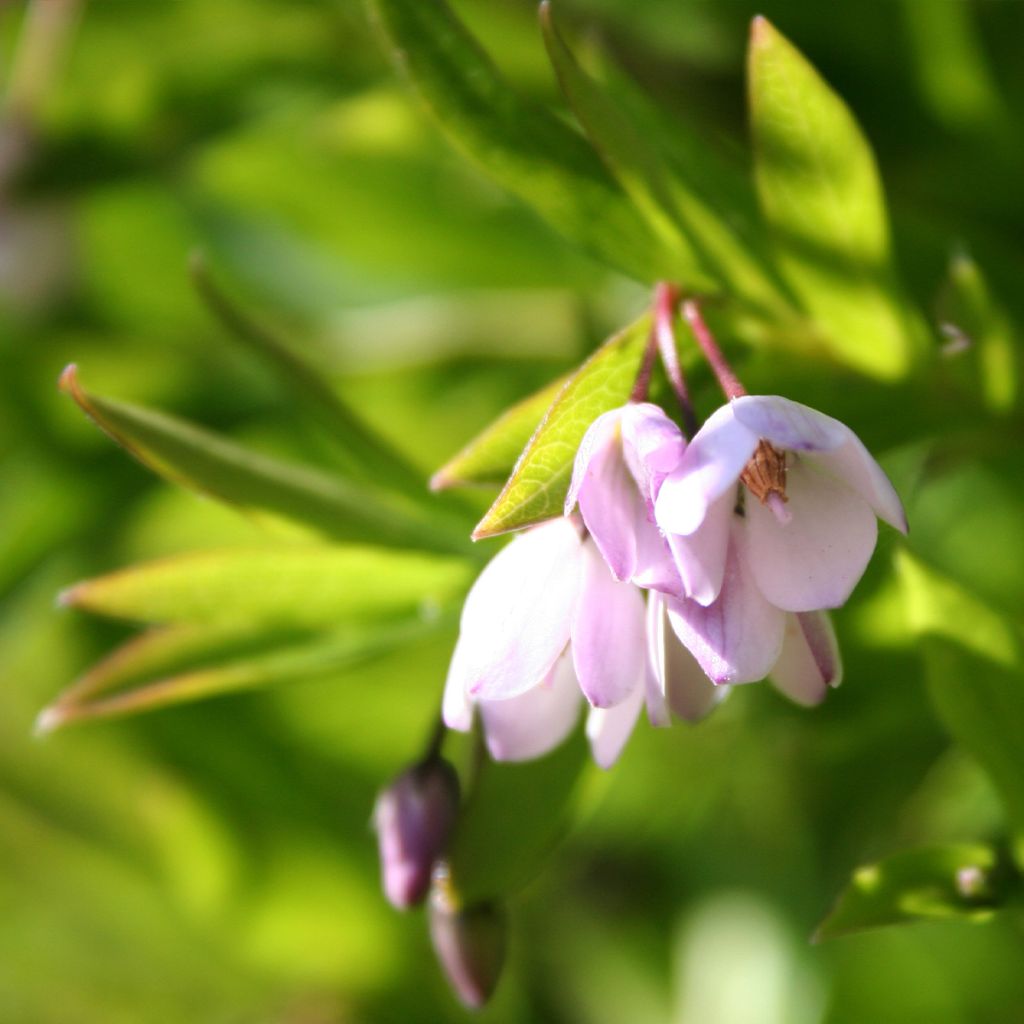
Sollya heterophylla Rosea
Sollya heterophylla Rosea
Sollya heterophylla Rosea
Bluebell Creeper, Australian Bluebell
Back-to-school special offer!
Get €10 off for every €50 you spend! And get up to €40 off on a single order.
How does it work?
1. Shop your favourites
Add your favourite plants to your basket. For every €50 you spend (excluding delivery charges, store credit and the plastic-free option), you’ll receive a €10 voucher.
€50 spent = €10 voucher
€100 spent = €20 voucher
€150 spent = €30 voucher
€200 spent = €40 voucher
2. Place your order
Once your basket reaches one of the spending thresholds, place your order. You can even choose your delivery date!
3. Receive your voucher
As soon as your order has been shipped, you’ll receive an email containing your personal voucher code and its value.
4. Use it on your next order
Your voucher is valid for 90 days from the date you receive it. It can be used once only, on a new order worth at least the value of the voucher, excluding delivery charges.
Please note: Vouchers can be combined with other offers, but cannot be split or refunded.
Home or relay delivery (depending on size and destination)
Important: You may be charged customs duties by your country’s customs authorities upon delivery.
Schedule delivery date
and select date in basket
This plant carries a 12 months recovery warranty
More information
We guarantee the quality of our plants for a full growing cycle, and will replace at our expense any plant that fails to recover under normal climatic and planting conditions.
Would this plant suit my garden?
Set up your Plantfit profile →
Description
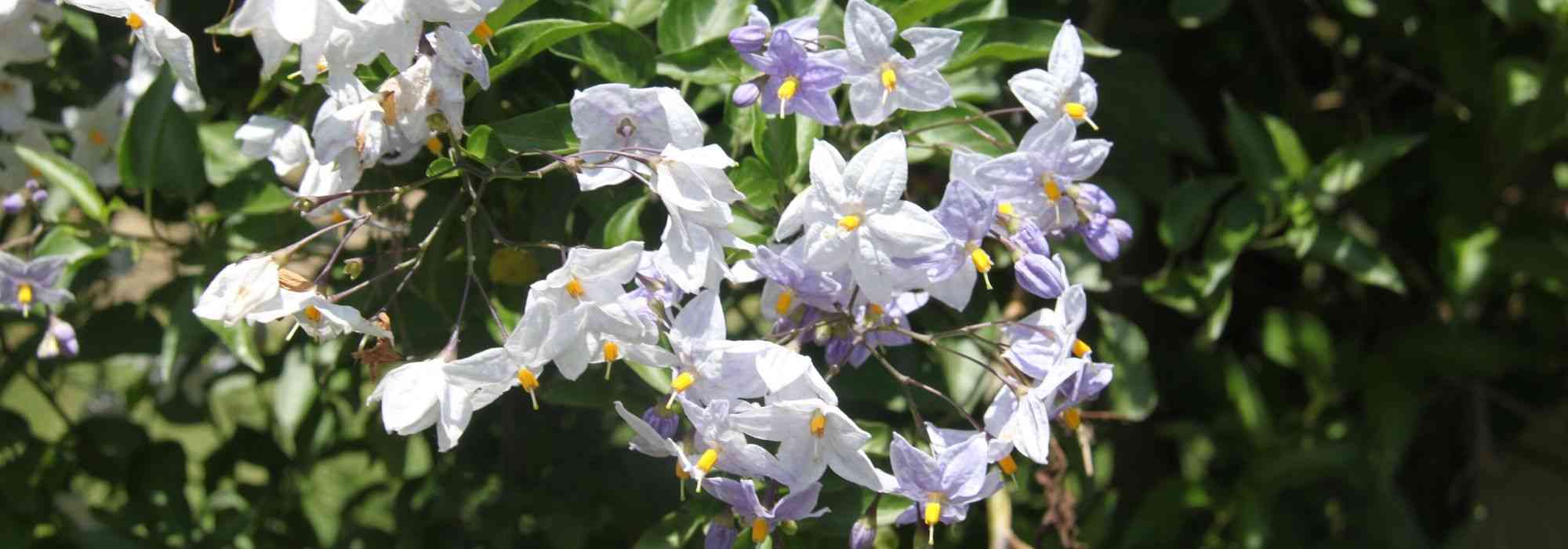
The Sollya heterophylla 'Rosea' is a small vine of Australian origin, which should be reserved for outdoor cultivation in the mildest climates, as it only withstands short periods of frost, down to -5 °C. With its fine decorative evergreen foliage, it climbs up to 2m (7ft) high on a trellis or any other support that allows it to attach with its voluble stems. Throughout the summer, it produces charming pink bell-shaped flowers. In climates too cool to accommodate it outdoors, it can be planted in a pot to be sheltered in winter.
The Sollya heterophylla, also known as Billardiera heterophylla, is a flexible plant with a woody base and herbaceous growth, belonging to the small family of Pittosporaceae, just like Pittosporums, shrubs to which it does not resemble at all. It is native to Western Australia, Tasmania, and the state of Victoria, located in southeastern Australia, and has occasionally naturalised on the French Riviera, as it easily self-seeds. With rapid growth, this plant, with a climbing, bushy, or spreading habit, produces voluble stems that can reach 1.50m (5ft) to 2m (7ft) under our climates, with a spread of 1m (3ft) to 1.50m (5ft). On its slender stems, it develops evergreen foliage, of a medium green colour, glossy, with a light green underside. Its leaves, 4 to 5 cm (2in) long, are entire and ovate or lanceolate in shape. In the 'Rosea' variety, as its name indicates, the flowers are light pink and not blue like in the species. Flowering occurs from June to September, in the form of small campanulate flowers, 1 to 2 cm (0 to 1in) long, with a very romantic appearance. They are grouped in terminal cymes, in groups of 4 to 8, delicately hanging from long purple peduncles, and are followed by the formation of edible dark blue berries, 2 to 3 cm (1in) long. The seeds germinate easily in light soil.
Despite its ornamental qualities, Sollya heterophylla 'Rosea' is not widely spread in Mediterranean regions with little frost, as it tolerates summer drought quite well. Fortunately for gardeners in cooler climates, it grows very well in pots, which can be adorned with a trellis to guide it, with its voluble stems wrapping around the posts and slats. It should be brought indoors in a frost-free, bright room in winter, such as a conservatory. With low maintenance and little susceptibility to insect or disease attacks, it is also a great choice for coastal areas. In the garden, it will be appreciated for its exuberance, lovely foliage, and long-lasting charming pink flowers, which blend with the foliage and flowers of its neighbours. Ideal for covering a fence, you can associate it with other climbers that bloom in spring to enjoy flowers throughout the growing season. For winter and early spring, a Clematis cirrhosa, another climber suitable for mild climates, will delight you with its charming single flowers, white or purplish. And to ensure a smooth transition with our little Sollya, plant the Clianthus puniceus Flamingo, or "lobster claw", an evocative name for its stunning coral pink flowers, which bloom from April to July.
Report an error about the product description
Sollya heterophylla Rosea in pictures
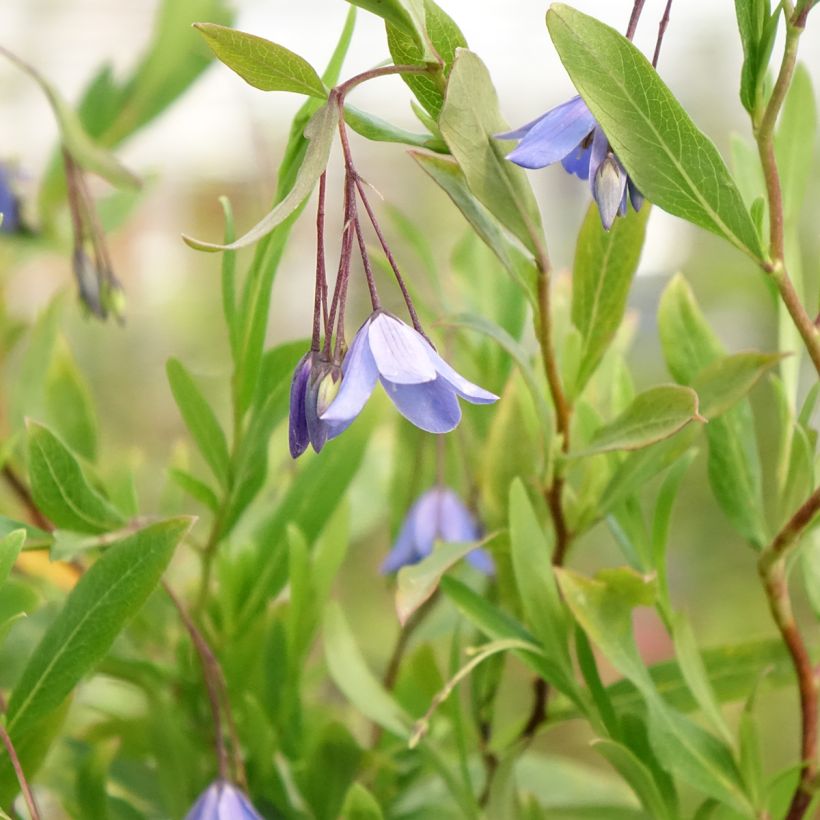
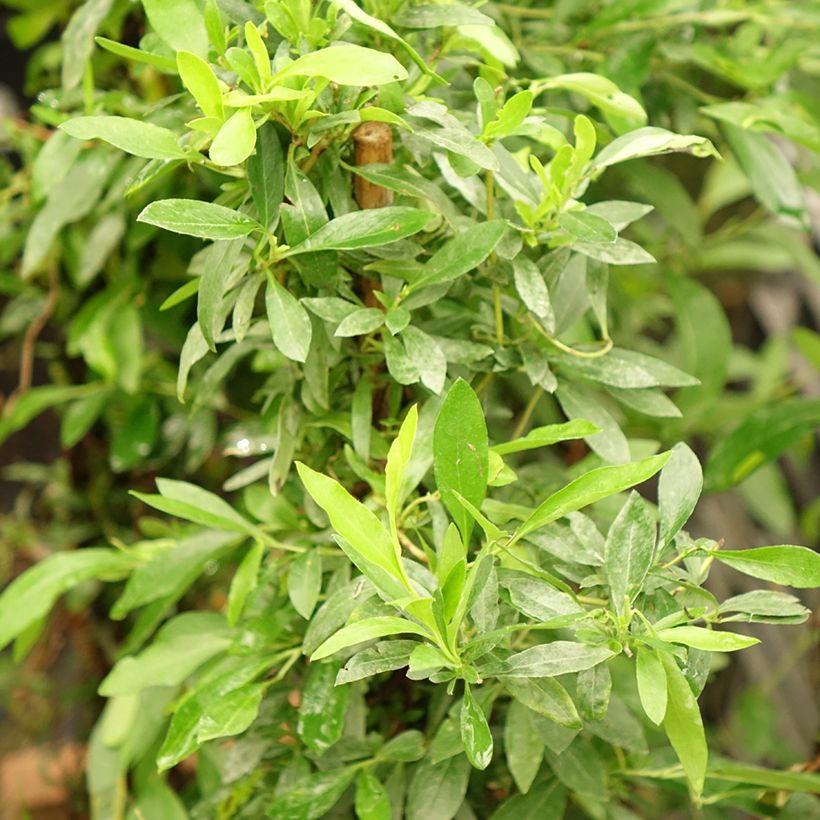
Plant habit
Flowering
Foliage
Botanical data
Sollya
heterophylla
Rosea
Pittosporaceae
Bluebell Creeper, Australian Bluebell
Cultivar or hybrid
Planting and care
Plant your Sollya heterophylla 'Rosea' as soon as the frosts are no longer to be feared, in a pot or in open ground, in not too strong sun or in partial shade. The Sollya grows in any well-drained and loosened soil, even slightly chalky. Dig a hole 30 cm (12in) in all directions to facilitate rooting, and add a little compost by mixing it with the existing soil. This plant occasionally withstands sea spray and tolerates wind during the season, but is sensitive to cold winter winds. Water regularly in the first years, especially in summer in case of prolonged drought (in hot and dry climates), and apply slow-release fertiliser once a year in spring. A well-established plant tolerates drought quite well in deep soil. It can be grown in a deep pot (30 cm (12in)). It will receive regular watering, as well as fertilizer every fifteen days. Bring it indoors to protect it from heavy frosts, in a cool and bright place.
Planting period
Intended location
Care
Planting & care advice
-

-
-
-
-
-

-
-
This item has not been reviewed yet - be the first to leave a review about it.
Recently viewed products
Haven't found what you were looking for?
Hardiness is the lowest winter temperature a plant can endure without suffering serious damage or even dying. However, hardiness is affected by location (a sheltered area, such as a patio), protection (winter cover) and soil type (hardiness is improved by well-drained soil).

The flowering period indicated on our website applies to countries and regions located in USDA zone 8 (France, the United Kingdom, Ireland, the Netherlands, etc.)
It will vary according to where you live:- In zones 9 to 10 (Italy, Spain, Greece, etc.), flowering will occur about 2 to 4 weeks earlier.
- In zones 6 to 7 (Germany, Poland, Slovenia, and lower mountainous regions), flowering will be delayed by 2 to 3 weeks.
- In zone 5 (Central Europe, Scandinavia), blooming will be delayed by 3 to 5 weeks.
In temperate climates, pruning of spring-flowering shrubs (forsythia, spireas, etc.) should be done just after flowering.
Pruning of summer-flowering shrubs (Indian Lilac, Perovskia, etc.) can be done in winter or spring.
In cold regions as well as with frost-sensitive plants, avoid pruning too early when severe frosts may still occur.
The planting period indicated on our website applies to countries and regions located in USDA zone 8 (France, United Kingdom, Ireland, Netherlands).
It will vary according to where you live:
- In Mediterranean zones (Marseille, Madrid, Milan, etc.), autumn and winter are the best planting periods.
- In continental zones (Strasbourg, Munich, Vienna, etc.), delay planting by 2 to 3 weeks in spring and bring it forward by 2 to 4 weeks in autumn.
- In mountainous regions (the Alps, Pyrenees, Carpathians, etc.), it is best to plant in late spring (May-June) or late summer (August-September).
The harvesting period indicated on our website applies to countries and regions in USDA zone 8 (France, England, Ireland, the Netherlands).
In colder areas (Scandinavia, Poland, Austria...) fruit and vegetable harvests are likely to be delayed by 3-4 weeks.
In warmer areas (Italy, Spain, Greece, etc.), harvesting will probably take place earlier, depending on weather conditions.
The sowing periods indicated on our website apply to countries and regions within USDA Zone 8 (France, UK, Ireland, Netherlands).
In colder areas (Scandinavia, Poland, Austria...), delay any outdoor sowing by 3-4 weeks, or sow under glass.
In warmer climes (Italy, Spain, Greece, etc.), bring outdoor sowing forward by a few weeks.
Shipping country and language
Your country of residence may be:
Your country of residence is:
For a better user experience on our website, you can select:
Your shipping country:
-
 Austria
-
 Belgium
-
 Bosnia & Herzegovina
-
 Bulgaria
-
 Croatia
-
 Cyprus
-
 Czechia
-
 Denmark
-
 Estonia
-
 Finland
-
 France
-
 Germany
-
 Greece
-
 Hungary
-
 Iceland
-
 Ireland
-
 Italy
Italy
-
 Latvia
-
 Liechtenstein
-
 Lithuania
-
 Luxembourg
-
 Malta
Malta
-
 Netherlands
-
 Poland
-
 Portugal
-
 Romania
-
 Serbia
-
 Slovakia
-
 Slovenia
-
 Spain
Spain
-
 Sweden
-
 Switzerland
Language:
-
French
-
 English
-
Spanish
-
Italian
-
German
-
Portuguese
-
Dutch
-
Finnish
My Account
Hello
My wish lists
My cart
Log in / Register
Existing customer?
This form is protected by reCAPTCHA - the Google Privacy Policy and Terms of Service apply.
New customer?
Create an account to track your orders, access our customer service and, if you wish, make the most of our upcoming offers.