Psidium cattleyanum f. lucidum - Strawberry guava
Psidium cattleyanum f. lucidum - Strawberry guava
Psidium cattleyanum f. lucidum
Strawberry guava, Cattley guava
Back-to-school special offer!
Get €10 off for every €50 you spend! And get up to €40 off on a single order.
How does it work?
1. Shop your favourites
Add your favourite plants to your basket. For every €50 you spend (excluding delivery charges, store credit and the plastic-free option), you’ll receive a €10 voucher.
€50 spent = €10 voucher
€100 spent = €20 voucher
€150 spent = €30 voucher
€200 spent = €40 voucher
2. Place your order
Once your basket reaches one of the spending thresholds, place your order. You can even choose your delivery date!
3. Receive your voucher
As soon as your order has been shipped, you’ll receive an email containing your personal voucher code and its value.
4. Use it on your next order
Your voucher is valid for 90 days from the date you receive it. It can be used once only, on a new order worth at least the value of the voucher, excluding delivery charges.
Please note: Vouchers can be combined with other offers, but cannot be split or refunded.
Home or relay delivery (depending on size and destination)
Important: You may be charged customs duties by your country’s customs authorities upon delivery.
Schedule delivery date
and select date in basket
This plant carries a 12 months recovery warranty
More information
We guarantee the quality of our plants for a full growing cycle, and will replace at our expense any plant that fails to recover under normal climatic and planting conditions.
Description
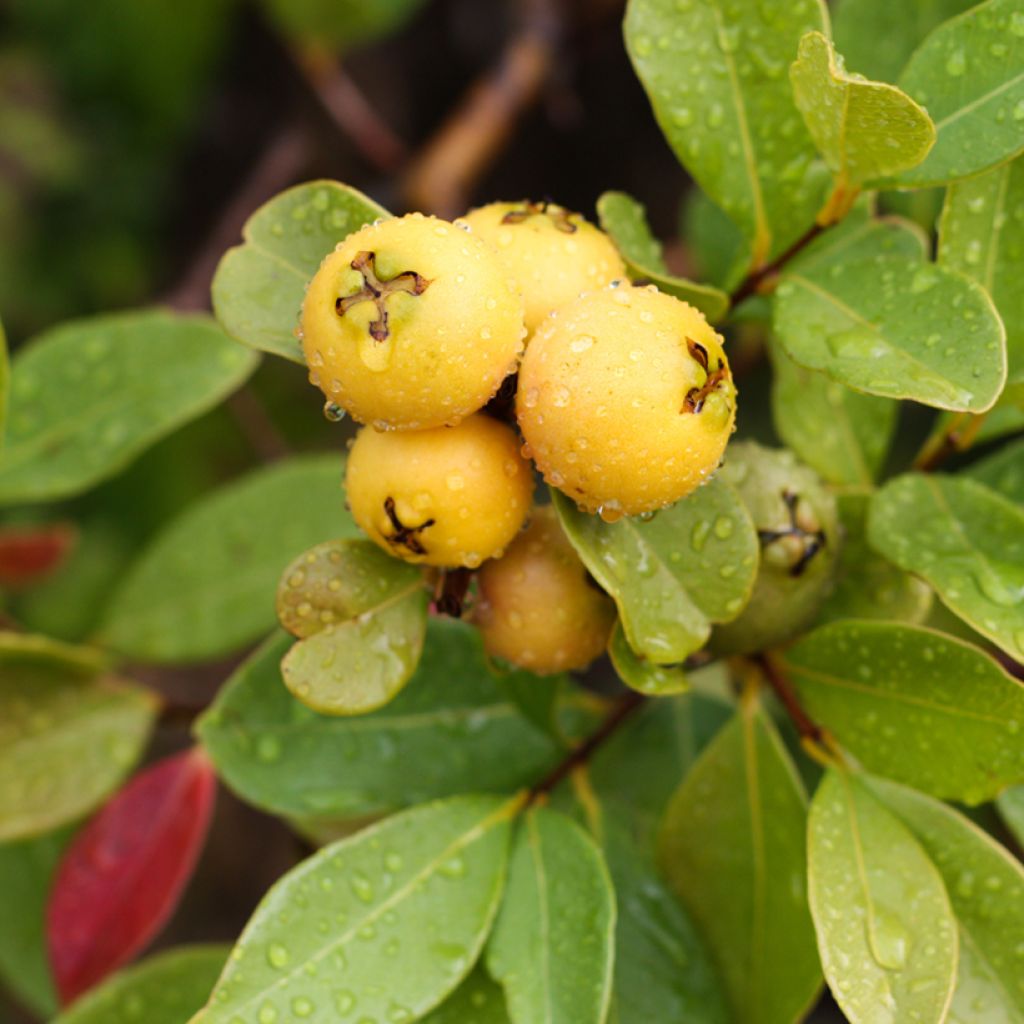
The Psidium cattleianum var. lucidum is a form of Chinese Guava with yellow fruits. This small fruit tree native to South America, also known as Cattley Guava or Strawberry Guava, appeals to curious gardeners, food enthusiasts, and lovers of exotic plants. Although its hardiness is moderate, comparable to that of a grapefruit tree, it is less demanding than most citrus trees. Its elegant white flowers, similar to those of myrtle, give birth to small edible fruits, sweet and slightly acidic, with green skin turning yellow when ripe. Harvesting takes place between August and October, depending on the climate and cultivation method. Chinese Guava tolerates various soil types, withstands heat well, and requires little water, although drought can affect the quality and quantity of fruits. It adapts well to container cultivation, allowing protection during winter.
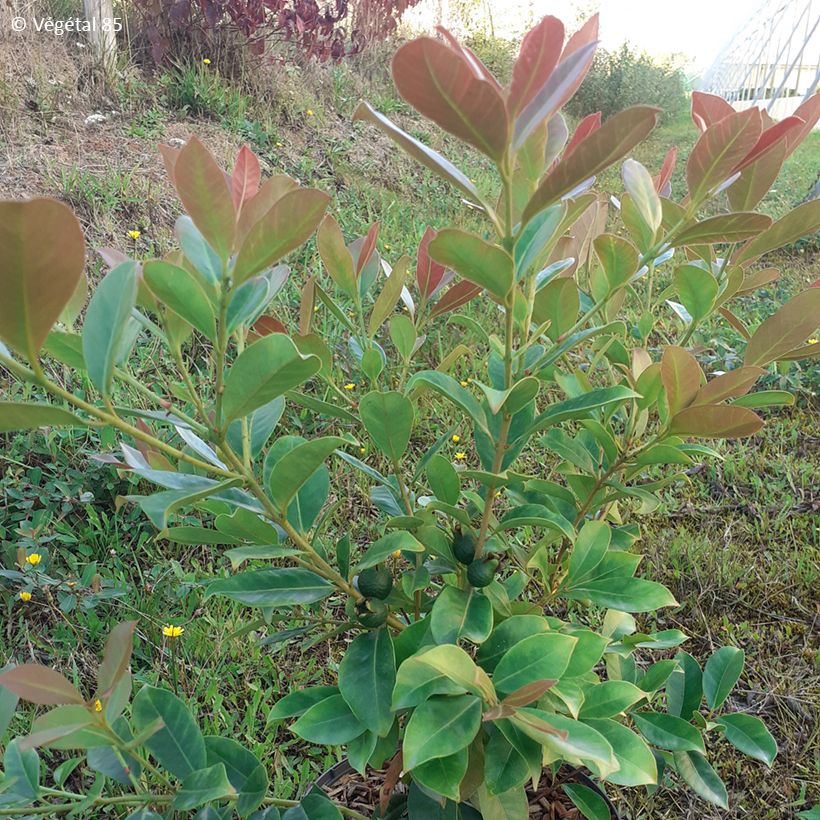
The Psidium cattleianum, sometimes spelled Psidium cattleyanum, is an evergreen tree belonging to the myrtle family, like the Feijoa, Eucalyptus, and Myrtles, sharing a flowering display adorned with prominent stamens. It is native to Latin America, particularly Brazil and Uruguay, where it is cultivated for its fruits. This species was later introduced to certain tropical to subtropical regions where it became invasive, especially in humid areas. The tree is slightly hardy, down to -5 to -7°C, but capable of regrowth from the stump when completely frozen. However, it will not flower in the same year if this occurs. Nonetheless, some data suggest that this yellow-fruited variant has slightly greater hardiness. Reaching around 3.50 m in height and 1.75 to 2 m in width in open ground under our latitudes, potentially more in width, it maintains a more bushy than arborescent habit, especially if grown in a container or regularly pruned. Its natural growth is rounded, dense, and slightly trailing.
The Psidium cattleianum var. lucidum has a slow to very slow growth rate. Its bark, smooth and cinnamon-brown in colour, peels off in thin flakes, revealing a pinkish underlayer. Its foliage is evergreen in winter, composed of leathery, oval leaves with rounded edges, shiny green on top, speckled with translucent pores. Arranged oppositely on the branches, they measure 3 to 12 cm long by 2 to 6 cm wide. The bush blooms on young shoots in late spring, in May-June in mild climates. Its white flowers, 2 to 3 cm in diameter, are lightly scented. From their white petals emerge a beautiful cluster of silky white stamens. After pollination by insects, they develop into round to pear-shaped fruits, 2 to 3 cm in diameter. Upon ripening, they turn yellow in colour. Their pulp is creamy white, with a melting and juicy texture. They contain hard seeds that are best removed before consumption. The flavour of these small guavas is sweet and acidic, with an aroma reminiscent of wild strawberries. Self-fertile, this fruit tree will be more productive with a nearby congenitor. Birds, like humans, greatly enjoy these small fruits.
Chinese Guava can only be acclimated in open ground in regions with mild winters. Elsewhere, it is best cultivated in a container, like a citrus tree, to protect it from frost by placing it in a bright but unheated location during winter. In a garden in a warm oceanic or Mediterranean climate, it can be planted as a hedge or standalone. An ideal collection plant for a tropical orchard, it pairs well with Pitayas, Passion Fruits, or even Prickly Pears. The fruits are enjoyed fresh, as juice, in fruit salads after seed removal, or cooked in compotes, jams, sorbets, syrups, or as pie fillings. Delicate and subtly aromatic, these fruits, however, do not keep well.
Report an error about the product description
Psidium cattleyanum f. lucidum - Strawberry guava in pictures
Plant habit
Fruit
Flowering
Foliage
Botanical data
Psidium
cattleyanum f. lucidum
Myrtaceae
Strawberry guava, Cattley guava
South America
Planting and care
The Psidium cattleianum lucidum thrives in all types of well-drained soils, tolerates some limestone, but prefers neutral or slightly acidic soils. It appreciates fertile, light, deep soils and requires periodic organic amendments and regular watering in summer if planted in hot and very dry regions. It can be planted by the sea, sheltered from spray by a vegetal screen.
Choose a very sunny and well-sheltered spot, for example against a well-exposed wall. For better fruiting, it is advisable to plant at least two plants, spacing them 1 m apart, or plant them in the same hole 40 cm apart. Planting is done in spring or autumn.
Dig a hole, add a mixture of garden soil, sand, and compost. Place the young plant, cover with soil, and firm it down. Water generously at planting and regularly during the growth period.
In cool or cold regions, it is advisable to grow it like a citrus tree, in a large pot for overwintering, protected from the cold, in a bright but unheated room. Use citrus and Mediterranean plant potting mix. Fertilise annually in spring and water your pot regularly.
Feijoa is not very susceptible to diseases and parasites. In areas where it is prevalent, the Mediterranean fruit fly (Ceratitis capitata) can be a problem for the harvest.
Planting period
Intended location
Care
Planting & care advice
-
-
-
-
-
-
-
-
This item has not been reviewed yet - be the first to leave a review about it.
Recently viewed products
Haven't found what you were looking for?
Hardiness is the lowest winter temperature a plant can endure without suffering serious damage or even dying. However, hardiness is affected by location (a sheltered area, such as a patio), protection (winter cover) and soil type (hardiness is improved by well-drained soil).

The flowering period indicated on our website applies to countries and regions located in USDA zone 8 (France, the United Kingdom, Ireland, the Netherlands, etc.)
It will vary according to where you live:- In zones 9 to 10 (Italy, Spain, Greece, etc.), flowering will occur about 2 to 4 weeks earlier.
- In zones 6 to 7 (Germany, Poland, Slovenia, and lower mountainous regions), flowering will be delayed by 2 to 3 weeks.
- In zone 5 (Central Europe, Scandinavia), blooming will be delayed by 3 to 5 weeks.
In temperate climates, pruning of spring-flowering shrubs (forsythia, spireas, etc.) should be done just after flowering.
Pruning of summer-flowering shrubs (Indian Lilac, Perovskia, etc.) can be done in winter or spring.
In cold regions as well as with frost-sensitive plants, avoid pruning too early when severe frosts may still occur.
The planting period indicated on our website applies to countries and regions located in USDA zone 8 (France, United Kingdom, Ireland, Netherlands).
It will vary according to where you live:
- In Mediterranean zones (Marseille, Madrid, Milan, etc.), autumn and winter are the best planting periods.
- In continental zones (Strasbourg, Munich, Vienna, etc.), delay planting by 2 to 3 weeks in spring and bring it forward by 2 to 4 weeks in autumn.
- In mountainous regions (the Alps, Pyrenees, Carpathians, etc.), it is best to plant in late spring (May-June) or late summer (August-September).
The harvesting period indicated on our website applies to countries and regions in USDA zone 8 (France, England, Ireland, the Netherlands).
In colder areas (Scandinavia, Poland, Austria...) fruit and vegetable harvests are likely to be delayed by 3-4 weeks.
In warmer areas (Italy, Spain, Greece, etc.), harvesting will probably take place earlier, depending on weather conditions.
The sowing periods indicated on our website apply to countries and regions within USDA Zone 8 (France, UK, Ireland, Netherlands).
In colder areas (Scandinavia, Poland, Austria...), delay any outdoor sowing by 3-4 weeks, or sow under glass.
In warmer climes (Italy, Spain, Greece, etc.), bring outdoor sowing forward by a few weeks.
Shipping country and language
Your country of residence may be:
Your country of residence is:
For a better user experience on our website, you can select:
Your shipping country:
-
 Austria
-
 Belgium
-
 Bosnia & Herzegovina
-
 Bulgaria
-
 Croatia
-
 Cyprus
-
 Czechia
-
 Denmark
-
 Estonia
-
 Finland
-
 France
-
 Germany
-
 Greece
-
 Hungary
-
 Iceland
-
 Ireland
-
 Italy
Italy
-
 Latvia
-
 Liechtenstein
-
 Lithuania
-
 Luxembourg
-
 Malta
Malta
-
 Netherlands
-
 Poland
-
 Portugal
-
 Romania
-
 Serbia
-
 Slovakia
-
 Slovenia
-
 Spain
Spain
-
 Sweden
-
 Switzerland
Language:
-
French
-
 English
-
Spanish
-
Italian
-
German
-
Portuguese
-
Dutch
-
Finnish
My Account
Hello
My wish lists
My cart
Log in / Register
Existing customer?
This form is protected by reCAPTCHA - the Google Privacy Policy and Terms of Service apply.
New customer?
Create an account to track your orders, access our customer service and, if you wish, make the most of our upcoming offers.