
Tomato looper, a pest spreading from the South
Identification, symptoms and treatments of the tomato moth
Contents
It is often a small hole with clearly defined edges, visible on green or fully ripe tomatoes, which catches the gardener’s attention. Then, when you cut the tomato open, you may find a small green caterpillar that has made itself comfortable inside the tomato flesh, quite literally devouring it. Unless it has already left to look for somewhere else… Whether you live in the south of France, where it was previously confined, or further north, you may already have encountered this pest. Behind this caterpillar is a moth, the tomato fruitworm (Helicoverpa armigera), sometimes known as the cotton bollworm.
Let’s get to know this pest, which can cause serious damage to tomato crops, and look at the various methods of prevention and control.
For more information: Tomatoes: sowing, planting, care and harvest.

The tomato fruitworm: what exactly is it?
Behind every caterpillar, there is a butterfly. And the butterfly responsible for the damage to your tomatoes is the tomato moth, also known as the corn earworm or Helicoverpa armigera. This lepidopteran is a moth of tropical or subtropical origin. It arrived during the 2003 heatwave and settled in the south of France, where it began to make a name for itself. Then, with the latest heatwaves, it has been gradually moving northwards across the country. So, as someone who lives and gardens near Saint-Étienne, in the Loire department, at an altitude of around 650 m, I noticed its presence for the first time in my tomato patch in summer 2023.
A moth active in spring
Male and female Helicoverpa armigera are slightly different. Both about 4 mm wide, they can be distinguished by the colour of their wings: orangey brown in the female and grey-green in the male. The forewings are also edged with a line of black spots. The female is slightly longer than the male and more robust too. Their mating flight takes place at dusk or during the night as soon as the soil temperature reaches 17 to 18 °C, which means April-May in the south and a little later elsewhere. During their short lives, both male and female feed on the nectar of nearby flowers and quench their thirst with drops of dew. The female can then lay between 300 and 500 eggs, generally on young shoots, the undersides of leaves and flower buds. Spherical and flattened at the poles, these eggs change from yellowish white to brown. Incubation lasts only four days! Then the larvae hatch.
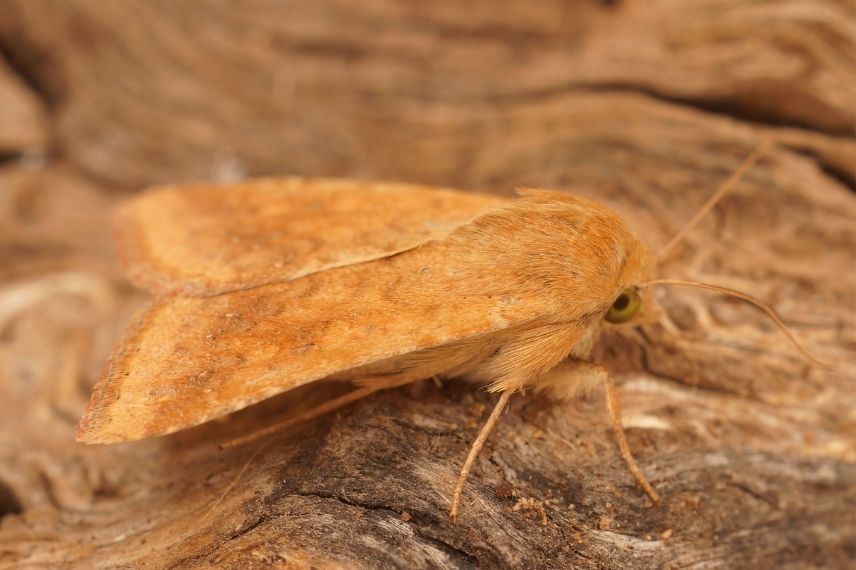
Adult female Helicoverpa armigera
The caterpillars’ development cycle
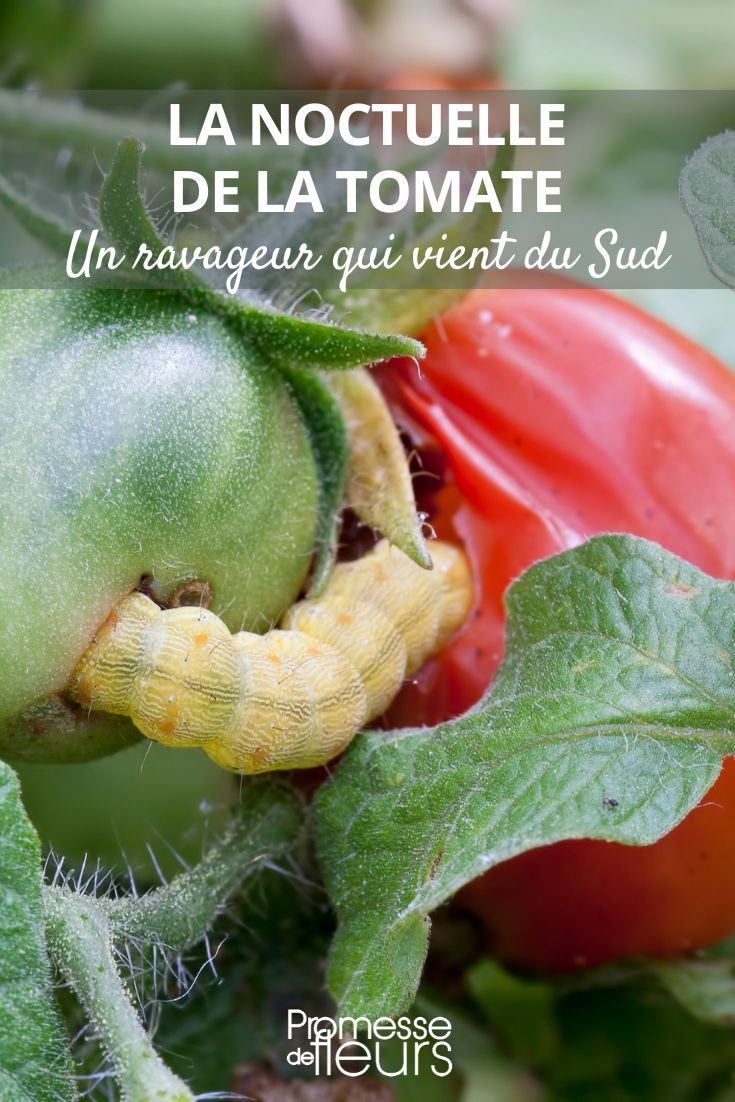
Tomato moth larvae pass through six stages of development, the duration of which depends on the temperature. Development can take 18 days at 22 °C, but up to 50 days at 17 °C. When they hatch, the young, inching caterpillars feed on young leaves. They can be very aggressive, even cannibalistic, towards their fellow caterpillars. During the second stage of development, they enter green or already ripe fruit, by making a small hole, often quite close to the peduncle. They feed and defecate inside it, making the tomatoes unfit for consumption. At the end of their development, these caterpillars, variously coloured green, yellow or brown, measure 30 to 40 mm in length.
Once they are well fed, after passing through all six stages of development, the caterpillars burrow into the soil to pupate. They spend the winter there as chrysalises. Then, the following spring, they return!
What damage does it cause to tomatoes and other vegetables?
These tomato moths mainly target tomatoes, but they can also attack peppers, aubergines, squashes, beans and sweetcorn. In other parts of the world, they also cause considerable damage to cotton and tobacco crops. They cause huge commercial losses for market gardeners because, once “the worm is in the fruit”, it becomes completely inedible. The caterpillars gnaw the tomato flesh, contaminating it with their droppings. By contrast, the damage to the leaves during the first larval stage is far less serious.
As it is quite difficult to see the moths in flight, or even their eggs, the infestation is only detected once the damage has been done. The first unmistakable sign is a hole in the tomato. There is often just one hole per tomato, usually a very round one. When you cut the tomato open, the extent of the damage to the flesh depends on the larval stage. Sometimes the caterpillar is still inside.
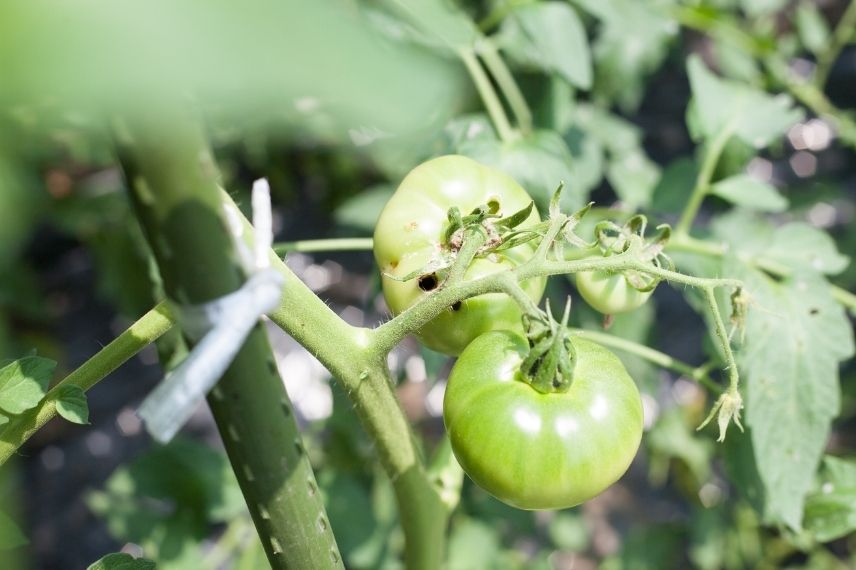
A small, perfectly round hole in a tomato is a sign of tomato moth damage
If the weather conditions are favourable, several generations of tomato moths may follow one another during the growing season.
How to control tomato fruitworm?
It is relatively difficult to control tomato moth. By the time you notice the first symptoms, the caterpillars are already settled comfortably inside the fruit of their host plant, completely out of reach.
To control it, you therefore need to intervene at other stages of its life cycle. However, there are few natural control methods available. The only truly effective treatment is Bacillus thuringiensis (Bt), a microbial insecticide that works on adults and, above all, on larvae during the first stage of their development. But you must not miss them, as they are vulnerable for just four short days and are often well hidden beneath the leaves. As for the adults, they fly at dusk or at night. In other words, they generally go unnoticed. This is why professional vegetable growers place pheromone traps before spraying with Bt, in order to monitor the flights. It is also recommended that you repeat Bt applications every 10 days on all parts of the tomato plants, including, and especially, the undersides of the leaves.
By inspecting your crops carefully (and with a good pair of glasses), you can also spot the caterpillars at the final stage of development, when they are trying to burrow into the soil for their diapause. You can also try to find the eggs!
Finally, the main method of control is the systematic destruction of attacked tomatoes. Above all, do not leave them to rot on the soil where they fall!
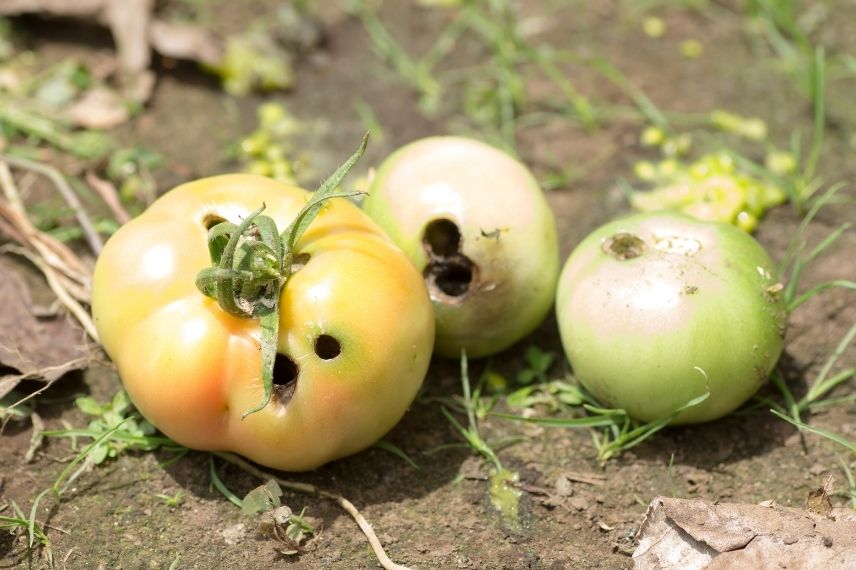
Here, this tomato appears to have been attacked by tomato moth. In fact, it has simply been damaged by hail. There is no sign of a caterpillar!
And then, you can count on the valuable help of a few beneficial organisms, namely tits (which are particularly fond of all kinds of caterpillars!), bats, which are highly effective at dusk, and hoverflies. This is why it is essential to encourage biodiversity in order to attract tits and other predators to your garden.
Find out more:
Preventive measures to prevent cotton bollworm attacks
As biological control of tomato moth looks set to be difficult, it makes sense to focus entirely on prevention! And there are plenty of preventive methods. By using them all, you will greatly increase your chances of discouraging tomato moths from settling in your garden:
- Install insect-proof fleece or netting as soon as you plant your tomato plants, in April or May depending on the region, to prevent the moths from laying their eggs directly on the host plant. If tomatoes are grown in a greenhouse, closing the openings in the evening and at night is enough to deter the adults.
- Set up pheromone traps for tomato moths to monitor the adults’ flight period and act accordingly.
- Carefully remove weeds around the base of the tomato plants. Adults can find a valuable food source there and drink dew.
- Encourage the natural predators of tomato moths to settle in your garden by putting up feeders and nest boxes, or by planting berry-producing shrubs for tits. You can attract hoverflies by planting nectar-rich plants or by building bat shelters.
- Strictly follow crop rotation. The caterpillars overwinter in the soil at the base of their host plants.
- Carefully destroy all crop waste: leaves, stems and unharvested tomatoes.
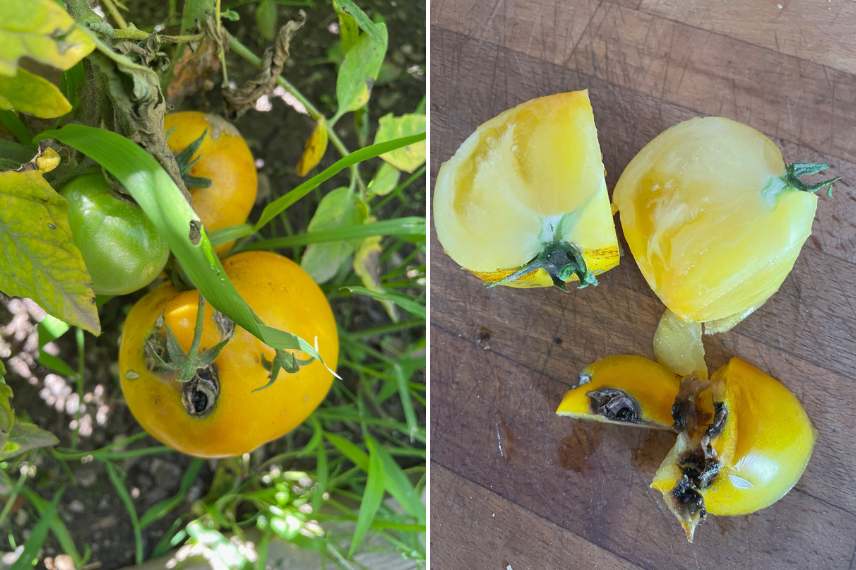
On the other hand, here the larva is indeed inside the fruit!
Personally, as I do every year, I open my vegetable garden to my four hens in winter, when crops are scarce. By scratching the soil and pecking around, they systematically destroy practically all the larvae. This season, so far, there are no small holes visible in the tomatoes…
- Subscribe!
- Contents
This form is protected by reCAPTCHA - the Google Privacy Policy and Terms of Service apply.

































Comments